The Lighting And Path Changes Coming To Lake Burley Griffin’s Bridge-to-bridge Walk
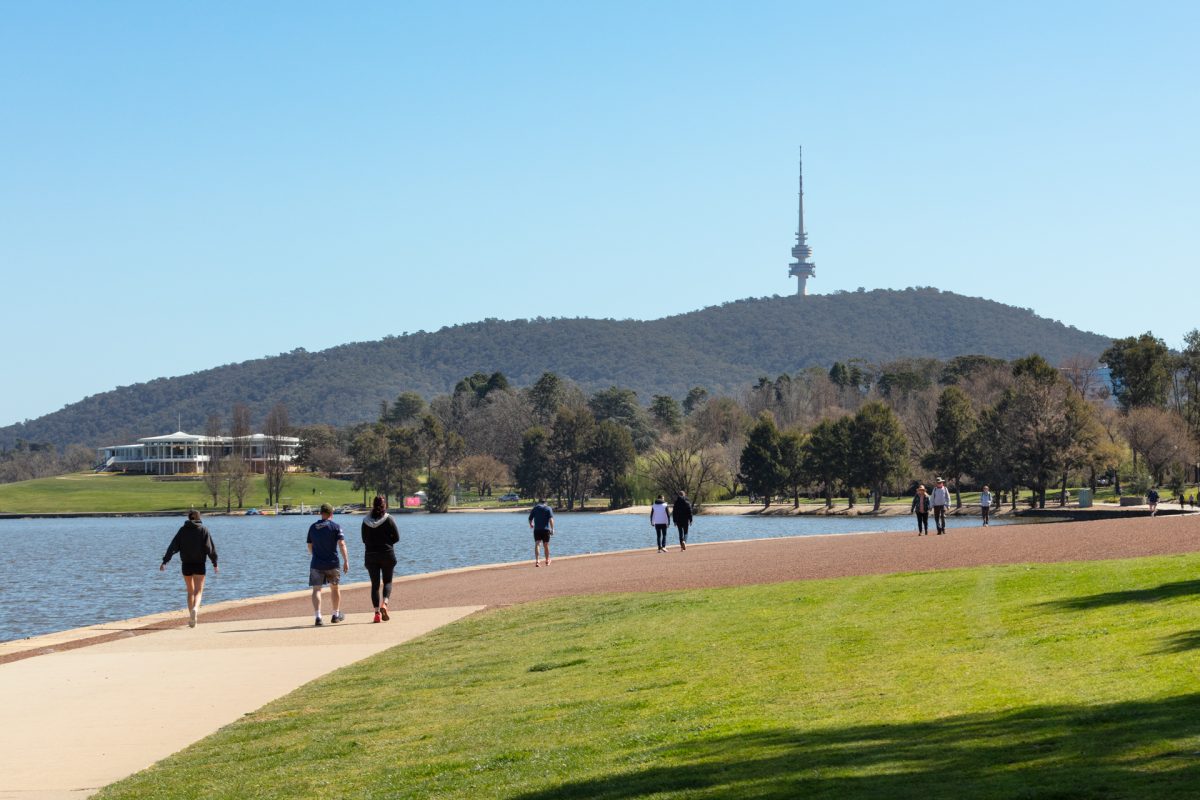
Sections of the Central Basin path around Lake Burley Griffin will be separated for cyclists and pedestrians. Photo: Michelle Kroll.
Cyclists and pedestrians going bridge-to-bridge will soon be separated – but just for the eastern section.
The National Capital Authority has released the Central Basin path changes around Lake Burley Griffin.
“A range of improvements are being rolled out for the ever popular bridge-to-bridge loop and this includes encouraging separation between pedestrians and cyclists,” a social media statement read.
“The foreshore path between Rond Terrace and Kings Avenue Bridge will be designated pedestrian-only with new signage and path decals rolling out over the coming weeks.
“Cyclists are asked to follow the signed cyclist-only and other alternative routes.”
Old and faded signage, along with path symbols, are being replaced and additional “slow” path symbols are being added on the ground of high-traffic areas.
A pedestrian only section is being established between Rond Terrace and Kings Avenue Bridge.
Cyclists will be encouraged to take an alternative route.
The works are expected to be complete within the next two months (weather permitting).
Pedal Power has long supported separating people walking and riding along the busier sections of Lake Burley Griffin’s paths (where there’s sufficient space to do so).
“We see the National Capital Authority’s changes on the northern side of Central Basin as a practical and relatively low-cost step towards improving safety and reducing conflicts between different path users,” executive director Cecily Michaels said.
“The plans indicate that people walking will continue to have good access to the café near Blundells Cottage, while people riding will be directed onto the former roadway between Blundells Cottage and the Carillon, which provides a generous amount of space.”
Parts of the bridge-to-bridge path will be separated for cyclists and pedestrians. Photo: NCA.
Ms Michaels noted the southern side of Central Basin, along Queen Elizabeth Terrace, was much more heavily used than the northern side.
She hoped more significant improvements would be made for that area in the future.
“We recognise the challenges of the southern side, particularly around the café precinct and would welcome the opportunity to work with the National Capital Authority on longer-term solutions that better separate people walking and riding where possible,” Ms Michaels said.
“In the meantime, we believe it makes sense for both southern paths to remain shared paths so people can choose the route that best suits them on the day while longer-term improvements are developed.
“Regardless of the path arrangement, we encourage everyone to be patient, considerate and respectful of other users so that the area remains safe and welcoming for everyone.”
Preliminary design has also been completed to improve lightning around the National Triangle and Central Basin.
The NCA received $10 million over two years to deliver a permanent lightning solution to make the area safer and more accessible.
Key feedback from the preliminary design phase included:
- The importance of balancing safety with protecting Canberra’s nationally significant heritage landscape. This has resulted in the use of pole top lighting in the majority of areas to ensure standards for pedestrian/footpath compliance
- Replace ageing and obsolete lighting infrastructure with a consistent LED lighting system to reduce maintenance costs, improve reliability and deliver a more uniform visitor experience across the Central Basin
- The “dark sky” principles will be adopted to minimise environmental impacts. This means it reduces glare, light spill and impacts on wildlife while maintaining safe public access and supporting the night-time character of Lake Burley Griffin.
The second stage of design is now under way to address specifications and technical requirements, as well as gain statutory approvals.
Smart lighting for the National Capital Estate to enable remote monitoring and adaptive dimming will also be considered in this stage.
Construction is expected to begin in 2027.
Popular Products
-
 Gas Detector Meter
$311.56$155.78 -
 Foldable Garbage Picker Grabber Tool
$93.56$46.78 -
 Portable Unisex Travel Urinal
$49.56$24.78 -
 Reusable Keychain Pepper Spray – 20ml
$21.56$10.78 -
 Camping Survival Tool Set
$41.56$20.78