Zeta Mobility Expands 4d Radar Ai Into Senior Care
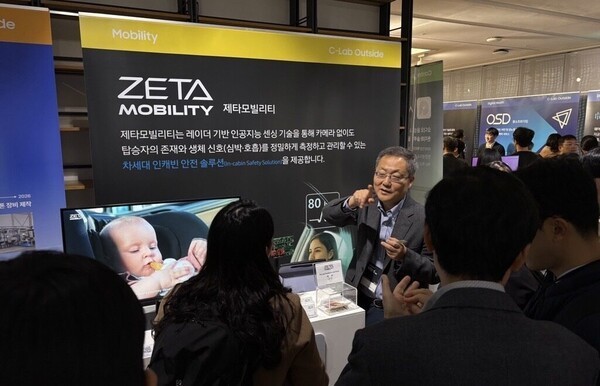
Startup Zeta Mobility is expanding its 4D radar artificial intelligence sensor-fusion technology, originally developed for autonomous driving, into senior care and healthcare. The company plans to produce tangible results this year through partnerships with a company and a university.
“We signed memorandums of understanding with two companies and institutions last month and began proof-of-concept testing,” Zeta Mobility Vice President Kim Sang-ki said on Sept. 9. The partners are senior care technology company Dolbomdream and Gachon University’s Intelligent Homecare Integrated Support Infrastructure Project Group, or AAL Center. Zeta Mobility aims to commercialize services for vulnerable populations using its technology.
Zeta Mobility is a deep-tech startup developing high-resolution 4D imaging radar and AI sensor-fusion technologies. The company was founded in February 2024 as a startup spun out of a laboratory at KAIST’s Graduate School of Mobility and joined the university’s startup incubator. In October that year, it was selected for the Ministry of SMEs and Startups’ Deep Tech TIPS program and Samsung Electronics’ C-Lab Outside startup support program. It was also selected for the ministry’s Super Gap Startup 1000+ program in April last year and received an award from the head of the Small and Medium Business Administration in May.
Radar emits electromagnetic waves, or millimeter waves, and analyzes reflected signals. Unlike conventional 3D radar, which measures distance, direction and speed, 4D imaging radar also captures height data. This allows scattered radar reflections to be converted into high-resolution three-dimensional point-cloud data.
Raw 4D radar data contains signal noise that makes it difficult to interpret. Zeta Mobility addresses this with its proprietary AI algorithm software, Zeta AI Engine. The software removes meaningless reflections and signal noise and extracts the shape of objects. By analyzing continuous time-series data, it can infer human movement, changes in posture and biometric signals such as heart and respiratory rates with more than 90% accuracy.
Zeta Mobility has integrated the technologies into three versions of its ARGUS platform, an intelligent system that detects, understands and transmits radar sensor data. The platform takes the form of a compact, low-power, high-efficiency board for edge AI, which runs AI models directly on devices where data is generated.
ARGUS-A is designed to detect safety conditions and driving environments for autonomous vehicles. ARGUS-C monitors vehicle occupants in real time. ARGUS-H is an indoor care product designed to detect falls among elderly people living alone and monitor biometric signals.
Zeta Mobility initially focused on autonomous driving and in-cabin occupant-detection sensors. But as commercialization and market adoption of autonomous driving progressed more slowly than expected, the company strategically shifted its business focus toward senior healthcare. Its 4D radar AI and sensor-fusion technologies can be applied to indoor residential spaces as well as vehicle interiors.
Partnerships With Dolbomdream, Gachon University to Test ARGUS-H
Zeta Mobility has secured infrastructure to test ARGUS-H through the two recently signed MOUs.
The company will first work with Dolbomdream on joint testing and commercialization of senior care and monitoring services. The companies plan to combine Zeta Mobility’s radar AI sensor technology with Dolbomdream’s wearable sensor-based healthcare technology and jointly pursue government projects and research and development programs. They also plan to expand their collaboration into worker safety management at industrial sites.
Existing senior-care technologies face trade-offs between accuracy, convenience and privacy. Falls among elderly people living alone frequently occur in private spaces such as bathrooms, toilets and bedrooms, where cameras face strong user resistance as well as ethical and legal constraints. Smartwatches and patch-type biosensors require users to wear them continuously and recharge them regularly. Elderly users may forget to wear the devices or take them off, creating monitoring gaps and potentially delaying responses to emergencies such as falls.
Zeta Mobility says its 4D radar AI technology can address those problems. ARGUS-H can be installed on a wall or ceiling to monitor an entire space without requiring the user to wear a device. Because it analyzes radar waveforms rather than visual images, it avoids capturing private visual information. It can also detect a person’s precise location and subtle movements in low-light or steam-filled environments where visibility is poor.
Zeta Mobility will work with Gachon University’s AAL Center to develop and commercialize intelligent homecare services for vulnerable populations. The center has researched a big-data platform for elderly people’s activities of daily living. Zeta Mobility plans to combine the university’s software and data research capabilities with its own technology to build infrastructure for real-time monitoring of elderly users.
The partners will also develop and deploy AI care equipment and personalized service models. They plan to support healthcare programs for elderly people run by local governments and community welfare organizations, while expanding into the senior healthcare and smart-home markets.
“We will use these recent demonstration agreements as a stepping stone to establish technical standards for smart-home senior care and secure our first supply contract with a construction company or healthcare platform within this year,” Kim said.
Popular Products
-
 Devil Horn Headband
$25.99$11.78 -
 WiFi Smart Video Doorbell Camera with...
$61.56$30.78 -
 Smart GPS Waterproof Mini Pet Tracker
$59.56$29.78 -
 Unisex Adjustable Back Posture Corrector
$71.56$35.78 -
 Smart Bluetooth Aroma Diffuser
$585.56$292.87