3 Signs Cash-strapped Consumers Are Nearing A “spend-pocalypse” That Would Hurt The Economy
Nearly 70 percent of U.S. GDP comes from consumers. What happens when they stop spending?
Lately, I’ve noticed that the press has been sounding the alarm about the possibility of a downturn in consumer spending. I get why. To buy more stuff, consumers must either see their wages grow faster than prices, spend their savings, or go into debt.
Well, since the COVID-19 recession, wages haven’t grown faster than prices. And the September inflation and jobs reports didn’t make that picture look any rosier. The Iran war is ensuring that prices have risen faster than workers’ pay for six months in a row. And while the U.S. currently has low unemployment, soft job generation with few new hires isn’t rocket fuel for wages. The risk is that consumers’ incomes won’t be able to keep up with prices, resulting in debt, broken budgets, and an inability to keep spending.
But, a dramatic drop in consumer spending hasn’t happened – yet. Will it? The answer is critical, as today nearly 70 percent of U.S. GDP comes from consumers. A slowdown in consumer spending will mean a slowdown for the economy. So, let’s look at three signs of a potential “spend-pocalypse,” including from the most up-to-date data on consumer balance sheets.
No. 1: Debt is growing
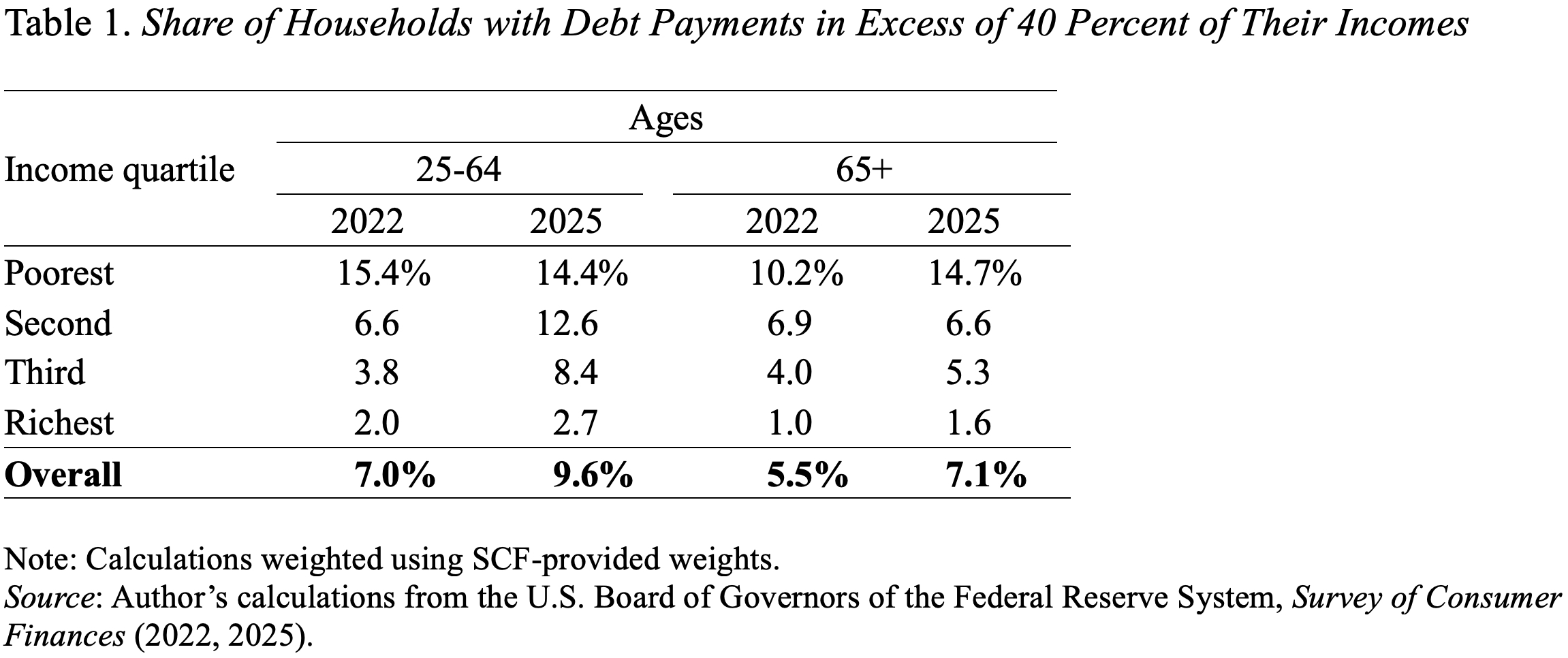
Every three years, the Federal Reserve releases the Survey of Consumer Finances (SCF), the gold standard when it comes to data on household balance sheets. The two most recent batches of data were collected in 2022 and 2025, with the 2025 data being released just last month. As part of the releases, the Fed publishes several measures of the debt burden. One is the share of households whose estimated debt payments on mortgages, car payments, credit cards, etc. exceed 40 percent of their income, considered a high burden. Table 1 shows how this share has evolved for people of working age (25-64) and of retirement age (65+) across the income distribution.
The table shows that the share of households with high debt burdens has increased. Indeed, the overall share is at its highest level since 2013. This increase was especially large for middle-class households of working age and for the poorest retirement-age households.
On the other hand, the richest quarter of households have very low debt burdens and have seen only relatively small increases in their debt burden since 2022. The reason? Those same survey data show that rich households have a net worth at least four times higher than the lower-income groups. The wealthy also saw larger wealth increases since 2022. So there’s no need for the rich to go into debt in order to consume. Everybody else appears to be in a bit of trouble.
The next phase of financial stress is delinquency on those debt payments.
No. 2: Delinquency is elevated
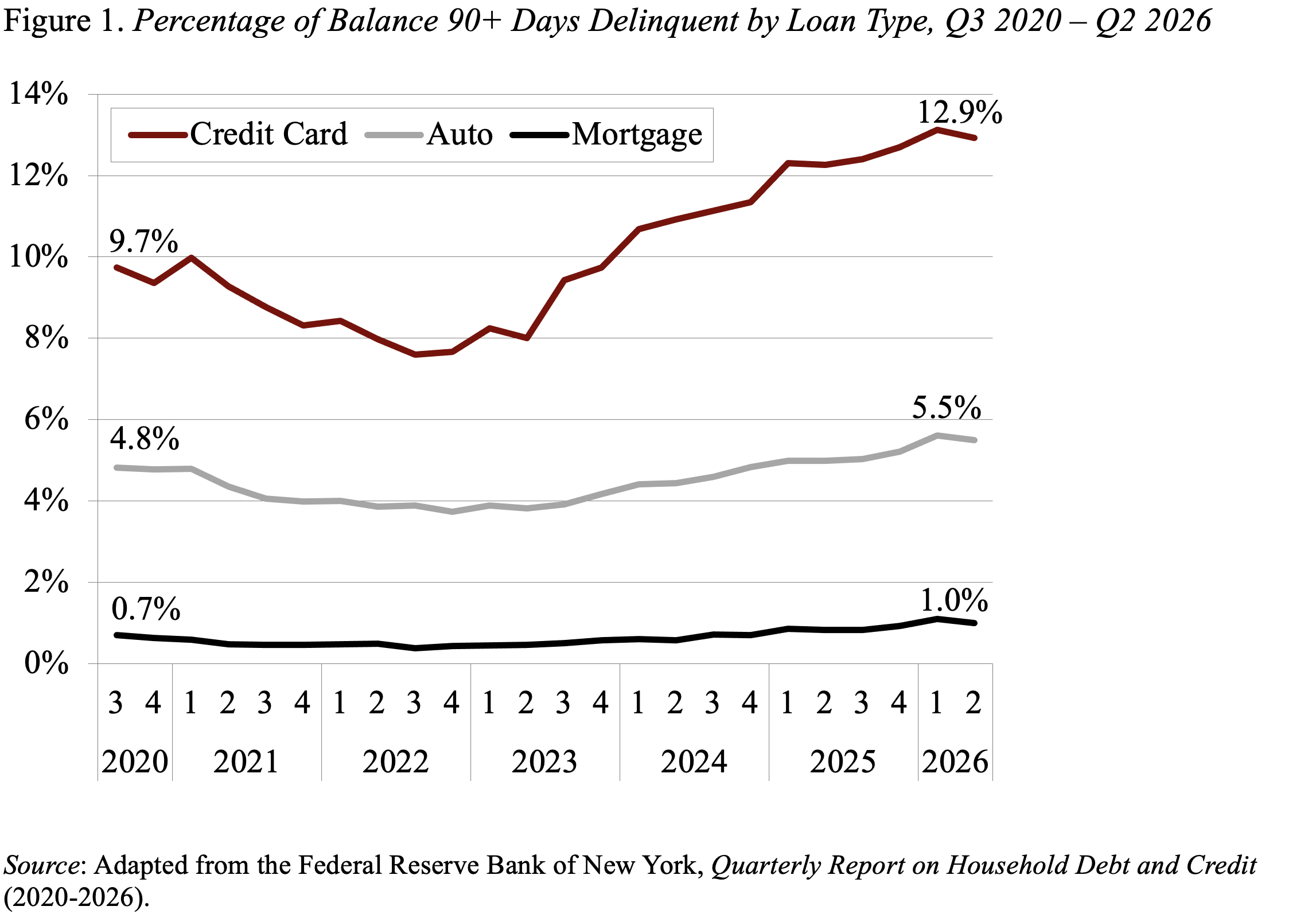
In addition to producing datasets like the SCF, each quarter the Federal Reserve releases its Report on Household Debt and Credit. The report follows an Equifax panel of consumers over time and tracks things like total debt, credit scores, and delinquency rates, which is defined as the share of the amount owed where the payment is 90 plus days late.
Figure 1 is adapted from these data and shows that the share of mortgages, auto loans, and especially credit card balances that are delinquent by 90 or more days is elevated relative to the beginning of the COVID-19 pandemic. Indeed, the full report shows that auto and credit card delinquencies are at their highest level since just after the Great Recession of 2007-09. The good news is that Figure 1 also shows that the rate of delinquencies leveled off in the first two quarters of 2026. It will be worth keeping an eye on whether 2025 marks the end of an upward trend on debt and delinquency, or whether inflation fueled by the Iran war reignites it again in the latter half of 2026.
No. 3: Consumer sentiment is historically low
A final signal of future consumer spending is a bit “softer” than things like income, prices, debt and delinquency. It looks at the question: How do people feel?
Studies across the decades have found that consumer sentiment is a modest predictor of future consumer spending. Well, consumer sentiment is low. Indeed, it is at one of the lowest points since tracking began in the 1980s. It’s lower even than during the Great Recession. To the extent that this portends future drops in consumer spending, this sign is flashing red.
Given all this information, what does the future of consumer spending hold? As long as the stock market remains strong, high-income families who derive much of their income from the ownership of these assets are likely to be able to keep driving consumption up. Table 1 shows that these people are not financially stressed. But if the stock market rally turns out to be an artificial intelligence bubble, watch out. For everybody else, all eyes will be on the job market. At present, it’s stable if a bit stagnant. A shift from stagnation to layoffs will threaten already shaky balance sheets – and consumer spending.
For now, the stabilizing of delinquency rates shown in Figure 1 gives me some hope that consumers have bent, but not broken. But global conflict, AI uncertainty, and elevated debt in a high interest-rate environment mean that could turn on a dime.
Popular Products
-
 Orthopedic Shock Pads For Arch Support
$71.56$35.78 -
 Remote Control Fart Machine
$80.80$40.78 -
 Adjustable Pet Safety Car Seat Belt
$57.56$28.78 -
 Adjustable Dog Nail File Board
$179.56$89.78 -
 Bloody Zombie Latex Mask For Halloween
$123.56$61.78