Do You Have A 'good' Pension? See Your State's Average
Traditional employer-paid pensions, once the gold standard for retirement security, now play a smaller role in providing retirees with predictable, monthly income for life. Younger generations who grew up with 401(k)s and individual retirement accounts (IRAs) must save for retirement largely on their own.
About 29% of workers are covered by a pension, or defined benefit plan, vs 61% with a 401(k), or defined contribution plan, according to research by the Federal Reserve. The Fed also reports that 52% of people 65 and older have a pension, but only 5% of those under age 25 do.
Traditional pensions remain a key source of retirement income for federal, state, and local workers (retirees with public pensions), and Americans who work at the dwindling number of companies that offer pensions. "If you have a pension, it gives you peace of mind," says Christian Weller, professor of public policy at the University of Massachusetts Boston.
The power of a pension
Why do retirees love pensions? Your employer invests for you and later funds your pension payment. More importantly, the monthly checks are guaranteed for life, providing a steady stream of income retirees can count on (for the most part), no matter what the economy or financial markets are doing.
"For many households, especially those with limited assets, the presence of predictable lifetime income appears to be closely associated with greater financial stability," says Leslie Muller, senior research associate at the Employee Benefit Research Institute (EBRI). A 2026 EBRI report found that access to guaranteed income streams, such as pension income, plays a key role in helping retirees preserve assets and manage financial shocks later in life.
Monthly pension checks, coupled with monthly Social Security benefits, can help cover essential monthly expenses during retirement. "Pensions are a critical part of a retiree's lifetime income," says Karen Friedman, executive director of the Pension Rights Center. With inflation high and the cost of living taking up a larger share of workers' wages, Friedman says it's getting harder for workers to save for retirement.
More than half of retirees (56%) say a traditional pension plan is a key source of retirement income, according to the 2026 EBRI/Greenwald Retirement Confidence Survey. Nearly all (92%) say Social Security is the top source of income.
While pension checks won't cover your entire salary, those monthly benefits can still offer much-needed income.
There are a number of factors that determine the size of a pension’s monthly benefit. The typical pension formula takes into consideration the number of years you worked at the company, your final average salary, as well as the so-called accrual rate, or how much pension benefit is earned for each year of service. So, the longer you work for a company and the more money you make, the higher your pension benefit will be.
How much is the typical monthly pension benefit check?
Here is the most recent data available on median pension benefits from the Pension Rights Center, a non-profit, non-partisan organization that protects and promotes workers' retirement security.
Type of pension | Monthly | Annual |
|---|---|---|
Private pension | $953 | $11,440 |
Federal government pension | $2,776 | $33,310 |
State or local government pension | $2,078 | $24,930 |
Military pension | $2,192 | $26,310 |
The amount beneficiaries receive varies by pension type. And in the broad categories noted above, median monthly benefits range from $953 to $2,776. What's important to remember is this monthly benefit can't run out and will be paid out for your entire life. "You can count on that money," says Weller. "That’s a deal that people know and understand. And they don’t have to worry about it."
Those monthly pension benefits compare favorably to the average Social Security benefit of $2,086 per month for retired workers, based on Social Security Administration data.
Weller says another key benefit of a pension is that it provides automatic retirement security without requiring workers to make a series of complex savings and investment decisions.
Private-sector pensions are also insured by the Pension Benefit Guaranty Corporation (PBGC), which pays benefits up to certain limits if a company goes bankrupt and can't fulfill its pension payment obligations. The PBGC caps the maximum monthly benefit, which varies based on the age at which benefits begin. (Religious institutions are not required to insure their pensions and may face shortfalls.)
And with the average 401(k) balance just $141,000 at the end of March 2026, according to Fidelity Investments, future retirees with guaranteed income streams from both Social Security and a pension will be in far better financial shape in their golden years.
Like Social Security, pensions also offer spousal and survivor benefits, creating even more financial security for married couples.
The average monthly public pension benefit by state
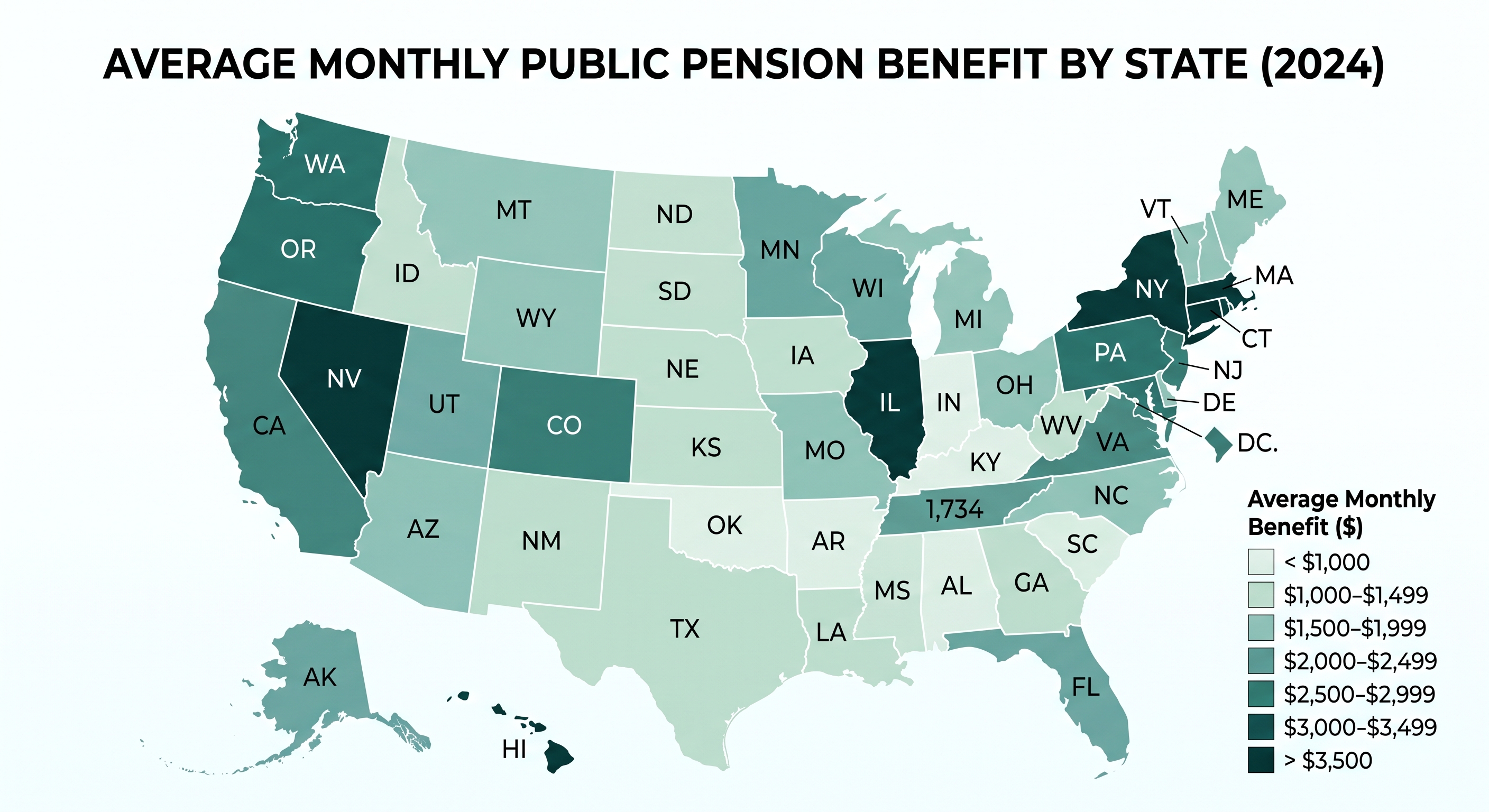
Where you live also affects how much your monthly pension check will be, according to a state-by-state analysis by the National Institute on Retirement Security (NIRS).
These figures are from 2024, the most recent available data, and cover public pensions, which tend to be higher than private ones.
State | Average Monthly Benefit | % of pre-retirement income replaced by pension |
|---|---|---|
Alabama | $1,927 | 50.00% |
Alaska | $2,180 | Varies |
Arizona | $1,797 | 69% |
Arkansas | $1,387 | 52%-60% |
California | $3,130 | 60% |
Colorado | $3,222 | 75% |
Connecticut | $3,808 | 39% |
Delaware | $1,996 | 56% |
District of Columbia | $2,135 | 60% |
Florida | $2,012 | 48% |
Georgia | $2,179 | 60% |
Hawaii | $2,654 | 53% |
Idaho | $1,787 | 60% |
Illinois | $3,365 | 50% |
Indiana | $810 | 33% |
Iowa | $1,593 | 60% |
Kansas | $1,438 | 56% |
Kentucky | $1,656 | 40% |
Louisiana | $2,321 | 75% |
Maine | $1,975 | 60% |
Maryland | $2,218 | 45% |
Massachusetts | $3,417 | 75% |
Michigan | $2,050 | Varies |
Minnesota | $1,753 | 51% |
Mississippi | $2,242 | 60% |
Missouri | $1,429 | 51% |
Montana | $1,772 | 60% |
Nebraska | $1,792 | 32% |
Nevada | $3,279 | 68% |
New Hampshire | $1,783 | 46% |
New Jersey | $1,947 | 50% |
New Mexico | $2,606 | 50%-75% |
New York | $2,140 | 60% |
North Carolina | $1,779 | 55% |
North Dakota | $1,436 | 60% |
Ohio | $2,577 | 66% |
Oklahoma | $1,064 | Varies |
Oregon | $2,795 | 45% |
Pennsylvania | $2,085 | 38% |
Rhode Island | $3,032 | 50% |
South Carolina | $1,823 | 55% |
South Dakota | $1,812 | 54% |
Tennessee | $1,734 | 45% |
Texas | $1,832 | 69% |
Utah | $2,048 | 45% |
Vermont | $1,928 | 50% |
Virginia | $1,761 | 30% |
Washington | $1,924 | 60% |
West Virginia | $1,407 | 60% |
Wisconsin | $2,285 | 48% |
Wyoming | $1,794 | 60% |
Source: National Institute on Retirement Security (NIRS) /AARP/NRTA, data through 2024.
Monthly benefits vary widely, from Connecticut's average monthly check of $3,808 to Indiana's $810.
How much of a beneficiary's pre-retirement pay the pension replaces also varies, ranging from 30% to 75%. NIRS data show most pensions cover 50% or 60%.
Keep in mind, however, that most private pensions do not account for inflation with a cost-of-living adjustment (COLA), so your actual purchasing power can diminish significantly over the years.
If you live in one of the 16 states that do not tax pension income, you'll be able to hold onto more of your pension payout.
The big decision: Lump sum or monthly payments?
Often, pension beneficiaries can take a lump sum instead of a monthly benefit, but experts say doing so means missing out on lifetime income and potentially mismanaging the lump sum and running out of money.
"If you have a pension and take the monthly benefit, it can’t run out," says Friedman. "You don’t have to worry about outliving your benefits or managing a lump sum. And the truth is, when retirees get into their 70s, 80s, and 90s, who wants to be figuring out how to invest money?"
For workers who are weighing taking a lump sum over a monthly check, it’s important to do an analysis to see how it impacts retirement security over the long haul, says Brian Donohue, partner at October Three, a pension consulting firm. “People have to run the numbers,” says Donohue.
Read More on Average Retirement Savings
Popular Products
-
 Put Me Down Funny Toilet Seat Sticker
$33.56$16.78 -
 Stainless Steel Tongue Scrapers
$33.56$16.78 -
 Stylish Blue Light Blocking Glasses
$85.56$42.78 -
 Adjustable Ankle Tension Rope
$53.56$26.78 -
 Electronic Bidet Toilet Seat
$981.56$490.78