Don't Expect Carney's Looming Spring Budget Update To Reflect The Financial Pain Canadians Are Feeling
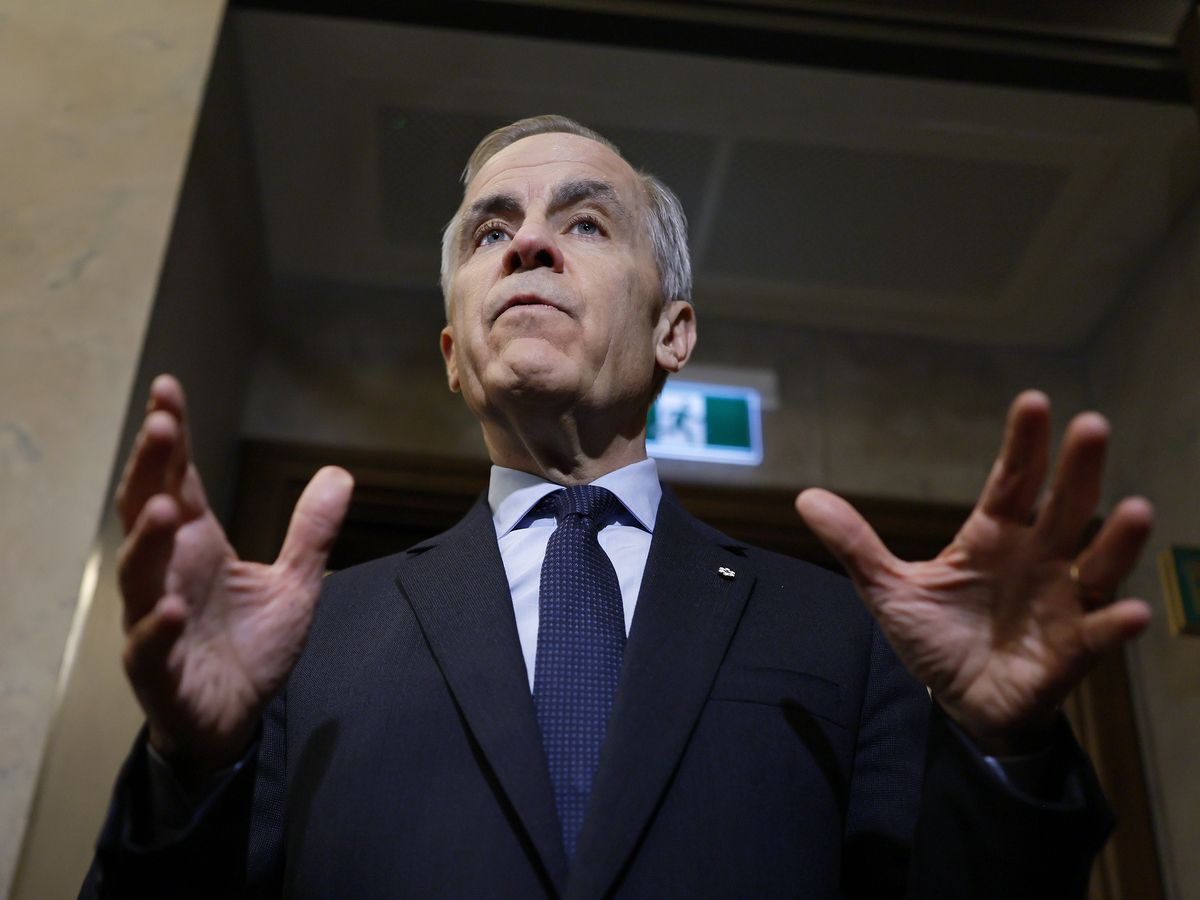
There’s a scene in the 1988 comedy The Naked Gun where Leslie Nielsen’s Lt. Frank Drebin waves his arms in front of a fireworks factory that has just exploded and calmly tells the horrified crowd, “Nothing to see here, please disperse.”
I’ve often thought about that scene as I’ve watched Mark Carney’s government handle the federal budget process. Behind Drebin, chaos; in front of him, reassurances. The gap between the two is the joke. Here’s some quick evidence.
During the anointing of Carney as Liberal leader in early 2025, he promised that if he were elected, he would separate the budget into two — an operating budget and a capital budget, a deceptive practice with a long history of failure . Such a practice lets the government reclassify routine expenditures as capital and brag that the operating deficit has shrunk. The financially literate — such as bondholders — are not fooled, but many people are.
After getting elected, his new finance minister in May 2025 announced there would not be a federal budget for 2025. After significant backlash, he reversed course and promised a budget in the fall.
In October, the Department of Finance followed up on Carney’s promise to separate the budget into operating and capital and provided its definition of capital, which, as expected, was ridiculously broad. It also announced it was moving the budget cycle from the spring to the fall. It did this without a parliamentary study and debate, conveniently ignoring the history of this very topic. This was accompanied by tidy I nternational Monetary Fund (IMF) comments crowing about the so-called positives of these moves.
The disastrous budget was then released in November with a new fiscal anchor: balance the operating budget within three years. But the Parliamentary Budget Officer (PBO) released a report calling the government’s definition of capital investment “overly expansive” and concluded that under an independent definition, capital investments would be roughly 30 per cent — or $94 billion — lower than the budget claimed.
Under that same definition, the “day-to-day operating balance” would remain in deficit every year through 2029-30. The PBO also pegged the probability that Carney’s deficit-to-gross-domestic-product anchor held at just 7.5 per cent. That isn’t a fiscal anchor; it’s a fiscal wish. Nothing to see here. But, alas, the IMF was impressed and provided the government with support that was passed along to Canadians via a glowing report .
Finally, it was announced last week that we will have a spring economic update on April 28 that cheerfully repeats the government’s all-purpose incantation: “building the strongest economy in the G7.” Right on cue, the IMF provided more praise and another tidy quote of support for Carney’s government, describing Canada’s fiscal position as “the cleanest dirty shirt.” Three quotes of IMF praise in six months. I’m expecting a fourth one on April 29. The fireworks should be great.
It’s worth noting that April 28 is two days before the personal tax filing deadline. Tax accountants — professionals who read and interpret federal fiscal policy — will be buried through that entire week. You could not design worse timing.
Canadians in general should appreciate the effect of moving the timing of the budget to the fall, accompanied by a spring update. The federal government’s fiscal year starts on April 1. Accordingly, early spring budgets have historically been presented to project the upcoming year.
Having an earlier budget release is fine by me, but the question is how much earlier ? By definition, fall can be anywhere from late September to late December, or four to six months before the start of the government’s fiscal year. A lot can happen during that time.
There have been fall budgets during our country’s history. Jean Chrétien tabled his first budget in November 1978. John Crosbie presented the Dec. 11, 1979, budget that brought down Joe Clark’s government two days later. Allan MacEachen tabled the Oct. 28, 1980, budget. Fall budgets were briefly the pattern, but they stopped because they didn’t work.
Michael Wilson’s Department of Finance explained why in a 1985 paper that considered the exact same question Carney has answered without consultation. Wilson concluded mid-January to mid-February was optimal for a budget, naming the fatal flaw of fall budgets plainly: “a fall budget forecast is likely to be less reliable” because it is prepared too many months in advance of the fiscal year.
He then formally referred his paper to both House and Senate committees for scrutiny. That is how you handle a major change to the budgetary process. You don’t announce it on a Monday and quote the IMF on a Tuesday.
Also, consider what’s happened since Nov. 4: the United States-Iran conflict, the Strait of Hormuz blockade and the regime change in Venezuela. None of that could have been forecasted, so the November 2025 budget forecasts are likely out of date.
Are we really building the strongest economy in the G7? Royal Bank of Canada released a report last week that said Canada saw a net capital outflow of more than $1 trillion — the largest capital exodus in Canadian history — between 2015 and 2024. For every dollar in, two dollars left. Canada ranked last in the G7 for capital investment. That’s concerning given there’s no real plan to reverse course.
- Forcing people to pay a moral tax if they leave the country won't inspire them to stay
- Canada's accountant shortage is starting to add up despite quieter tax season
Which brings us back to Lt. Drebin.
Operating and capital split? Nothing to see here. Budget cycle adjusted without parliamentary study? Please disperse. A fiscal anchor with a 7.5 per cent probability of holding? Move along. A trillion dollars of capital gone and an IMF blessing with fireworks rolled out 11 days before the spring update? Nothing to see here. The government is waving its arms and telling Canadians not to look.
The difference between The Naked Gun and Carney’s fiscal strategy is that one of them is knowingly funny.
Kim Moody, FCPA, FCA, TEP, is the founder of Moodys Tax/Moodys Private Client, a former chair of the Canadian Tax Foundation, former chair of the Society of Estate Practitioners (Canada) and has held many other leadership positions in the Canadian tax community. He can be reached at kgcm@kimgcmoody.com and his LinkedIn profile is https://www.linkedin.com/in/kimgcmoody.
_____________________________________________________________
If you like this story, sign up for the FP Investor Newsletter.
_____________________________________________________________
Popular Products
-
 Large Wall Calendar Planner
$55.76$27.78 -
 Child Safety Cabinet Locks - Set of 6
$83.56$41.78 -
 USB Touchscreen Heated Fingerless Gloves
$75.56$37.78 -
 Golf Swing Trainer Practice Stick wit...
$21.56$10.78 -
 Golf Swing Training Belt
$41.56$20.78