How Much Do Older Workers Value Retiree Health Insurance?
The brief’s key findings are:
- Retiree health insurance (RHI) is increasingly rare, but little is known about how much workers value these benefits, especially compared to pension benefits.
- Our analysis relies on a natural experiment in 2008 involving older state workers in Rhode Island.
- These workers had to choose between retiring early and keeping their existing RHI coverage or retiring later with less generous RHI but a larger pension.
- The results show that workers value an extra dollar of RHI twice as much as an extra dollar of pensions.
- The lingering question is, if workers value RHI so highly, why have employers cut back so dramatically?
Introduction
Retiree health insurance (RHI) is increasingly rare, and even government employers – long a bastion for RHI – are cutting back. Little is known about the implications of this retrenchment, and particularly about the value that employees place on RHI.
This brief, which is based on a recent study, estimates how much older workers value RHI using a natural experiment in Rhode Island state government.1 In 2008, the state cut back on RHI in a way that presented employees eligible for retirement with a choice: they could retire by September 30, 2008, and keep the existing generous RHI benefit, or they could retire later and continue accruing pension benefits at the cost of having less generous RHI in the future. The natural experiment makes it possible to assess how workers are willing to trade a dollar of RHI for a dollar of pension benefits.
The discussion proceeds as follows. The first section provides background on employer-provided RHI and the gaps in knowledge about how much older workers value this fringe benefit. The second section describes the natural experiment in Rhode Island, while the third section presents a conceptual model for assessing workers’ valuation of RHI. The fourth section describes the data and methodology used to estimate state workers’ willingness to pay for RHI. The fifth section presents the results, showing that older state employees are highly sensitive to RHI. Specifically, increasing the RHI cut by $1,000, in present value terms, caused a 0.6 percentage-point increase in the likelihood of retiring by September 30 (to keep the more generous benefits). In contrast, increasing the potential value of future pension wealth by $1,000 reduced early retirements by only 0.3 percentage points. The final section concludes with a conundrum: if older workers value RHI so highly, why have employers cut back so dramatically?
Background
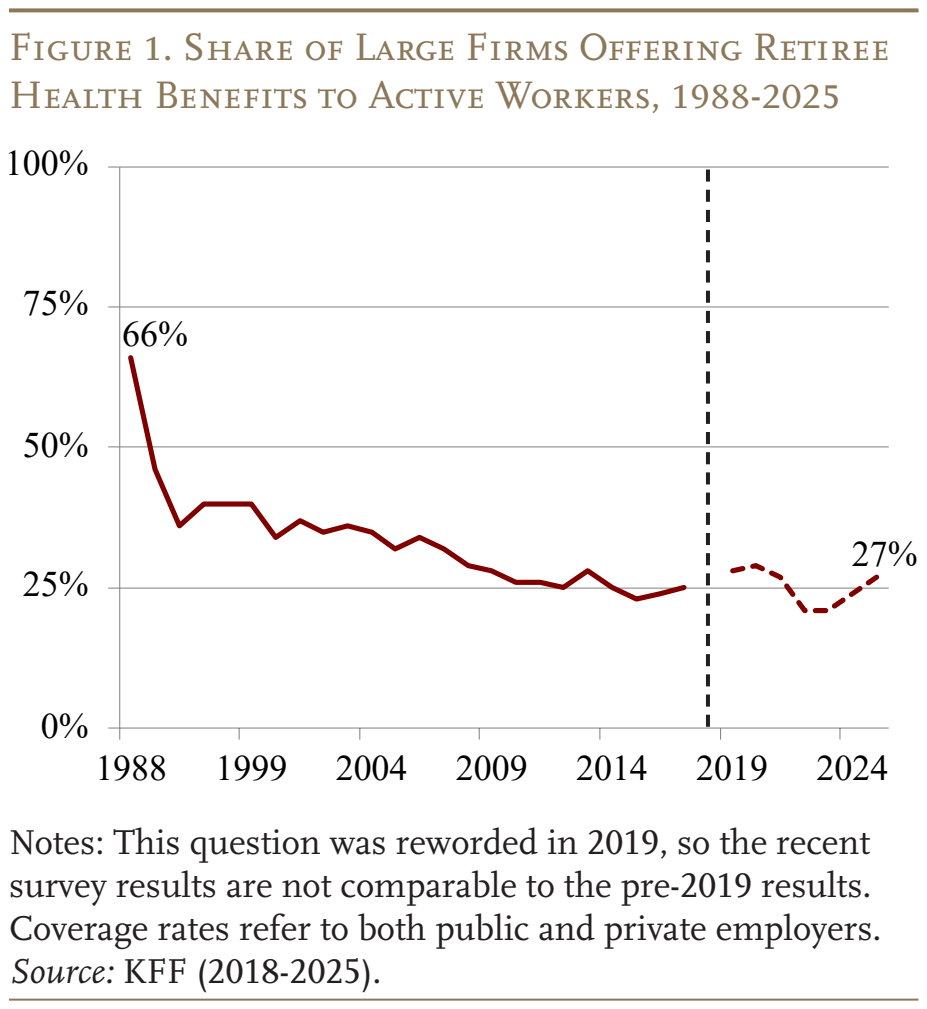
Older Americans are increasingly unlikely to receive RHI. The share of large employers offering coverage declined from 66 percent in 1988 to around 30 percent today (see Figure 1). And the existing RHI programs have also become much less generous with rising deductibles and other out-of-pocket costs.2 The remaining RHI programs are concentrated in the public sector. In 2014, virtually all government employers offered RHI, and they spent about as much on it as on health insurance premiums for active employees.3 Yet, even public sector employers have been scaling back as they grapple with both rising healthcare costs and underfunded pension systems.
Often lost in the debate around RHI is the value that employees place on these benefits. From the employee’s perspective, compensation in the form of health benefits has many advantages. For example, employer contributions to health insurance are generally not subject to income or payroll taxes. Employer plans also have lower prices than individual-market substitutes due to less adverse selection. And the administrative efficiency of a group plan may save workers hours of paperwork and comparison shopping. Thus, compensation in the form of health benefits may be worth more to employees than its dollar cost to employers. On the other hand, of course, getting in-kind benefits is less flexible than cash.
Despite RHI’s numerous attractive characteristics, relatively few studies estimate workers’ willingness-to-pay for it. A substantial literature finds that workers retire earlier when they have access to RHI coverage.4 However, most of these papers are now quite dated, and only a handful use quasi-experimental variation to consider how workers are willing to trade RHI for other forms of compensation (typically Social Security or pension benefits). Furthermore, the magnitude of workers’ willingness-to-pay is quite large in these papers, and it is not clear whether such large estimates reflect workers’ true preferences or are artifacts of specific contexts.
This study explores the willingness-to-pay issue by taking advantage of a natural experiment that has broad relevance to the current RHI landscape: public sector workers.
A Natural Experiment in Rhode Island
Like many other state and local governments, Rhode Island offers deferred compensation to its employees in the form of RHI and defined benefit pensions. These programs were significantly underfunded for decades, prompting the state to undertake a series of benefit cuts to curb rapidly rising costs. The first reform took place in 2005, when the state reduced the generosity of its pension for non-vested employees (those with fewer than 10 years of tenure at the time). The second reform – which is the subject of this study – took place in 2008 and focused on RHI rather than pension benefits. The state subsequently cut back its pension system two more times, in 2009 and 2012, ultimately converting to a hybrid retirement plan that pairs a smaller defined benefit pension with a defined contribution account.
Within this context, the 2008 reform dramatically reduced the generosity of Rhode Island’s RHI program for state employees. Before the reform, the state offered two types of benefits. Tier 1 benefits allowed retirees and their spouses to buy health insurance at the state’s active group rate, which was substantially less expensive than the retiree rate pool. The Tier 1 subsidy lasted until age 65, at which point retirees were required to enroll in Medicare. Meanwhile, Tier 2 provided these retirees an additional state subsidy of premiums for the life of the retiree (but not their spouse). The 2008 reform eliminated the Tier 1 benefit and reduced the generosity of the Tier 2 subsidy for most workers.
Importantly, the state allowed workers to keep their pre-reform benefits if they retired from state service by September 30, 2008. As a result, active workers were suddenly presented with a choice: retire by September 30 (if eligible) and retain the generous RHI promised at hire; or continue working past September 30 and accept a much lower RHI benefit. The magnitude of the RHI cut varied by the age and tenure of employees, who also typically accrued additional pension wealth by continuing to work, so the choice architecture makes it possible to elicit how older state workers value one dollar of RHI benefits relative to a dollar of pension benefits.
Conceptual Framework
The Rhode Island reform effectively asked employees whether they wanted to trade higher RHI subsidies for future salary and pension accruals in their government jobs. Pension benefits commenced no earlier than the employee’s Normal Retirement Age (NRA), which was 60 but dropped to any age for employees with 28 years of tenure. Once retired, beneficiaries received a 3-percent cost-of-living adjustment. The goal of our exercise is to determine how older state workers value one dollar of RHI benefits relative to a dollar of pensions.
The first step of the analysis identifies two groups of employees: a “treated” group who became eligible to retire between September 30, 2007 and September 30, 2008 and a “control” group who became eligible to retire between September 30, 2006 and September 30, 2007 (a year without any RHI or pension reforms). The analysis then compares the share of treated employees who chose to separate by September 30, 2008 with the similar share of “control” employees. This exercise reveals the extent of excess retirement due to the RHI reform.
The second step uses a regression to obtain employees’ willingness to pay for RHI. The regression includes a variable capturing the present value of RHI that workers gained by separating by September 30, 2008 and another variable reflecting the present value of pension wealth lost by separating by that date. Using an “instrumental variable” defined as being in the treated group isolates the causal impact of a dollar of RHI on the probability of separation. Willingness-to-pay is then estimated by comparing this coefficient with the comparable estimate for pension benefits (estimated in this study and also drawn from prior literature).
This conceptual framework captures the key trade-offs faced by workers. On the one hand, they can retire now, enjoying more leisure and facing lower health insurance payments, but also having lower income (both now and in the future due to lower pension benefits). On the other hand, they can continue to work and receive higher income now and in the future but enjoy less leisure and face larger health insurance payments down the road. The control group faces the same leisure and future income considerations when making their retirement decision, but without the RHI consideration.
Data and Methodology
The analysis relies on a detailed database of personnel records for Rhode Island state employees between 2003 and 2017. Using these data, we define a treated group of 456 employees who were actively employed by the state on September 30, 2007 and who reached their NRA sometime between that date and September 30, 2008. As noted above, these treated employees had a choice to retire from state service with the more generous RHI benefits or to keep working and retire later with less generous benefits. For comparison, the analysis also defines a control group of 472 employees who were actively employed one year prior, on September 30, 2006, and who reached their NRA by September 30, 2007. These control employees made their initial retirement decision without needing to consider any RHI cut.
Table 1 compares the treated and control employees along demographic and other characteristics. The hope is that the two groups will look similar along every dimension except for their exposure to the RHI reform. Reassuringly, that assumption appears to bear out: when first observed, in September 2007 and September 2006 respectively, the two groups of workers were age 54.5 on average, with 24 years of accrued tenure. They were 51 and 58 percent female, respectively, and had an average nominal monthly salary of $4,696 and $4,590 (the average salary in the treated group being slightly higher due to inflation).5
The next step is to define, for each worker in the sample, a variable that represents the employee’s accrued RHI benefits if they end state employment at a particular time. It is calculated as the present discounted value of the lifetime employer RHI subsidy, assuming that the employee separates and claims his benefits at his wealth-maximizing date. Similarly, a second variable denotes the employee’s pension wealth, assuming that the employee separates and claims his pension at his wealth-maximizing date.
With these values in hand, it is possible to calculate the counterfactual gain (or loss) in terms of RHI (DRHI) and pension benefits (DPension) if an employee retires from state service within the first year of observation (by September 30, 2008 for the treated group and September 30, 2007 for the control group).
The final step is to determine how workers trade off the changes in the values of RHI and pension benefits when choosing a separation date. This step requires specifying a linear probability model – for the treated and control employees in the sample – of the form:
Retires in first year observed = a + B1(DRHI) + B2(DPension) + B3(control variables)
where “Retires in first year observed” is a 0/1 variable that equals 1 if the employee leaves state service within the first year of observation (by definition before the RHI cut for employees in the treated group). B1 and B2 are the coefficients on the two key gain/loss variables. Conceptually, they can be interpreted as the impact on retirement of increasing future RHI or pension wealth by $1,000. Comparing the relative magnitudes of B1 and B2 answers the question: how do workers value an additional dollar of RHI benefits relative to pension benefits? Control variables include gender, age, tenure, salary, and type of employee, such as nurse or corrections officer.
A concern with this straightforward equation, however, is that workers – particularly unionized state workers – may have already selected or negotiated a favorable compensation package that maximizes benefits at their preferred retirement age.6 In that case, the equation does not reveal how workers would trade off the different forms of deferred compensation if forced to choose. Moreover, the regression does not control for many unobserved factors that might correlate with the variables of interest: workers’ preferences for leisure, their other sources of RHI coverage, expected future earnings both in and out of state government, and retirement benefits that they might be able to obtain in the private sector.7
To get around these issues, the analysis identifies the value of RHI by using only the reduction in benefits caused by the 2008 reform as the source of variation in DRHI. This “instrumental variables” approach – where being in the treated group is used as a predictor for DRHI – yields an estimate of the excess retirements caused by the sudden drop in RHI benefits. Assuming that those attaining retirement eligibility before the end of September 2008 and those attaining it a year earlier are similar in their preferences for leisure as well as their outside job options, the only difference between them with respect to their retirement decision is that the former group must choose between the enhanced RHI (when retiring early) and increased pension wealth (when retiring later), whereas the control group does not face this trade-off.
Of course, no comparable source of variation is available for pension wealth, since the 2008 reform did not touch pension benefits. Hence, it is impossible to establish that the increase in future pension wealth from postponed retirement caused workers to retire later. To increase confidence in the results for the pension wealth variable, the study benchmarks the estimated coefficient against findings from previous studies that did establish a causal relationship between changes in retirement and changes in pensions.8
Regression Results
The results from the simple ordinary least squares regression and the preferred specification, where being in the treated group serves as an instrument for future RHI wealth, are very close. The preferred specification, however, establishes a causal relationship. That is, it is possible to say that each $1,000 of RHI benefits lost because of the reform caused a 0.6-percentage-point increase in the likelihood of retiring by September 30, 2008 (see Figure 2). The corresponding coefficient on pension wealth gained by retiring after the first year is only 0.3 percentage points, and the relationship cannot be characterized as causal. In any case, the employees in the sample appear to value a dollar of RHI wealth twice as much as a dollar of pension wealth.
This seeming preference for RHI could arise for several reasons. Most obviously, Rhode Island’s RHI reform was likely quite salient to employees, and their behavior might reflect resentment for what was perceived as a broken promise as much as their intrinsic valuation of RHI. Yet, prior studies in other contexts have also found that older workers value RHI benefits more than equivalent pension wealth.9
A second possibility is that the coefficient on the pension variable is incorrectly estimated. As noted above, the 2008 reform did not touch pension benefits, so it is not possible to establish a causal relationship. Encouragingly, though, a thorough review of the literature finds estimates substantially smaller than the 0.3 percentage points found in this study. So, the relative preference for RHI could be much larger than reported.
Another possibility stems from the fact that RHI and pensions can be thought of as insurance against different risks. The former protects against health expense risk, while the latter protects against longevity risk. The results suggest that workers – at least public-sector ones – are more worried about health-related financial shocks than about outliving their resources. Of course, this is in the context of the state and local sectors, where the marginal dollar of longevity insurance may be of limited worth since so much compensation is already in the form of pension payments.10
Conclusion
The financing of public pensions, and the incentives they create for the state and local workforce, have been the subject of much academic and policy interest. Much less studied are the RHI benefits that governments offer to their workers, despite a sea change in both the prevalence and generosity of these plans over the past two decades. This study fills the gap by using a policy reform in Rhode Island to estimate how much older state workers are willing to pay for RHI.
Specifically, the reform asked retirement-eligible state employees – who were age 55 on average – to choose between retiring immediately with enhanced RHI or continuing to work and earn additional pension accruals (as well as salary). The findings show that older state workers value an additional dollar of RHI twice as much as an additional dollar of pension benefits. This high valuation of RHI is consistent with prior studies comparing workers’ relative valuation of Medicare and Social Security benefits and suggests that older workers are more concerned about insuring against future healthcare costs than protecting against longevity risk.
These findings raise the question of why RHI benefits are in decline if workers value them so highly? In the state and local sectors, governments seeking to reduce the cost of funding employees’ retirement benefits often turn first to RHI because it lacks the constitutional and legislative protections typically awarded pension benefits. But these results instead suggest that governments seeking to reduce expenditures should reallocate their deferred compensation package toward RHI.
More broadly, the results also raise questions about the drivers of private-sector cuts in RHI generosity over the past couple of decades. The reasons may lie in either different preferences of workers across sectors or in the different trade-offs these workers face: not between pensions and RHI, but between salary and RHI. It may be that private-sector workers would still prefer cash today over health insurance tomorrow – a question for future research.
References
Blau, David M. and Donna B. Gilleskie. 2006. “Health Insurance and Retirement of Married Couples.” Journal of Applied Econometrics 21(7): 935-953.
Boyle, Melissa A. and Joanna N. Lahey. 2010. “Health Insurance and the Labor Supply Decisions of Older Workers: Evidence from a U.S. Department of Veterans Affairs Expansion.” Journal of Public Economics 949(7): 467-478.
Brown, Kristine M. 2013. “The Link Between Pensions and Retirement Timing: Lessons from California Teachers.” Journal of Public Economics 98: 1-14.
Clemens, Jeffrey and David M. Cutler. 2014. “Who Pays for Public Employee Health Costs?” Journal of Health Economics 38: 65-76.
Collins, Sara R., Herman K. Bhupal, and Michelle M. Doty. 2019. “Health Insurance Coverage Eight Years After the ACA: Fewer Uninsured Americans and Shorter Coverage Gaps, but More Underinsured.” Survey Brief. Washington, D.C.: The Commonwealth Fund.
Employees’ Retirement System of Rhode Island. 2006-2009. Actuarial Valuation Report.
Fitzpatrick, Maria D. 2014. “Retiree Health Insurance for Public School Employees: Does It Affect Retirement?” Journal of Health Economics 38: 88-98.
Fitzpatrick, Maria D. 2015. “How Much Are Public School Teachers Willing to Pay for Their Retirement Benefits?” American Economic Journal: Economic Policy 7(4): 165-188.
Fitzpatrick, Maria D. and Michael F. Lovenheim. 2014. “Early Retirement Incentives and Student Achievement.” American Economic Journal: Economic Policy 6(3): 120-154.
French, Eric and John B. Jones. 2011. “The Effect of Health Insurance and Self-Insurance on Retirement Behavior.” Econometrica 79(3): 693-732.
Garthwaite, Craig, Tal Gross, and Matthew J. Notowidigdo. 2014. “Public Health Insurance, Labor Supply, and Employment Lock.” The Quarterly Journal of Economics 129(2): 652-696.
Gustman, Alan L. and Thomas L. Steinmeier. 1994. “Employer-Provided Health Insurance and Retirement Behavior.” Industrial & Labor Relations Review 48(1): 124-140.
GRS. 2007. State of Rhode Island Retiree Health Care Benefits Plan Actuarial Valuation Report. Providence: RI.
Gruber, Jonathan and Brigitte C. Madrian. 1995. “Health Insurance Availability and the Retirement Decision.” American Economic Review 85(4): 938-948.
Karoly, Lynn A. and Jeannette A. Rogowski. 1994. “The Effect of Access to Post-Retirement Health Insurance and the Decisions to Retire Early.” Industrial & Labor Relations Review 48(1): 103-123.
KFF. 2018-2025. “Employer Health Benefits Survey.” San Francisco, CA.
Koedel, Cory, Michael Podgursky, and Shishan Shi. 2013. “Teacher Pension Systems, the Composition of the Teaching Workforce, and Teacher Quality.” Journal of Policy Analysis and Management 32(3): 574-596.
Koedel, Cory and P. Brett Xiang. 2017. “Pension Enhancements and the Retention of Public Employees.” Industrial and Labor Relations Review 70(2): 519-551.
Lutz, Byron and Louise Sheiner. 2014. “The Fiscal Stress Arising from State and Local Retiree Health Obligations.” Journal of Health Economics 38: 130-146.
Madrian, Brigitte C., Gary Burtless, and Jonathan Gruber. 1994. “The Effect of Health Insurance on Retirement.” Brookings Papers on Economic Activity 1994(1): 181-252.
Morrill, Melinda S. and John Westall. 2019. “The Role of Social Security in Retirement Timing: Evidence from a National Sample of Teachers.” Journal of Pension Economics and Finance 18(4): 549-564.
Ni, Shawn and Michael Podgursky. 2016. “How Teachers Respond to Pension System Incentives: New Estimates and Policy Applications.” Journal of Labor Economics 34(4): 1075-1104.
Nyce, Steven, Sylvester J. Schieber, John B. Shoven, Sita Nataraj Slavov, and David A. Wise. 2013. “Does Retiree Health Insurance Encourage Early Retirement?” Journal of Public Economics 104: 40-51.
Quinby, Laura D. and Gal Wettstein. 2021. “Do Deferred Benefit Cuts for Current Employees Increase Separation?” Labour Economics 73 (102081): 1-14.
Quinby, Laura D. and Gal Wettstein. 2026. “How Much Do Older Workers Value Retiree Health Insurance?” Working Paper 2026-2. Chestnut Hill, MA: Center for Retirement Research at Boston College.
Rogowski, Jeanette and Lynn A. Karoly. 2000. “Health Insurance and Retirement Behavior: Evidence from the Health and Retirement Study.” Journal of Health Economics 19(4): 529-539.
Rust, John and Christopher Phelan. 1997. “How Social Security and Medicare Affect Retirement Behavior in a World of Incomplete Markets.” Econometrica 65(4): 781-831.
Shoven, John B. and Sita N. Slavov. 2014. “The Role of Retiree Health Insurance in the Early Retirement of Public Sector Employees.” Journal of Health Economics 38: 99-108.
The Pew Charitable Trusts and the John D. and Catherine T. MacArthur Foundation. 2016. “State Retiree Health Plan Spending: An Examination of Funding Trends and Plan Provisions.” Report.
Wettstein, Gal. 2020. “Retirement Lock and Prescription Drug Insurance: Evidence from Medicare Part D.” American Economic Journal: Economic Policy 12(1): 389-417.
Endnotes
- Quinby and Wettstein (2026). ︎
- Collins, Bhupal, and Doty (2019); and KFF (2023).
 ︎
︎ - The Pew Charitable Trusts and the John D. and Catherine T. McArthur Foundation (2016). Lutz and Sheiner (2014) point out that fully pre-funding these obligations would require another 1 percent of revenue dedicated to RHI trust funds. ︎
- Examples in the public sector include Nyce et al. (2013); Fitzpatrick (2014); and Shoven and Slavov (2014). Similar studies in the private sector include: Gustman and Steinmeier (1994); Karoly and Rogowski (1994); Madrian, Burtless, and Gruber (1994); Gruber and Madrian (1995); Rust and Phelan (1997); Rogowski and Karoly (2000); Blau and Gilleskie (2006); Boyle and Lahey (2010); French and Jones (2011); Garthwaite, Gross, and Notowidigdo (2014); and Wettstein (2020). ︎
- One key dimension, however, along which the two groups differ is pension benefits: the treated group has a higher share of workers exposed to the 2005 pension cut (denoted as “Schedule B”) because they were hired slightly later, on average. Consequently, Schedule B membership is included as a control in all the regression specifications. ︎
- This outcome would occur if workers select employers based on the structure of their compensation package or negotiate the package through a strong union (Clemens and Cutler 2014). Although most pension and RHI reforms are legislated with some union input, the Rhode Island reform was primarily motivated by legal and cost concerns rather than worker preferences. Unlike pensions, RHI benefits for current workers are not constitutionally protected and so are easier to cut without legal challenges. ︎
- While much of the variation in DRHI is due to the 2008 reform, tenure, salary, birth year, and age at separation also drive accrual patterns. ︎
- See, for example, Brown (2013); Koedel, Podgursky, and Shi (2013); Fitzpatrick and Lovenheim (2014); Ni and Podgursky (2016); Koedel and Xiang (2017); Morrill and Westall (2019); and Quinby and Wettstein (2021). ︎
- Wettstein (2020); and Gruber and Madrian (1995). ︎
- Fitzpatrick (2015). ︎
Popular Products
-
 Smart GPS Waterproof Mini Pet Tracker
$59.56$29.78 -
 Unisex Adjustable Back Posture Corrector
$71.56$35.78 -
 Smart Bluetooth Aroma Diffuser
$585.56$292.87 -
 Enamel Heart Pendant Necklace
$49.56$24.78 -
 Digital Electronic Smart Door Lock wi...
$211.78$105.89