Is 'buy And Hold' Really The Best Investing Strategy? What You Lose From Missing The Market's 30 Best (and Worst) Days
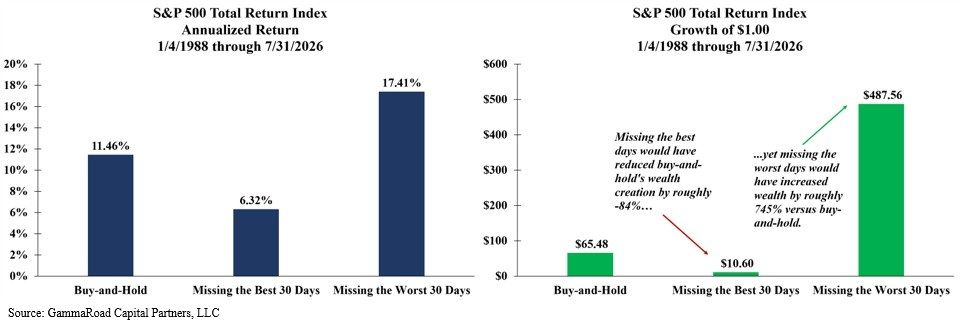
Investors hear a common refrain year after year: "It's better to buy and hold and ride out the downturns. Missing only the 30 best days of market returns can meaningfully lower your portfolio value."
At GammaRoad Capital Partners, we decided to test this assertion.
Using the S&P 500 Total Return Index since its base date of January 4, 1988, a buy-and-hold investor earned an 11.46% annualized return through July 31, 2026, turning $1 into $65.48.
Missing only the market's 30 best days over that same span cuts the annualized return to 6.32%, leaving that $1 at just $10.60. That's a loss of roughly 84% of the wealth a buy-and-hold investor would have built.
That fact is frequently highlighted to support the case for staying invested through downturns. It is also only half the picture.
Run the same exercise on the market's 30 worst days instead, and a $1 investment that avoided them would have delivered a 17.41% annualized return and grown to $487.56. That's more than seven times what buy-and-hold produced.
Challenging the conventional narrative
What should an investor make of this information?
It is remarkable that just 30 out of 9,716 market days can create such an extreme impact on wealth creation. While no one can predict the future, thoughtful portfolio construction and the inclusion of risk management strategies can allow an investor to avoid the futility of prediction altogether.
About Adviser Intel
The author of this article is a participant in Kiplinger's Adviser Intel program, a curated network of trusted financial professionals who share expert insights on wealth building and preservation. Contributors, including fiduciary financial planners, wealth managers, CEOs and attorneys, provide actionable advice about retirement planning, estate planning, tax strategies and more. Experts are invited to contribute and do not pay to be included, so you can trust their advice is honest and valuable.
The best and worst days do not scatter randomly across the market's history. Since 1988, a best or worst day has occurred within 21 trading days of another best or worst day more than 70% of the time.
The single most common gap between them was one day, meaning an extreme day was often followed immediately by another one.
Notably, nearly all of these days showed up during bear markets: On average, the S&P 500 had already fallen 29.17% from its prior peak by the time one of these best or worst days occurred.
Unless investors have tremendous luck or impossible foresight, conventional wisdom suggests that we simply have to take the bad days with the good.
However, the path dependency of returns and the asymmetric nature of drawdowns vs recoveries mean that passively holding through these periods can be far more consequential than the conventional narrative implies.
Consider that a -10% drawdown requires an +11.11% rally to get back to even, a -25% drawdown requires a +33.33% rally, a -40% drawdown requires a +66.67% rally, and a -50% drawdown requires a +100% rally just to break even.
For an investor with a real deadline — retirement in five years, a child's tuition bill, a home purchase — the amount of time it takes to recover from these drawdowns presents material consequences for their lives.
A downturn that hits at the wrong moment can force a retiree to withdraw a larger share of a smaller portfolio to cover the same living expenses, extending the damage well beyond the market's own recovery.
The conventional narrative relies on the assumption that it isn't possible to consistently avoid the worst periods, and therefore investors should remain fully invested and ensure they receive the benefit of the best periods.
Looking for expert tips to grow and preserve your wealth? Sign up for Adviser Intel, our free, twice-weekly newsletter.
However, there are approaches that can help you avoid some (or even most) of the impact of the worst days, which, as we've confirmed, carry far greater influence on annualized returns.
Portfolio diversification and risk-managed strategies, which adjust equity exposure based on volatility or market conditions, will likely underperform a fully invested passive approach in the late stages of a bull market.
In exchange for this trade-off, they aim to reduce the depth and length of the drawdowns that inflict the most damage on long-term returns and the financial planning that relies upon them.
The question worth asking is not whether you can time the best or worst days. You cannot. The question to ask is whether your portfolio is built to withstand the market environments where the worst days tend to occur.
Past performance is not indicative of future results. Please see the important disclosures that are integral to understanding the limitations applicable to the quantitative information in this article.
Related Content
- Buy and Hold … or Buy and Hope? It's Time for a Better Retirement Planning Strategy
- What Your Portfolio Says About You and Your Relationship with Risk
- When Markets Are Jumpy: A Financial Planner Explains How to Stay Grounded
- 33 Stocks That Could Rally 33% or More
- The 5 Best Long-Term Investment Stocks to Buy for Steady Returns
This article was written by and presents the views of our contributing adviser, not the Kiplinger editorial staff. You can check adviser records with the SEC or with FINRA.
Popular Products
-
 Classic Oversized Teddy Bear
$23.78 -
 Gem's Ballet Natural Garnet Gemstone ...
$171.56$85.78 -
 Butt Lifting Body Shaper Shorts
$95.56$47.78 -
 Slimming Waist Trainer & Thigh Trimmer
$67.56$33.78 -
 Realistic Fake Poop Prank Toys
$99.56$49.78