Let’s Elect Candidates Who Will Make The Wealthy Pay Taxes
And let’s use some of those revenues to make Social Security contributions fairer.
For years, policymakers have treated the nation’s fiscal challenges as separate debates. One discussion focuses on the federal deficit. Another debate centers on the growing concentration of wealth and political influence. A third asks how to restore Social Security’s finances. In fact, these are not three unrelated problems. The solution to all three is to start taxing the gains of the ultra-wealthy and use some of the revenues to rectify a historical decision that accounts for the bulk of Social Security’s shortfall.
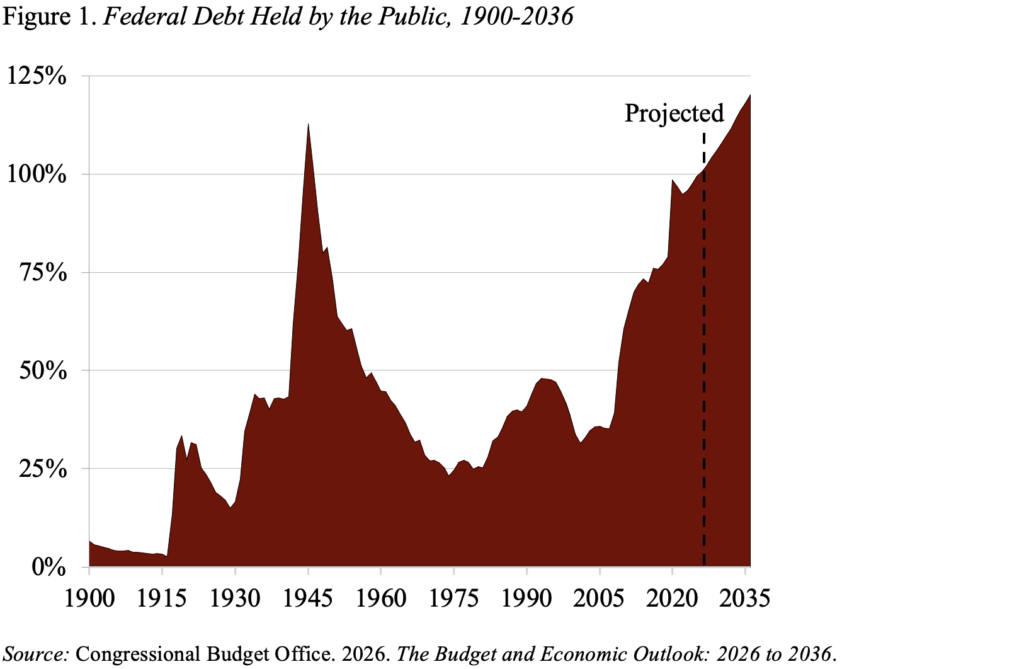
The federal government now runs persistent deficits even during periods of economic growth. An aging population and rising healthcare costs contribute to the problem, but they are only part of the story. Over the last several decades, policymakers have repeatedly reduced taxes on high-wealth households by cutting rates on estates, capital gains, and corporations. At the same time, sophisticated tax planning has allowed many of the wealthiest Americans to defer or avoid taxation altogether. The result is predictable: government revenues have failed to keep pace with spending commitments, and debt has climbed steadily (see Figure 1).
The same tax system has also accelerated the concentration of wealth. The top 0.1 percent of households now hold 6 times the wealth of the entire bottom 50 percent of households – compared to only about 2.5 times in 1989 (see Figure 2). Income from work is generally taxed as it is earned. Wealth, by contrast, can often grow for decades without ever being taxed. Appreciated assets are not taxed until sold, and under current law many capital gains disappear altogether when assets are passed to heirs. These rules increase both economic inequality and the political influence that accompanies great wealth. The most dramatic example, of course, is Elon Musk’s contributions of almost $300 million to elect Donald Trump.
While the wealthy escape taxation entirely, wage earners are being asked to pay too much. Today, Social Security participants pay roughly what they would have to pay for comparable benefits under a funded plan, such as a 401(k). But the system is running a deficit because Social Security does not accumulate contributions in a trust fund; it operates on a pay-as-you-go basis. This arrangement reflects a historical decision to pay benefits far in excess of contributions to people retiring in the 1940s-1950s. This transfer to early generations means that contributions must compensate for workers’ inability to invest their contributions and earn interest. But the deficit associated with a pay-as-you-go system – roughly 60 percent of the total (see Figure 3) – should not rest on the shoulders of today’s workers but rather should be borne by those most able to pay.
A tax system that asks the billionaires to pay their share of running the government could address all three problems – mounting national debt, concentration of wealth and power, and the Social Security deficit. At this point, the ultrawealthy have removed themselves from the tax system almost entirely. They need to be brought back in, which means that we need to tax income earned from capital as effectively as we tax income from earnings. As suggested by numerous tax experts, that agenda involves four major changes:
- Raise the corporate tax rate. The corporate tax rate has declined from 35 percent in the 1990s to 21 percent. Critics of this decline note that it didn’t produce the influx of capital advertised. It simply provided tax relief for the wealthy, who own the bulk of the stocks.
- Tax capital gains under the income tax at the same rate as ordinary income. Yes, some of the gains are due to inflation, but the owner also benefits from deferring the tax until the asset is sold. Importantly, since wage earners are taxed at ordinary rates when they withdraw their 401(k) accumulations, why shouldn’t the wealthy do so as well?
- Apply constructive realization at death. Right now, the wealthy can avoid all tax on their gains by not selling their appreciated assets during their lives, and their heirs enjoy a stepped-up basis when they inherit the asset. Canada taxes gains at death, with the taxes paid by the estate of the donor. We should adopt that approach as well.
- Replace the estate tax with an inheritance tax. The estate tax has been gutted and raises very little income. Resurrecting the tax is unlikely given the effective campaign against a “death tax.” Instead, individuals who receive an inheritance, in excess of some minimum amount, should be taxed on this money under the federal income tax.
Bringing the wealthy into the nation’s tax system to reduce our annual deficits and contain the inequality and political power of the wealthy is only the first step. The second – and equally important – step is to apply an earmarked portion of the revenues to covering the portion of Social Security’s deficit arising from giving away the trust fund. This is not a new idea, but rather an idea whose time has come.
If our billionaires started paying taxes and helped support government programs and stabilize Social Security, we might start to like them.
Popular Products
-
 Pet Oral Repair Toothpaste Gel
$59.56$29.78 -
 Opove M3 Pro 2 Electric Massage Gun
$901.56$450.78 -
 Portable Electric Abdominal Massager ...
$45.56$22.78 -
 Bee Venom Capsules for Joint Support ...
$43.56$21.78 -
 Ashwagandha & Black Cumin Seed Oil
$43.56$21.78