Love Your Kids But Fear For Their Finances? You Need A Spendthrift Trust
It’s perfectly natural to want your children to be well cared for after you’re gone. It’s also natural to wonder if they can manage an inheritance with the same care it took to build. After all, loving your children and trusting them with a large windfall are not the same thing.
An outright bequest can overwhelm a child who has never managed a large sum of money — much less a family business or other complex assets. A spendthrift trust, on the other hand, allows you to provide for them without dropping a huge lump sum into their checking account all at once.
What a spendthrift trust actually does
The name "spendthrift" comes from an English term for someone who is extravagant and recklessly wasteful with money. A spendthrift trust, an often-misunderstood estate-planning tool, lets you provide for your loved ones while protecting your legacy from poor decisions and creditors. Unlike a regular trust that lets you hand over assets, money or property all at once, a spendthrift trust rations money gradually according to its terms. That’s because the trust — not your children or other beneficiaries — owns the assets.
The trustee manages the spendthrift trust, deciding when, how much, and for what purpose funds are distributed according to your set terms. Your child does not have a right to demand a lump sum, to use the trust as collateral for a loan, or to pay a creditor. Sometimes this can be misconstrued as a vote of no confidence. However, if explained well, it is actually just the opposite, as this type of trust can help support your loved ones for decades when structured properly.
The risks of an outright inheritance
Over the next 25 years, trillions in U.S. personal assets will change hands in what’s known as the Great Wealth Transfer. The scale of that alone can make you feel a little uneasy about your kids’ finances after you’re gone.
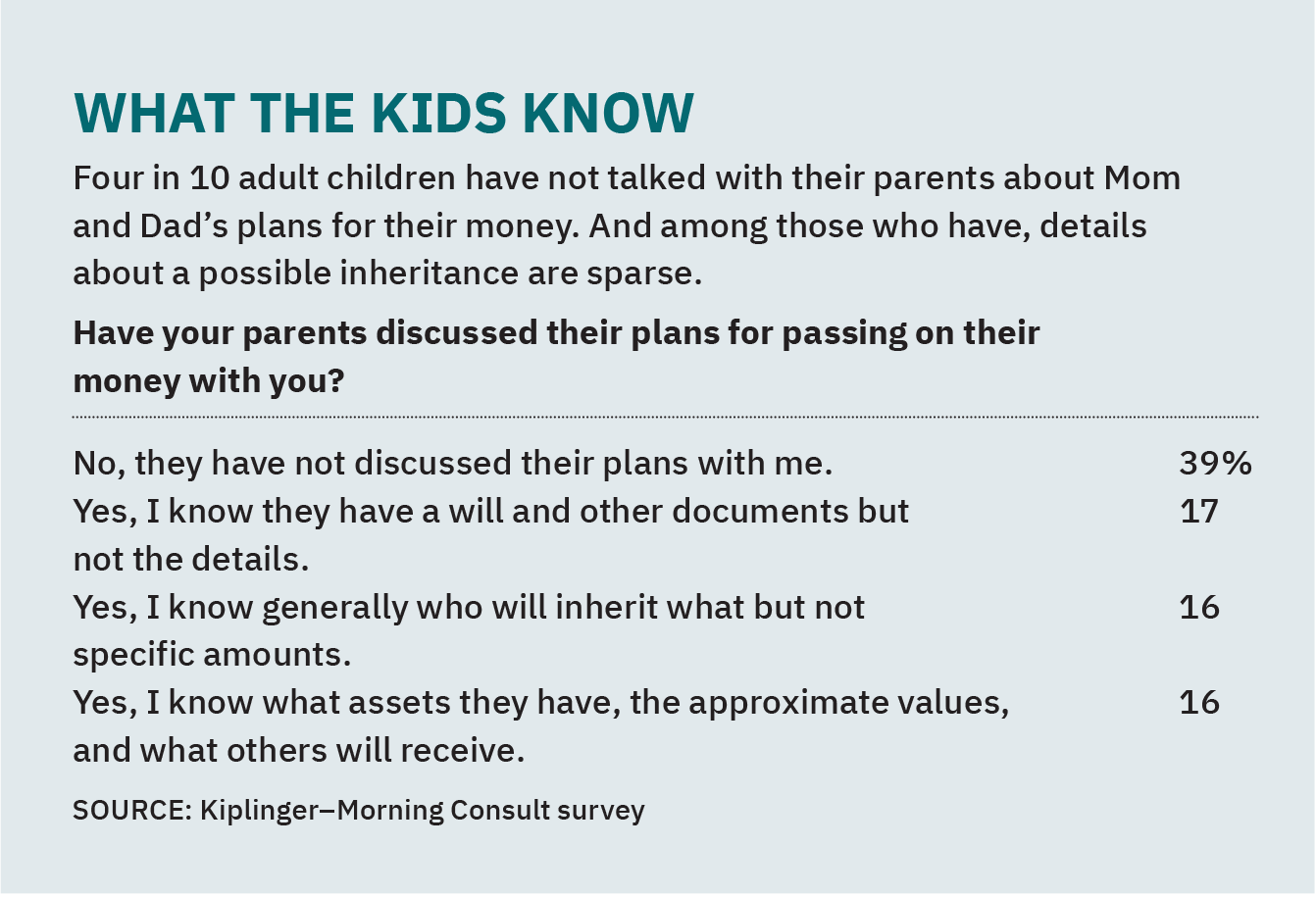
Research by Morning Consult, in partnership with Kiplinger, shows why that uneasiness is so common: families often aren’t on the same page. Nearly twice as many parents expect to leave a meaningful inheritance (46%) as adult children who expect to receive one (23%). The same survey found that 11% of parents also worry their children won’t handle an inheritance responsibly.
With an outright inheritance, money and assets transfer directly to your beneficiaries without restrictions. That gives them full control over the inherited assets immediately upon your death and can expose those assets to risks that you never intended, especially if the beneficiary isn’t prepared. It’s not unusual that a lump-sum inheritance disappears faster than it arrived. The value of a spendthrift trust is that it can protect your heirs not just from creditors or lawsuits, but sometimes from their own financial mismanagement.
Who is a spendthrift trust for?
Spendthrift trusts are especially useful for beneficiaries who:
- Are young or financially immature, such as a teenager or a grandchild.
- Have special needs and/or receive government benefits.
- Have mounds of high-interest debt.
- Might be facing a divorce.
- Have a history of poor money management.
- May struggle with gambling or other addiction.
- Works in a profession with a high risk of lawsuits, such as doctors, lawyers and business owners.
- Is at risk of financial scams or exploitation.
When creditors can access trust assets
Spendthrift protection is not airtight. Even in states with clear statutes, courts may still allow creditors to access assets despite the spendthrift provision. For instance:
- Child support and alimony. Most states treat child support and alimony obligations as exceptions to spendthrift protection. A former spouse or child owed support can often compel a court to order distributions or wage garnishment.
- Basic needs providers. Some states allow creditors who provide beneficiaries with necessities, such as food, shelter or medical care, to file a claim against trust assets.
- Federal government claims. Federal tax debts and certain other federal obligations, such as defaulted federal student loans, may override a state's spendthrift protections.
- Tort victims. Some states allow victims of the beneficiary's intentional wrongdoing to obtain trust assets.
The specific exceptions depend entirely on your state's law, and a spendthrift provision that works well in one state may offer fewer protections in another state. Keep in mind, too, that the protection covers only those assets held inside the trust. Once you distribute the assets to your beneficiaries, they become the beneficiaries' property and ordinary creditor rules apply.
How to write the trust so it actually works
Creating a spendthrift trust is similar to creating any other trust, and the spendthrift clause itself can be relatively short. Under the Uniform Trust Code, saying the beneficiary’s interest is held “subject to a spendthrift trust” is often enough. However, you may choose to add provisions and conditions that let you decide when and how much to distribute to the beneficiary.
For example, you may add a provision that restricts how much your beneficiary can access each year. Or, you might add a condition that limits how your beneficiary can spend the money.
"Let’s say you are providing a $200,000 inheritance for your two children. You have one child who isn’t especially careful with money and the other is," says Oliver Kevin Morrisey, inheritance and estate lawyer at Empower Probate Lawyers. "You don’t split $200,000 equally. For the impulse spender, you might include a provision in the trust that pays $2,000 per month and can be used only for rent, education or healthcare. The other child can receive the $200,000 outright."
However, states have different rules about what you can and can’t stipulate in a spendthrift provision. Scott Jones, founder & financial advisor of Genesis Wealth Advisor Group, LLC, says, "In many states, an inheritance can be reached by creditors the moment it lands in the beneficiary's name, so the money mom and dad worked forty years to save can be gone before the beneficiary sees any of it."
That’s why it’s wise to consult with an estate planning attorney to ensure you’re following your state’s rules concerning the spendthrift provision.
Remember that a spendthrift clause may be overkill if your children or other beneficiaries are financially mature and stable, you have a modest estate, or you have no concerns about excessive spending or possible claims from creditors. A revocable living trust that becomes irrevocable at your death, with a spendthrift clause included, is often enough for many families.
How to choose a trustee
Choosing the right trustee for a spendthrift trust matters. You can choose a family member, a good friend, a bank or a trust company. Family members likely know your needs best, but a professional trustee with no emotional attachment can offer an objective third-party perspective. No matter who you pick, be sure the trustee is knowledgeable about financial matters because this person will distribute funds, protect assets, and ensure your beneficiaries use the money as you intended.
Pros and cons of a spendthrift trust
A spendthrift trust is one way to tell your beneficiaries you love them enough to protect the inheritance you built from impulsive spending or financial mismanagement that has nothing to do with whether or not they are "good kids." Instead, it is your way to help ensure their long-term financial security.
But keep in mind the drawbacks. Your beneficiaries have limited access to their inheritance, which can be frustrating in an emergency. And since the trust relies entirely on the trustee for distributions, disagreements may occur. Roughly 33% of adult children expect an inheritance will create conflict with their siblings, according to the Kiplinger-Money Consult survey. With that in mind, the best way to prevent arguments among your children is to take the first step. It’s never too early to start talking about your kids' finances.
Get expert retirement strategies and lifestyle insights delivered to your inbox. Subscribe to our free newsletter, Retirement Tips.
Related Content
- We Asked 5,000 Americans About Inheritance and the Great Wealth Transfer. Here's What We Learned
- Why So Many Families Are Unprepared for the Great Wealth Transfer — and What You Can Do About It
- How to Talk to Your Adult Kids About Their Inheritance
- Your Beneficiaries Might Be Outdated. Here's How to Check
Popular Products
-
 Put Me Down Funny Toilet Seat Sticker
$33.56$16.78 -
 Stainless Steel Tongue Scrapers
$33.56$16.78 -
 Stylish Blue Light Blocking Glasses
$85.56$42.78 -
 Adjustable Ankle Tension Rope
$53.56$26.78 -
 Electronic Bidet Toilet Seat
$981.56$490.78