New York Lawmakers Want To Give Your Favorite Dive Bar A Rent Freeze

Juliana Kaplan/Business Insider
- Many NYC small businesses are struggling with rising rents.
- New York State lawmakers have proposed legislation to stabilize commercial rents.
- Real estate industry interests say the measure would be 'destructive' for property owners.
Henry Yao's 200-square-foot military surplus shop on New York's Lower East Side has hung in there for over 20 years. Other local businesses aren't so lucky: He said he's known many of his peers who have shuttered due to rising rent.
In neighboring Chinatown, business owners cited rent as one of their biggest challenges, with a Chinatown Small Business Impact Study finding that rents had increased by 39% from 2010 to 2019.
"At least I survive," Yao, a 63-year-old who has owned Army & Navy Bags in NYC's Lower East Side neighborhood for 22 years, said. "Not like before, but I'm still okay."
It's a familiar story to many New Yorkers: Their favorite dive bar or local coffee shop shutters unexpectedly, replaced by a sad, empty storefront. The reason? Very often, a rent hike.
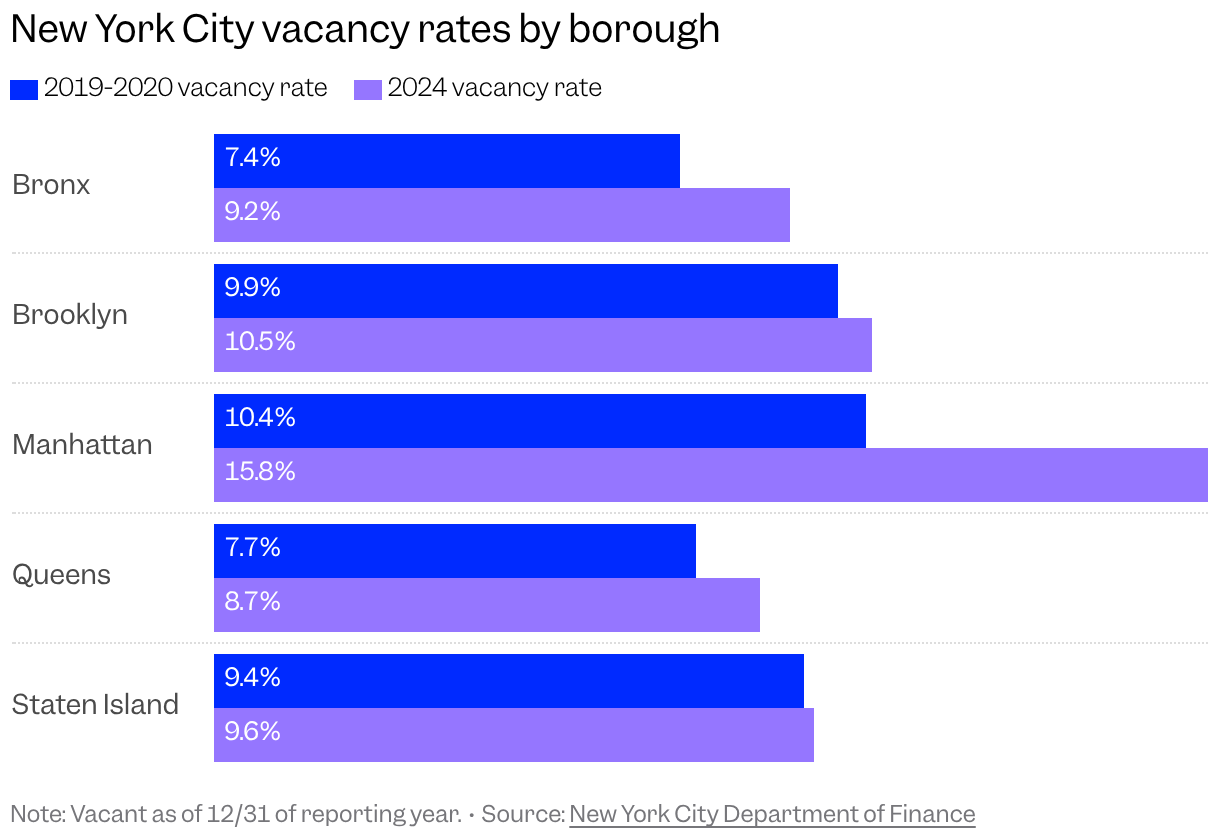
Now, some New York lawmakers want to step in and offer those small businesses more stability and protection when it comes to their rent. State Assemblymember Emily Gallagher has proposed legislation — the "New York City Small Business Rent Stabilization Act" — that would create a Commercial Rent Guidelines Board to set maximum annual rent increases for all commercial leases across the city. The legislation comes as storefront vacancy rates are rising across the city.
"Small businesses are an essential part of what makes our city thrive, but it is increasingly impossible to run a successful local business due to unpredictable, outrageously expensive commercial real estate costs," Gallagher said in a statement.
The Big Apple's economy — like that of the rest of the country — is powered by small businesses. A whopping 98% of New York City's businesses have fewer than 100 employees, and 89% have fewer than 20 employees. Small businesses with fewer than 50 employees account for 25% of total employment in the city. Because small employers make up the majority of the city's businesses, they stand to benefit the most from the rent stabilization legislation.
But these businesses can face big hurdles. So-called "high-rent blight," or when rising property values hurt local merchants and economic activity, is nothing new, especially in gentrifying areas of New York City. The median rent per square foot for storefronts has risen from $4.51 in 2019 to around $5 in 2024 — and hikes are even steeper in increasingly trendy and gentrified parts of the outer boroughs. In Brooklyn, for instance, the average monthly rent per square foot rose by 36% from pre-pandemic levels, per data from NYC's Department of Finance, while in Queens it rose by just over 9% from 2019 to 2024. Simultaneously, the average rent price in Manhattan fell by 17%, although it still sits well above the costs in the outer boroughs.
Even so, vacancy rates across all boroughs have gone up since the pandemic, and businesses are finding themselves paying more in emptier neighborhoods.
"I think so many people talk about rent control, but not for business," Yao said. The 63-year-old has owned Army & Navy Bags in NYC's Lower East Side neighborhood for 22 years.
"I am the one who said yes to sign a new contract because I have no options. No matter where I go, it's high like that," Yao said. "It's not like, oh, just this landlord or whatever. It's overall."
A city of affordability
Another big hurdle for NYC's small businesses is the complex web of city requirements and fees required to get started. Mayor Zohran Mamdani has made streamlining small business regulation a key priority. In mid-January, he signed an executive order requiring several city agencies to compile a list of all city fines and fees and find ways to eliminate them.
"You cannot tell the story of New York without our small businesses," Mamdani said in a press release. "Yet, our City has long made it too hard for these same businesses to open their doors, and to keep them open."
Jason Alpert-Wisnia / Hans Lucas / AFP via Getty Images
Rent hikes and lease issues were among the most common challenges Julian Hill dealt with during his years advising small businesses as an attorney at the New York City nonprofit TakeRoot Justice.
Hill, now a law professor at Georgia State University, said regulations on commercial rent increases have "been a long time coming." He added that the move would give small business owners "a little bit more leverage and protection" around lease renewals.
"At the moment, a landlord has complete discretion to raise the rent 100%, 300%, 500%, if they like, at the end of the lease term," Hill said.
New York has experimented with commercial rent control in the past. From 1945 to 1963, the state regulated rent increases for businesses of all sizes. In the decades since, the City Council and New York State lawmakers have debated another rent control measure, but never passed anything into law. Commercial rent regulation is rare in the US. Berkeley and Seattle have temporarily implemented rent control measures for businesses, but both have since expired or been overturned.
Hill said that commercial rent control would particularly help Black- and immigrant-owned businesses, which in turn could slow the tide of gentrification in neighborhoods across the city.
"It's hard to talk about how do you stem gentrification without talking about maintaining some of the commercial architecture and some of the commercial communities that are in place," he said.
Real estate industry groups are critical of the proposal. They say it would hurt property owners already struggling with rising maintenance costs, property taxes, and insurance premiums.
"Rent stabilization in the multifamily sector has created this environment where you have capped rents and expenses that just continue to escalate, and the quality of the housing is suffering because of that," said Ann Korchak, the board president of the Small Property Owners of New York. "If you do the same thing in commercial transactions, you could see the same thing happen."
Yao, the Lower East Side business owner, said he takes things one day at a time. For now, he's doing okay.
"I love it. It's just, love is one thing," Yao said. "You survive — another thing. That's all I can say."
Popular Products
-
 Orthopedic Shock Pads For Arch Support
$71.56$35.78 -
 Remote Control Fart Machine
$80.80$40.78 -
 Adjustable Pet Safety Car Seat Belt
$57.56$28.78 -
 Adjustable Dog Nail File Board
$179.56$89.78 -
 Bloody Zombie Latex Mask For Halloween
$123.56$61.78