Older Workers Embrace Job Hopping – And It’s Good For Their Retirement Prospects
Moving from job to job allows workers to trade up to higher-paying employers.
When I talk to relatives about my work as a labor economist, I get the sense that they think the younger generations are a bit fickle with respect to their jobs. At many family gatherings, I’ve heard some version of the same comment. “You know, we used to work the same job forever, you all just move around.” When this happens, I nod politely but think to myself: “you’re wrong.”
In fact, the rate at which people switch jobs has been declining over the last several decades. Between the 1990s and the 2010s, a recent study out of the Federal Reserve found that the rate of job-to-job transitions has dropped by about a third. The reasons for this decline are not well understood but have implications for both the labor market and for retirement security. Despite what my relatives seem to think, job movement is likely a good thing for the economy. For the labor market writ large, job-to-job transitions allow workers to “trade up” to higher-paying employers and thus tend to drive earnings upwards. Job-to-job mobility also benefits the macroeconomy by allowing workers to gradually move to jobs that they are better at, increasing productivity.
For older workers specifically, declining mobility would also be a concern. Work I did with Steven Sass showed that workers who voluntarily switch jobs in their 50s had significantly longer careers than those who stayed put. For workers with at least some college, 45% of those who stayed in their initial job were in the labor force at 65 versus 55% of workers who moved jobs. For workers with a high school degree or less, those numbers were 40% and 48% respectively. Given that extending one’s career is often one of the best ways to improve retirement security, the overall decline in job-mobility could be a threat.
The question is: has the trend for older workers followed the overall trend? Some evidence suggests that most of the decline in job-to-job mobility has been centered among younger workers. But no research I am aware of has looked at people in their 50s. Plus, even the work on younger workers stops pre-COVID. So, I wondered what’s happened to both overall job mobility and mobility for older workers through the tumultuous years of COVID and its aftermath.
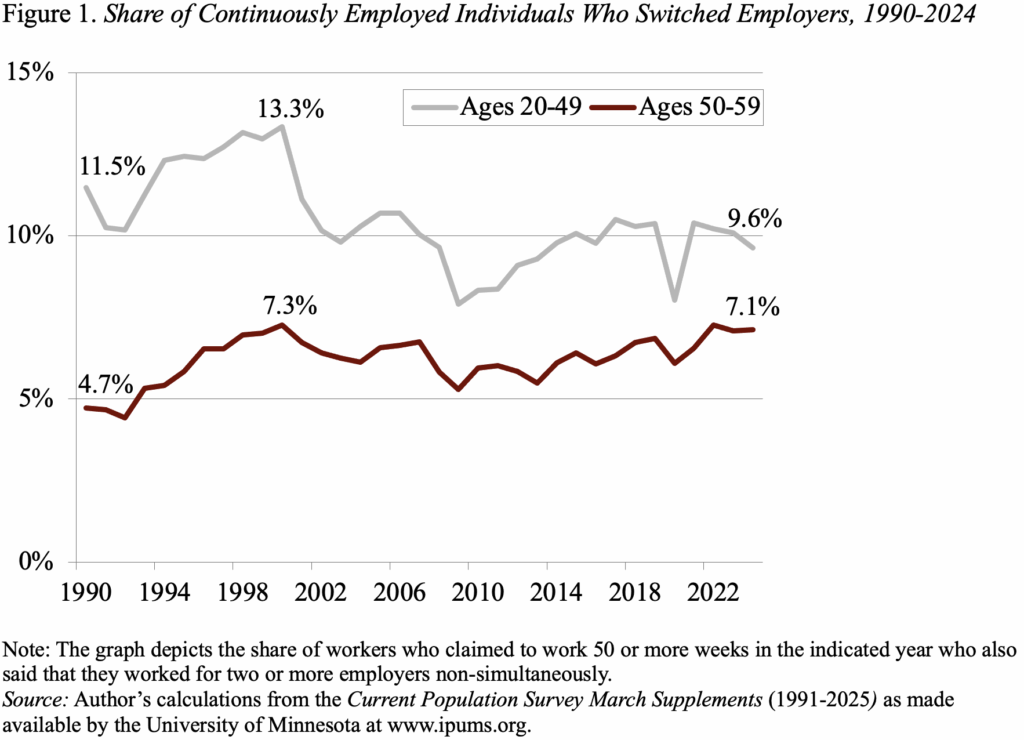
To give all of this a look myself, I followed the methodology of a recent paper that used The Current Population Survey’s Annual March Supplement to look at individuals’ job movement within a given year. Basically, the paper asked what share of people switched from one employer to another in the prior year without any intervening spell of non-employment. Figure 1 shows the results for 1990 to 2024 divided into two age groups: 1) 20-49; and 2) 50-59.
For both age groups, the highest rate of mobility occurred in the year 2000 after rising during the 1990s. However, the younger group experienced sharp declines during the Dotcom Recession and then during the Great Recession. And, despite a rise in mobility during the 2010s, mobility rates for those ages 20 to 49 remain well below the 2000 peak. On the other hand, for those ages 50-59, the mobility drops during recessions were much smaller. And they recovered nearly all the way to their 2000 peak.
So, older workers seemed to have bucked the downward mobility trend. Or, at least they have for now. As I mentioned in another recent post, measures of the job market have been all over the place. Two measures especially relevant for mobility – job openings and job quits – have dropped considerably from their post-pandemic highs. And unemployment has edged up from post-pandemic lows — in February it rose to 4.4 percent as the U.S. unexpectedly lost jobs. Given the relationship between job market weakness and mobility shown in the figure above, one wonders if job changes may be getting ready to decline again and how older workers would be affected. It’s something I’ll be keeping an eye on in the coming year, given its far reaching implications for both early and late-career workers.
Popular Products
-
 Gas Detector Meter
$311.56$155.78 -
 Foldable Garbage Picker Grabber Tool
$93.56$46.78 -
 Portable Unisex Travel Urinal
$49.56$24.78 -
 Reusable Keychain Pepper Spray – 20ml
$21.56$10.78 -
 Camping Survival Tool Set
$41.56$20.78