The Good, The Bad, And The Ugly Of Rising Interest Rates
Unlike higher gas prices, which hurt almost everyone, higher borrowing costs have an uneven impact.
In September 2024, then presidential candidate Donald Trump promised: “we’re going to put a temporary cap on credit card interest rates … at around 10 percent.” Yet, today, the Bankrate Monitor National Index shows the average credit card APR at a historically elevated 19.6 percent. Mortgage rates are also at levels not seen since the turn of the century. And those numbers are only likely to rise, as these and other interest rates often increase within a few months of hikes in the federal funds rate, like the one that just happened last month.
But unlike higher gas prices, which hurt almost everyone, higher borrowing costs have a mixed impact – especially for older Americans. People with credit card debt suffer. But a higher federal funds rate also leads to higher returns on assets that retirees often hold. Given high government debt, funding needs for the AI buildout, and Iran War fueled inflation, interest rates are likely to remain high. So, it’s worth a look at the various ways – good, bad, and ugly – that high rates affect those near and in retirement.
The Good: Annuities and Cash-Like Assets
Higher interest rates have a few clear benefits for those near and in retirement. For near retirees who are considering annuitizing some of their wealth, higher rates are helpful. For example, the monthly payout for a $100,000 annuity bottomed out around $425 for a 65-year-old female when interest rates fell during COVID and have rebounded to nearly $600 a month as rates have risen. Certainly, this impact could be good news for the admittedly small (but perhaps growing) number of people who use annuities.
A more common positive impact is for those who hold cash-like assets with interest rates that respond to the federal funds rate: mainly savings accounts, money market accounts, and short-term certificates of deposit. According to an analysis of the Survey of Consumer Finances (SCF), roughly 3 in 5 Americans ages 55 and over hold at least some wealth in these assets. Still, those assets are usually a small part of older American’s net worth – 3 to 4 percent on average. So, while rising interest rates can help here, it may not be a huge boon. The bad news is that more common assets may be negatively affected.
The Bad: Houses, Bonds, and (maybe) 401(k)s
When people think of high interest rates, they often think of mortgage rates. But since over 70 percent of people 55+ own their homes, it’s natural to assume that mortgage rates don’t affect them. Still, higher mortgage rates make it harder to unlock home equity by downsizing and moving to a place more amenable to retirement. For example, one study found that rises in interest rates reduced lifestyle moves to independent living communities for four to five years.
Aside from this effect, rising interest rates can also negatively affect certain assets held by those near and in retirement. The most obvious type would be directly held bonds or bond mutual funds, whose prices tend to drop when interest rates rise. However, only about 6 percent of these households hold such assets.
Far more ubiquitous are bonds held indirectly, often through target date funds (TDFs) in 401(k)s. Roughly half of households ages 55-64 have assets in a 401(k) and about a third of those balances are in TDFs. Since these funds shift to bonds as people approach retirement, higher interest rates could reduce returns in many workers’ 401(k)s. Whether this happens depends a bit on how stock prices react to the higher rates, something that is more ambiguous. Still, it’s worth keeping an eye on whether 401(k) returns decline at a crucial time for retirement savers. Then again, at least those with TDFs have a pile of assets. The people really hurt by higher rates are those with a pile of debt.
The Ugly: Big Credit Card Balances
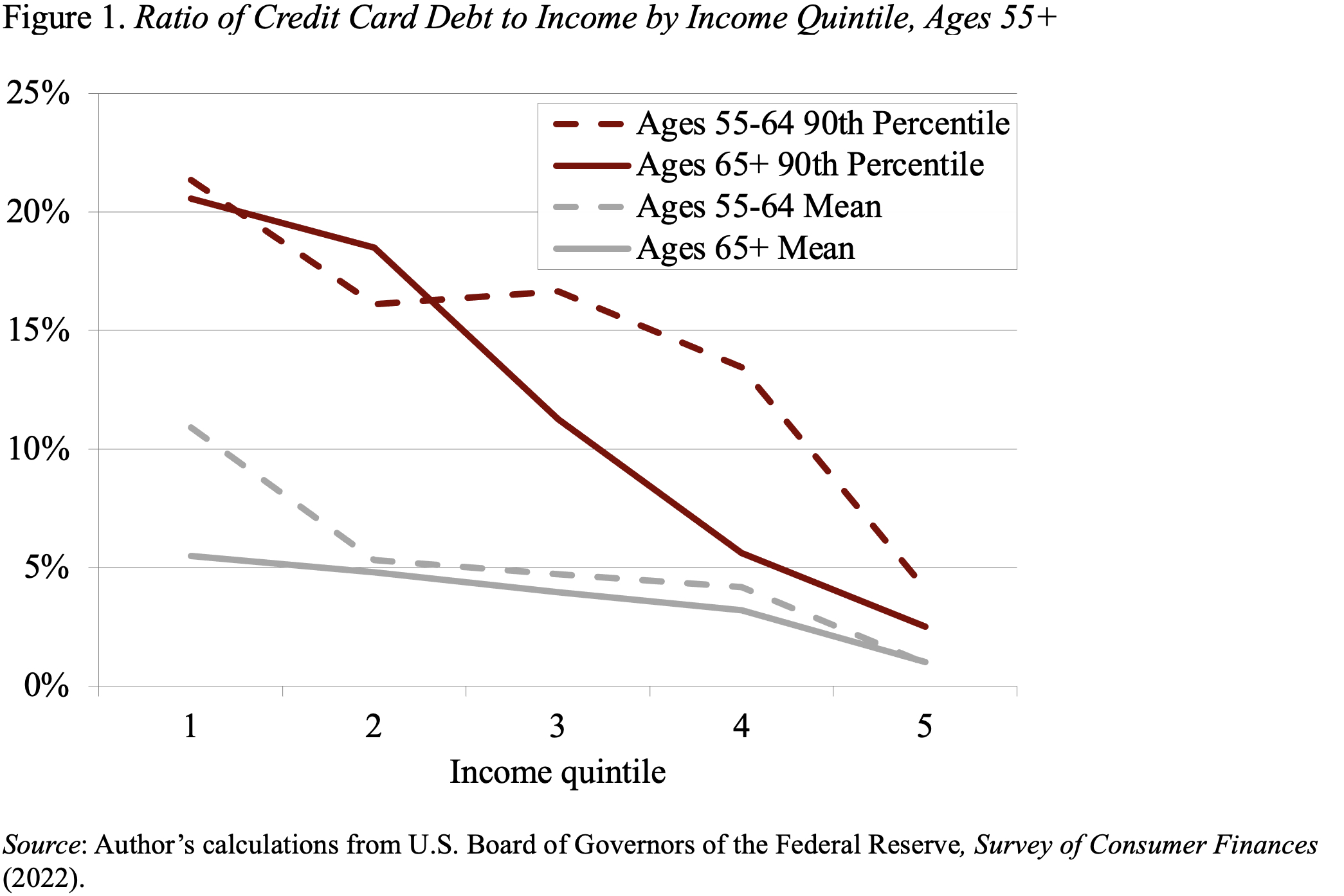
The most vulnerable group to increasing interest rates are those who must deal with higher borrowing costs without much ability to increase their earnings. Many of these people are low income. Figure 1 divides people ages 55-64 and 65+ into five roughly equal income groups from low to high and shows their credit card debt divided by their income. A higher value indicates a higher debt burden relative to what can be afforded.
The figure shows that some lower-income people have a high debt burden than those with more money. At the average, the poorest 20 percent of 55-64-year-olds (gray dashed line) hold credit card debt equal to over 10 percent of their income. For those 65+, the number is 5 percent (gray solid line). The comparable numbers for the richest 20 percent are much lower, around 1 percent.
The figure also highlights that some lower-income people are in real trouble. If you look within that poorest 20 percent, you’d see that 10 percent of people have credit card balances worth over 20 percent of their income. For the richest 20 percent, that same number is below 5 percent. To the extent that recent and future federal-funds-rate hikes spill over to credit cards, low-income people will be hit the hardest.
I’ve written in this space before about how the Trump Administration’s policies have either hurt the vulnerable or disproportionately helped the rich. While higher interest rates aren’t a policy aim of the administration – indeed the administration has agitated for lower rates – its policies have led to higher rates. By passing a large tax cut and following it up with a costly war, the U.S. debt-to-GDP ratio is at near-record highs despite an economic expansion.
Relief on rates likely isn’t coming, and the ugly truth is the most likely group to be hurt is already low income.
Popular Products
-
 Gas Detector Meter
$311.56$155.78 -
 Foldable Garbage Picker Grabber Tool
$93.56$46.78 -
 Portable Unisex Travel Urinal
$49.56$24.78 -
 Reusable Keychain Pepper Spray – 20ml
$21.56$10.78 -
 Camping Survival Tool Set
$41.56$20.78