The Treasury Just Made A Surprise Move. Here’s What It Means For Your Wallet.

Andrew Harnik/Getty Images
- In a surprise move, the Treasury Department doubled bond buybacks in an effort to ease surging yields.
- Officials want to avoid higher yields, which can mean pricier mortgages, slower hiring, and weaker stocks.
- Sign up for First Trade, Business Insider's daily markets newsletter.
When the biggest story on the beat is a surprise Treasury-market intervention, the work is really cut out for a newsletter scribe such as myself.
People overwhelmingly prefer the high-flying stock moves in the AI sector, or the wily antics of the retail-investor community. Bonds are a tough sell.
But you have to trust me here. What's happening in Treasurys is a big deal, and it could have a large impact on you and your finances.
Ok, fine. What's the big deal in the Treasury market?
I thought you'd never ask! There's a lot of focus on a global government-bond sell-off that's pushed yields to multi-decade highs. The 30-year US Treasury yield hit its highest level since 2007 this week. That really freaked people out.
But what's causing the sell-off in the first place?
For starters, investors are starting to get a bit skittish that the sudden need for AI capex — and the resulting explosion of debt financing — will raise the cost of capital for everyone.
Then there's the unpredictability of geopolitics, headlined by the US-Iran war that's disrupted the macroeconomy this year. When we're talking about a bond that matures in 30 years, a lot can happen in that time — and investors don't like uncertainty in the global order.
And then there's the US budget deficit. It's pacing to be one of the biggest on record in 2026, and government spending doesn't look to be slowing any time soon.
So what can be done about it?
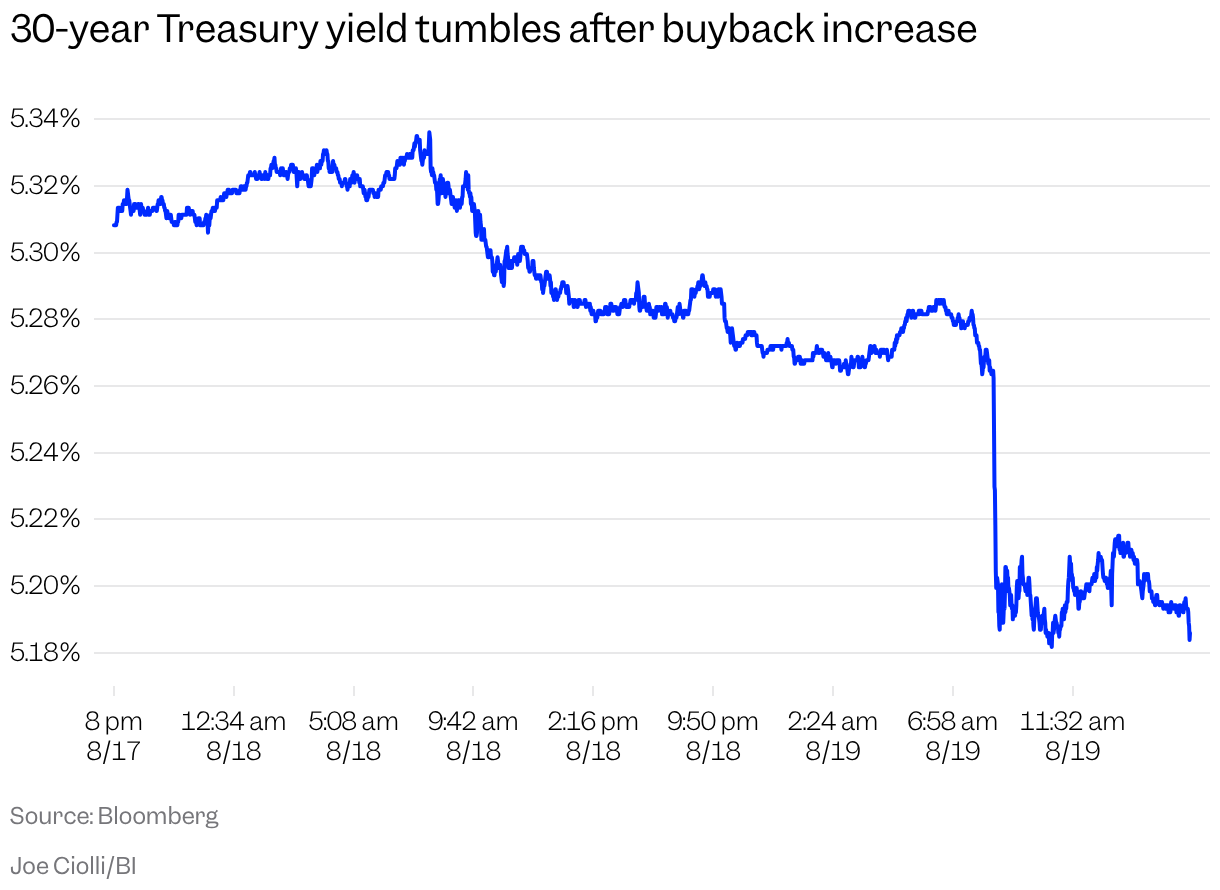
Well, actually, Treasury Secretary Scott Bessent directly addressed the situation on Wednesday by unexpectedly increasing government buybacks of bonds dated between 10 and 30 years by more than double. It was interpreted as a clear attempt to ease surging bond yields.
Did it work?
Actually, yes! For one day at least. As the chart below shows, the 30-year Treasury yield fell as much as 15 basis points intraday, its biggest drop in at least the past year. The 10-year yield tumbled as well. And major US stock indexes climbed on the relief.
Isn't what he did pretty extreme?
It was certainly unexpected. While the Treasury has increased buybacks before, it's done so during scheduled quarterly announcements. This was an unforeseen one-off.
Ultimately, Bessent did it because — by his own past admission — the government views bond yields as a scorecard of sorts. The lower, the better. The highest 30-year yield in 19 years just wasn't going to fly.
This is all well and good … but what does it all mean for me?
Well, higher Treasury yields ripple through basically every corner of your financial life. They can push up mortgage rates and other borrowing costs, while also making it more expensive for companies to borrow, invest, and grow. That can weigh on everything from stock prices to hiring to the broader economy. When the government's cost of borrowing goes up, yours usually does too.
So enjoy Wednesday's short-term, government-intervention-fueled victory while you can. Bessent's actions were a mere Band-Aid. We're going to be hearing a lot more about Treasurys.
Popular Products
-
 Put Me Down Funny Toilet Seat Sticker
$33.56$16.78 -
 Stainless Steel Tongue Scrapers
$33.56$16.78 -
 Stylish Blue Light Blocking Glasses
$85.56$42.78 -
 Adjustable Ankle Tension Rope
$53.56$26.78 -
 Electronic Bidet Toilet Seat
$981.56$490.78