The Two-stage Tfsa And Rrsp Tax Arbitrage Savings Strategy That Works For Fast-growth Incomes
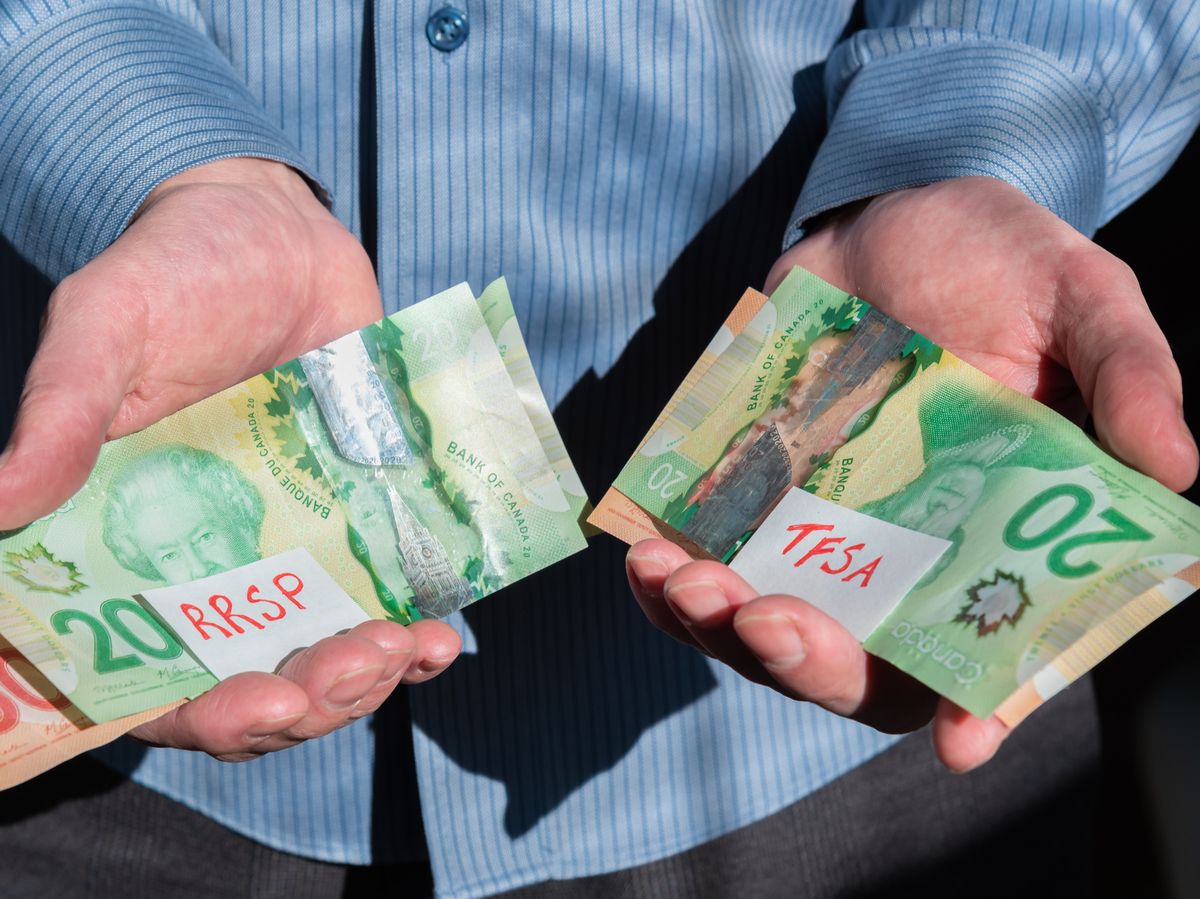
One piece of advice you will often hear is to put money into a tax-free savings account in the short term, but then move it to a registered retirement savings plan down the road.
The strategy can be useful, but what you should know is that it is largely circumstantial.
The main rationale behind this concept is based on income tax arbitrage. In short, RRSP deductions are worth more (in terms of the money refunded) when your income is enough to put you into a higher tax bracket. There is a legitimate case to be made for pursuing this strategy if your income starts relatively low and rises relatively quickly.
But it requires the discipline of diverting a substantial portion of income increases toward savings rather than lifestyle enhancements.
Here’s how this might work for, say, someone who embarks on a career in consulting, the professions or sales — where income can be relatively modest as you begin to build your roster of clients but can grow quickly and to a substantial number within four or five years. In that instance, it might make sense to put money into a TFSA while your income is relatively low and then slowly repurpose that money to supplement RRSP contributions as income rises.
For instance, let’s say your income is $70,000 and growing by $10,000 a year for the next three years. Then, in year four, income starts growing by $25,000 a year.
Here is how it could play out in a two-stage strategy.
Most people know that the RRSP contribution limit is 18 per cent of the previous year’s earned income and that TFSA contribution room is now more than $109,000 over a person’s lifetime over the age of 18, growing by $7,000 a year up to 2026, and could be set at $7,500 a year starting in 2027.
If you were to put $7,000 out of $70,000 into a TFSA starting this year, and $7,500 for each of the next three years as income inched to $100,000, you would have $29,500 contributed at the end of year four. With luck, that amount would have also grown along the way. That’s the first four years in stage one.
Then comes the next stage. In year one of stage two, our intrepid saver could simply contribute $8,000 to an RRSP instead of a TFSA, bringing taxable income down to $117,000 — the cusp of the two lower brackets.
Starting the following year, money could be slowly withdrawn from the TFSA to top up RRSP contributions. Here comes the arbitrage. That’s where we turn the corner and begin re-purposing our TFSA money. With annual income mushrooming to $125,000, annual contributions should now go toward an RRSP.
Although provincial taxes also come into play, let’s just look at the federal side to keep things simple. Income between $58,523 and $117,045 is taxed at 20.5 per cent. The next marginal tax bracket on income exceeding $117,045, is 26 per cent. These numbers are indexed to inflation, so the threshold is a bit higher every year.
In year three of stage two, the saver could put more (say $16,000) into an RRSP and top it up with an additional $10,000 from the TFSA. Taxable income would be only $124,000 on an earned income of $150,000.
In year four of stage two, the saver could set aside, say, $24,000 into an RRSP and add the final approximately $20,000 from the (now empty) TFSA. Taxable income would be $131,000 on an earned income of $175,000.
In year five of stage two, the saver could set aside, say, $32,000 on an income of $200,000. That’s still only saving 16 per cent of earned income, but it also leaves the person with more after-tax income than ever before: $168,000.
Did you notice how the person’s net income rose every year despite ever-increasing plan contributions? This is likely only possible with a rapidly rising income, but I have met several people in a similar situation.
What I just laid out was a nine-year plan played out in two distinct phases. Of course, the plan could continue as time goes on, only with the RRSP getting the priority. Remember that RRSP contribution room carries forward forever, so any unused room could be used to catch up later.
People should aim to set aside 18 per cent of earned income wherever possible, but by the time they approach $200,000, they will hit the allowable maximum. As of 2026, that maximum RRSP contribution room is $33,810.
If income continues to grow at the previous rate — in other words it reaches $225,000 the following year and $250,000 the year after that, and so on — savers could continue to set aside a higher portion of their income until the RRSP contribution room carried forward has been maximized. By this time, the saver would likely have more than a decade’s worth of TFSA contribution room built up and could also contribute the amount that was withdrawn previously (in stage two). Once yearly earned income surpasses $250,000, diligent savers should be able to not only maximize annual RRSP contributions but also catch up on available TFSA contribution room.
This kind of savings plan doesn’t take a great deal of work, and as you can see from the example, net income after taxes can increase every year along the way, so lifestyle needn’t be sacrificed. While those who choose this path will experience net income increases for spending on lifestyle that are relatively modest compared with those who spend it on lifestyle now, the long-term benefits in terms of financial independence can be truly massive.
John De Goey is a portfolio manager with Designed Securities Ltd., regulated by the Canadian Investment Regulatory Organization and a member of the Canadian Investor Protection Fund.
Popular Products
-
 Automotive CRP123X OBD2 Scanner Tool
$649.56$324.78 -
 Portable USB Rechargeable Hand Warmer...
$61.56$30.78 -
 Portable Car Jump Starter Booster - 2...
$425.56$212.78 -
 Electric Toothbrush & Water Flosser S...
$43.56$21.78 -
 Foldable Car Trunk Multi-Compartment ...
$329.56$164.78