Tiktok Ceo Says Ai Is Overhyped Now And Underrated Long Term
Big technologies come with two price tags. The first is what people expect it to do next year. The second is what it actually does over the next 20.
We tend to set the first one too high and the second one too low. Futurist Roy Amara put that idea into words decades ago, and it has held up through electricity, personal computers, and the internet.
The dot-com crash erased trillions of dollars in stock value in 2000 and 2001. The survivors then built the digital economy most of us now carry in our pockets.
Artificial intelligence (AI) is living through its first price tag right now. Big Tech keeps raising its spending plans, and skeptics keep asking where the profits are.
The boom is in “the early stages of a bubble,” Bridgewater founder Ray Dalio wrote in a year-end post, according to Fortune. His firm has been quietly reshaping its portfolio amid those bubble warnings.
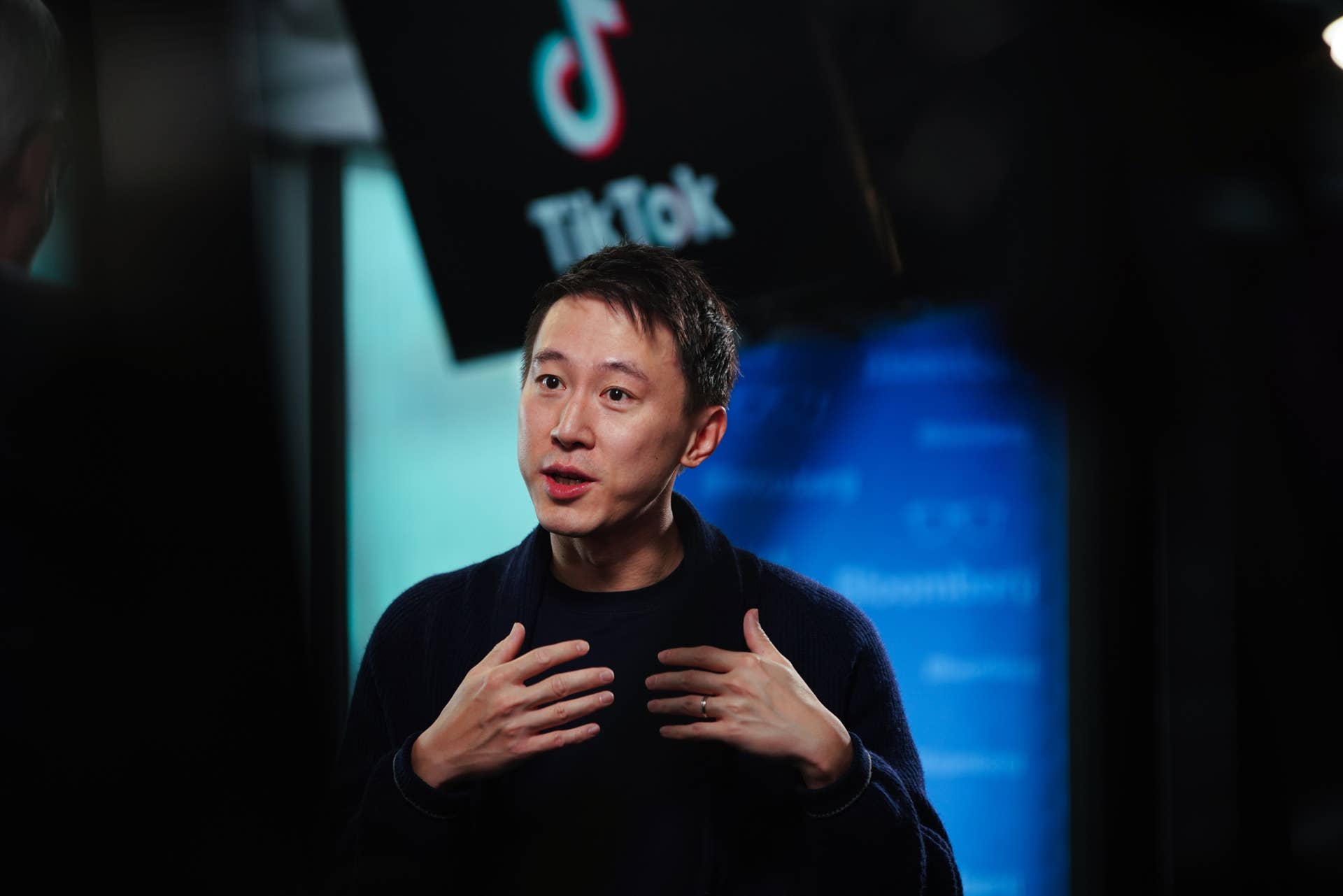
Now the head of an app most people associate with dance videos is making the case for the second price tag. TikTok CEO Shou Zi Chew thinks the market is wrong about AI in both directions.
What TikTok’s CEO expects from AI-fueled scientific breakthroughs
Speaking at the DBS Asia Future Forward Conference in Singapore on Monday, Oct. 12, Chew said AI’s short-term impact may be overstated while its long-term potential remains underestimated.
He put a clock on that second part. Within two to three years, “we’re going to have a real scientific breakthrough” in physics, biotech, chemistry, and materials science, he said, according to CNBC.
More Artificial Intelligence:
- Bill Gates says some jobs should be reserved for humans
- Microsoft’s CEO says AI industry is skipping a step that could matter a lot
- Palantir hits record as its next AI market gets awkward
That isn’t idle talk from Chew. ByteDance, TikTok’s Chinese parent, has been pushing its AI research beyond consumer apps.
In April, its Seed research team released Protenix-v2, a model that predicts and helps design biomolecular structures for work such as drug discovery, according to ByteDance Seed. Chew said the company is also exploring collaborations with scientists.
I studied pharmacy before I ever covered a stock. What struck me about Chew’s list is that it skips chatbots entirely and goes straight to the slowest, most expensive work in the economy, the years it takes to turn a molecule into a medicine.
Why Big Tech spending looks overhyped right now
The overhyped half of Chew’s argument shows up in the budgets. Alphabet (GOOGL), Amazon (AMZN), Meta (META), and Microsoft (MSFT) plan to spend about $725 billion on capital projects in 2026, up 77% from 2025, according to a Financial Times tally reported by Tom’s Hardware.
Bulls see that as proof of demand. “The AI economy is healthy,” Jefferies analyst Brent Thill said, as reported by the Financial Times.
Related: Nvidia’s AI power problem is turning into its biggest edge
The corporate results are less tidy. An MIT study found 95% of generative AI pilots at companies had yet to turn a profit, Fortune reported in its coverage of Dalio’s warning.
Most of that $725 billion buys chips, servers, and data centers to run chatbots, ads, and cloud services. Those products are real, but the money is being spent years ahead of the profits needed to justify it.
The tiny research bet inside a $725 billion boom
The underrated half of Chew’s argument is getting funded, too, just on a much smaller scale. Here is how the science track has moved:
- October 2024: Google DeepMind’s Demis Hassabis and John Jumper shared the Nobel Prize in Chemistry with David Baker for AI protein-structure work, according to the Nobel Prize.
- April 2026: ByteDance’s Seed team released Protenix-v2 for biomolecular structure prediction and design, according to ByteDance Seed.
- Oct. 7, 2026: Google DeepMind, Meta, and Isomorphic Labs committed $300 million combined to Biohub’s Virtual Biology Initiative, part of a $1.8 billion effort with the Department of Energy and the National Institutes of Health, according to Interesting Engineering.
The goal of that last project is a “virtual cell” that could “dramatically accelerate scientific discovery,” Biohub Head of Science Alex Rives said, according to Interesting Engineering.
Here’s what I found when I ran the numbers. The $300 million from the three tech backers equals about 0.04% of the $725 billion the four Big Tech giants plan to spend this year.
Put another way, for every $1,000 of capital spending, roughly 41 cents goes to this headline science bet. Even counting the full $1.8 billion, including data and computing resources that aren’t new cash, it’s about one-quarter of 1%.
My analysis points to an uncomfortable mismatch. Investors are paying for the expensive half of AI, while the half Chew calls underrated runs on a fraction of the money.
Chew’s warning about AI agents and your money
Chew didn’t pitch a clean utopia. He warned that people may give AI agents broad permissions without understanding the consequences, including letting those agents make purchases on their behalf, according to CNBC.
He also said more capable AI models make fraud cheaper for criminals. That is a near-term risk you can manage today.
If you try an AI shopping or booking agent, don’t hand it your main debit card with open-ended approval. Use a virtual card number or a credit card with a low limit, and turn on purchase alerts.
How patient investors can play AI’s long game
If you own an S&P 500 index fund, a big chunk of your retirement money already rides on that $725 billion bet. You don’t need to pick a winner to have exposure.
What you can control is your time horizon. Chew’s clock points to late 2028 or 2029, which is about the length of time it takes a hyped sector to either prove itself or reset.
The next read on the spending side comes when the four giants report quarterly results in the coming weeks. Watch whether they talk about science and drug discovery as revenue lines, or only as press releases.
The first price tag gets all the headlines. The second one is where your kids’ medicines, and maybe your portfolio’s best years, will come from.
Related: The AI agent race creates a new battleground for payments
Popular Products
-
 Mommy Diaper Backpack with Stroller O...
$111.56$55.78 -
 Ai Dash Cam with Front & Rear HD, GPS...
$295.56$147.78 -
 Smart Auto-Recharge Robot Vacuum Cleaner
$613.56$306.78 -
 Wireless Health Tracker Smart Ring - R11
$131.56$65.78 -
 Electric Hair Straightener and Curlin...
$161.56$80.78