Your monthly hit of all the things that are fit to print without a better place to live.
Today is election day here in New York City, so again a reminder that if you are a registered Democrat and live in NY-12 today is the final day to vote for Alex Bores for Congress, and as per my argument yesterday that this matters a lot for ensuring we have a sensible Congressional response to AI.
‘What a bunch of assholes,’ indeed. I can grudgingly accept this sort of thing when it maximizes profits and the amount is meaningful, but this is different.
Jack: This sort of digital arson is so frustrating. Pretty sure Dante had a place in mind for rights-holders who destroy valuable archives.
Arnold Kling says we read fewer books because we should read fewer books, because alternatives have improved and opportunity costs are higher. Sounds right. I read a lot, but little of it is books. I’d like to read and review more books, but opportunity costs end up being too high.
Dad books, as in serious nonfiction books especially ones that teach you about history or how things work, are in freefall. Kling is presumably right that this is due to superior alternatives. The danger is that substitution is largely instead into worse products, but mostly I don’t think the dads retained all that much from those books.
I continue to be torn on whether my failure to read more books is a mistake.
Bad News
Texas BBQ restaurants, including historic ones, are closing due to high meat prices. I notice I am confused, as doubtless those in Texas know about the price changes, and beef is something like $6 (up from $3) wholesale and then the brisket costs $36 a pound, so even if the wholesale increase is 100% the price changes should be highly sympathetic and not that large. I especially don’t understand ‘line out the door and we have to limit brisket to one day a week because we don’t make money on it,’ but I’m just a basic econ guy.
Yes, this seems like a fair summary of the tipping debate at this point.
just matt: the biggest problem with tipping, because it’s a (barely) optional expense, is that is redistributes costs from anti social actors to pro social actors
It makes sense that people would buy advertising in this way, since it is disguised and it is cheap and often you get a lot more views than you pay for.
Lane Brown: A typical clipping campaign costs clients roughly a dollar per thousand views, what marketers call a $1 CPM. By comparison, a billboard might cost $10 per thousand estimated passersby; a TV spot can cost $30 or more per thousand viewers; a magazine ad can run even higher. An officially purchased TikTok ad, the kind labeled “Sponsored,” can cost ten times what a clipping campaign does, with the added disadvantage that its viewers will know they’re watching an ad.
What to do about it?
Instagram didn’t respond directly to me but did recently announce what looked like an oblique answer: The company would expand an existing rule so that “if you mostly share content from others that you didn’t make or meaningfully edit, your account won’t be recommended to people who don’t follow you.”
The key word is mostly, and they have to detect this, but yes. That seems wise. I would set the threshold rather low to trigger something like that, and if a ‘clipping’ campaign involves multiple people posting the same clips it seems rather easy for the platform to detect this and deboost the posts or even the accounts. Mostly I don’t care about clipping, since if you choose to curate a feed that includes such things, that’s basically on you. The astroturfing of comments seems more toxic, but also don’t hate the player, hate the game, and don’t trust data you can’t trust. So does when people are doing this to attack others, rather than build themselves up.
Mostly this is just pure ‘solve for the equilibrium’ and ‘people respond to incentives.’ As certain people would say, Build A Better Game. The game is remarkably resistant to such efforts, and reading this did not convince me the fakery was anything like 90%. For example, Brown mentions the fight over an ad campaign, where the claim is 15% of discussion was a paid campaign. That’s only 15%, and for a place with an unusual level of manipulation. Let’s not get carried away. The equilibrium is mostly not-ads, because you otherwise drive people away from platforms and invalidate the signal.
Tyler Cowen presents new left-wing efforts at things like confiscatory taxation and even calls for violence as the even worse replacements of the negative side of wokeism. I don’t think that this is substitution of manifestation or reallocation of fixed social energies, if anything such things contribute to and inflame each other. I also think that attacking speech is in practice far worse, and got farther, so if this is the change for now at least I will take it.
AnechoicMedia: America’s postal system is a sort of negative lootbox where 99.9% of items are trash but the other 0.1% are special quest items that if not promptly handled result in crippling debts or your arrest.
When you move, the system swiftly begins delivering the spam to your new location – even notifying paid sponsors of your change of address to serve new ads – but offers only a temporary, best-effort attempt to forward the critically important letters to your new address.
The IRS will send the most important letter of your life, only once, to an address you lived at two jobs ago, with no confirmation or follow up, until the problem has metastasized into a crisis.
At least private collectors hound you with calls like they actually want your money.
jesus christ the IRS will mail you a letter saying you need to pay a penalty with daily interest and direct you to their website which DOESN’T TELL YOU HOW MUCH YOU OWE THEM
The IRS has exactly zero of its act together on so many levels, and the number of ways I need to fix their dumb mistakes and misunderstandings keeps multiplying. There clearly isn’t any malice, but it’s crazy, and the hotline to call for some of them literally just says they’re too busy and hangs up on me every time I try to call them.
It has indeed become more difficult to befriend others with different politics than it was 10 or especially 20 years ago. I and Timothy Lee are willing to mostly agree to disagree on such matters, but people largely aren’t like that anymore, and demand that you match their views and their level of outrage on hot button issues. The difference is that Lee thinks it’s still getting worse, whereas I thought this peaked in 2020-2021.
Trader sentenced to prison for telling the truth, and then exiting his positions when the price moved. In this particular case, I do get it, given he would exit his full position within minutes or hours of revealing his information. But you could fairly say that this means his information and opinion is priced in, so why should he have an opinion after that? The counterargument is that he was giving a false impression that he would not exit so quickly, or that he held a stronger opinion.
I disagree but can see it if I squint, in this particular case, but once you go down this road everyone talking their book is at the political whim of a prosecutor, and short sellers being allowed to talk their books is a vital part of a well-functioning market. At minimum we need to offer safe harbor after some period of time (e.g. 24 hours) or if it passes your named target price.
Uber and similar services continue to hill climb towards systematically lying to their customers about time estimates. Long term this has huge deadweight loss and destroys trust, but that accumulates over time so the A/B test says to do it.
The studies continue to show that walking generates more ideas than sitting, and it is the movement that matters, and we now understand the mechanism, yet few of us take advantage, myself included. The good news is you only need 15 minutes and the creative mode sustains afterwards, so I get around this by going out to grab breakfast.
If you want to cook at home you need to accept you will be throwing food out, and do so well before it becomes highly unpleasant to finally throw it out. Worry about food waste in terms of the costs, but don’t treat it as some sinful outcome and don’t force yourself to eat things that are no longer good, or never were. I also endorse ‘start with some basic things, do each a bunch of times, and build from there.’
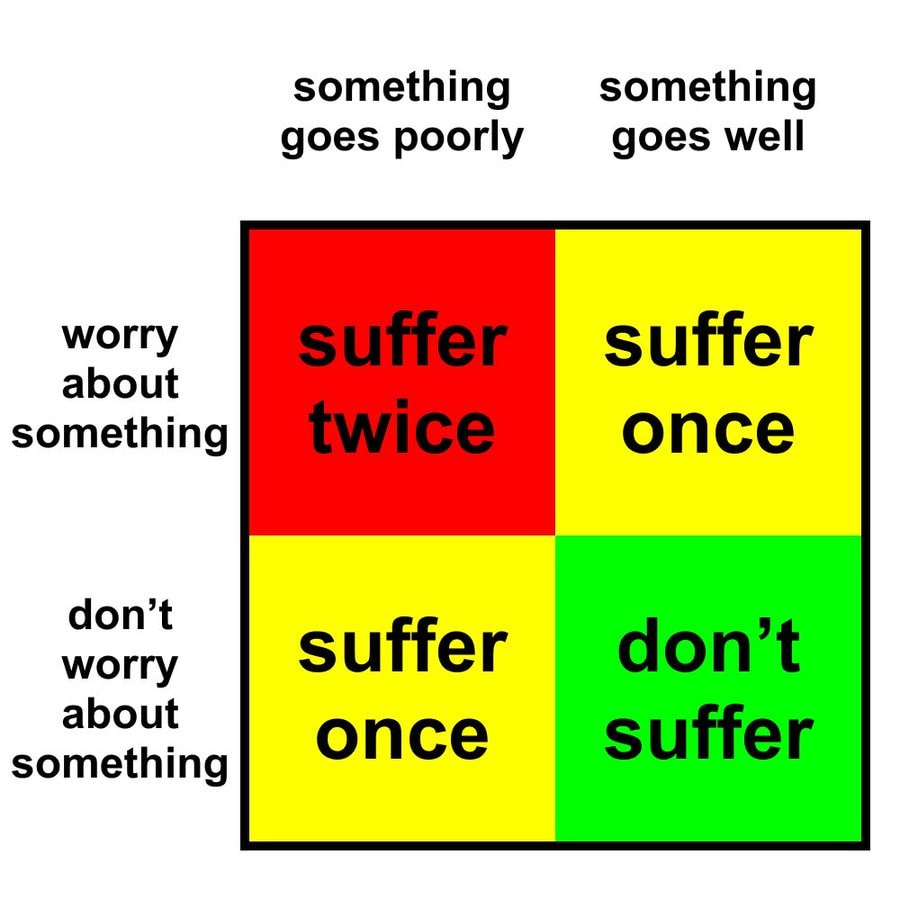
Think like this:
s. ceren (FEMMEPATH): This concept changed my brain chemistry entirely. Every time I’m anxious I just keep repeating “don’t suffer twice” cuz literally why the fuck would I do that
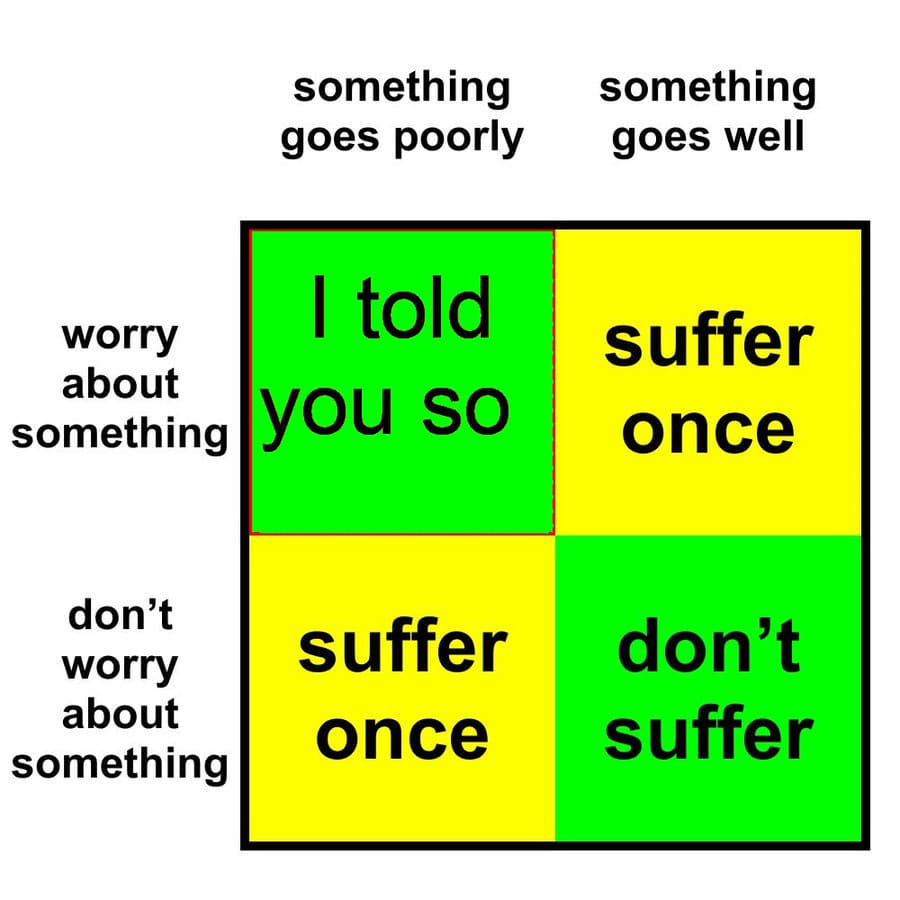
Definitely do not think like this from Tinzann:
This is also importantly wrong in many cases:
Robin Hanson: The usual argument is that if you suffer more via worry, you lower the chances of suffering in other ways.
Worry can be useful in general, because it causes you to do things that avoid things that cause worry, or do things that cause you to not have to worry, and offers good reinforcement learning feedback. You probably wouldn’t want to worry never. But when you notice further worry does not impact the outcome, stop worrying. Another tactic is to notice you would be inclined to worry if you were someone who worries (Buddhism style), to inform your actions, but not actually worry.
When you have a simple thing to say, best say it simply:
David Hines: Best tip I’ve found for getting back to sleep when you wake up in the middle of the night is something I saw on Japanese twitter: close your eyes and look left and right repeatedly, faking REM; your brain will go “oh yeah right we’re supposed to be asleep when we’re doing that”
Rabble With A Cause: My favorite trick is to start at my toes and flex individual groups of muscles and hold for five seconds, then release, until my entire body has been relaxed. I’ve never made it above my waist before I’m asleep.
@ben_r_hoffman: I just have a spoonful of raw honey and try to tune into phantom sounds (basically voluntary tinnitus), and eventually phantom images if they appear before I’m fully asleep.
@ben_r_hoffman: See, this is why I find so much writing on meditation, yogic states, etc even by rationalist-adjacent types so alienating; to get across this very simple point they’d write ten thousand words introducing a hundred unusual terms and seven distinct claims of metaphysical privilege.
There at other times is value in understanding why it works on a deeper level, but mostly nah, it’s fine.
With notably rare exceptions, the chance of any kid going pro in sports should be treated as approximately zero, no matter how talented. Even going for a college scholarship is a rough ask. That doesn’t mean don’t play sports, sports are great, but maybe don’t take them too seriously as a life planCaptain B Zar: This is written by a parent of a child that bats last on his house league team..
Jacob Turner: A PARENT’S JOURNEY THROUGH YOUTH SPORTS:
Age 5: “He’s got a cannon.”
Age 6: “He’s the fastest kid out there. Coach said so.”
Age 7: “Rec ball isn’t challenging him anymore.”
Age 8: “We tried out for select. Obviously made it.”
Age 9: “$2,800 for the season. Plus uniforms. Plus tournaments. Plus hotels.”
Age 10: “Cooperstown is basically a family vacation, right?”
Age 11: “He needs a hitting guy. And a pitching guy. And probably a mental performance coach.”
Age 12: “I’m not a crazy sports parent. The OTHER parents are crazy.”
Age 13: “We changed schools. For academics. (And also baseball.)”
Age 14: “Showcases are a requirement at this age.”
Age 15: “Ya his ranking just ticked up. We’re cooking.”
Age 16: “He just needs to get seen by the right school.”
Age 17: “The D1 schools want him to walk on. He’ll earn a spot by sophomore year.”
Age 18: “Okay, D2 is actually really competitive.”
Age 19: “He’s redshirting. Strategic.”
Age 20: “He’s focusing on school now.”
Age 21: “You know what? He’s so much happier.”
Roughly 7% of high schoolers play in college. About 1.5% of those get drafted.
Less than half of draftees even play one day in the big leagues.
The odds of our kids going pro are somewhere between “struck by lightning” and “find a $100 in old shorts.” I love youth sports (all my kids play a bunch of them) just keep a good perspective my friends.
Captain B Zar: This is written by a parent of a child that bats last on his house league team.
Jacob Turner: This is written by a parent who was a top 10 pick, played pro baseball for 11 years and has four pretty dang athletic kids.
Basic hotel requirements, reminder that there is a purely correct take:
Joe Weisenthal: I don’t have expensive tastes or any particular desire for luxury. But I’ve done a lot of travel this year, and I’ve concluded there are three things I want a hotel room to have:
– Blackout curtains
– Power outlets next to the bed
– One button to turn off all the lights.
I would add a reasonably comfy bed and a TV that lets you use your streaming services, and not having any horrible problems (everything works, nothing is dirty, no major outside sounds, etc), and ideally a useable desk workspace and decent chairs.
But in practice, 80% of hotel room value is whether your curtains work. That’s it.
If you are thinking you’ll suddenly pursue your unconventional dreams once you make more money, and don’t have a specific threshold or plan, you are probably wrong.
Ben Landau-Taylor: Approximately nobody will finally pursue their unconventional dreams once they finally amass enough wealth and prestige. The barrier isn’t resources, the barrier is that it’s unconventional. 98% of the weirdos I know were pursuing their weird dreams as broke 24-year-olds.
Richard Ngo: AGI company employees should explicitly ask “how much wealth and prestige would I need to be comfortable leaving to do something unconventional?”
Because the actual answer is usually either “a level I already have” or “always more than I have”, which should prompt reflection.
Richard Ngo: I felt much more spacious after I had $2M in my bank account, even though my nominal wealth had been higher than that for a while. At that point it became much harder to find excuses for trading off against independence.
This is ignoring the question of whether working for that AGI company or other conventional job is increasing existential risk or otherwise actively a bad thing, or whether there is some moral imperative in the thing you want to do instead. It could just be a thing you want to do.
Tyler Cowen is a fan of 80,000 Hours: The Book, calling it ‘the one book that really matters.’ I have not had the hours (ha!) to read the book, but I do worry the thinking is growing rapidly obsolete.
Awareness, by default, makes a lot of mental health problems worse via identification.
We have known this for a while. This is especially true on the margin.
If you have the extreme version of the thing that most benefits from identification and intervention, chances are you knew about it. If you have the version that is mild where getting in your head likely only makes it worse and you want to avoid identifying with it, you might not want that new awareness.
I am very grateful that I did not get encouraged to put various labels on my behaviors when I was younger. I believe it would have made my situation vastly worse.
Michael Inzlicht: Imagine a 19-year-old scrolling TikTok. She watches a creator list five “signs you have undiagnosed anxiety.” She recognizes three in herself. By the end of the week, she’s describing herself as anxious to her friends. A month later, she’s avoiding situations she used to handle fine.
What went wrong?
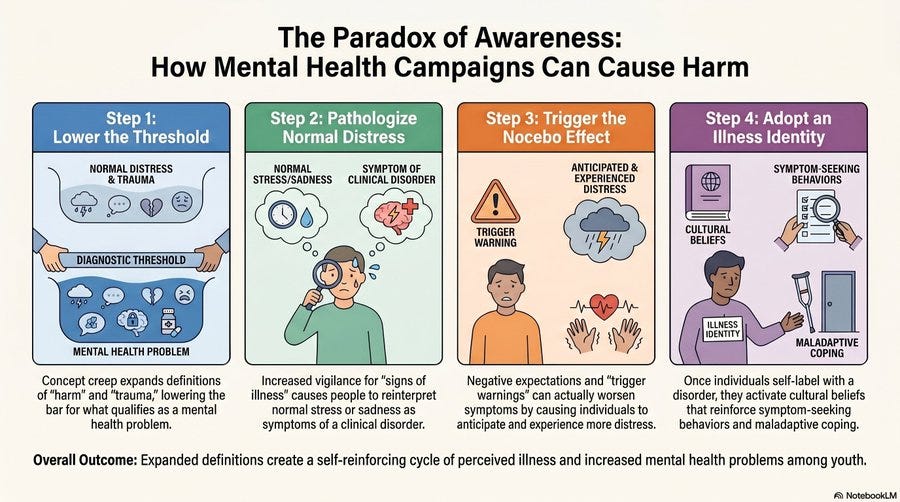
In a new paper by my PhD student Dasha Sandra, titled “Why mental health awareness can harm: Converging explanations for a societal problem”, we argue that well-meaning mental health awareness can backfire, and we identify how. Four separate literatures (concept creep, nocebo effects, prevalence inflation, and illness self-labeling) have been circling the same problem from different angles. We show they converge on three mechanisms:
1.Awareness lowers the threshold for what counts as a disorder.
2. It trains people to scan their inner lives for symptoms and reinterpret normal distress as pathology.
3. Once someone adopts an illness identity, they behave in ways that confirm and deepen it.
The evidence is wide. Learning that loneliness is harmful makes solitude feel worse. Learning that stress is harmful worsens well-being and performance. Awareness videos about fake conditions like “wind turbine syndrome” produce real headaches. Trigger warnings raise anticipatory anxiety without reducing distress.
This does not mean awareness should stop. It means awareness can have unintended consequences, including manufacturing the suffering it tries to prevent. Inoculating people against these mechanisms works, and we already have evidence it does.
Robin Hanson: A key modern bad trend: “Awareness lowers the threshold for what counts as a disorder. It trains people to scan their inner lives for symptoms and reinterpret normal distress as pathology. Once someone adopts an illness identity, they behave in ways that confirm and deepen it.”
sarah: People are doing this with autism like nothing else
I notice I am still willing to write for them if the opportunity arises, but yeah, this was pretty terrible, much worse than what happened with Cade Metz and Scott Alexander, and it’s hard to think of them as still being the paper of record.
Liar Liar
A surprisingly useful question, if you can say it in a way that makes it clear you are not angry and are offering them an out: “Are you lying to me right now?”
Defender of the Defender(s): “are you lying to me right now?” is a surprisingly good technique for spotting manipulation. You can ask it in good faith.
Sometimes people lie because they’re scared. Asking them to double check if they want to be lying right now can trigger an exhaust valve
ben hsieh: the main reason this would work on me is that a lot of people seem to be begging to be lied to, and it would give me permission to stop doing that (pretty much only lying by omission, but even so).
boy⁷: if i know someone is lying i usually ask “are you sure?” and if they backtrack i don’t hold it against them. if they doubledown on the lie im pissssseddddd
This is counterintuitive, since the obvious answer is ‘no’ in all cases, but actually the question can do a lot of work. Here are some ways I might use it, with obvious risks involved, including that my question might effectively be a lie in its own way:
Common knowledge that I want a truthful answer. You might think it is socially appropriate to lie here, or I was asking you to lie, or that you needed to say the polite thing, or I was asking pro forma. I am clarifying that I want you to tell me the real answer. And if you backtrack now, you’re saying that this lack of common knowledge is why you didn’t tell the truth, and I’m promising to give you grace
A way to look for tells, by forcing you to double down and seeing your reaction.
A way to signal both that you suspect (or perhaps outright know) they are lying, and you would forgive (or partially forgive) them admitting to the lie now, and/or would be extra pissed if they double down on it.
This can, if presented properly, be a signal that the cost if caught lying about this, or the consequences for it not being true if relied upon, are actually very high, perhaps way, way higher than you might have thought. Are you sure?
Or simply to signal to them and others that you are for sure not calling them a liar, just don’t lie to me, also yes you are basically calling them a liar.
A way to get it on the record that they really are making the claim.
A way to get them to affirm their promise or claim, and thus make them a lot more motivated to act on it or make it true.
A way to point out that you might be lying reflectively, and you should ponder.
A way to point out that you might be wrong about your true beliefs or intentions, or ability to keep a promise or deal, and you should stop to ponder that.
A way to let people without credibility establish local credibility, by letting them risk their One Time. Up to a point, even if you’re a Well Known Liar with zero baseline credibility, so long as you haven’t been lying about whether you are lying, you can get credibility by claiming you are not lying about a particular thing. This works because once you burn this, it is gone.
Conspiracy Theory
Conspiracy theories will on average be about as well executed as other similarly sized concerted actions. That mostly rules out some theories, and does not rule out others. It also avoids the problem of assuming ‘all conspiracy theories are false’ since that gives too much power to those deciding what counts as a conspiracy theory, and will occasionally be importantly wrong.
It is Love Island USA season. I have very much been enjoying watching it in real time, but have lacked the bandwidth to write it up.
Before that started I was able to see the movie Obsession, which I don’t think is an all-time great or anything but I do think there are reasons it qualifies as a must see.
Between Love Island USA, LessOnline and everything surrounding Fable, I have not had time to watch much else, or almost any movies, or play any games, which is not sustainable in the long term for me, so I’m writing this down to remind myself of that.
I finally watched Euphoria, which might be the show that goes the hardest of all time. It can be a rather hard watch, but hot damn on so many levels. My thoughts are in many ways close to this writeup. The end of the third season and especially the last episode is, despite being very well shot and acted, quite frankly, mostly belabored anvilicious self-indulgent wish fulfillment, which keeps Euphoria out of Tier 1, but I still have it squarely in Tier 2 (Worth It), and I’m still very happy Season 3 exists.
LessOnline was, as expected a great experience, and I was sad I was unable to stay for Summer Camp and Manifest (or try out going to VibeCamp?), but duty calls. I highly recommend pretty much any event at Lighthaven, on both the serious and fun tracks.
A Matter of Taste
Scott Alexander is Contra Everyone On Taste, complete with saying that the critic thing where you evaluate on many aspects of art at once and frame it in historical context is bad because if different things have the same name they can’t all survive. In particular, he insists on a distinction between the philosophical point-scoring game and the creating-beautiful-things game. Also a lot of other strong opinions.
I definitely think we should when relevant draw distinctions between different aspects of a work of art (of whatever medium). If I had to pick four, there’s Quality of the work, there’s the novelty or philosophical or educational aspect of the work, there’s cultural relevance and place in history, there’s whether it’s actually tasty or beautiful or enjoyable. If I pick two, it’s Quality versus enjoyment.
There is also a time to pick one. It is good and right that ultimately one must offer the verdict. Where is this restaurant, from 0.0 to 10.0? Where is this movie from 0 to 5 stars? You must choose, and you must combine all of these things, and that includes deciding what you care about in each instance. You can be great in many different ways. You can, as I have, claim that the best movie of 2025 is Resurrection and the second best was The Naked Gun, followed by Thunderbolts*, Bogunia and Companion. Very obviously I am not measuring one fully unified thing there.
And we can each have distinct scales, and that is fine.
I will say, we do not have enough things of the form ‘boomer from Ohio mass producing awe-inducing statues for dentists offices.’ We need to be creating a lot more actually beautiful and pleasing and fun and good-to-be-around-or-experience things, even if they are deeply unoriginal and those with ‘taste’ find them lame. Give me more of the food that tastes good, broadly construed, although not exclusively.
The periodic ‘best episodes of TV’ thread is back. Fun as always. Way too much love for Battle of the Bastards, and too many episodes that don’t work as movies because they depend on your existing investment in the show. The episode of TV that impacted me the most was not mentioned, and also does not work at all unless you know and are invested in what has already happened. In the little-considered comedy category I know it is not the right answer but I will always have a soft spot for The One Where Everyone Finds Out.
Scott then follows this up with additional explorations of taste. He starts with rules for flags, where yes you should mostly follow the rules but I notice I don’t care. He then talks about movie plot holes, where this mostly isn’t even subjective. The subjective part is how much we should care in a given case, and when Rule of Fun should largely overrule it, but yeah if your comic says Ultra-Man can shoot 1,000 feet and then you show him shooting 1,250 feet down you’d better at least handwave it or I’m docking you at least some points, and if something is actually a load bearing plot hole or otherwise a larger violation I’m docking a lot. The rules must be consistent. If you don’t dock points for it then I’m docking for that, too.
Then Scott admits that yes, some tech company names are good, others are bad, and it matters. So that’s a start, at least.
He finishes with Nostalgebraists Hydrogen Jukeboxes, which analyzes AI writing as using a limited set of gimmicks and patterns and cliches that locally impress people, similar to how some Kenyans were taught a related bag of tricks, complete with instruction to start each piece with a saying or other cliche. For any given passage it works, but with too much exposure you quickly develop an immunity through repetition, and there is no there there.
That, Alexander asserts, is the essence of poor taste, the overuse of cheap and easy and generally overused particular choices and tricks. Good taste is avoiding this, staying fresh and unique in details.
If you haven’t been overexposed yet, there is nothing wrong with ‘poor taste.’ That first paragraph, on its own, is pretty good. The cliche wasn’t a cliche the first time.
That means that something being ‘poor taste’ in this sense is a function of your level of exposure. So the house on the left is really loud and obnoxious and unpleasant if every house is like that, and you’d eventually grow tired of it, but if such places are rare, it’s super cool.
Whereas the house on the right is subtle, it has taste, it has high perplexity.
The problem is it is also ugly.
This is not a complete theory of taste, but it is a theory of one key aspect of taste. I appreciate that. Taste is in part about ‘staying ahead of’ the overuse of tropes and cliches. If you’re targeting only children or those new to the genre or style then you largely don’t ‘need’ this type of taste, whereas if you appeal to experts you need a lot.
A theory of nostalgia, or of older creations being ‘grandfathered in,’ is that they largely get a pass for what would, now, be a lack of taste. Super Mario Bros. is original because it is the original. If you echo it, you’re not. The Taj Mahal gets to look like the Taj Mahal, whereas your version is tacky. The music you hear at age 17 is awesome.
My guess is this is something like 50%-75% of taste, depending on how expansively this includes the ability to find the new things and figure out which old things are also busted. It is pretty good at avoiding actively bad taste. It is not sufficient, on its own, to give you actively good taste, or for something to be good. There has to be an actual Quality and value to the thing, on various levels, and you need to be able to see that.
This taste can also be extended to richness, and the ability to operate on multiple levels. Bluey is good, and is good taste, because it has proper Parental Bonus and tackles real things in real ways, on top of being good at the things children notice.
That is, I think, the place I most differ with many of those who claim great taste. They say that something in great taste cannot also be less filling. It cannot be appealing to the masses who don’t know any better. I say the opposite. I say that for something to be in truly great taste, it must also be less filling. To reach for greatness, you must be good at first glance, good for the novice, good for the perplexed, and also reward rich repeated engagement and the eye of the expert. It is additive.
If you are great in the abstract and can be appreciated by those who have seen it all, but you are ‘difficult’ and require focus and active engagement, that’s not as great, and not in as good taste, and also means you were in Easy Mode. Art being ugly matters. I have the eyes of ‘good taste’, sometimes, but I want to also keep the eyes of a child.
If you do your job, then someone who doesn’t pay really close attention will miss most of the jokes, but will have a good time anyway.
Other times, sure, you’re creating Euphoria, and the children of all types need to look away. But that’s a cost, not a benefit.
Gamers Gonna Game Game Game Game Game
The Library of Leng, an archive of Magic: The Gathering articles from times past.
A lot of gamers who like the NBA got a lot of fun out of 82-0 drafting teams of all-time greats.
Civilization VII gives up its most unique feature, allows players to play as one civilization the entire game. They did not have much choice given (predictable) player reactions, but this makes me sad, when a game makes a unique bold bet, builds around it, and then tries to rip the bold bet out.
See Master of Orion 3, with a brilliant initial design document where the game was designed to be unplayable by hand, then they let and made you play it by hand, so then the game was unplayable. Better to go down with the ship and try again next time.
I still haven’t played Civilization VII, which is not something I would have predicted, but I do plan to when I next have that kind of time. Which might be never, who knows.
I get the thinking here from master game designers, that if too many people like your game then you are catering to expectations too much and you need to be bolder. The key is to use this as an opportunity to do something cool, it shows you have points you can spend.
Edutainment products, or ‘gamifying’ learning, is usually the worst of both worlds. You get very little entertainment, and very little learning. I have seen this as well. You either want a game that’s actively fun that naturally teaches you along the way, like Kelsey Piper’s examples of Opus Magnum or Crusader Kings, or a classic like Oregon Trail, or you want to do explicit learning like Khan Academy and find your motivation somewhere else.
I Was Promised Flying Self-Driving Cars
A new paper analyzes the potential of self-driving trucks. If you assume full L4/L5 adoption nationwide, with no driver, this is estimated to reduce shipping costs 35%. They then model trade flows, but not the impact of this on jobs or GDP or prices. My guess is this underestimates impact of full driverless systems because cost reductions don’t include the increased flexibility involved especially after adjustments, but also we are not going to get this full diffusion for a while.
Waymo continues to feel a legal obligation to exclude riders under 18, despite the case for underage riders being actively stronger since they often cannot themselves drive and the Waymo is safer both from accidents and people than using an Uber or a bus. Apparently this means Waymo feels obligated to profile, such as wolfie’s 27 year old girlfriend being denied service on this basis.
Congratulations to my good old New York Knicks. We finally did it, in rather absurd fashion. I wish I had been able to experience more of it in real time, but it is so tough when you don’t people to watch it with and you’re pressed for time.
Greece imposed price controls on domestic 500ml water bottles that did not adjust with time, so now you can only buy 750ml water bottles, or foreign water. It is scary to see serious proposals for price controls on food, for reasons I need not explain.
What should we do about jawboning? Adam Thierer suggests incremental reforms that might help, but that I notice wouldn’t solve the biggest jawboning issues, such as the dispute between DoW and Anthropic.
We need to end ballot propositions. Ten percent less democracy and all that. In this case, DC might vote on freezing all the rents for two years. Yeah, don’t allow that.
Ranty Man: It’s important to know that the social media ban for under 16s is not a ban for under 16s. It is a ban on *selected* social media for EVERYONE. Until you identify yourself.
Arthur B.: The blackest pill about the UK social media ban is how popular it is. 70% to 80% support among adults in the UK. Regardless of the harm it causes, it’s a sad reminder that things are bad not because of a few bad politicians but because people fundamentally hold horrible policy preferences.
Alessandro Riolo: Upon learning of Starmer’s crusade against children under 16 watching YouTube, my 10-year-old son commented: “He’s proposing it now because his own children have just turned 16.”
This surprised me, as I wasn’t even aware or remembering he had children. I looked it up and apparently he has two, born in 2008 and, crucially, 2010!
So far, I found it the most revealing comment I heard about the whole shebang.
If they had excluded YouTube this would be a similarly terrible idea, but its terribleness would be less obvious. The people know what they want, and they deserve to get it good and hard.
Coase had a fun but deeply silly hypothesis that a monopoly had little value, because in time period 1 you would sell to everyone at the monopoly price, but having saturated that market you would then lower the price, and then do it again, and do this all quickly, until price was equal to marginal cost (plus epsilon, one hopes).
Except obviously no. That is stupid. The monopolist would not do that, because the alternative path maximizes profits. And indeed, the paper, by Tabarrok and Groseclose, decisively rejects the Coase Conjecture using electronic book prices. Publishers of books don’t quickly lower the price to ~$0, due to that being an obviously stupid thing to do.
It is an even stupider thing to do than Alex describes, because once you anticipate future price drops you will postpone your purchase.
Games are a place where a soft form of this indeed happens. If you wait, prices drop, first with sales then with base prices, and you can get games at large discounts, often 90%+ discounts after a few years. If you’re not playing socially on any level and care about prices, there’s basically no good reason not to do this, and many gamers know this. It is a form of time-based price discrimination, but it is a slow deterioration, and borne of other games being imperfect but good substitutes in many cases.
Does the gaming regime maximize profits? I think no. You’d make more money if you could credibly commit to not discounting, or not doing so for a long time, but this simply is not credible. I’ll still buy games at full retail price sometimes, but I need to be very excited, and I often feel dumb soon after.
Variously Effective Altruism
If you have multiple outlier negative interactions with someone, and especially if they keep endlessly arguing with you when you give them lesser reprimands, then without a very large compensating upside yes you probably need to basically ban them from everything you can ban them from. Also, yes, it is almost never right to amplify the worst things, that would otherwise remain buried, in order to complain about them, and especially to complain that the buried thing wasn’t formally censored. Has Streisand taught you nothing.
Also one should go to great lengths to avoid outright censorship in places like LessWrong. I’ve started to delete reported pure AI slop comments that add nothing whatsoever to the discussion, because at this point you have to, but my bar for deleting things that actually say something is very high.
One thorny question is allocating credit for impact, charitably or otherwise. Can you do better than Shapley values? What are the right counterfactuals? I think largely people end up asking wrong questions, and the general correct form is ‘use good decision theory’ and trying to pick and credit the right algorithms.
Support Anti-Aging Research
I have no idea if this particular technology is actually good, but I am excited to see them raise mid-nine figures to try it out.
NewLimit: Following breakthrough results, we’re bringing longevity medicine to human trials.
We’ve raised a $435M Series C led by @foundersfund to make it happen.
Reprogramming cell age has the potential to create more healthy years for everyone. We’re closer than ever to realizing it.
Brian Armstrong: Aging is arguably the root cause of most major diseases (loss of function in our cells). Four years ago, we made a bet that aging was treatable, and NewLimit was born.
NewLimit now has a prototype drug that reverses the age of some human cells (restores function they had when they were younger), and a clinical trial scheduled for next year (with more drug candidates in the pipeline).
Grateful to Founders Fund, Thrive, Greenoaks, and the rest of the investors for this latest round. @jacobkimmel and the team are just getting started.
The Lighter Side
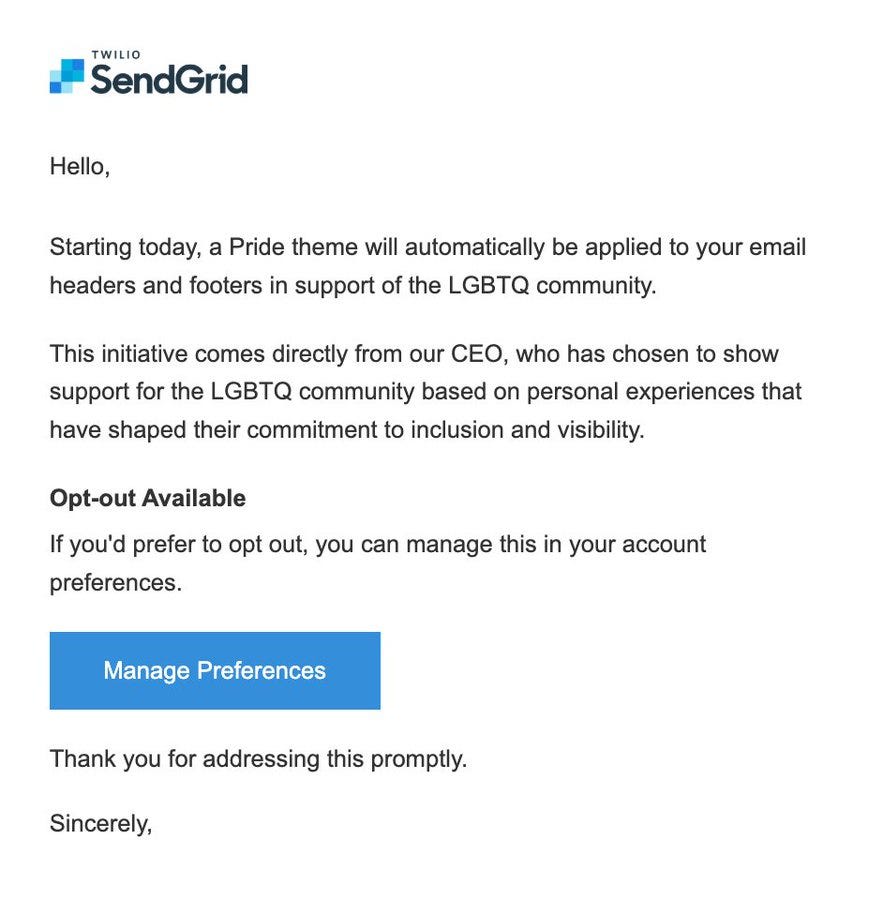
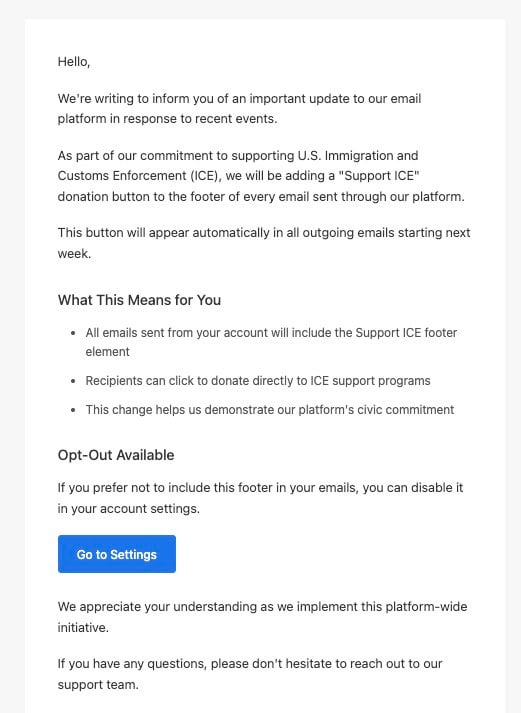
Don’t you want to show your support?
Alexander Leishman: hilarious phishing email I just got. 10/10 execution
Fleeting Yeets: I got a similar one, but ragebaiting ICE support
Think about what we could accomplish if we worked together.
OSINTtechnical: One reason the US is considering acquiring Greenland is to secure access to seafood that could potentially bring back unlimited shrimp at Red Lobster. – US official to the New Yorker


 Ashwagandha & Black Cumin Seed Oil
 Shilajit Capsules for Strength & Vita...
 Pre-Workout Supplement for Strength, ...
 Centrum Multivitamin for Energy, Immu...
 Bee Venom Capsules for Joint Support ...