‘back To Basics’: How Two Operators Are Building The Future Of Memory Care
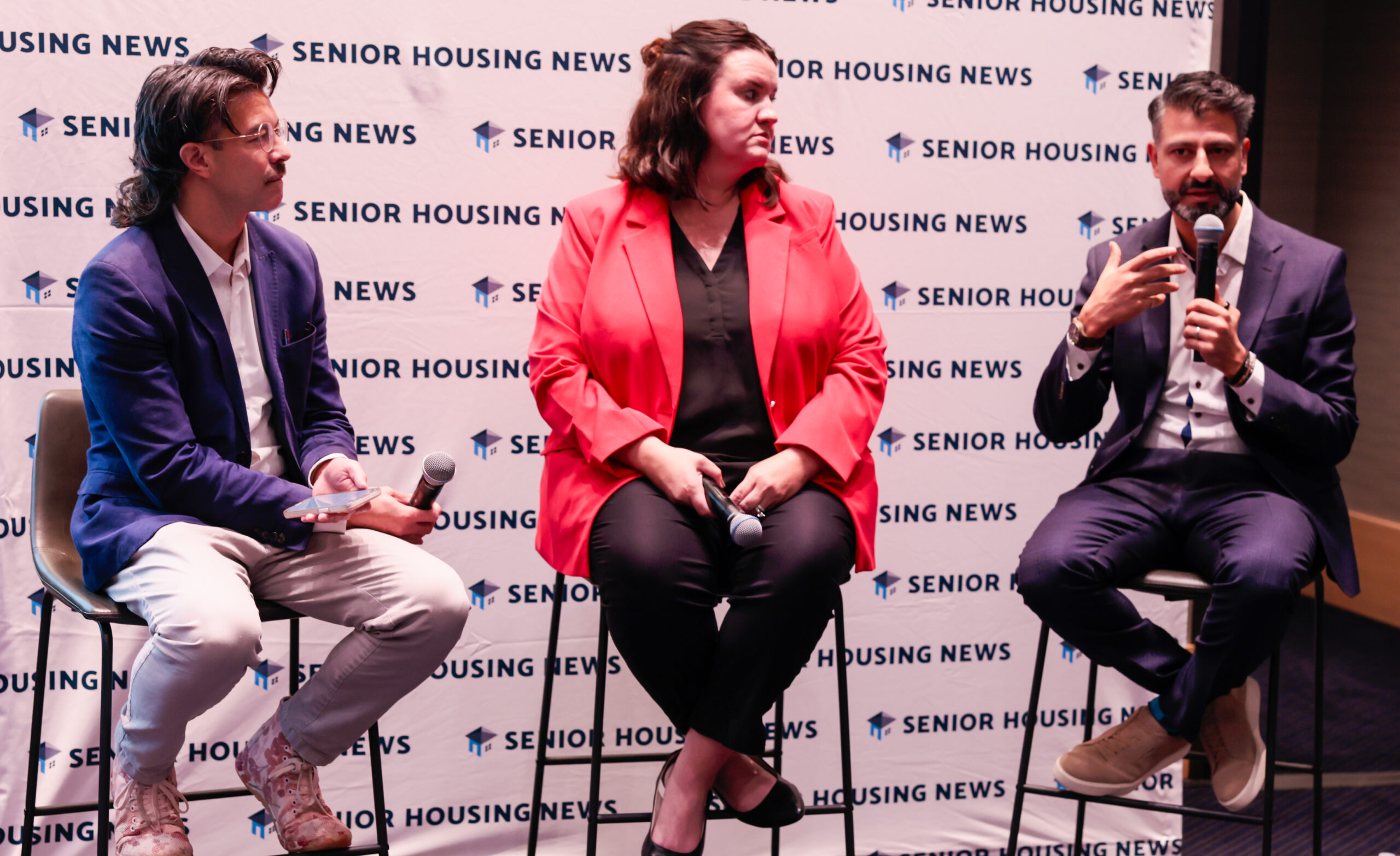
Two senior living operators are bringing about the future of memory care by building it.
Among the communities pushing the boundaries in memory care is Aster Gardens by Optima Living in Alberta, Canada. The 157-unit community has six floors, with each designed to feel like “a small, intimate neighborhood,” according to Ali Shivji, principal at Optima Living. There is also a deliberate focus on creating intuitive spaces for residents with dementia.
“Everything from visual cueing to the way we think about the use of the space was very important,” Shivji said during Senior Housing News’ BRAIN event in November.
The community’s memory care space is located on the third floor, and in order to incorporate outdoor space, included large outdoor patios with a central column of natural light coming into the space. The floor also has a circular hallway so residents don’t get lost. Rooms and shared spaces are also designed to be flexible, and every common area has two or more uses for the room.
The main idea behind the community’s design is to engage stakeholders, Shivji added.
“We have seen beautiful buildings so many times that lack life that don’t have real meaning,” Shivji said. “On the flip side, some of our oldest buildings have the highest occupancy and the highest resident satisfaction … It comes down to so much more than the physical asset.”
Operators also have to overcome the challenge of memory care, especially when they are more akin to a franchise model, such as Legato Living, whose small home communities are often in the middle of residential neighborhoods. According to CEO Erin Render, Legato aims to keep buildings to single story with smaller units for memory care residents.
“For some reason, we are still building memory cares way too big,” Render said. “We all know that as the disease progresses, the safety awareness decreases, and unfortunately, many of our residents don’t even know which one is their room. Having a nice, private suite is not as important.”
Operators also have to consider building beyond safety. While safety is foundational, Shivji said it’s not how design work is started, which focuses more on dignity and allowing residents to still live their lives, adding future designers need to make sure they aren’t defaulting to a “hospital mode.”
What is needed moving forward is a return to the basics of caring for people and improving communication, according to Render.
“So often, you know, throughout the 20 years in the industry, it’s been trying to design to our adult children who are making these decisions,” she said. “By the time someone is diagnosed with moderate dementia, they have like, a 12 inch diameter visual field, so why are we still building these grand things to impress the adult children?”
The post ‘Back to Basics’: How Two Operators are Building the Future of Memory Care appeared first on Senior Housing News.
Popular Products
-
 Adjustable Shower Chair Seat
$107.56$53.78 -
 Foldable Toilet Grab Bar
$357.99$249.78 -
 Heated Massage Recliner Lounge Chair
$641.99$383.78 -
 Ergonomic Mesh Reclining Gaming Chair
$291.99$203.78 -
 Executive Office Desk Set
$601.99$359.78