Home Insurance Now Takes A Record 9% Of Your Mortgage Payment, The Highest Ever
Quick Read
-
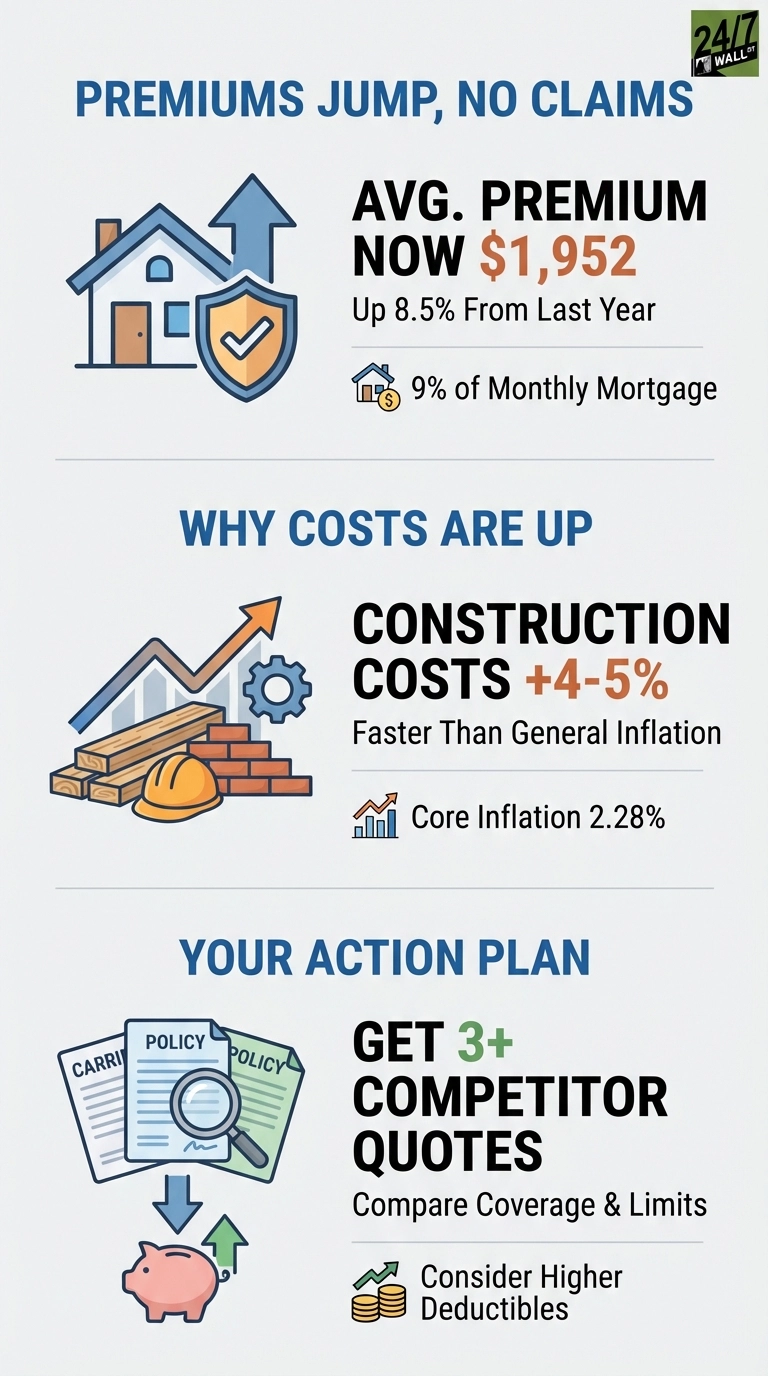
Average homeowners insurance reached $1,952 annually, up 8.5%. Insurance now represents 9% of typical monthly mortgage payments.
-
Construction costs rose 4-5% while core inflation hovers around 2.28%. This gap drives premium increases beyond general inflation.
-
Premium increases vary widely between carriers. Some raise rates 20% while competitors remain flat.
- Are you ahead, or behind on retirement? SmartAsset's free tool can match you with a financial advisor in minutes to help you answer that today. Each advisor has been carefully vetted, and must act in your best interests. Don't waste another minute; learn more here.(Sponsor)
A Reddit user’s homeowners insurance jumped from $2,155 to $3,088 in one year. That’s a 43% increase, despite no claims. This scenario plays out across America. You maintain your home, avoid claims, and still watch premiums climb. The forces driving these increases are measurable and structural.
Insurance now consumes roughly 9% of the typical monthly mortgage payment, the highest share on record. For many households, these increases strain budgets and complicate refinancing or home purchases.
National premiums tell a stark story. The average homeowner now pays $1,952 annually, a figure that has climbed steadily since the pandemic disrupted construction supply chains. That represents an 8.5% jump from just last year, adding real pressure to household budgets already stretched by inflation.
Home insurance premiums are experiencing significant increases, with the average premium now at $1,952, up 8.5% from 2025, largely due to rising construction costs. This infographic provides actionable steps homeowners can take to mitigate these rising expenses, such as getting multiple quotes and considering higher deductibles.The gap between general inflation and insurance costs reveals the problem. While core inflation hovers around 2.28%, the construction sector faces its own crisis. Labor shortages mean contractors command premium wages, and material costs remain elevated from pandemic-era disruptions. These forces combine to push rebuilding costs up 4-5% annually, more than double the broader inflation rate.
The Cost Reality Insurers Face—And Pass to You
Your premium isn’t priced on your claims alone. It’s anchored to what insurers would pay to replace your home today. Construction costs rose roughly 4-5% in 2025, driven by labor shortages and material price increases following pandemic-era supply disruptions. Core inflation sits at 2.28%—above the 2% target.
When lumber costs spike or skilled trade workers command higher wages, insurers adjust coverage limits upward to ensure they can rebuild your home. That recalculation happens annually, independent of whether you filed a claim. The Consumer Federation of America documented how widespread this problem has become, finding premium increases in nearly every corner of the country between 2021 and 2024. Meanwhile, the reinsurance market, where insurers buy their own protection, finally showed relief in early 2026 with rates dropping nearly 15%. But that wholesale savings takes time to filter down to retail premiums.
Why Shopping Around Matters More Than Ever
State regulators must approve rate increases, but the process varies widely. In prior-approval states like California, insurers submit detailed justifications. In file-and-use states, insurers implement changes faster with less oversight. This creates pricing inconsistencies: one carrier may have secured approval for a 20% increase while competitors remain flat.
When your renewal notice arrives with a steep increase, request quotes from at least three competitors. Compare coverage limits, deductibles, and replacement cost calculations line-by-line. Insurers weight risk factors differently, your carrier may penalize roof age heavily while another prioritizes distance from fire zones.
Also scrutinize your replacement cost estimate. If your insurer increased your dwelling coverage by 15% but local construction costs rose only 5%, you may be overinsured. Ask for a detailed breakdown and compare it against local contractor estimates.
What to Do Right Now
First, document your current coverage details and replacement cost estimate. Second, get quotes from competitors before your renewal deadline. Third, consider raising your deductible strategically. Deductibles offer one lever you control. Insurers have pushed average deductibles up 22% since last year, but accepting a higher out-of-pocket threshold in exchange for lower monthly premiums can make sense if you have emergency savings to cover potential claims.
The most expensive mistake: assuming your carrier’s increase reflects the entire market. Premiums vary by hundreds or thousands of dollars for identical coverage. Insurers often reserve better rates for new customers.
This content is for educational purposes and does not constitute personalized financial advice.
If You have $500,000 Saved, Retirement Could Be Closer Than You Think (sponsor)
Retirement can be daunting, but it doesn’t need to be. Imagine having an expert in your corner to help you with your financial goals. Someone to help you determine if you’re ahead, behind, or right on track. With SmartAsset, that’s not just a dream—it’s reality. This free tool connects you with pre-screened financial advisors who work in your best interests. It’s quick, it’s easy, so take the leap today and start planning smarter! Don’t waste another minute; get started right here and help your retirement dreams become a retirement reality. (sponsor)
The post Home Insurance Now Takes A Record 9% of Your Mortgage Payment, the Highest Ever appeared first on 24/7 Wall St..
Popular Products
-
 All-Purpose First Aid Kit for Home & ...
$144.99$100.78 -
 CPR Breathing Mask with One-Way Valve
$33.99$22.78 -
 Lightweight Waterproof Outdoor Surviv...
$111.99$77.78 -
 Smart Ring Health Tracker
$67.99$46.78 -
 Unisex Arch Support Shoe Pads
$48.99$33.78