In Blended Families, Beneficiary Forms, Trusts Determine Who Inherits
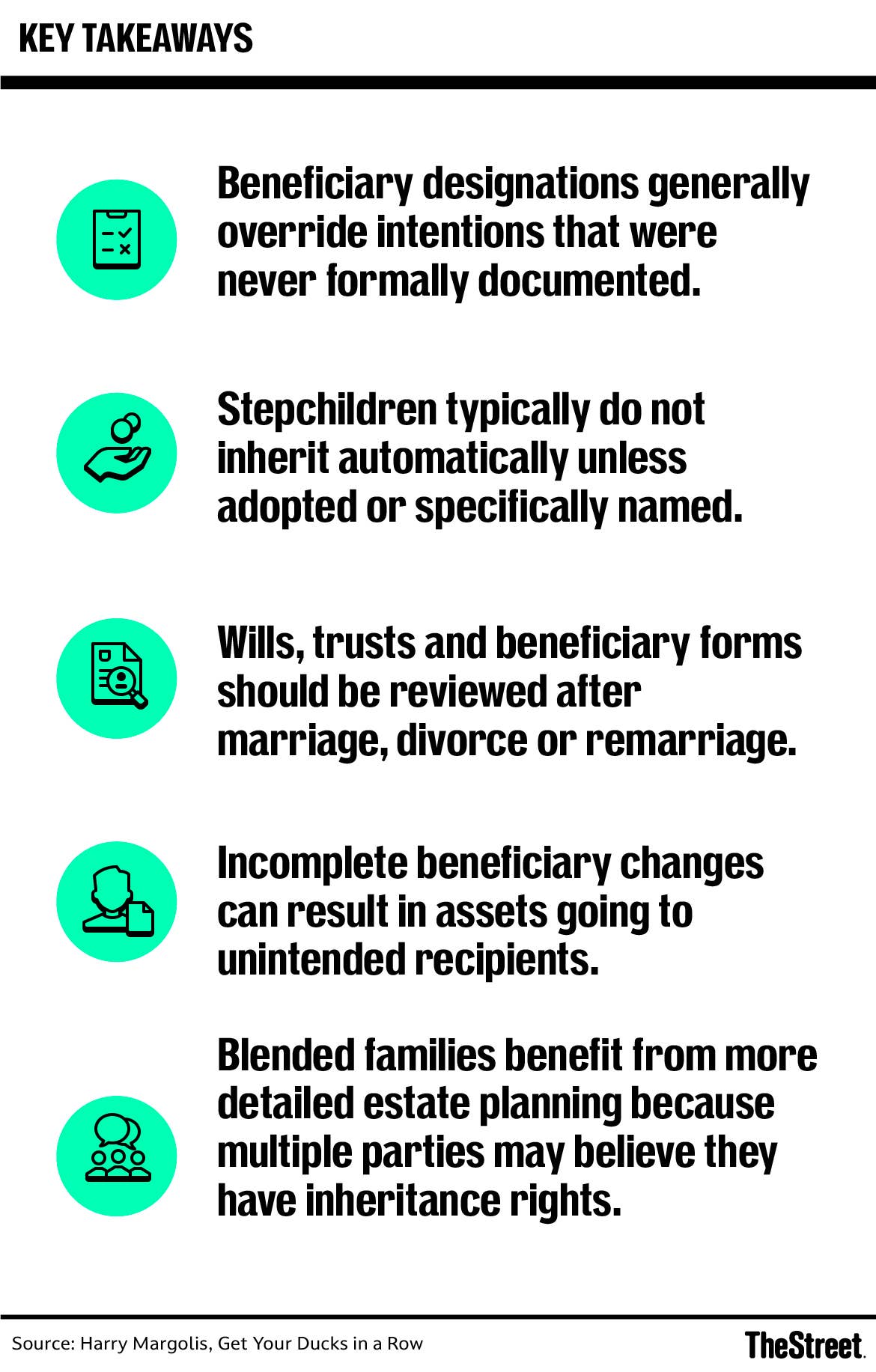
A spouse, stepchild or longtime partner may assume they will inherit assets after a loved one's death. In many cases, they are wrong, attorney Harry Margolis, author of Get Your Ducks in a Row, said in a recent interview.
The outcome, he said, often depends not on family relationships or verbal promises, but on beneficiary designations, trust documents and other legally binding records. In blended families, those documents can produce inheritance outcomes that surprise surviving family members.
The issue matters because more Americans are entering second marriages, raising stepchildren and building nontraditional family structures. When estate plans fail to keep pace with those changes, disputes frequently follow.
Below is a transcript of the interview with Margolis, edited for brevity and clarity.
Who can make a claim against an estate?
Bob Powell: What happens when stepchildren, ex-spouses, new partners and others have competing claims on the same estate in a blended-family situation? Here to talk with us about that is Harry Margolis, author of Get Your Ducks in a Row. Harry, welcome.
Harry Margolis: There are several ways someone can have a claim against an estate.
One is by being a named beneficiary in a will or trust. Another is through a biological relationship to the deceased. Children and grandchildren, for example, may have inheritance rights depending on state law.
In a blended family, people may occupy similar family roles, but if they are not blood relatives, have not been adopted or have not been named in estate planning documents, they may not have a legal claim.
Spouses also have rights under state law. Ex-spouses generally do not, unless those rights arise from a contract or legal agreement.
A third way someone may have a claim is through a contractual arrangement. That could be a written agreement, a promise or an expectation created through a specific arrangement.
The rights involved depend on whether there is a will, a trust and what state law says about intestacy, which refers to the rules governing estates when someone dies without a will.
That can make matters far more complicated than a traditional estate plan where assets pass to a spouse and then equally to children.
Beneficiary designations often override expectations
Bob Powell: What happens when someone names a beneficiary on an IRA or 401(k), but a current spouse argues that the deceased intended to change the designation from an ex-spouse or another beneficiary?
Harry Margolis: There was an interesting case in Massachusetts involving a businessman who owned a successful chain of taquerias.
He had married and had children, but after his death a dispute arose involving a life insurance policy because his sister remained the named beneficiary.
Evidence suggested he had tried to change the beneficiary designation to his wife. He had contacted a representative and communicated his wishes. However, the change was never completed.
The court ruled in favor of the sister because the insurance policy was a contract. The contract specified the steps required to change beneficiaries, and those steps had not been completed.
Even though he appeared to have intended a different result, the beneficiary designation controlled.
Trust documents generally control inheritance outcomes
Bob Powell: Is the same principle true when a trust names biological children rather than stepchildren, and the stepchildren believe they should inherit?
Harry Margolis: Generally, yes. The governing document controls.
There can be exceptions if an expectation was created or if there was a quid pro quo arrangement.
For example, if someone agreed to provide care based on a promise that they would be included in a trust and that promise was never fulfilled, there may be grounds for a claim.
But that would generally be a contractual claim rather than a claim based on family status alone.
Informal instructions may not be enough
Bob Powell: In the life insurance example, what if the deceased had written a notarized statement saying he wanted his wife to receive the proceeds if the beneficiary change was not processed in time?
Harry Margolis: Probably not.
The outcome depends on the requirements contained in the insurance contract. The policy typically specifies the process required to change beneficiaries, and courts often enforce those requirements.
Estate plans must be updated after family changes
Bob Powell: This seems like another example of why people need to keep their documents current.
Harry Margolis: That's right, especially when family relationships change.
Blended families require more intentional planning
Bob Powell: Anything else families should know about estate planning and competing claims?
Harry Margolis: Estate planning becomes even more important in blended families because the legal system is not really designed around those family structures.
You have to create your own system through careful planning and properly executed documents.
Related: How to secure your child’s financial future with a special needs trust
Popular Products
-
 Fireproof Document Bag with Zipper Cl...
$60.87$31.78 -
 Acrylic Desktop File Organizer with 5...
$100.99$69.78 -
 Child Safety Cabinet Locks - Set of 6
$83.56$41.78 -
 Travel Safe Lock Box with 4-Digit Cod...
$146.99$78.78 -
 Dual Laser Engraver
$5,068.99$3034.78