Living Trusts: What They Do And Who Needs One
A growing number of households are turning to living trusts as a way to simplify estate planning, avoid probate, and ensure assets are managed if they become incapacitated.
But while the benefits are clear, the strategy is not one-size-fits-all — and mistakes can be costly, Harry Margolis, author of "Get Your Ducks in a Row," said in a recent interview.
Below is a transcript of that interview, edited for clarity and brevity.
Understanding living trusts: What they are and how they work
Robert Powell: You might be familiar with the term “living trust,” but do you know what it is? Here to talk with us about that is Harry Margolis, author of "Get Your Ducks in a Row." Harry, welcome.
Harry Margolis: Good to see you again, Bob.
What is a living trust?
Robert Powell: I’ve heard the term and written about it, but many people probably still don’t know exactly what it is. Where should we begin?
Harry Margolis: First of all, a living trust is really a revocable trust. They’re the same thing, and that can create some confusion.
A trust is a financial entity you create where one person, or a few people, act as trustees for the benefit of others, the beneficiaries. Every trust has a grantor, the person who creates it, trustees who manage it, and beneficiaries who receive the benefits.
The trust itself is a written document that sets out how the trustee will manage property, whether that’s real estate, investments, or savings, for the beneficiaries. You sign a trust agreement to set it up, usually with an attorney, though forms are available online.
A revocable or living trust allows you to create this entity to hold assets and pass them to beneficiaries upon your death without going through probate. That makes the process much more seamless. It also allows trustees to step in and manage assets if you become incapacitated.
In most cases, the grantor is also the beneficiary during life, and other people are named as beneficiaries after death.
TheStreet
Funding the trust
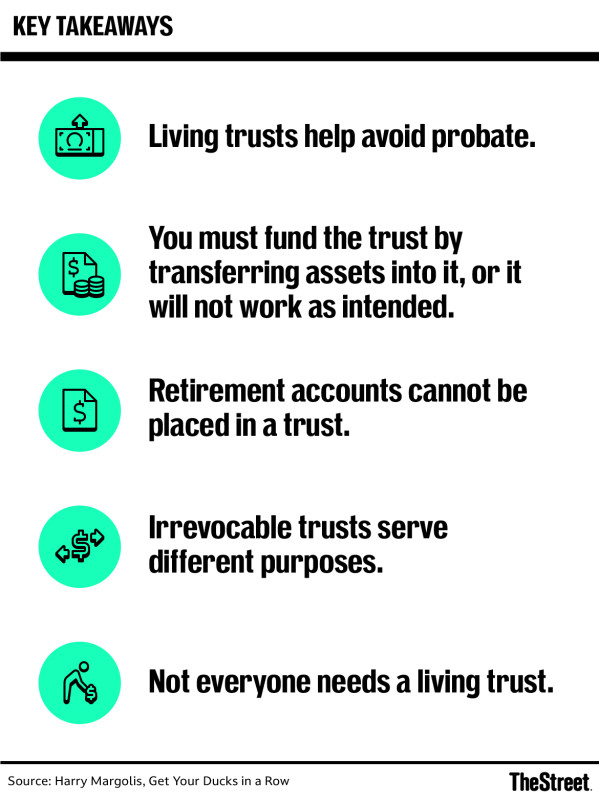
Harry Margolis: To make the trust work, you actually have to fund it. The trust is just a document, and it only governs property placed into it.
That means setting up bank or investment accounts in the name of the trust. If you want to include real estate, you must execute a deed transferring the property into the trust.
Even though the trust holds the assets, you still control them. Because it’s revocable, you can make changes, hire or remove trustees, and change beneficiaries. You also use your own Social Security number while you’re alive and competent.
What assets can and cannot go into a trust?
Robert Powell: Typically, people put their house or maybe a life insurance policy into a living trust. But retirement accounts like a 401(k) or IRA can’t go into a trust, correct?
Harry Margolis: That’s right. Retirement accounts cannot be placed into a living or revocable trust. The only way to do it would be to liquidate them and pay the taxes, which generally doesn’t make sense.
However, you can name a trust as the beneficiary of a retirement account. There may be reasons to do that. For example, you might worry that beneficiaries will withdraw and spend the money too quickly, or you may have a child with special needs who cannot manage the funds or could lose public benefits.
That said, it gets complicated. You should not do this on your own or use a generic form. You need an attorney with expertise in this area.
In general, inherited retirement accounts must be distributed within 10 years for individual beneficiaries and five years if a trust is the beneficiary. However, certain properly drafted “see-through” trusts can qualify for the 10-year rule. Some beneficiaries, such as spouses or individuals with disabilities, may stretch distributions over their lifetime.
Because of these rules, professional guidance is essential.
Living trusts vs. irrevocable trusts
Robert Powell: There’s a lot to like about living trusts. How do they compare with irrevocable trusts?
Harry Margolis: You should only use an irrevocable trust if you have a clear reason to do so, because you give up control.
With an irrevocable trust, you typically need a separate tax ID and must file a separate tax return. In some cases, transferring assets into the trust may be considered a completed gift, which has estate and gift tax implications.
More importantly, you cannot change an irrevocable trust. People usually use them for asset protection, such as shielding assets from creditors, or to qualify for public benefits like Medicaid.
Unless you have a specific reason like that, a revocable or living trust is usually the better choice.
It’s also worth noting that a revocable trust becomes irrevocable upon your death, since no one then has the authority to change it.
Who may not need a living trust?
Robert Powell: Is there any reason someone wouldn’t need a living trust?
Harry Margolis: If you have relatively simple circumstances, such as one or two children and limited assets, you may be able to avoid probate by naming beneficiaries on accounts or using joint ownership on real estate.
That said, I’ve grown more favorable toward living trusts over time.
They avoid probate, simplify administration, and allow a successor trustee to manage assets if you become incapacitated. They also encourage people to consolidate accounts, which can make managing finances easier.
For heirs, it simplifies things significantly. Instead of dealing with multiple institutions and proving authority, there’s typically one account, and the successor trustee already has authority.
Related: How to choose an executor or trustee for your estate
Popular Products
-
 Mini Fire Extinguisher Spray
$54.99$37.78 -
 Surge Protected Power Strip
$43.99$29.78 -
 Solar Powered Wireless Outdoor Securi...
$233.99$162.78 -
 Solar Outdoor Motion Sensory Flood Li...
$68.99$47.78 -
 Solar Street Lights
$25.99$17.78