Severe Storms Drive $43b In U.s. Insured Losses As 2026 Winds Down
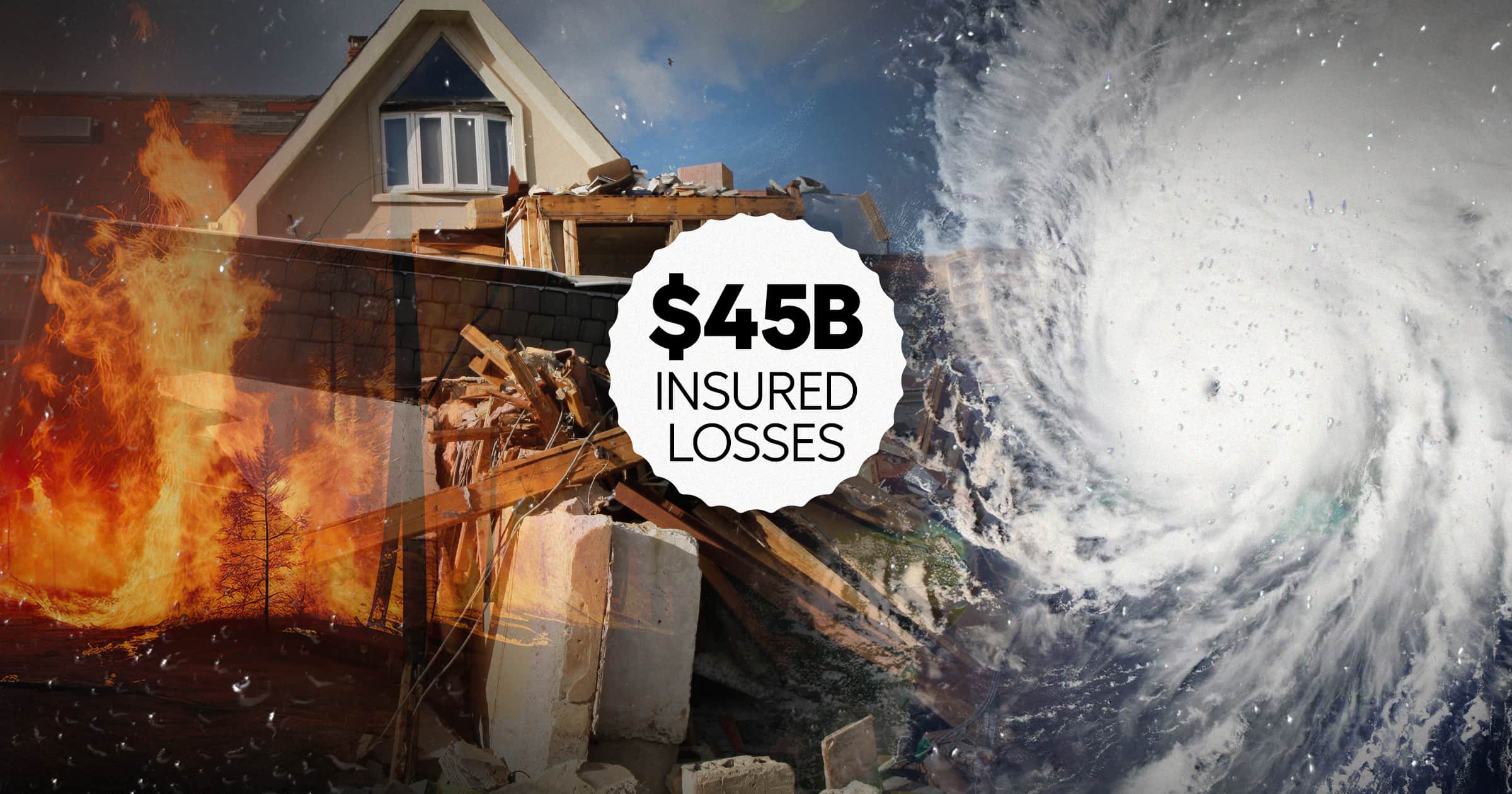
More than 50 severe storm outbreaks have resulted in substantial losses for U.S. insurers this year, with insured losses exceeding $43 billion through September, according to Aon.
At least 13 of those events generated more than $1 billion in insured losses. April was the costliest month, with nearly $12 billion in losses, according to Michal Lörinc, head of catastrophe insight at Aon’s Reinsurance Solutions.
“This year has largely been a continuation of what we’ve seen over the last half decade,” said Steve Bowen, chief science officer at Gallagher Re. “There aren’t a lot of new surprises.”
U.S. insured losses from severe convective storms have exceeded $40 billion on an inflation-adjusted basis for four consecutive years, Gallagher Re reported. Aon ranks this year's total among the five costliest for the peril, behind 2023, 2024, 2025 and 2020.
The scale of the losses is a significant change from the industry's experience less than two decades ago. In 2008, U.S. insured thunderstorm losses topped $10 billion on a nominal basis for the first time, Bowen noted. In 2023, losses exceeded $60 billion.
Aon attributed the long-term increase primarily to growing property exposure and inflation, along with the number of damaging outbreaks this year.
Where storms strike and how much property is exposed can affect the resulting damage and insurance claims.
Two major outbreaks contributed to April's losses: storms across the Midwest from April 13-15 and a prolonged outbreak affecting the central United States from April 23-29. Aon ranks the latter as the seventh-costliest severe convective storm event in U.S. history, Lörinc said.
Large hail typically accounts for most U.S. insured losses from severe convective storms, and 2026 followed that pattern, according to Lörinc. The year also included damaging tornado activity, including storms from March 10-12 and tornadoes in Illinois and Michigan.
Texas typically accounts for the largest share of U.S. severe storm losses because of its property exposure and the frequency of damaging outbreaks.
This year, however, losses were more concentrated in the Midwest, according to Lörinc and Bowen, respectively.
A separate Moody’s analysis found that hail reports in Texas during the first half of 2026 were down sharply from recent years, while Great Lakes states, including Ohio, Illinois, Wisconsin and Michigan, accounted for a larger proportion of insured losses.
The analysis used National Weather Service Storm Prediction Center local storm reports to assess weather activity. Those reports are not insurance claims and do not directly establish the financial cost of each storm.
Since 2010, Texas has accounted for about 20% to 22% of U.S. thunderstorm losses. Its share was somewhat lower this year as the Midwest experienced a greater concentration of losses, Bowen said.
Aon pointed to the importance of understanding both the location of damaging storms and the concentration of property exposed to them.
Property exposure and repair costs add to losses
Storm activity is only one factor in the amount insurers pay. Property values and repair costs also affect claims.
Aon identified growing property exposure and inflation as the primary drivers of the long-term increase in severe convective storm losses.
Bowen also cited rising construction and labor costs, supply-chain pressures and the concentration of properties in areas prone to damaging storms.
“The hazard component is certainly a big deal,” Bowen said. “Another continuing driver of overall replacement cost has been things like inflation and supply chain issues, as well as the fact that we’re seeing a higher concentration of properties in known high-risk areas for the peril.”
The relationship between climate change and severe convective storms remains less certain than for some other natural catastrophe risks. Research has focused less on a clear increase in the overall frequency of storm outbreaks and more on possible changes in individual storms, Bowen said.
He cited research showing more reports of larger hail and more intense winds in some outbreaks. But researchers have not found a clear long-term shift in the overall number of tornadoes or the strongest tornadoes.
“Hail is where we feel a bit more confident than anything else,” Bowen said, describing the evidence for changes in hail behavior as more developed than for other severe storm hazards.
Reinsurance market heads toward 2027 renewals
Repeated storm losses are putting greater focus on how insurers manage exposure across multiple events.
For insurers, understanding where exposures are concentrated and how losses can accumulate across a portfolio over the course of a year is increasingly important, Lörinc said.
Continued storm losses are likely to keep accumulation risk, retentions and frequency protection central to reinsurance discussions ahead of the January 2027 renewals.
Aon does not expect those pressures to reverse the buyer-friendly reinsurance market. Record reinsurance capital and plentiful capacity point toward continued flexibility, although insurers with weaker severe storm loss experience or concentrated exposures could face more risk-specific pricing and coverage terms.
Gallagher Re's third-quarter report also pointed to substantial reinsurance capacity ahead of the renewals. Six consecutive quarters had passed without an individual natural catastrophe generating more than $10 billion in insured losses, the firm found.
Favorable catastrophe experience has supported strong industry earnings, robust capital positions and reinsurance capacity, according to Gallagher Re.
But severe convective storms continue to generate substantial cumulative losses through repeated outbreaks, even without a single event reaching the insured-loss level of a major hurricane or other catastrophe.
The absence of a $10 billion insured-loss event could partly be attributed to luck, rather than a shortage of damaging storms, Bowen said. The reinsurance market has also benefited from strong traditional and alternative capital.
“The expectation going into January 1 is that the softening conditions in the market are likely to continue,” he said.
Property insurers therefore face continued losses from repeated severe storms while entering a reinsurance market supported by strong capital. Exposure concentration and accumulation remain important underwriting concerns, even as broader market conditions favor buyers.
© Entire contents copyright 2026 by InsuranceNewsNet.com Inc. All rights reserved. No part of this article may be reprinted without the expressed written consent from InsuranceNewsNet.com.
The post Severe storms drive $43B in U.S. insured losses as 2026 winds down appeared first on Insurance News | InsuranceNewsNet.
Popular Products
-
 Fireproof Document Bag with Zipper Cl...
$60.87$31.78 -
 Acrylic Desktop File Organizer with 5...
$100.99$69.78 -
 Child Safety Cabinet Locks - Set of 6
$83.56$41.78 -
 Travel Safe Lock Box with 4-Digit Cod...
$146.99$78.78 -
 Dual Laser Engraver
$5,068.99$3034.78