The Designs That Define America
What makes a design “American?”
That’s a question we’ve been asking ourselves as the United States nears 250 years of existence. In that time, the country has been defined through objects, ideas, and systems that, if not born in the U.S., at least reside here spiritually and culturally.
But American design is a deeply personal thing. The country has protected its individualistic streak, sometimes at staggering costs—so one person’s beliefs about what is quintessentially American could vastly differ from those of their neighbors.
It made us wonder: What do designers—the people who shape our current world—see as the designs that define America? We asked more than 30 of them, and here’s what they said.
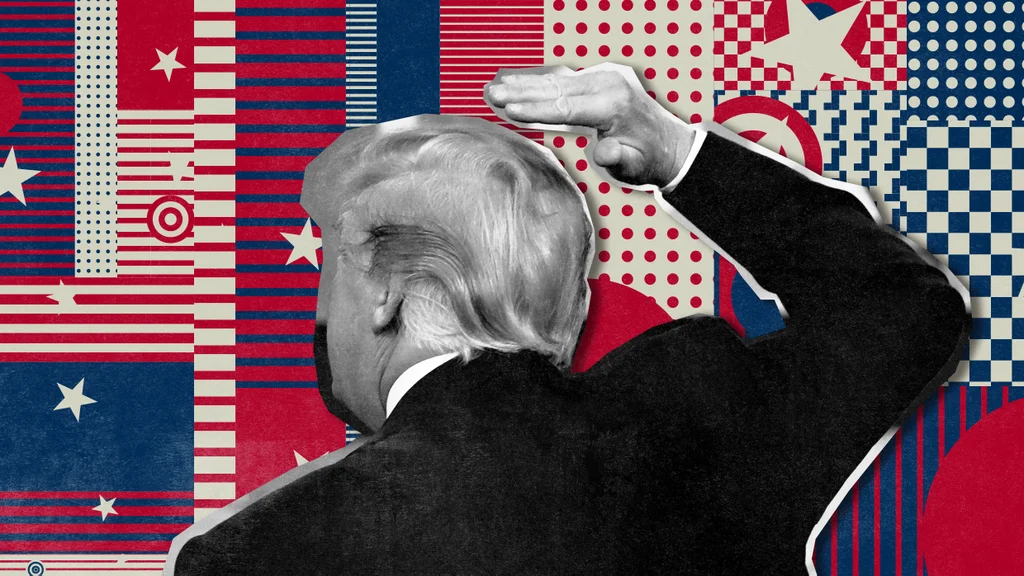
President Trump’s comb-over
I probably spend too much time drawing political cartoons, because I can think of no more defining piece of American design than the President’s elaborate, tragicomic comb-over. It’s appropriately gaudy, loud (almost audibly loud), and blunt. You can’t deny the ingenuity behind it. How is it done? What holds it up? And yet, it really isn’t fooling anyone. All it takes is a bit of reality—a stiff wind, a light rain—to reveal its artifice to the rest of the world.
—Barry Blitt, political cartoonist
Thoreau’s cabin on Walden Pond
Not exactly a design, but a choice and a site. I think it is iconic in that it represents a part of the American character that is independent, values the natural world, and relies on one’s moral intuition—all values that are ever more crucial in times like these.
—Billie Tsien, founding partner, Tod Williams Billie Tsien Architects
Charles Harrison’s plastic trash can
A design that defines America is the plastic trash can that the OG Black Supertoken, Charles “Chuck” Harrison, designed for Sears Roebuck & Co. in 1966.
Since 1681, America has prioritized white comfort over Black death and harm. Harrison’s innovative use of injection-molded polyethylene lightened the can’s weight from 20 pounds to 5 pounds and offered morning silence. It delivered on its promise of (white) middle-class ease and comfort in the curbside removal of excess consumption. And its stackable, squared-off shape and easy grip helped prevent back and shoulder injuries to, then, the nation’s overwhelmingly Black sanitation workers, whose demands for fair compensation and “I Am a Man” dignity culminated in the 1968 sanitation strikes in Memphis and in St. Petersburg, Florida.
Harrison’s plastic trash can shows us that the United States could achieve both white comfort and Black care, by design.
—Dori Tunstall, design anthropologist, founder of Dori Tunstall Inc.
Biscuit bowl
Like Bill Withers’s “Grandma’s Hands,” this evokes Southern Black family traditions linking memory, labor, tenderness, and inheritance.
—Michele Y. Washington, designer, researcher, strategist, design writer
Fiesta tableware
Homer Laughlin’s candy-colored Fiestaware is about as American as it gets, especially for collectors of—ahem—a certain age, like me. The art deco-influenced concentric rings and the mix-and-matchiness of it all were a small design rebellion against the fussy, floral dinnerware of the late 1930s. You were meant to combine colors rather than buy a matched set. Don’t tell Americans to fit a mold.
—Gail Anderson, chair, School of Visual Arts BFA Design & BFA Advertising
Fiesta tableware (again!)
Fiestaware stands out as an iconic American design. Launched in the middle of the Great Depression, it presented a range of bold, colorful, art deco-inspired tableware that could intentionally be mixed and matched—breaking away from traditional Victorian-style china—at an affordable price point. Choosing joyful colors, a break from tradition, and the name “Fiesta” offered a very American, very optimistic counterpoint to the socioeconomic situation of the time.
Plus, through ingenious industrial design, the brand was able to provide modernism to the everyday, working-class citizen. The company, which still manufactures in West Virginia, continues to offer the same bright and cheerful product lines at affordable prices.
—Sophie Lou Jacobsen, designer
Obama Center inscription
I consider Michael Bierut’s monumental typographic inscription for the Obama Presidential Center to be one of the best pieces of design of the last century. Its power as American design lies in the way it gives physical form to one of the country’s most enduring ideas: that America is an argument, an aspiration, and a promise still being made. The typographic excerpt of President Obama’s 2015 speech in Selma, Alabama, is not merely applied to the building; it becomes part of the architecture itself, turning language, history, and hope into public space. In doing so, it suggests that America is not defined by certainty, but by the ongoing act of becoming.
—Debbie Millman, designer and host of the Design Matters podcast
Louis Kahn’s Fisher House
Louis Kahn’s Fisher House is a quietly but profoundly influential piece of American architecture. While it may not be widely known outside architectural circles, its impact extends far beyond its cultural reputation, shaping the design of countless homes across the East and West Coasts, and leaving a lasting mark on American residential architecture.
—Tom Kundig, founder and principal-owner, Olson Kundig
Noguchi IN-50 coffee table
Isamu Noguchi’s IN-50 coffee table is undoubtedly an American design icon. At once table and sculpture, it’s the synthesis of global influences by way of a half-American, half-Japanese sculptor and a Midwestern furniture manufacturer open to the possibilities of new forms. A few years before the table’s production, Noguchi wrote from inside the Poston internment camp: “To be hybrid anticipates the future. This is America, the nation of all nationalities.”
—Amy Auscherman, director of archives and brand heritage, MillerKnoll
Bazooka bubble gum
Is there anything more red, white, and blue than bite-size Bazooka bubble gum? It’s an emblematic pink chunk of chewy pleasure, and comes with a neatly folded comic strip featuring Bazooka Joe.
—Steven Heller, cofounder and cochair emeritus, SVA MFA Design
The skyscraper
Chicago is the birthplace of the modern skyscraper, a world-changing innovation from the City of the Big Shoulders, an iconic American design.
The Home Insurance Building, completed in 1885, is credited as the first tall building raised on a steel frame. Chicago has been a laboratory for the form ever since. The Willis Tower, built from nine bundled tubes of varying heights, stood as the tallest building in the world from 1974 to 1998. Marina City was innovative in a different way, bringing your whole life downtown so you could live and work in one place. And now the Obama Presidential Center offers a new vision for what a presidential library can be.
The skyscraper is an optimistic design, one of innovation and idealism. It comes from the belief that there’s nothing we can’t accomplish, that we can strive for the heights, and, through hard work and determination, build the future. It’s a design that keeps us all looking up.
—Bud Rodecker, partner and design director, Span
McDonald’s logo
Now a global phenomenon, nothing says America more than seeing the “golden arches” from a mile away. McDonald’s embodies the American dream in more ways than one, for all of its good, bad, and ugly consequences. I’ll take a Filet-O-Fish, small fries, and chocolate milkshake, please.
—Jesse Reed, cofounder, Order
Enron logo
I would choose this classic mid-’90s Enron logo designed by Paul Rand. This scandal changed America, and the design carries all the baggage that went with it. The mark perfectly distills three prominent themes: power, money, and greed. I don’t mean this in a cynical way; I love all the parts of America, and aggressive accounting and off-balance sheet transactions are part of our story.
—Martin Grasser, designer
“We the People”
“We the People.” The most consequential idea anyone had ever committed to typography.
Thomas Jefferson understood what every great designer knows: that the right words, designed with intention, can reorder the world. This design did. It traveled across prairies and forests and mountains and continents and oceans as a printed thing—read, copied, passed hand-to-hand. To the student in Paris, a man in Ghana, a woman in Beijing, who encountered those three words and understood instantly that the world could change.
I think design is hope made visible. The U.S. Constitution remains the first and most hopeful design act in American history. And the most radical one in the history of the world. And a headline we must never, ever stop running.
—Brian Collins, founder, Collins
“We the People” calligraphy
“We the People . . .” It has to be the original calligraphy; a backward-leaning light Fraktur form of blackletter with swashes. Not only is the phrase at the heart of American democracy and the nation’s origin story, but it is still what we aspire to and what has inspired people in other countries. The original calligraphy is immediately recognizable, and people can easily fill in the rest of the sentence.
There is not much that I can think of that is broadly iconic, distinctly American, and not tied to a specific section of the country, period of time, or group of Americans. The only item that comes to mind is the Stars and Stripes in its basic design, as opposed to a specific iteration. But “We the People” says more than the flag does.
—Paul Shaw, designer, historian, and calligrapher
Large language models
Large language models require no manuals, no training, no expertise. Built on a breakthrough idea from a 2017 Google paper, “Attention Is All You Need” (Vaswani, et al.), LLMs make talking to a machine feel, almost seamlessly, like talking to a human. That ease has set off our next great technological revolution, sparking a global race among companies, governments, and researchers to define what comes next.
The innovation is iconically American in the fullest sense: not just in its ambition, but in its contradictions, playing out in courtrooms, classrooms, and boardrooms alike. What excites me most is accelerating scientific discovery, finding cures to our most damaging diseases, and putting the power of code in everyone’s hands. What gives me pause is the loss of creative control and the tonal flattening of writing, art, and everything we hold inherently human. LLMs show us that the most consequential design decisions aren’t about what we build, but what we decide it’s for.
—Anijo Mathew, dean, IIT Institute of Design
National parks
There is no more iconic piece of public design in America than our National Park System. While it may not seem like something designed at first glance, the development and maintenance of America’s 63 national parks has involved very real and intentional design decisions by National Park Service staffers across decades. Each is tailored to the unique topography, microclimate, local culture, and regional specificity of the states across America that they’re in.
I keep thinking about Ken Burns’s documentary series The National Parks: America’s Best Idea and the lessons it holds for designers about our role in upholding democracy: that we have a responsibility to develop and preserve beautiful, natural, and freely accessible spaces that belong to everybody, for the public good today and for future generations. Our national parks offer a shared collective experience.
As these institutions that we love and often take for granted become increasingly under threat by federal funding cuts and efforts to extract these lands for private gain, we as designers have a responsibility to advocate for them.
—Chris Merritt, principal, Merritt Chase
Michael Schwab’s national parks posters
The ability to distill the natural beauty of the places that define the diversity of the U.S. into iconic, timeless designs not only bolstered the tourism to and protection of the parks, but became synonymous with how we envision both their collective and individual beauty that is unmistakably American.
—Ben Sherwood, creative partner, Design Bridge and Partners
Coca-Cola logo
The classic Coca-Cola wordmark has endured since the 1880s. It would seem to go against everything we strive for in our identity design practice. It is ornate and stylized, with a dozen little details—yet it’s undeniably legible and instantly recognizable. The Coca-Cola wordmark means America everywhere in the world.
—Sagi Haviv, partner, Chermayeff & Geismar & Haviv
Coca-Cola (again!)
American design isn’t about fancy, highbrow minimalism. It’s about making something look incredibly cool, making it feel great in your hand, and printing a billion copies of it. And nobody does that better than Coke. It is the absolute peak of American design because it’s beautiful, it’s loud, and it doesn’t give a damn about being subtle.
Think about the bottle. In 1915, Coke basically told designers: “Make a bottle so distinct that if you grab it in a pitch-black room, or if you drop it on the ground and it shatters, you still know exactly what it is.” That is peak American design logic. It’s gorgeous, but it’s practical. Coke’s design is built for speed and eyeballs. That aggressive, fire-engine red and the swooping white wave are meant to scream at you from a crowded store shelf, a sketchy vending machine, or a massive billboard on the highway.
The most American thing about Coke’s design is that it simply refuses to change. Every other company panics every five years and flattens their logo into some boring, generic font because a tech trend told them to. Coke is still using cursive handwriting from the 1880s and a bottle shape from World War I. It’s a design that is so stubborn, and so bulletproof, that the rest of the world just had to accept it as a permanent part of American culture.
—Satoru Wakeshima, partner, CBX
Levi’s denim
Levi’s denim is the embodiment of American design because it’s built on values that never go out of style: craft, resilience, honest materials, and the dignity of hard work. It wasn’t designed to be precious. It was designed to last and show age, with every fade and crease becoming part of its story.
There’s also a deep layer of nostalgia for me, too: I remember seeing the cover of Bruce Springsteen’s Born in the U.S.A. as a first-generation kid of immigrant parents. At the time, I read those worn Levi’s and the American flag as symbols of pure patriotism. As an adult, I came to understand the tension behind it—pride, struggle, contradiction, and resilience that all coexist in the American experience. That’s what makes Levi’s unmistakably American—not perfection, but who we are at our best: hardworking, imperfect, optimistic.
—Matt Sia, executive creative director, Pearlfisher
Airstream
For me, a design symbol of America and its vastness is the Airstream. The 1936 Airstream Clipper is the first all-aluminum riveted trailer that took inspiration from airplane construction. The form and material symbolize an optimistic, futuristic, and generous America. It’s a vehicle built for exploring America’s varied landscape and national parks, as well as a way of communing with its diverse people. I own a 1972 Airstream International, which I painstakingly renovated for family trips.
—Yves Béhar, founder, Fuseproject
Eames fiberglass Shell chairs
Ray and Charles Eames designed the fiberglass shell chair for a Museum of Modern Art competition in 1948, which was focused on low-cost furniture design. The chair was meant to bring good design to the masses: beauty, form, and function at an approachable price. It had versatility and modularity, with armed versions, stacking versions, and a handful of colors. It solved a real problem through design, considering everything from manufacturing and cost to form, function, and use.
—Anthony Cappetta, partner and creative director, Super Okay
Cowboy hat
It may be a myth, but the cowboy is seen as the independent, solo man on a horse, representing individualism, freedom, and self-reliance—a new beginning untethered by societal restraints.
—Tom Geismar, founding partner, Chermayeff & Geismar & Haviv
Revolution
American design quintessentially distills many complex thoughts down to one representational image that somehow speaks for a nation of many ideologies. Choosing just one piece of design is incredibly difficult. Recently I had the honor of working on an exhibition at Beinecke Library at Yale University titled Unfurling the Flag: Reflections on American Patriotism.
To me, American design is revolution design. Each generation of Americans has been a participant in a movement. Revolution is the American birthright. We constantly seek to reform our ways of being. I love the cover drawing for The New Yorker by Saul Steinberg on January 5, 1976. Channeling the innocence of youth individually and as a country, the simplicity of the illustration wistfully speaks to our polarity, our politic, and for our to-be-written future.
—David Jon Walker, professor of art in graphic design, Yale School of Art
Empire State Building
The Empire State Building is a symbol of New York, of course, but New York has always been a symbol of progress, ambition, and fortune—and (as someone who has traveled extensively) those qualities still feel distinctly American to me (for better or worse).
Historically, it was completed during the Great Depression, and remained mostly empty for years. Images show it towering over a vast emptiness that had nothing else like it. It rose above it and still came out on top.
As a female founder who grew up lower-middle-class and started working at 10 years old, that’s the American dream to me: starting from practically nothing and—despite all odds, and due to the spirit of possibility rooted in this country—building something beautiful, that innovates, and that makes an impact.
—Talia Cotton, founder, Cotton Design
Empire State Building (again!)
The Empire State Building is American ambition made physical. It represents optimism, ingenuity, and the belief that every generation can build something taller than the last. Nearly a century later, it still feels timeless. Artists ranging from Andy Warhol to Jay-Z to Galaxie 500 have been inspired by it. I still get a thrill every single time I see it, whether from a plane, the street, or my apartment window.
—Tom Murphy, chief creative officer, VML
Falcon 9
My choice would be SpaceX’s Falcon 9. It’s one of the rare objects whose design fundamentally changed the economics of an entire industry, not by looking different but by making reusability practical at scale. To me, that’s the highest expression of design—when engineering, aesthetics, and systems thinking come together to permanently expand what’s possible.
—Jesse Lee, CEO and founder, Basic.Space, and chairman, Design Miami
1964 Ford Mustang
The ’64 Mustang is a great car that really proved itself—it’s long-lasting, fun, and athletic. The car is also easy to work on by an owner, for those Americans with a “do it yourself” mentality. The design is still super cool and inspiring to the current industry.
—Hugh Trumbull, partner, Kohn Pedersen Fox
Theme Building
The Theme Building at Los Angeles International Airport (LAX) embodies American design and serves as a global gateway to one of our nation’s most iconic cities. This building is a testament to possibilities, people, and innovation—trademarks of American progress. A true American icon, the Theme Building symbolizes boundless optimism and breakthrough thinking. Opened in 1961, the building still has so much potential to shine in America’s future.
—Barbara Bouza, FAIA, NOMA, IIDA, executive director, Live, Work, Play, CannonDesign
American Jeep
One design that represents a cooperative vision of America is the U.S. Army Jeep from World War II. It originated from the response and vision of three different companies—Bantam, Willys, and Ford—responding to a 1940 U.S. Army brief for a new and more agile vehicle. In many ways, it was intended to supplant the agile but logistically complex army horses. But the Jeep that was manufactured in 1945 was noticeably different and improved from the first ones, and that is because it was also designed by every GI who complained about a flaw or suggested an improvement.
In some sense, it was also an example of anonymous design, something that appealed to many artists and designers, including Eames Office founders Charles and Ray Eames. This is because war, through its horror, focuses us and gives those of us on the same side a shared desire to make the most effective choices with as little ego as possible.
Today, a mantra is: Move fast and break things (generally other people’s things as it turns out). Our challenge in the 250th anniversary year of our country is to be able to work together and design together, with quality, ethics, and effectiveness among our constraints—without the connective tissues of violence or greed.
—Eames Demetrios, director, Eames Office, and chairman of the board, Charles & Ray Eames Foundation
Transit hubs
Transit hubs are the cathedrals of our day. They are built to accommodate the populace with awe-inspiring, dynamic spaces filled with daylight at vast scales. Seminal examples include Grand Central Terminal in New York, and Dulles International Terminal near Washington, D.C.
The trend continues with a recent example built in our own backyard, with the new arrivals terminal at the Portland International Airport. With each of these examples, iconic form and dynamic space provide a sense of wonder and calm. It’s necessary medicine for those moments navigating the manic to-and-fro of contemporary travel.
—Brent Linden, principal, Allied Works
Popular Products
-
 Large Wall Calendar Planner
$55.76$27.78 -
 Magnifying Glass Light 3X Ultra-Thin ...
$23.99$15.78 -
 Anti-Glare Blue Light Laptop Privacy ...
$51.99$35.78 -
 Ultra-Thin Webcam Privacy Cover Slide...
$37.99$25.78 -
 USB Rechargeable LED Pen Light with P...
$41.99$28.78