Uninsured Drivers: The Floor Is Moving; The Gap Isn’t
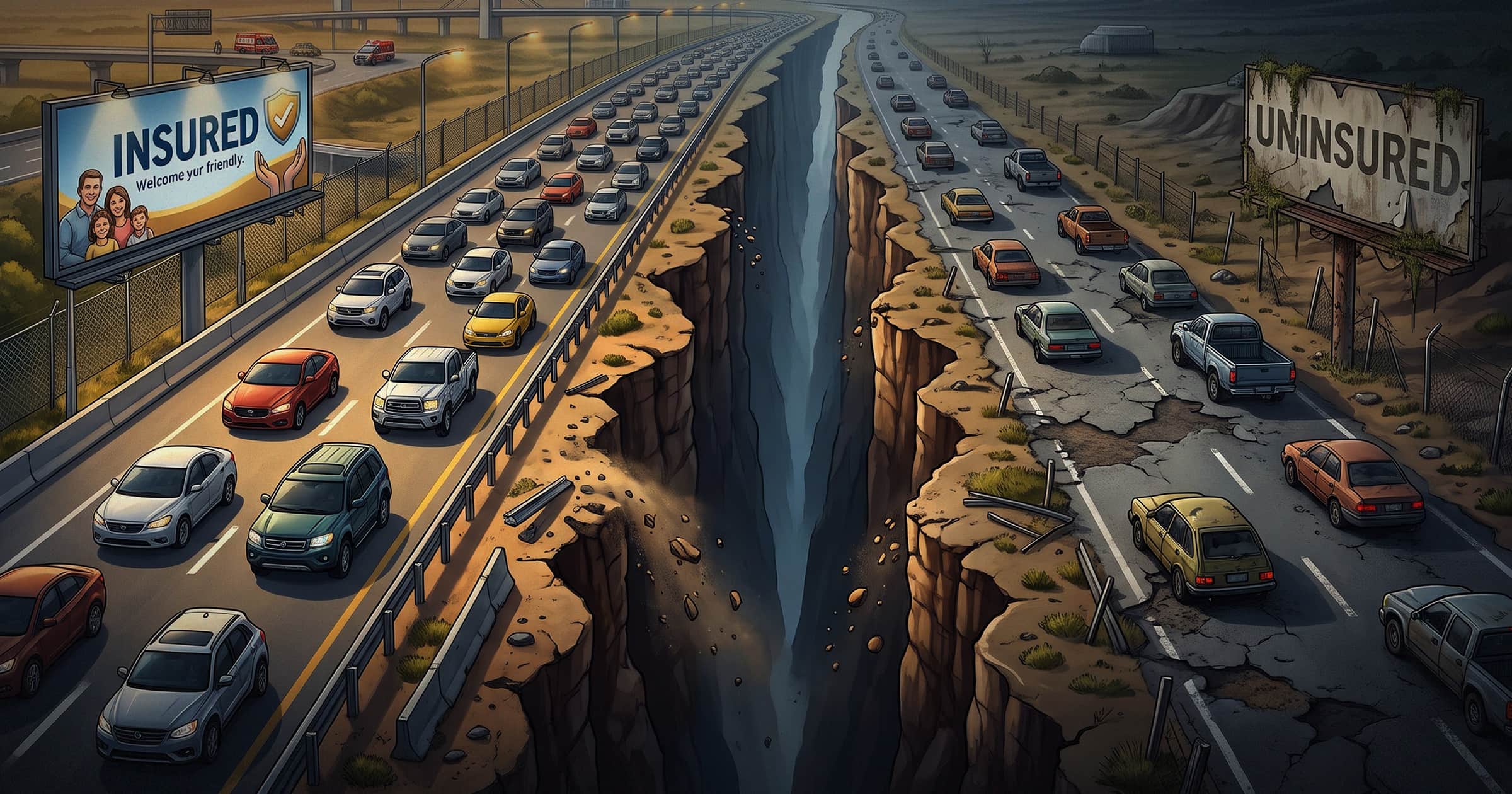
Seven states have raised their minimum auto liability limits since January 2025. That is more movement than the previous decade produced. Yet roughly 1 in 7 U.S. drivers carries no insurance at all, and one in three is either uninsured or underinsured, according to the Insurance Research Council.
For agents, the two numbers belong in the same conversation. A client’s real exposure isn’t set by what they must carry. It is set by what the other driver carries, and in many states that is very little or nothing.
The new floors
Here are the increases that took effect in 2025 and 2026:
| State | Old minimum | New minimum | Effective |
| California | 15/30/5 | 30/60/15 | Jan. 1, 2025 |
| Utah | 25/65/15 | 30/65/25 | Jan. 1, 2025 |
| Virginia | 30/60/20 | 50/100/25 | Jan. 1, 2025 |
| Massachusetts | 20/40/5 | 25/50/30 | Policies written or renewed on/after July 1, 2025 |
| North Carolina | 30/60/25 | 50/100/50 | Policies written or renewed on/after July 1, 2025 |
| New Jersey (Standard Policy) | 25/50/25 | 35/70/25 | Policies issued or renewed on/after Jan. 1, 2026 |
| Hawaii | 20/40/10 | 40/80/20 | Policies effective on/after Jan. 1, 2026 |
California’s change was its first since 1967; Massachusetts’s was its first since 1988. North Carolina paired its increase with matching UM/UIM limits.
One practical note: some widely used national reference tables still show pre-2025 figures for several of these states. If a client or a carrier worksheet cites “15/30/5” for California, it’s out of date. Confirm limits with the state department of insurance.
The uninsured map doesn’t line up with the floor
The IRC’s 2025 study, Uninsured and Underinsured Motorists: 2017–2023, estimates that 15.4% of drivers were uninsured in 2023, up from 12.4% in 2017. State rates ranged from 5.7% in Maine to 28.2% in Mississippi.
Set those rates next to each state’s requirements and a pattern for agents emerges:
| State | Uninsured rate (2023) | Liability minimum | UM required by law? |
| Mississippi | 28.2% | 25/50/25 | No |
| New Mexico | 24.1% | 25/50/10 | No |
| Michigan | 22.3% | 20/40/10 (plus PIP) | No |
| Tennessee | 21.3% | 25/50/15 | No |
| Missouri | 20.7% | 25/50/25 | Yes |
| Florida | 20.6% | No BI liability required; $10K PD + $10K PIP | No |
| California | 20.4% | 30/60/15 | No |
| Maine | 5.7% | 50/100/25 (plus med pay) | Yes, UM and UIM |
| Utah | 6.2% | 30/65/25 (plus PIP) | No |
| Idaho | 6.4% | 25/50/15 | No |
Sources: IRC via Triple-I (uninsured rates, 2023 data); Triple-I/APCIA financial responsibility table and state insurance departments (requirements). The IRC estimates uninsured rates from the ratio of UM claims to bodily injury claims.
Two readings stand out.
First, a minimum is not a measure of protection. In Florida, where bodily injury liability isn’t compulsory for basic registration, a client hit by a driver who meets every legal requirement may still face an injury claim with no third-party BI coverage behind it. In Mississippi, more than one driver in four on the road is uninsured, and UM isn’t mandated.
Second, higher floors don’t erase the gap. California just doubled its bodily injury minimums, yet its 2023 uninsured rate (20.4%) was among the ten highest in the country. Raising the floor helps clients who are hit by insured drivers. It does nothing for drivers with no policy at all, and it can push affordability-strained drivers to lapse. Higher limits also tend to raise renewal premiums, as North Carolina’s Department of Insurance warned policyholders ahead of its July 2025 change.
Maine is the useful contrast: high limits, mandatory UM/UIM and medical payments, and the lowest uninsured rate in the country. Correlation isn’t causation, as Maine’s low urban density and other factors play a role, but it’s a clean example for a client conversation.
Underinsured is the bigger, quieter number
The IRC estimates that another 18% of drivers carry liability limits too low to cover the damage they cause, bringing the combined uninsured-or-underinsured rate to 33.4% in 2023, up 10 percentage points since 2017.
That’s the figure agents can use with clients who “just want the state minimum.” Their own minimum-limits liability protects other people. Their UM/UIM coverage is what protects them from everyone else’s minimum.
Talking points for the renewal conversation
- Lead with the other driver. “In our state, roughly X% of drivers carry nothing. Your UM coverage is the part of the policy that pays you when that happens.”
- Match UM/UIM to liability limits where the state allows, instead of defaulting to the statutory floor.
- Explain the renewal bump. In states that raised minimums, clients renewing at the old floor will see higher premiums. Showing the reason up front heads off the shopping call.
- Flag the no-fault and PIP structures in Florida, Michigan, New Jersey and others, where the client’s own PIP pays first and the tort threshold shapes what’s recoverable.
- Revisit stacking and setoff rules. North Carolina’s 2025 law changed how UIM interacts with the at-fault driver’s limits, and similar rules vary by state.
States are slowly bringing their floors closer to what injuries actually cost. But the floor only binds the drivers who buy a policy. In a market where one driver in three is uninsured or underinsured, the most important limit on a client’s policy may be the one protecting them from the other car.
© Entire contents copyright 2026 by InsuranceNewsNet.com Inc. All rights reserved. No part of this article may be reprinted without the expressed written consent from InsuranceNewsNet.com.
The post Uninsured drivers: The floor is moving; the gap isn’t appeared first on Insurance News | InsuranceNewsNet.
Popular Products
-
 Fireproof Document Bag with Zipper Cl...
$60.87$31.78 -
 Acrylic Desktop File Organizer with 5...
$100.99$69.78 -
 Child Safety Cabinet Locks - Set of 6
$83.56$41.78 -
 Travel Safe Lock Box with 4-Digit Cod...
$146.99$78.78 -
 Dual Laser Engraver
$5,068.99$3034.78