Who’s Left Holding The Risk When Insurers Drop Ai Liability Coverage?
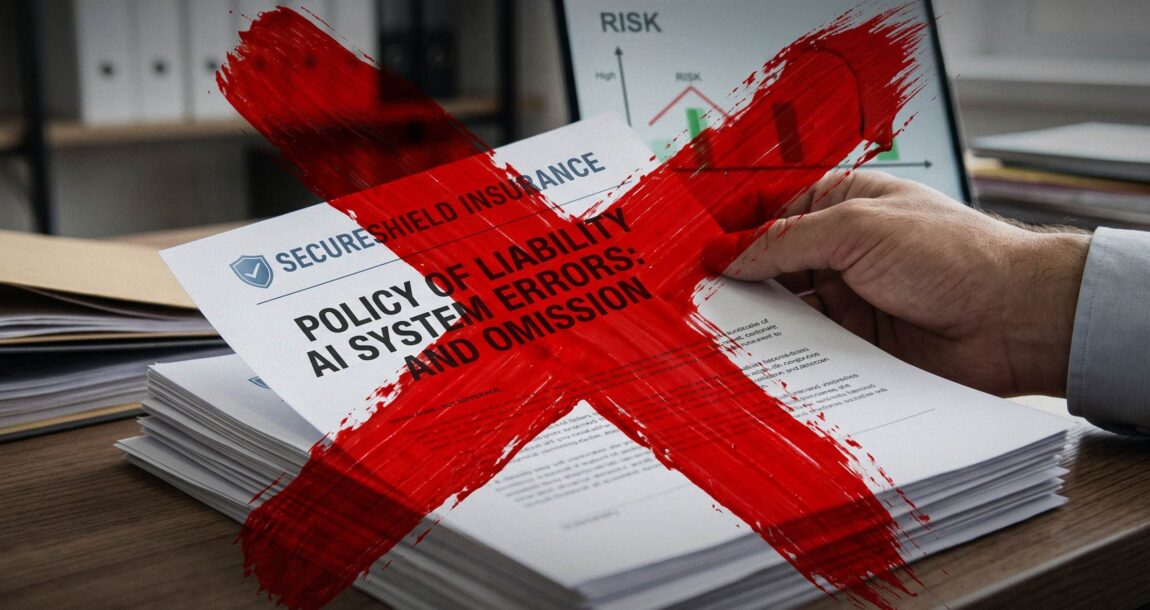
Carriers in all 50 states have won approval to carve artificial intelligence out of standard liability policies. For the businesses your clients run, and for the advisors who insure them, the coverage gap is no longer hypothetical.
Something quiet but consequential has happened in the insurance market over the past year. State regulators have approved more than 80% of carriers' requests to exclude AI from standard liability policies. Major writers, including Berkshire Hathaway, Chubb and Travelers, have received regulatory approval to strip damages caused by AI out of corporate coverage. This rarely made headlines, and there was not a single announcement or broad press release about it.
The shift arrived the way most structural changes in insurance do, one endorsement and one renewal at a time. But the cumulative effect is large. The standardized commercial general liability forms produced by the Insurance Services Office now give carriers a clean way to exclude generative AI exposures, and industry estimates put adoption of that language across a large majority of new commercial forms.
For agents, advisors and the businesses they serve, this is not an abstract policy debate. It is a balance sheet question. When an AI system produces a faulty output, an infringing piece of content or a downstream business loss, the question of who pays has quietly changed.
Why are insurers excluding AI from liability coverage?
Insurers are excluding AI because they cannot price a risk that has almost no loss history. Underwriters are not running from the technology itself. They are running from the fact that generative AI gives them no track record of claims to model.
Sound pricing depends on loss history, the frequency and severity data that piles up over the years. Generative AI has no such track record. The models change monthly, the use cases multiply weekly and the failure modes are still being discovered. Industry surveys suggest that a large share of insurers track no AI metrics at all, leaving actuaries without the raw material they need to build a price. Faced with an exposure they cannot quantify, carriers are doing the rational thing. They are excluding it until they can.
That caution is compounded by how quickly AI is being woven into everyday operations. By most estimates, the overwhelming majority of organizations now use AI in some capacity, and a growing share of business software ships with AI features switched on by default. The exposure is no longer confined to a few experimental projects. It is spread across the whole enterprise, and much of it is invisible to the people writing the policies.
What an AI exclusion actually leaves uncovered
An AI exclusion removes coverage for damages tied to an artificial intelligence system. This includes everything from faulty automated decisions to infringing AI-generated content and the downstream business losses that follow. The result is a gap most companies have not budgeted for.
The math is uncomfortable. Organizations are deploying AI almost everywhere, yet far fewer have put real governance around it. Industry surveys repeatedly find that although the vast majority of companies use AI, only a small percentage have established board oversight of it. A meaningful share of executives also believes their organization has already had a security incident tied to “shadow AI,” the tools employees adopt without approval.
So, you have near-universal adoption, thin governance, and a documented history of incidents. That is the exact profile that underwriters flee. Liability that used to sit, by default, inside a general liability or cyber policy is migrating back onto the corporate balance sheet, often without anyone formally deciding that it should. For the advisor, that gap is both a risk to flag and an opportunity to serve. Clients who assume their existing policies cover errors caused by AI are increasingly mistaken.
What advisors should tell clients now
Advisors should tell clients to read their renewal endorsements closely, map where AI touches the business, and treat the exclusions as an early signal of where loss is concentrating.
First, read the endorsements. AI exclusions are often introduced quietly at renewal, buried in form changes rather than spotlighted. Clients deserve to know, in plain language, what their policy no longer covers.
Second, map the exposure. A business with AI touching customer communications, underwriting, code generation or financial reporting carries a very different risk profile than one without it. That map should drive the coverage conversation.
Third, treat the exclusion as a signal. When sophisticated carriers move in unison to shed a category of risk, they tell the market something about where the loss is concentrating. Smart organizations read that signal and act on it before a claim forces the issue.
How can a business stay insurable for AI risk?
A business stays insurable by proving it has reduced the risk. Insurability has always rewarded demonstrable risk reduction, and AI is no exception.
The companies that fare best in this market will be those that can demonstrate to underwriters a credible, proactive security and governance posture. That means more than tools that flag problems after the fact. It means controls built to stop incidents before they happen. Attacks powered by AI increasingly move faster than any human response. Defenses that neutralize a threat before it executes change the loss math in a way that detection and response alone cannot.
That posture does two things at once. It genuinely lowers the odds of the kind of incident a policy would have covered, and it gives underwriters something concrete to price favorably as dedicated AI coverage products mature. Documented, evidenced resilience is what reopens the conversation about both coverage and premium.
The risk didn’t disappear; it moved
The retreat from AI liability is not a temporary market quirk. It is a signal about where enterprise risk is genuinely concentrating right now, and it should reset how organizations think about both security investment and insurance strategy.
The risk did not go away when the exclusion language went in. It simply changed hands. The organizations and the advisors who see that early will be the ones holding manageable exposure instead of uninsured loss when the next AI incident lands.
© Entire contents copyright 2026 by InsuranceNewsNet.com Inc. All rights reserved. No part of this article may be reprinted without the expressed written consent from InsuranceNewsNet.com.
The post Who’s left holding the risk when insurers drop AI liability coverage? appeared first on Insurance News | InsuranceNewsNet.
Popular Products
-
 Fireproof Document Bag with Zipper Cl...
$60.87$31.78 -
 Acrylic Desktop File Organizer with 5...
$100.99$69.78 -
 Child Safety Cabinet Locks - Set of 6
$83.56$41.78 -
 Travel Safe Lock Box with 4-Digit Cod...
$146.99$78.78 -
 Dual Laser Engraver
$5,068.99$3034.78