Researchers Have Documented Mugger Crocodiles And American Alligators Positioning Sticks And Twigs On Or Around Their Snouts During Birds’ Nesting Season — Apparently Using The Sought-after Nesting Material As Bait To Lure Birds Within Striking Distance.
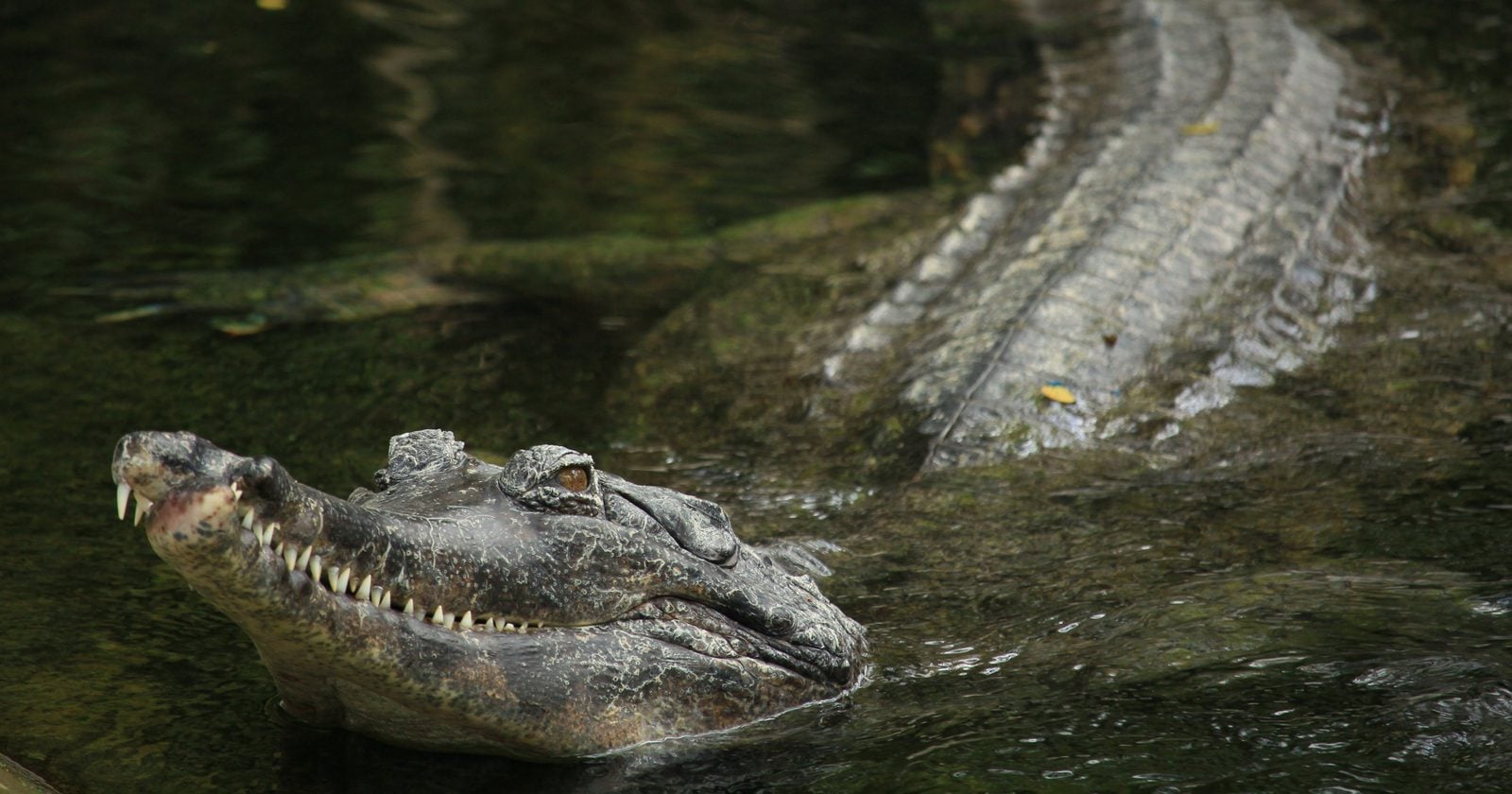
A crocodile lies still in shallow water near a colony of nesting birds, most of its body underwater, so all a passing egret sees is what looks like a floating log with a few sticks on top. The bird, hunting for twigs to build its nest, drops in to grab one. The log lunges.
That image sits at the center of one of the more surprising claims in animal behavior from the last decade or so. The observation is real, but the interpretation is not as settled as the headlines made it sound.
Today, we get into it.
We are not herpetologists or animal-cognition researchers, and what follows is our reading of a scientific dispute rather than a verdict on it. The core studies here are small, and one was later withdrawn, so treat this as a curious look at an open question, not a resolved fact.
The claim as it was first reported
The observation came from a team led by Vladimir Dinets, then a research assistant professor of psychology at the University of Tennessee, Knoxville. In a 2013 paper titled “Crocodilians use tools for hunting,” Dinets and his co-authors described mugger crocodiles in India and American alligators in Louisiana lying half-submerged with sticks balanced across their snouts. This happened near bird colonies, and mostly during the season when the birds build nests and good sticks are hard to find. Dinets first noticed it in mugger crocodiles in India in 2007.
The claim was ambitious. The paper called this the first report of tool use in any reptile, and the first known case of a predator timing its lure to a seasonal habit of its prey. Dinets did not undersell it. “This study changes the way crocodiles have historically been viewed,” he said at the time. “They are typically seen as lethargic, stupid and boring.” The “lethargic, stupid and boring” line is rhetoric more than a measured claim, but it captures why the result caught on.
Gordon Burghardt, an ethologist at the same university who had no part in the work, told Live Science that “this is indeed the first convincing evidence of tool use in any reptile.” That was his view in 2013.
Where the interpretation gets slippery
To call this tool use, you have to show the animal is doing something on purpose.
A crocodile basking near a bird colony in spring will likely collect floating debris on its snout whether it means to or not. Sticks drift. Rivers near nesting colonies are full of dropped twigs at exactly the season the paper describes.
So the real question is not whether crocodiles are seen with sticks on their heads. It is whether they are putting them there deliberately, and whether they are doing it to catch birds.
The 2013 evidence rested on two things. One was scattered sightings. The other was a year of careful watching at four Louisiana sites, two near bird colonies and two not. Stick-displaying rose sharply from March to May, the nest-building window. That timing is genuinely suggestive. What it cannot do on its own is tell deliberate baiting apart from a basking animal that simply collects more debris when there are more birds and more loose sticks around.
The actual hunting was also rarely caught in the act. As a later write-up put it, the behavior had “never been documented leading to successful predation of birds in the wild.” Rare events are hard to build a strong cause-and-effect case on, however striking they are when they do happen.
The pushback
Adam Rosenblatt and Alyssa Johnson at the University of North Florida tried to test the idea.
They ran a controlled experiment on captive American alligators at four Florida parks, two near bird colonies and two not, adding sticks during nesting season to see whether the animals would use them the way the baiting idea predicts.
Their conclusion was cautious: “Our results do not generally support the hypothesis that crocodilians tailor stick-displaying behaviors to specific environmental contexts, therefore the hypothesis that crocodilians are true tool users is also called into question.”
In one comparison, they reported, “the alligators at a no-rookery site actually displayed the behavior more frequently than a paired rookery site.”
That reads like a clean rebuttal, but it isn’t, for two reasons. First, the paper has since been withdrawn, so its conclusions cannot serve as firm refutation.
Second, the authors themselves warned that captive animals are not an ideal way to study this. Enclosures crowd alligators together at unnatural densities and feed them on a schedule, so their urge to hunt birds looks nothing like a wild animal’s.
A write-up of the experiment noted only four alligators displayed sticks for more than ten minutes, all at bird sites, but no birds ever came close and no alligator tried to catch one. Thin evidence on both sides: it doesn’t confirm baiting, and it doesn’t cleanly rule it out.
What’s actually well-supported
Strip away the contested part and something solid remains. Crocodiles and alligators do turn up near bird colonies with sticks on their snouts. It happens more during nesting season, when those sticks are worth more to the birds. Now and then a bird that comes for a stick gets eaten.
What is inferred, and still argued over, is the step in the middle: that the reptile is deliberately setting a trap, rather than just snapping at whatever wanders into range while it happens to be wearing some debris.
The two readings aren’t as far apart as they sound. Even the modest version, an ambush predator that parks itself where prey is drawn and cashes in on a seasonal windfall, is more flexible than the old caricature of a slow-witted log with teeth. Whether that clears the bar for “tool use” in the strict sense is partly a question about crocodiles and partly a question about how we define the term.
Holding the finding loosely
Dinets suggested the interest here runs deeper than crocodiles. These findings matter, he said, not only because “they show how easy it is to underestimate the intelligence of even relatively familiar animals,” but also because crocodilians are close relatives of the dinosaurs, which he suggested could hint at how those animals behaved. That last leap is worth taking as a maybe rather than a conclusion.
The fair position, as far as we can tell, is neither to file crocodilian tool use as an established fact nor to treat it as debunked. One suggestive study built on timing, plus one follow-up experiment that was withdrawn and run in a setting its own authors called unsuitable, is not enough to close the case. What the episode does show is that crocodilians keep doing things that don’t fit their reputation, and that the interesting work is still ahead.
The post Researchers have documented mugger crocodiles and American alligators positioning sticks and twigs on or around their snouts during birds’ nesting season — apparently using the sought-after nesting material as bait to lure birds within striking distance. appeared first on Space Daily.
Popular Products
-
 Dinosaur Costume Hoodie for Dogs and ...
$50.88$29.64 -
 Rechargeable Electric Dog Nail Trimme...
$87.99$60.78 -
 Double-Sided Pet Grooming Gloves Hair...
$48.99$33.78 -
 Long Pin Slicker Brush for Dogs Groom...
$60.99$41.78 -
 Pet Grooming Shedding Brush Comb
$10.99$6.78