Winners Of The British Wildlife Photography Awards 2026
Mark Parker / British Wildlife Photography Awards
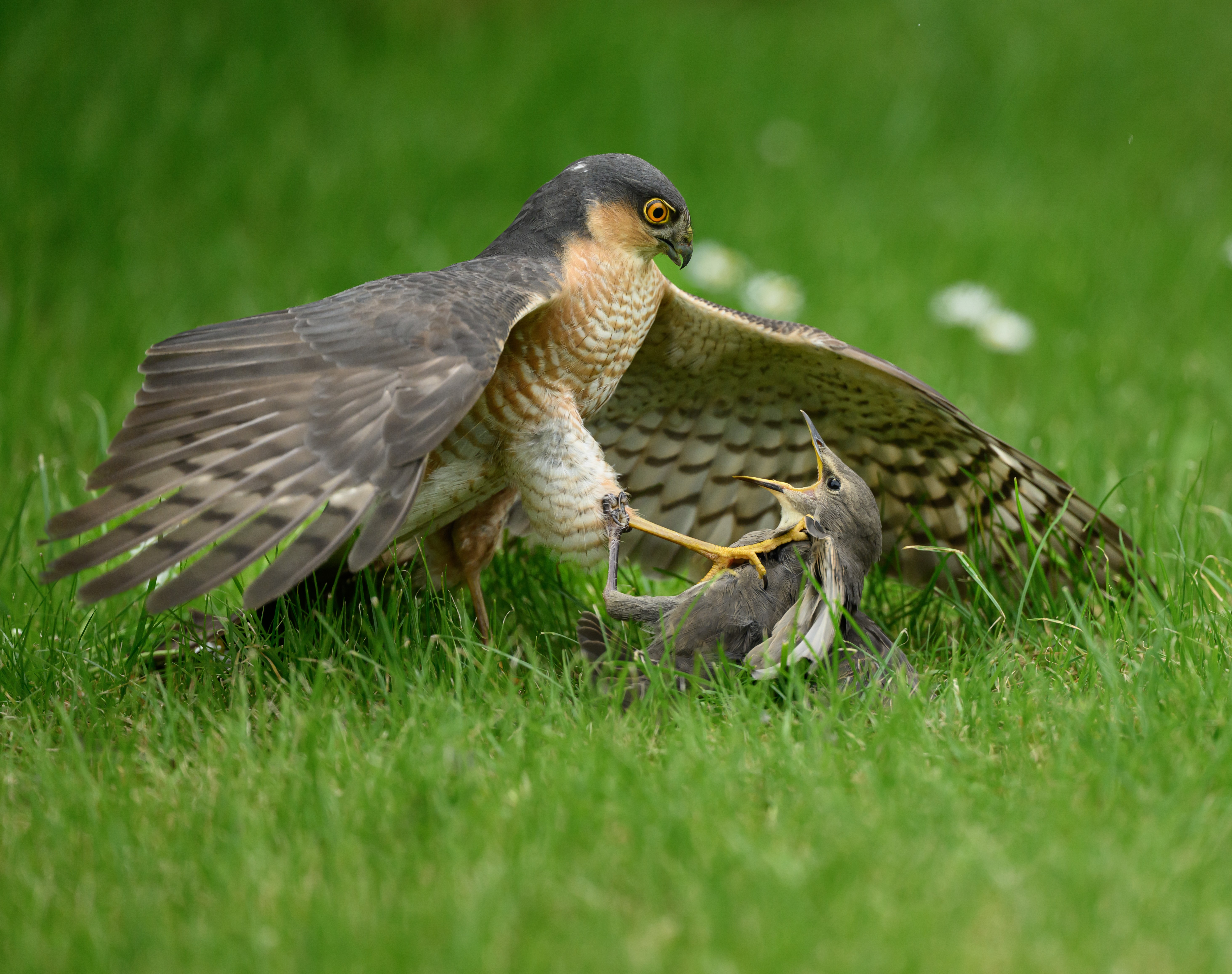
Nemesis. Winner, Animal Behavior. Parker: “Because the sparrowhawk had never gone to ground before on previous visits to the garden, and not knowing how long it would stay, I just wanted to get an image to record the event before then concentrating on my settings. The story I think the image portrays is evident in the eye contact between the two subjects and the vicelike grip they have on each other, however, the eye contact and grip of the juvenile starling is out of pure fear while that of its nemesis is one of dominance and relief in finally catching a much-needed meal.”
Kyle Moore / British Wildlife Photography Awards
Night Dweller. Runner-up, Urban Wildlife. Moore: “While working on a project photographing foxes in the urban environment, I was drawn to this particular security hut because of the neon lighting. The fox was used to receiving handouts from the night security workers and would frequently come up to the windows, waiting for an easy meal. I set up my camera and used a wireless remote so as not to disturb the fox. A subtle flashgun was used to illuminate the ghostly shape as the fox approached some litter left by the main door.”
Sarah Darnell / British Wildlife Photography Awards
The Fur Flew. Runner-up, Animal Behavior. Darnell: “It was an exciting start to my early morning when I was able to witness the agility and effort of a pair of hares boxing. They were so close that I could hear the puffs and pants as they performed in front of me. As the activity became more intense, fur was lost, and I loved how it stayed on top of the hare’s head throughout this frenetic time. So intent were they to win the battle of wills they ignored my presence lying on the ground in plain sight.”
Mark Richardson / British Wildlife Photography Awards
Beams of Brightness. Winner, Wild Woods. Richardson: “This photograph was taken at dawn on a frosty winter’s morning in southeast England, just as the sunlight broke through the canopy of the woodlands. Using a telephoto lens, I framed the scene with a reasonably close crop to give a sense of energy and atmosphere to the emerging, dramatic light, and to emphasize the golden halo created around the tree in the center of the image.”
Julian Terreros-Martin / British Wildlife Photography Awards
New Life. Winner, Hidden Britain. Terreros-Martin: “During 2020, many of us around the world were isolating at home due to various lockdowns brought on by the COVID-19 pandemic. My dad and I decided to build a reflection pool in our back garden as a way to continue photographing the wildlife around our house, which mainly consisted of birds and hedgehogs at night. Fast forward four years, and the reflection pool remains unused and unloved, at least by us. Over this time, however, it seems that various frogs have taken a liking to our pool, so much so that they have spawned in it. Using the Laowa 24mm probe lens, I was able to partially submerge the lens into the pool and photograph what was happening underwater. The lights at the end of the probe illuminated the scene, allowing me to capture a close-up macro image of a single egg still attached to the rest but hanging on the edge of the spawn ball.”
Marc Humphrey / British Wildlife Photography Awards
Dipper Dream. Winner, Habitat. Humphrey: “Dippers are creatures of habit, and after spending numerous days observing these entertaining birds, I was able to discover many of their favored rocks. I wanted to capture something different, encapsulating the stunning woodland and rushing white water that these birds are so at home in.”
Adam Ferry / British Wildlife Photography Awards
Surprising Meal. Runner-up, Hidden Britain. Ferry: “I often think of house spiders as one of the most imposing of spiders in the U.K., however, this photo shows that even these large creatures can be food. Surprisingly, to this unsuspecting spider, the cellar spider, which is a master of taking down large prey thanks in part to its extremely long legs.”
Mario Suarez / British Wildlife Photography Awards
Winter Touch. Runner-up, Habitat. Suarez: “A mountain hare photographed in the Cairngorms National Park, the U.K.’s largest National Park”
Barry Webb / British Wildlife Photography Awards
Slime Molds and a Water Droplet. Winner, Botanical Britain. Webb: “These one-millimeter-tall Lamproderma scintillans were found on a tiny fragment of wood, on a very wet woodchip pile. When the water droplet evaporated on the two fruiting bodies on the right, they dried out and reverted to their original blue colour. It is thought that the iridescent surface of these fruiting bodies may act as a water repellent in order to protect the spores within the sporocarp.”
Paul Hobson / British Wildlife Photography Awards
A Toad Swims Across Its Woodland Pond. British Wildlife Photographer of the Year 2026 and Black & White Winner. Hobson: “I am lucky to have a pond close to my house that has relatively clear water, especially in late winter and early spring before the algae starts to grow. Toads use this pond to breed in and I decided I wanted to try to capture an image looking up from the bottom of the pond. To try to do this, I built a glass box to house the camera and keep it dry.”
Simon Withyman / British Wildlife Photography Awards
Asleep at the Wheel. Winner, Urban Wildlife. Withyman: “After discovering a family of foxes living on a trading estate, I initially used my car as a hide. Over several weeks, I gradually introduced myself and my camera equipment, allowing time for this young mother to become familiar with my presence and learn that I posed no threat. I often saw her resting in some unusual spots, but none more so than on this cushioned seat of an old vehicle.”
James Lynott / British Wildlife Photography Awards
Glowing Bright. Winner, Coast & Marine. Lynott: “A spiny squat lobster captured fluorescing during a night dive in Loch Fyne, in November 2024. Image taken using two Sea&Sea YS01-Solis strobes with Nightsea excitation filters.”
 Beef Flavor Dog Chew Bone – Safe & Bi...
 Natural Grass Chew Ball for Rabbit & ...
 Dinosaur Costume Hoodie for Dogs and ...
 Rechargeable Electric Dog Nail Trimme...
 Double-Sided Pet Grooming Gloves Hair...