‘neutral’ Voters Could Be Dangerous For Democracy
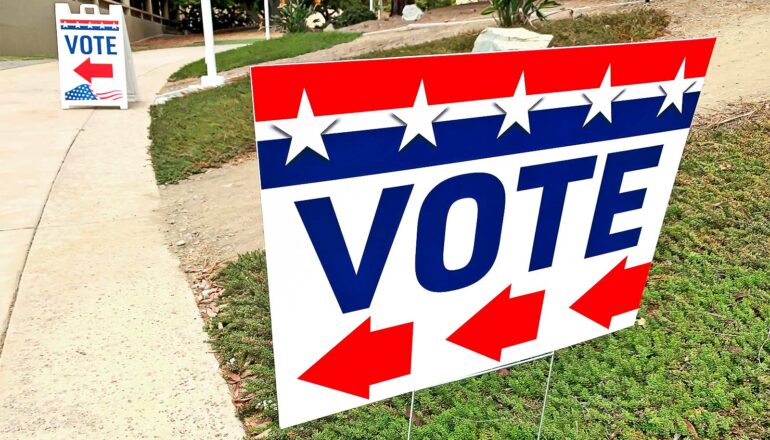
According to a recent study, voters who are comfortable living in the middle—neither agreeing nor disagreeing when asked about substantive issues relevant to upholding democracy—might be the largest group to blame for democratic decline in the United States.
These “democratic neutrals” are what the study’s coauthors consider some of the most dangerous voters in the current political environment.
Using three surveys of more than 45,000 voting-age Americans, the researchers found that about half of the US population expresses an attitude of democratic neutrality—or an “unwillingness to support or oppose policies or practices that undermine democracy,” explains Matthew E.K. Hall, lead author of the study recently published in the journal Nature Human Behaviour.
“Neutrality towards democracy, rather than outright opposition, has enabled democratic backsliding among various Western democracies as elected officials leverage citizens’ neutral attitudes to pursue antidemocratic outcomes,” Hall and his two coauthors write in their study.
The danger in this “neither support nor oppose” mentality lies in its lukewarm approach to what matters and to which lines should or should not be crossed when it comes to protecting our democracy. And that, Hall says, is problematic because if the public isn’t willing to hold its leaders accountable, then there’s nothing to stop them from behaving in ways that undermine democracy.
Hall, who a professor of constitutional studies in the University of Notre Dame’s political science department and the director of the Rooney Democracy Institute, conducted the research with B. Tyler Leigh, research fellow at the Rooney Democracy Institute, and Brittany C. Solomon, an assistant professor of administrative leadership in the Mendoza College of Business.
Relying on data from two surveys they conducted in the summers of 2024 and 2025, and a third, larger survey sent weekly through the YouGov panel between 2022 and 2023, the researchers asked participants about their attitudes toward undemocratic practices. The questions included whether they agreed, disagreed, or felt neutral when asked about their support for four examples of undemocratic practices: reducing outparty polling stations, ignoring outparty court decisions, remaining loyal to the party over the Constitution, and censoring partisan media.
Roughly 50% of participants checked the neutral category for at least one question. In contrast, outright agreement with undemocratic practices was much less common. But, between the two segments, up to two-thirds of respondents did not actively oppose undemocratic practices on the part of government officials, political candidates, and leaders.
“Not actively opposing undemocratic practices is different than actively supporting democracy,” Hall says.
Neutrality, the researchers note, is especially concerning because it can be associated with authoritarianism, tolerance of norm violations, extremism, distrust, and obscuring antidemocratic views.
Another, equally critical point, Hall says, is that this neutrality exists at similar rates on both sides of the aisle, among Republicans and Democrats, as well as nonpartisans.
The researchers identified several reasons that voters choose the “neither agree nor disagree” category. Hall explains that some Americans tolerate politicians undermining democracy on a conditional basis if it means those entities enact policies they favor, but then they don’t like those same undemocratic decisions when made by leaders in the other party. They vote according to the mantra, “It depends.”
Some voters are just uncertain about which direction to lean, or believe they don’t have the knowledge or understanding to vote appropriately. Other voters are simply indifferent or apathetic—they simply do not care about politics. Another group of neutrals are ambivalent toward the survey questions because they care strongly in two conflicting directions and feel indecisive. A fifth group actually supports antidemocratic policies but feels social pressure to say they don’t, so they feign neutrality.
“Regardless of why Americans express neutrality, those who do so are just as likely to vote for authoritarian politicians as the relatively small number of Americans (less than one in five) who explicitly support undemocratic practices,” Hall says.
Hall and his coauthors says that neutrality is not only a big problem, but it’s also a problem that will take a novel approach to fix.
“The problem is the people sitting on the sidelines, not paying attention or prioritizing short-term issues over the long-term stability of this country,” Hall says.
“This will require a completely different approach with regard to persuasion strategy when you realize that’s the group we—as proponents of American democracy—need to be focusing on. Promoting democracy is going to look a little different than we thought.”
What does that promotion look like then? Hall and his coauthors see the primaries for the approaching 2026 midterm elections as the next opportunity to encourage Americans to vote for candidates who will support and protect American democracy. Messaging will need to encourage voters to “vote against candidates who undermine American democracy—even (and especially) if they are candidates from their own party,” emphasizing that staying neutral will no longer suffice.
“American politics have really been shaken in this last decade, particularly with regard to partisanship and polarization,” Hall says.
“The elites have lost control of the throttle and the mass public is driving—and that’s not necessarily a bad thing if the mass public values democracy. But if they don’t value democracy, then we will spin out.”
The research was supported by the Rooney Democracy Institute, which is dedicated to promoting scholarship, knowledge, and dialogue on American democracy.
Source: University of Notre Dame
The post ‘Neutral’ voters could be dangerous for democracy appeared first on Futurity.
Popular Products
-
 Automotive CRP123X OBD2 Scanner Tool
$649.56$324.78 -
 Portable USB Rechargeable Hand Warmer...
$61.56$30.78 -
 Portable Car Jump Starter Booster - 2...
$425.56$212.78 -
 Electric Toothbrush & Water Flosser S...
$43.56$21.78 -
 Foldable Car Trunk Multi-Compartment ...
$329.56$164.78