An Extra-embarrassing White House Correspondents’ Dinner
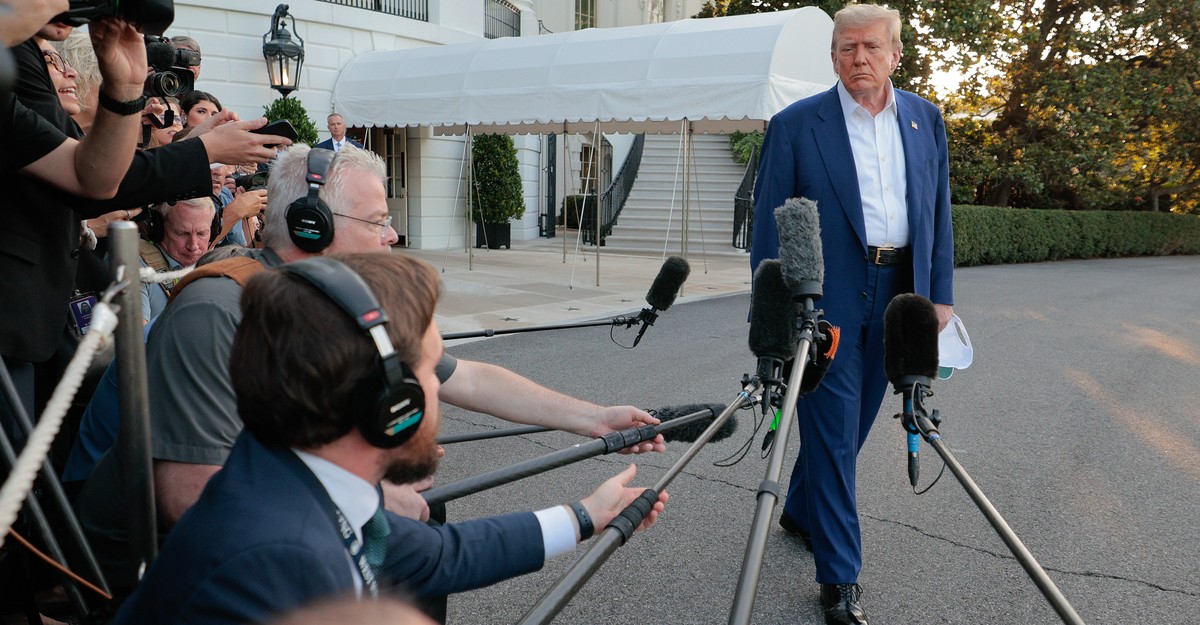
Even in the best of times, the annual White House Correspondents’ Dinner is an awkward and ethically fraught affair. Journalists spend the evening partying with the president and administration officials whom they’re supposed to cover rigorously and skeptically. I’ve been to the dinner several times over the years. It’s typically crowded and a little chaotic, and the ratio of non-journalists to journalists is about 10 to 1. The evening is promoted as a celebration of journalism and the First Amendment, but it has always been a bit of an embarrassment.
These aren’t the best of times for White House correspondents or, for that matter, the First Amendment. And this year’s gala figures to be even more awkward and embarrassing than usual.
After declining all invitations to the event throughout his years in office, President Trump informed the White House Correspondents’ Association last month that he would be attending this year’s dinner. His surprising decision sets up a bizarre dynamic: On Saturday night, the president will break bread with the same people he’s spent a decade calling “fake” and “enemies of the people.”
[Andrew Ferguson: A republic too fractured to be funny]
Trump easily qualifies as the most anti-press president in the dinner’s 105-year history. In just the past 15 months, he has sued news organizations, threatened to jail journalists, and repeatedly suggested taking broadcast licenses away from TV networks that have reported stories he didn’t like. His administration has defunded NPR and PBS, hobbled Voice of America, and driven mainstream journalists out of the Pentagon. A few weeks after Trump assumed office last year, his administration took control of the White House press pool, enabling the president to dictate who covers him when he’s inside the Oval Office, on Air Force One, or at Mar-a-Lago. The WHCA, which had selected pool members for decades, objected to being pushed aside. The White House ignored its protests.
This state of affairs raises two questions: What explains Trump’s change of heart about attending the dinner? And why was he invited in the first place?
The second question is the easier one to answer. The WHCA has always invited the president to its annual dinner; Calvin Coolidge became the first chief executive to show up in 1924. Trump has accordingly been invited every year that he’s been president, including last year, after he commandeered the press pool. Trump’s motives for accepting the invitation, however, are harder to parse. During his first term, he made a big show of skipping the event, holding campaign-style rallies on the night of the dinner. (He boycotted it last year, too, but without the counterprogramming.) Now, for the first time as president, he’s suddenly all in. He posted his decision to accept the invitation on Truth Social in early March, writing that the WHCA had asked him “very nicely” and that the correspondents “admit that I am truly one of the Greatest Presidents in the History of our Country, the G.O.A.T., according to many.” The correspondents said no such thing, of course, but that’s Trump’s version.
Trump might have been encouraged by the WHCA’s choice of after-dinner entertainment. The organization usually hires a comedian to roast the president and the assembled reporters, but it announced in late February—a week before Trump said he would attend—that it would feature the “renowned mentalist” Oz Pearlman. Pearlman’s act is safely apolitical, which means that Trump won’t have to face barbs at his expense. (The WHCA’s president, Weijia Jiang of CBS News, declined to comment.)
The prospect of being made fun of has been an issue for Trump. As a guest, in 2011, he sat mostly stone-faced at his table as both President Obama and Seth Meyers fired zingers at him. The comedian Michelle Wolf’s grilling of Trump and his administration in 2018 (her opening line: “Like a porn star says when she’s about to have sex with Trump, let’s get this over with.”) prompted some conservatives to walk out in protest. The following year, the WHCA avoided blowback by hiring the historian Ron Chernow as its speaker. The organization’s plans collapsed last year when the comedian it had hired, Amber Ruffin, referred to the Trump administration as “kind of a bunch of murderers” on a podcast a few weeks before the event. Amid criticism from the White House and elsewhere, the WHCA quickly unhired Ruffin and dispensed with a comedy routine altogether. Trump skipped the dinner anyway.
[Megan Garber: The slow, awkward death of the White House correspondents’ dinner]
Despite his public disparagement of the event (at one point, he even forbade subordinates from attending), Trump has privately been intrigued by it. In his 2021 book, Betrayal, the ABC News reporter Jonathan Karl writes that Trump toyed with the idea of coming to the dinner in 2020. Karl, who was serving as the WHCA president at the time, recounts that he was summoned to a White House meeting with Trump to discuss the president’s role. “Am I supposed to be funny up there?” Trump asked Karl. The president was inclined to come, according to Karl, but wanted the WHCA to get rid of the comedian it had already booked, Hasan Minhaj. Karl declined to negotiate, and Trump never followed up. The dinner that year was ultimately canceled due to the pandemic.
Trump may have come to the realization that the benefits of attending outweigh the risks. “I think he’s recognizing he only has so many more chances to do the things a president can do,” a former WHCA board member, who requested anonymity because he wasn’t authorized by his employer to speak on the record, told me.
Trump will be both the guest of honor and keynote speaker, and the assembled press corps, their bosses, and their guests will be seated below him. With the nation’s 250th birthday approaching, he could use the occasion as an opportunity to mend fences, to put aside mutual antagonisms, and to declare a new spirit of cooperation—kidding, of course! Trump will clearly do none of those things. The more likely outcome is that he will heap scorn upon the journalists, who will have no choice but to sit and take it.
“In his second term, Trump is determined to ‘own’ every organization that opposed him or embarrassed him in his first term,” George Condon, a former WHCA president, told me. The Correspondents’ Dinner has never been known for the quality of its food. For the reporters and editors in attendance, this year’s meal might be particularly hard to stomach.
Popular Products
-
 Gas Detector Meter
$311.56$155.78 -
 Foldable Garbage Picker Grabber Tool
$93.56$46.78 -
 Portable Unisex Travel Urinal
$49.56$24.78 -
 Reusable Keychain Pepper Spray – 20ml
$21.56$10.78 -
 Camping Survival Tool Set
$41.56$20.78