Forget The Rust Belt Or The Sun Belt. The ‘wired Belt’ May Be The Next Frontier Of American Political Power
The laid-off factory worker from Youngstown, Ohio, became the defining figure of American politics for the past two decades. The jobless financial professional from Philadelphia’s suburbs could be the defining figure of the future, and their demands may be harder to ignore.
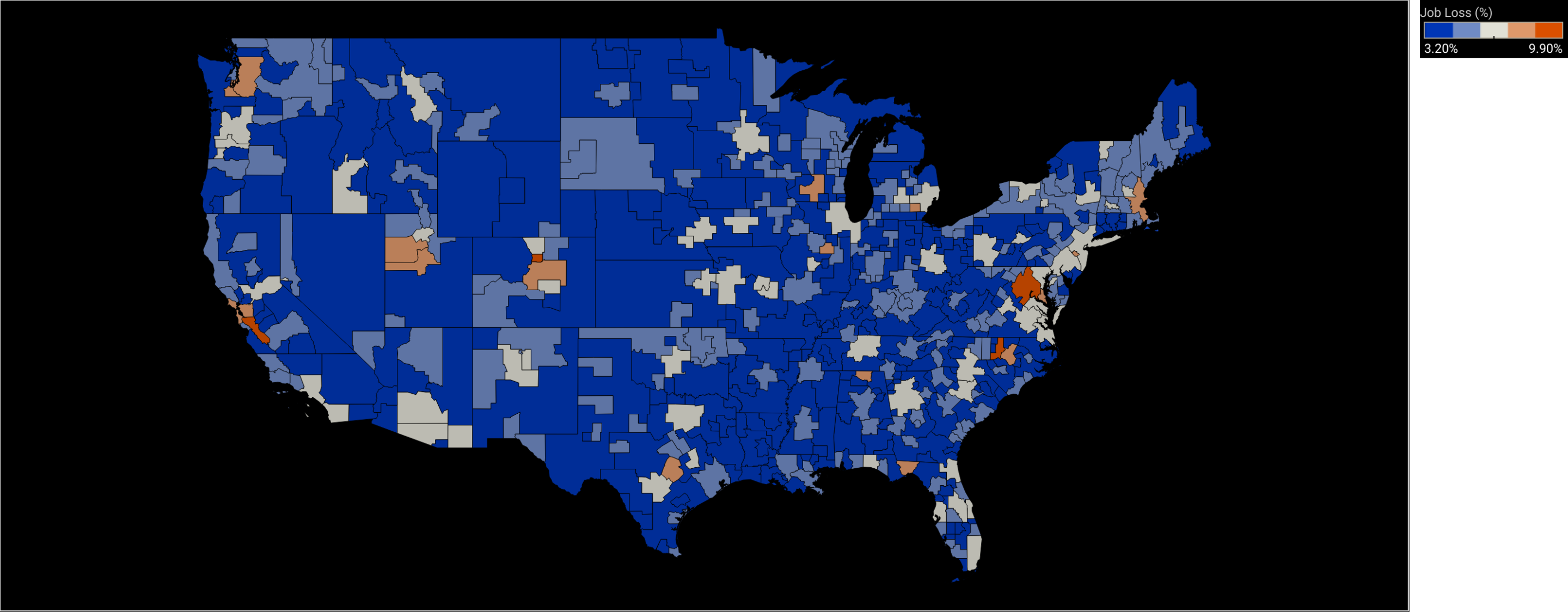
That’s the warning from the Fletcher School at Tufts University. The American AI Jobs Risk Index—an analysis mapping the economic and geographic impact of AI job risk across 784 occupations—shows exactly where the white-collar workers most threatened by AI displacement live.
Bhaskar Chakravorti, the dean of global business at Tufts University’s Fletcher School and the study’s lead researcher, said that with the proper organization, these workers will become a stronger political force than any the U.S. has seen in recent decades. This geographical concentration, which he terms the “Wired Belt,” includes the suburban rings surrounding America’s biggest metros, many of which exist in swing states.
“These are people who are on LinkedIn,” he told Fortune. “They know their congressman’s phone number. They’re good at writing, web design, data analysis, marketing. Their political activism is likely to be much more forceful.”
The looming threat of AI automation has struck a chord with millions of Americans. A recent NBC News poll found the technology is less popular than President Donald Trump and Immigration and Customs Enforcement, even after its deadly Minneapolis crackdown. Besides the cybersecurity risks and environmental impact that fuel anger toward the technology, one of the main concerns stirring fears and frustration is that knowledge work is appearing increasingly susceptible to AI automation.
The swing-state voters who could decide America’s next election
The study estimates that 9.3 million jobs are vulnerable to AI automation across the country. That amounts to a towering $200 billion in lost income. In an extreme scenario where AI is able to replace a larger share of labor, that figure rises to $1.5 trillion.
Chakravorti’s research identifies several primary clusters with a high concentration of knowledge-driven work, including metros like San Jose, Seattle, Boston, and New York. These areas face 3.5 times the job loss and over five times the income loss compared to traditional manufacturing regions.
But the real political punch lies in the suburban rings of pivotal swing states, specifically around Philadelphia, Atlanta, Phoenix, and Detroit. These are the regions that everyone comes to know during each presidential election: Bucks County, Pa.; Gwinnett County, Ga., or Maricopa County, Ariz. They’re the spots with the biggest door-knocking efforts, where TV journalists swarm undecided voters and poll after poll shows a tightening race. All of that is because who takes the White House is most likely decided by voters in these regions. And it doesn’t take much. In 2024, Trump won Wisconsin by roughly 29,000 votes.
Chakravorti said in a recent essay in the Financial Times that one-sixth of vulnerable jobs exist in swing states, representing an estimated $119.5 billion in income.
It’s not exactly clear who will harness the power of the Wired Belt. The Trump administration has taken a laissez-faire approach to AI regulation. But the president is now reportedly weighing government oversight over AI model releases. Some progressives, like Sen. Bernie Sanders (I-VT) and Rep. Alexandria Ocasio-Cortez (D-NY), have proposed actions like a national data center moratorium.
While many of the Wired Belt voters Chakravorti characterizes tend to lean Democratic, there was a shift to the right in the 2024 election. He said whichever party successfully offers a plan for greater human capital investment and a transition to an AI-driven economy that supports these disgruntled workers will hold the keys to these critical suburban districts in the midterms, and in 2028.
“There is an opportunity to just get those 100,000 voter swings in the swing states and the election, you know, could be operating in a way, you know, moving in a very different direction in terms of the outcomes.”
But it’s not exactly clear to what extent AI will impact the job market. Some tech companies have credited AI with recent layoffs, but the unemployment rate among young workers—those most threatened by automation—is down to 7.6% from a high of 9.2% last September.
Still, there are small signs the AI job apocalypse that economists and business leaders warn about could slowly be turning into reality. The Bureau of Labor Statistics’ April jobs report showed a better-than-expected 115,000 gain, but white-collar sectors like financial activities and information services lost nearly 24,000 roles collectively.
Whatever the case, Chakravorti predicted the mere threat of job loss could be enough to trigger a new political wave across suburban America.
“The threat should be enough to push people into action if they begin to start connecting the dots,” he said.
This story was originally featured on Fortune.com
Popular Products
-
 Fake Pregnancy Test
$61.56$30.78 -
 Anti-Slip Safety Handle for Elderly S...
$57.56$28.78 -
 Toe Corrector Orthotics
$41.56$20.78 -
 Waterproof Trauma Medical First Aid Kit
$169.56$84.78 -
 Rescue Zip Stitch Kit
$109.56$54.78