I Recognize The Look On Liam Ramos’s Face
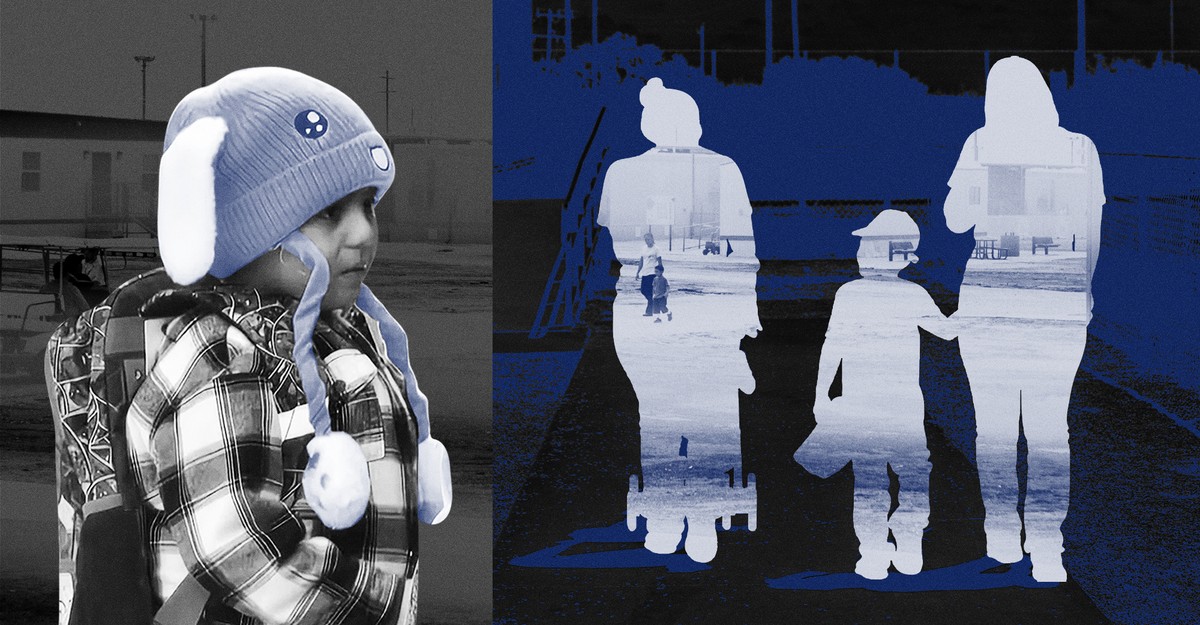
When the first photo of 5-year-old Liam Ramos went viral in January, it became an instant symbol of the Trump administration’s mass-deportation campaign: his blue bunny hat, his Spider-Man backpack, his hunched shoulders, his scared eyes as ICE detained him and his father outside their home in a Minneapolis suburb.
The second photo of Liam, a week later, enraged people who were now invested in his story: Lying on his father’s lap at the Dilley Immigration Processing Center, about 70 miles south of San Antonio, Texas, he looked pale and lethargic. His eyes were open a tiny slit. His mother told reporters that Liam had a fever, was vomiting, and refused to eat.
What struck me about the second image, and his mother’s update, was how familiar his transformation was. I’ve visited Dilley several times, and have seen many children go from bright-eyed to listless.
With his move to Dilley, Liam became part of an ongoing national experiment in detaining immigrant families. George W. Bush’s administration briefly used the practice to provide respite to asylum seekers who had just crossed the border and had no plans for where to go next. But ICE officials soon argued that family detention should be used as a deterrent. In a former medium-security prison surrounded by razor wire north of Austin, young children and their parents wore jumpsuits and were confined to cells for up to 12 hours a day; it closed in 2009 after lawsuits and government inspections showed that children there were sick and malnourished.
The Obama administration eventually opened Dilley on a remote patch of Texas flatland where temperatures can hit 90 degrees even in December. Its open-air layout of trailers was supposed to be more humane. But for years now, in interviews and court filings, families have described an emotionally crushing atmosphere, with revolting food, foul water, and a dangerous lack of medical care. They say bright bedroom lights that never turn off make it almost impossible to sleep, compounding their misery.
[J. Weston Phippen: Is it an immigration detention facility or a child-care center?]
In 2016, a government advisory panel recommended that ICE end the practice of family detention, and instead use monitoring programs that allow people with pending asylum cases to settle and work in the United States. But under Donald Trump, the agency has twice backtracked on plans to do that, arguing that housing children at Dilley is safe and necessary in order to discourage border crossings. Even that rationale, though, no longer adequately describes Dilley’s role. Instead of detaining recent border crossers almost exclusively, Dilley is now also housing families that had established lives in the United States and were arrested in ICE sweeps.
When I toured Dilley in the fall of 2019 with a group of reporters, ICE’s acting director, Matt Albence, led us across the 54-acre campus, which could detain up to 2,400 people. Albence, who now works for the private prison company GEO Group, said he was proud of how Dilley was run and pushed back against its critics. “This is clearly not a concentration camp,” he said.
On the tour, I learned that when families arrived, they entered a small locked chamber called a sallyport, where they were screened for communicable diseases. Most had just finished an exhausting journey across the southern border, and were given a 15-minute “cool-down period” in an air-conditioned area that looked like a school administrator’s office, with tile floors and faux-wood laminate cubicles. After a snack, they started a 12-hour intake process that involved a full physical, a shower, fingerprinting, a rules orientation, and an initial asylum screening called a “credible-fear interview.” Girls older than 10 were given a pregnancy test. Then they were assigned to a dorm room in one of Dilley’s five “neighborhoods,” which were labeled by color and animal, and given name tags that indicated their preferred language.
A sign at reception—Recreation just for YOU!—said that karaoke, Hula-Hoops, and air hockey were available every day from 8 a.m. to 8 p.m. “Just let a recreation staff member know what you want to do!” To minimize the risk of sexual harassment and assault, only mothers or fathers could be detained in the facility at a given time. (Posters for how to report sexual assault were everywhere.) This meant that two-parent families were separated: One parent was sent to a separate adult detention center, sometimes in another state.
Each of Dilley’s 20 housing trailers had space for 120 people. The detainees slept in rooms that could accommodate up to six families in double bunk beds. In one room, I saw a teenage girl slumped forward on a couch, holding her head in one hand, staring blankly at the wall in front of her. Former ICE officials who were involved with the facility’s planning later told me that the government had deemed individual bathrooms an unnecessary expense. Instead, communal ones were placed at the end of each trailer, a long walk from the farthest bedrooms.
We toured an austere courtroom that reeked of bleach, and an airless cafeteria with a rancid smell. There were amenities, such as a “salon” that offered free haircuts and a computer lab with a few children clicking away under a poster that translated E pluribus unum into English and Spanish. We were told that Dilley offered Zumba classes a few times a week. We visited a day care with space for 15 children, which parents could use in two-hour increments; the sole attendant was trying to soothe three crying babies.
The few parents and children I saw outdoors looked sedated by the heat. Some huddled near skinny trees. The government had paid for landscaping, but the plants immediately died in the brutal climate, according to Claire Trickler-McNulty, a former senior adviser at ICE.
[Eric Schlosser: ‘We voted for retribution’]
Throughout the tour, we heard coughing and saw faces covered in snot. Parents said they waited hours in the heat and rain outside the medical unit, only to be sent away with Tylenol, ibuprofen, or nothing at all.
On another trip to Dilley about a month later, I met a Mexican mother named Patricia who told me that her teenage daughter was refusing to eat and had tried to commit suicide a week earlier. “I wouldn’t wish this on anyone,” Patricia said. A Honduran mother named Cindy told me that her 8-year-old son, Jostin, had become unrecognizable since they arrived. “He acts like a small child,” she said. “He speaks in a whisper, constantly asking for Mommy.” Jostin wasn’t eating either, she explained, and “everytime he goes into the cafeteria, he throws up.”
Later, I interviewed a mother and son named Kenia and Michael after they were released from Dilley. Michael, who was 11, started having violent meltdowns in the facility—something that had never happened before—and they continued for months afterward. Detained children experience more stress than their bodies can handle, child-welfare experts told me, and are profoundly destabilized by seeing their parents’ fear and helplessness.
The advisory panel convened at the end of the Obama administration was supposed to recommend improvements to family detention, but instead voted unanimously to end it. “Detention is never in the best interest of children,” the panel’s report said.
When Trump took office in 2017, his administration disregarded the recommendation. President Biden’s Department of Homeland Security finally closed Dilley in the summer of 2024. Trump reopened it a few months later, as part of a $45 billion expansion of the immigration detention system that has also involved Guantánamo Bay, tent cities on military bases, and converted warehouses.
CoreCivic, the private prison company that operates Dilley, reported that its management revenue from ICE more than doubled between the fourth quarters of 2024 and 2025—partly because of reopening Dilley. In an earnings call last year, CoreCivic’s then-CEO called this “truly one of the most exciting periods” in his 32-year career with the company.
The trailers at Dilley are now rusted from floods, and well past their intended lifespan. ICE created a barrier between some of the trailers so the facility can house mothers and fathers at the same time. This year, its population has fluctuated between 900 and 1,400, including pregnant women and children as young as two months old, according to Faisal Al-Juburi, a co-CEO of Raices, whose lawyers provide free counsel to families there. Like Liam Ramos, whose family came from Ecuador in 2024 and requested asylum, some detainees have pending applications for legal immigration status. And some were picked up at their court appearances or at appointments at ICE offices.
It’s become harder to learn what’s happening inside Dilley in recent months, though reports suggest that conditions are worsening. ICE is no longer offering tours to journalists. After ProPublica published pictures and letters written by detained children, guards reportedly started confiscating crayons and paper. In 911 logs, ProPublica found reports of “toddlers having trouble breathing, a pregnant woman who passed out and an elementary-school-aged girl having seizures. Local authorities were also called in for three cases of alleged sexual assault between detainees.”
Democratic Representative Joaquin Castro of Texas went to Dilley on February 20 and reported that families were “locked up like criminals and being treated like animals,” and that some children had untreated asthma and appendicitis. Castro has long opposed family detention and criticized Trump’s immigration policies. “There’s a lot of little, little kids who really probably don’t know how to process this experience,” he said in a video posted on YouTube.
[Caitlin Dickerson: An American catastrophe]
Lawyers at the National Center for Youth Law are allowed to perform periodic inspections of Dilley and interview detainees, under a 1997 federal court settlement that set minimum standards for the detention of children and families. Becky Wolozin, a lawyer at NCYL, told me that since the facility reopened under Trump, she and her colleagues have interviewed detained children with Wolf-Hirschhorn syndrome, severe autism, and other serious developmental illnesses. There was a measles outbreak earlier this year. Wolozin said that basic childhood illnesses such as ear infections can become dangerous in Dilley because children are often sleep deprived and malnourished. “Kids have fevers for a frightening amount of time, and persistent coughs and headaches,” she said. “We’re seeing that only after many, many visits to the medical wing, or even to the hospital, do they actually get treated with antibiotics.”
In January, an 18-month-old detainee got sick at Dilley with COVID, RSV, pneumonia, and bronchitis and had to be hospitalized for severe respiratory distress, according to a federal lawsuit. ICE then returned her to Dilley, where her lawyers say the medical staff withheld her prescribed medication until the lawyers secured her release. In a statement, a DHS spokesperson said that the child received “proper treatment,” including her prescribed medications, and that all detainees “receive timely and appropriate medical care from the moment they enter ICE custody.”
Todd Brian, a spokesperson for CoreCivic, said in a statement that the company doesn’t “cut corners on care, staff or training, which meets, and in many cases exceeds, our government partners’ standards.” He said that detainees receive three nutritious meals a day and have access to a team of “registered nurses, licensed vocational nurses, nurse practitioners, and board‑certified physicians, including pediatric specialists.” Brian said that any allegation that buildings were not being maintained was “patently false,” adding, “Emergency medical services are activated immediately when a child’s clinical presentation exceeds what can be safely managed on-site.”
The Trump administration is fighting restrictions on its use of Dilley—including a 20-day limit on detaining children and families under the 1997 court settlement—by arguing that existing laws are sufficient to keep the children there safe. Al-Juburi told me that the average stay is currently about 63 days, and that one family was detained at Dilley for almost five months. Raices has gotten some clients released through habeas corpus petitions; Liam Ramos was freed through the same maneuver within days of the Dilley photo going viral. But Al-Juburi said the petitions are time-consuming and must be made one at a time, even though the same legal logic applies to many of the children there.
In recent court filings, ICE has called Dilley a “model of regulatory compliance and humane care.” DHS said in its statement that children at Dilley “have access to teachers, classrooms, and curriculum booklets for math, reading, and spelling,” as well as “3 meals a day, clean water, clothing, bedding, showers, soap, and toiletries,” all of which is “generously funded by the U.S. taxpayer.” The statement says that detention “is a choice” and encourages families to self-deport.
I recently spoke with a subcontractor who quit working at Dilley this year; he requested anonymity so that he wouldn’t lose his security clearance. He said that since he’s been out of a job, he’s been stressed about money because he has a toddler at home and his partner is pregnant with a second child. But he told me that seeing Liam Ramos and so many other sick and miserable children—the constant crying and vomiting—got to be too much.
“A lot of these kids have bags under their eyes, which is something that you don’t see with kids,” he said. “They have worse bags than their parents.”
Popular Products
-
 Put Me Down Funny Toilet Seat Sticker
$33.56$16.78 -
 Stainless Steel Tongue Scrapers
$33.56$16.78 -
 Stylish Blue Light Blocking Glasses
$85.56$42.78 -
 Adjustable Ankle Tension Rope
$53.56$26.78 -
 Electronic Bidet Toilet Seat
$981.56$490.78