J.d. Vance's Communion Of Saints

In 2015, Donald Trump published a book entitled Crippled America: How to Make America Great Again. It’s a work that’s almost never brought up by either his supporters or detractors, which even the most hardcore politics nerds have forgotten about, just as they’ve forgotten about “Stronger Together,” the campaign book Hillary Clinton and Tim Kaine published the following year. From these books we expect focus-group cliches, vapid crowd-pleasers, and reminders that politicians are just like us, for they eat toast with butter and strawberry jam in the morning!
J.D. Vance’s memoir Communion: Finding My Way Back to Faith is not a typical politician’s book. It is J.D. Vance’s magnum opus, a grand ideological declaration of war against the “experiment of replacing a Christian culture with something else” that has produced “rising racial strife, a gender gap among our young people, falling rates of love and partnership, and a society with a declining population.” Yada yada yada. It would be nice if we could ignore such arguments, but unfortunately the man they’re coming from is an 80-year-old’s heart attack away from the most powerful office on Earth. How did J.D. Vance come to acquire such views? The memoir provides some hints, along with hints of how he’ll campaign during his inevitable run for the Presidency.
Communion starts by telling us about Vance’s early religious upbringing. His biological father was not originally present in his life. His drug-addled mother would occasionally “get religion” and take him to church. Presumably she would lose religion, perhaps because she objected to the religious morality, perhaps because she was bored; Vance doesn’t say. He says more about the religious views of his grandmother, “Mamaw,” who rarely attended church, loved Billy Graham but hated most other televangelists, thought evolution was “bogus” and felt that abortion, while wrong, should be legal. As for Vance’s grandfather, “Papaw,” Vance tells us he “can’t recall him ever mentioning his faith.” It doesn’t seem to occur to him that maybe this was because Papaw had none.
The drug-addled mother who occasionally has a bout of religiosity, the creationist but pro-choice grandmother, the religiously indifferent grandfather, all represent a common type of person in working-class, red-tribe white America. They likely vote Republican, and might show up in the cross-tabs as “white born-again or evangelical Christians,” but are not Ned Flanders social conservatives. The 2028 Republican primaries may hinge on whether such people find Vance’s Christian message too extreme.
Someone who was closer to the staunch Christian conservative stereotype was Vance’s biological father, who Mamaw called a “holy roller.” After his father reconnected with him, Vance began regularly attending his church, in which “religious and political conservatism were more explicitly linked.” Vance describes the environment:
In the mid-1990s, a wave of prophetic theory was sweeping through American evangelical churches. Tim LaHaye and Jerry B. Jenkins’s blockbuster Left Behind books told the story of an impending apocalypse and were wildly popular in Dad’s church. One old woman told me that I had handsome eyes, which might earn me a beautiful wife if the Lord didn’t come before I was old enough to marry.
A family member purchased the popular televangelist John Hagee’s Prophecy Study Bible, which fused Hagee’s prophetic theory with relevant passages from the New King James Bible. I watched telecasts by Hagee and Hal Lindsey, another famous apocalypse theorist. I became convinced that the world would end in 2007, at the latest.
It is in 2005, as he is preparing for deployment to Iraq, that Vance starts to question his religion:
I was struck by the contrast between what was happening in our lives and the political issue that most animated church communities at that time: the fate of Terri Schiavo. {snip}
I shared the view that we ought to err on the side of life in a case like Schiavo’s. But, to my younger self, the passion behind the Schiavo fight, juxtaposed with the problems in my life, laid bare how the church I loved seemed to prioritize faraway controversies over the everyday needs of our community. As tragic as Schiavo’s case was, it seemed like a genuinely freak occurrence in a world filled with overlooked tragedy. It felt to me like our pastors spoke in abstractions about family values, while glossing over the divorce and family instability that had wrecked my family and community. They worried about the unborn, but ignored the abuse, neglect, and struggles in homes like mine.
He goes on to detail how as his grandmother died and his mother fell again into addiction, he found the church’s message irrelevant:
{snip}The sermon that Sunday focused on the end times and why every person present must be prepared for the Second Coming of Christ.
I sat there in a silent rage. I looked around at the churchgoers, happy families and elderly couples and children bored out of their minds.
Who are these people? I thought. Did they know any narcotics addicts? Did they labor under the crushing weight of loss and grief and worry?{snip}
I hated all of this—the complacency and the irrelevant sermons about the Rapture.
Communion is a narrative about how Vance once had, lost, and regained his faith, but I wonder if he’s been a nonbeliever this whole time. This would explain why he felt the imminent end of the world irrelevant to his life. Religion isn’t a source of truth but a community-building exercise, and if it ain’t building community then what’s the point?
Vance describes becoming an atheist in Iraq, where he embraced Ayn Rand’s philosophy:
After years of prosperity gospel teaching, I was ready for a sterner lesson. I was tired of the illusion that achievement and wealth came, like magic, to anyone who prayed hard enough for them.
Stop whining, stop praying, and start working your ass off if you want anything out of life, I told myself.
Rand’s message reflected why I had joined the Marines in the first place: The Corps was exceptional, and it was hard. Rand’s many critics generally missed what made her work so appealing to a young guy like me: I knew that life was a struggle, and I was sick of people pretending it wasn’t.
I dismissed Christianity as being too wishy-washy. Pray; hope you get lucky; and if you don’t, well, “it’s God’s will.”
“Start working your ass off if you want anything out of life” was exactly what Vance did, graduating from Ohio State University and then Yale Law School, after which he worked for Republican Senator John Cornyn, spent a year as a law clerk for Bush-appointed District Court Judge David Bunning, then briefly worked as a corporate lawyer before moving to San Francisco to work in Peter Thiel’s venture capital firm. His career is heavily entwined with conservative politics, and you may suspect his “return” to faith was nothing but a politically convenient career move. I think this probably had something to do with it, if only subconsciously. But I also think Vance honestly embraced religion in order to deal with the family trauma that still afflicted him despite his success:
{snip}Usha and I were engaged, but I just knew I’d screw up our happy life somehow. When we eventually had kids, I feared that I’d abandon them or abuse them or fail them in some other way. I could win the race against financial or political or business competitors. But with Usha and the kids we didn’t even have yet, I felt like I was racing against the ghosts of my past. I couldn’t beat them any more than my own mother could beat her addiction.
{snip}
I could read studies until I was blue in the face about how kids who were abused were more likely to abuse. Or how married couples with divorced parents were more likely to divorce. These things were obviously true, and the knowledge undoubtedly helped doctors contextualize their patients’ problems.
But I yearned for a way of understanding the world that could make room for both the importance of my past and the existence of my own agency. It was one thing to sit in a therapist’s chair and talk about what had happened to me and how connected it was to something I did. “Perhaps I lost my temper on the road because I was nearly killed in my mom’s road rage incident.” Perhaps. But perhaps I lost my temper on the road because I screwed up. One of the ways we allow the ghosts of the past to control us is by scapegoating them for our own misdeeds. The invisible hand is the hand of the devil.
For an evangelical, the weirdest Catholic sacrament may be the rite of confession and reconciliation. The idea of speaking of my sins to a stranger mortified me. Yet our Catholic friend Sam described confession in a way that resonated with me: It’s like therapy, but with less whining and more guilt. You can recognize the social aspect of sin—the fact that some people are influenced by the problems and even traumas of their youth. And you can also recognize that even a very damaged person is still responsible for their misdeeds.
In American politics, it’s beneficial to declare yourself Christian. Within sections of the Republican Party, it’s beneficial to adopt a fundamentalist Christian identity and extreme social policies. It is not necessary to write paragraph after paragraph of this stuff. Maybe this is all an elaborate long-con, Vance is still a Randian individualist fueled by the will to power who pretends to still care about these family traumas because redemption narratives sell. I don’t think so, to me, this is real. Christianity helps Vance, and if it helps him, it must help everyone. You don’t want to see yourself as a broken man who needs religion as a crutch, you want to see yourself as part of a broken, sinful humanity, every member of which needs the grace of the Lord. This interpretation of Vance’s religiosity was all-but-endorsed by his non-Christian wife Usha, who said that “I grew up in a Hindu household that was a very stable household. I have not felt the same need to seek something different that he has.”
Does he really believe? I would say Vance is not a theist, but also not an atheist. The theist believes that the statement “God exists” is true, the atheist says it is false, Vance denies that the concept of truth applies to the statement, which is its own form of anti-rationalism distinct from true theism. He describes how he views religious beliefs:
The point is that no matter how well-read you are, how thoughtful you fancy yourself to be, most of the knowledge in your head is mediated by the people and institutions you trust.
This is especially true when the things about which you’re expected to form an opinion are uncertain, or even impossible, to truly “know” in any meaningful sense. Religious beliefs are less like certainties such as the boiling point of water—which can be verified through testing—and more like claims about complex systems.
This contradicts not only rationalism, but also the Bible. After all, it was very possible for the various Biblical prophets to know God: He spoke to them! He told Noah that the world would be destroyed in a flood Noah later watched happen. He gave Moses the Ten Commandments on Mount Sinai. Thousands saw Christ perform miracles. We’re used to thinking of religious claims as fundamentally different from scientific claims, not being testable. Yet the Bible describes exactly that, in an experiment designed to distinguish the true God from false ones (1 Kings 18):
Then Elijah said to them, “I am the only one of the Lord’s prophets left, but Baal has four hundred and fifty prophets. Get two bulls for us. Let Baal’s prophets choose one for themselves, and let them cut it into pieces and put it on the wood but not set fire to it. I will prepare the other bull and put it on the wood but not set fire to it. Then you call on the name of your god, and I will call on the name of the Lord. The god who answers by fire—he is God.”
{snip}
At the time of sacrifice, the prophet Elijah stepped forward and prayed: “Lord, the God of Abraham, Isaac and Israel, let it be known today that you are God in Israel and that I am your servant and have done all these things at your command. Answer me, Lord, answer me, so these people will know that you, Lord, are God, and that you are turning their hearts back again.”
Then the fire of the Lord fell and burned up the sacrifice, the wood, the stones and the soil, and also licked up the water in the trench.
The world described in the Bible is of great interest to true-believing evangelical Christians, for whom it’s true history. It doesn’t seem of much interest to Vance, for whom the focus is on the present, what God can do for individuals and the community. This passage typifies Vance’s approach:
How could a devoutly Christian wife leave her devoutly Christian husband, or vice versa? It is a thorny problem that the Christian faith embraces. Yes, God’s grace works miracles in the character of individual men and women; if you’re a believer, God is constantly making you a better version of yourself. But many individual believers are terrible spouses regardless. There is King David, a pious man who speaks to God with the ease that most of us call our relatives. Yet King David is terribly unfaithful to his wife and brutally violent in his administration. God’s grace is real, the Bible tells us, but it doesn’t always fix people, at least not right away.
We see how King David is trotted out to address a modern problem, though Vance seems to know little about him. David, according to the Biblical narrative, did not have a “wife,” he had eight named wives and more unnamed wives and concubines. And the idea that he was “unfaithful” to any of them is anachronistic. In David’s culture, husbands did not owe their wives sexual exclusivity. When David slept with the wife of one of his generals, this was an offense against the general, not his wives.
That’s how he became religious; how did he become a BASED populist? Communion hints at the answer:
One of Usha’s co-clerks was a football player from Massachusetts named Sam. Usha’s politics were more moderate than her conservative judge’s, but Sam made Judge Amul Thapar seem like a flaming liberal. He was big—an offensive lineman from Amherst—and brash, and we became fast friends.
Raised in a Jewish family in Boston, Sam became an evangelical Christian thanks to influence from fellow students and a professor at Amherst. After a couple of years, he found himself attracted to the tradition and liturgy of the Catholic faith.
He’d go on extended rants about the Reformation and immigration and every other topic. “You think we started to go off the rails with Obama? This all started with John Calvin. He’s the real villain of comprehensive immigration reform.”
You may wonder how this makes sense, as the Catholic Church has been significantly more pro-immigration than Protestant churches, and Catholic voters are more likely to vote Democratic than Protestant ones. But if you’re analyzing such a statement logically, you’ve already lost the plot. The outlandishness is the point, for wow, BASED. Women shouldn’t vote? BASED. Nobody should vote? Even more BASED. Blood and soil, that’s BASED. Actually no, that’s too modern, what’s really BASED is going back to 1720 absolute monarchy and a state church. Richard Hanania calls this the Based Ritual, and it’s how many young Rightists talk both online and IRL.
The Based Ritual is covered in layers of humor and irony, and many who indulge in it (I myself am certainly guilty) are not right-wing radicals. Vance, you’ll notice, is mildly disparaging of Sam’s “rants.” Yet years of hearing this stuff is bound to impact someone, warping their sense of normality and making extreme views seem moderate in comparison. Vance would go from a normie Republican in 2016 to saying UFOs are demons in 2026, and it probably has a lot to do with the social environment he has been in. The race and conspiracy stuff is most notable and offensive to the liberal media, but also important is a more fundamental populism, where positive characteristics are ascribed to the white working-class regardless of real-world facts about their behavior. Vance’s first book put a lot of blame for hillbilly problems on hillbillies themselves. In Communion, they have been transformed into the salt of the Earth:
When people ask me what I most admire about Appalachian people and culture, a few things come to mind. I sometimes talk about the sense of family loyalty and pride of place. I often say that my family cared far less about credentials and job accomplishments than about people and kin.
This attitude was far more Christian than anything I’ve encountered in the halls of power, and though I lost it for a while, the seeds planted by that family when I was a kid are undoubtedly a major part of my journey back to my faith.
Many are apt to give people latitude to romanticize their own culture. If the Sicilian man wants to talk about the glory of the Sicilian mother, we don’t see a reason to dispute him. This indulgence is out of place with Vance, who shows nothing but contempt and hostility for the 28% of Americans who are not religious. Thus, I can observe that for all their supposed value on “people and kin,” the only solely Appalachian state (West Virginia) has the largest proportion of nonmarital births among whites. Maybe “Appalachian culture” is the problem? Maybe they should take cultural inspiration from the lowest ranked states like Utah and Colorado?
Source: National Vital Statistics Reports Volume 74, Number 1, Table IV
Vance and those who think like them are probably aware of these facts, in the same way liberals know, deep down, that blacks commit more crime than whites. But why dwell on reality? If blacks commit crime, that’s a consequence of systemic racism, the real “deep” truth is that blacks are the heroes of Civil Rights movies who just want to be educated and promote tolerance and enlightenment. Likewise, for Vance, the sentimental view of Appalachia is the deep truth. If reality doesn’t align with it, it’s evidence of the outgroup’s malign influence. Vance spends a lot of time in Communion complaining about the breakdown of the family. No blame is put on low-class people, nor perverse incentives created by government. The problem is corporations, rich people and “the gods of GDP.” He sees the malignant influence of said gods in his own life:
I am especially sensitive to these issues around holiday time. Many members of my family work in retail, which is one of the few growing sectors of the economy in and around my southwestern Ohio hometown. And every year, in early November, I dread the logistics around Thanksgiving dinner. I say “dread” because it is rare that everyone can attend. Some of those pressures are reasonable—people have multiple family meals to attend, and they can’t be in two places at the same time. But virtually every year, some accommodation is made not to the other side of the family or the realities of scheduling, but to the gods of GDP.
{snip}
And layered on top of them are the hundreds of thousands of silent workers who leave Thanksgiving celebrations early (or miss them altogether) so they can fold clothes or unbox merchandise or stand guard at the entrance of a superstore like medieval knights.
A healthier society would recognize how gross it is to send sixteen-year-olds to work from 4 p.m. on Thanksgiving to 4 a.m. on Friday.
In some sense, what Vance says is true. The desire for money (”GDP”) motivated those workers to go out and work on Thanksgiving, just as it motivated their employers to have them work. But Vance’s actual message is that this problem was caused by educated guys in suits and ties who came up with the idea of “GDP.” This is, of course, ridiculous. Everyone wants to maximize their income, and mom-and-pop shops treat their low-wage employees with the same means-to-an-end attitude as the big corporations. But it’s how the New Right thinks. Every problem is the fault of either foreigners or white people who went to college and talk fancier than the humble country folk.
Continuing his GDP jeremiad, Vance turns to work and school schedules:
During the 2020 presidential campaign, Democratic candidate Kamala Harris proposed lengthening the school day for American children. The goal was to make the school day better map onto the American workday, so that children would be at school for the entire time their parents worked.
This proposal undoubtedly came from a reasonable desire to make life easier for parents. But look how Mother Jones, one of the leading journals of the American Left, described Harris’s proposal to ease the scheduling problem:
That burden typically falls to women, a million of whom work less than full-time in order to keep up with caregiving responsibilities for elementary school–aged children. This hardship is particularly pronounced for low-income mothers and mothers of color, who are the most likely to have unpredictable or inflexible work schedules. Experts estimate the United States loses $55 billion in productivity each year thanks to the public school calendar.
You can see here the tension between making life easier for families and maximizing GDP, and it leads Harris (and others) to make a fatal mistake. If the problem is that school schedules misalign with parental work schedules, why is the solution to force kids to spend a few extra hours at school or in after-school programs? Wouldn’t it be better to enable parents of young kids to spend less time at work and more time with their kids? That’s what Americans say they want but are unable to do.
The answer, of course, is that reducing working hours would also reduce output and wages. Is it a tradeoff worth making? Maybe. But like most everyone who rants against GDP, Vance isn’t facing up to what a lower GDP would actually mean. He’s not talking about living in smaller houses and apartments, replacing cars with walking, biking, or public transportation, or eating at home rather than in restaurants. The hatred for “GDP” isn’t anti-materialism; it’s a grudge against people who talk about GDP and commit the crime of being more sophisticated than J.D. Vance’s extended family.
Vance’s anti-GDP, anti-corporate ideology isn’t connected with much of a policy agenda. We’re told that Vance supports blue laws and unions, though exactly what he wants to do for unions is left unsaid. Liberals will doubtless point out that when the chips fall, Vance has supported things like the 2025 Big Beautiful Bill, which cut taxes on the wealthy. They’ll say Vance’s act is all a giant hoax to trick the working-class into cutting rich people’s taxes. It makes political sense to lob this accusation. Still, if there’s anything we can agree on, it’s that we don’t expect working-class people to open this book and read it. Anyone who’s interacted with strongly ideological people knows that many of them lack a thought-out political agenda. They will spill gallons of ink against their enemy (capitalism, racism, feminism, misogyny, secularism, wokeness, the elites, sex trafficking, etc) yet have little idea of how they would actually combat it if put in a position of political power. This doesn’t mean their hatreds aren’t genuinely felt.
What does Vance think about race? There are some indications that white identity is important to him. In April 2025, Vance raged on Twitter about “the mass invasion of the country my ancestors built with their bare hands.” He said that Zohran Mamdani had “no gratitude” and “no sense of owing something to this land and the people who turned its wilderness into the most powerful nation on earth.” It is true that white people founded America, and it was largely they who built it into a global superpower. But what, precisely, should Zohran “owe” to their descendants? Vance doesn’t say, and he perhaps hasn’t thought about it, he’s just parroting the BASED mindset he hears from his friends. In Communion, Vance moves away from white identity, at least rhetorically, praising Christianity for “bringing people together” through things like the Civil Rights Movement.
Vance is not a white nationalist, if nothing else because white nationalism, by including all white people regardless of religion, is too inclusive. Unlike some groypers, who live in nowhereville towns in Nebraska and think of whiteness and Christianity as synonymous, Vance understands that the majority of American non-Christians are white. It is these affluent, successful, irreligious whites who Vance hates most as the objects of his inferiority complex. My sense of Vance is that he doesn’t care much about non-whites. If he thinks it benefits him politically to stir up blood libels, he’ll stir up blood libels. If it will benefit him to embrace amnesty because most illegals are “Christian,” that’s exactly what he’ll do.
Vance’s ideology can be thought of as attempting to create a “fusionism” between the Online Right and the pre-2016 National Review Republicanism that Vance formerly espoused. There’s a bunch of stuff about birth rates, but no criticism of feminism. (The word “feminism” does not appear in the book.) Instead we’re told that women aren’t having kids because corporate fat cats want them to work for the sake of GDP. Illegal immigration is bad, not for any racial reason but because of “human trafficking.” Race relations have gone sour, but it’s not the fault of BLM activists. No, it’s the secularist (usually stereotyped as a white male) who’s to blame:
Much has been made about rising racism in modern America. In 2021, Gallup found that race relations had reached their lowest level in a decade. On the left, people worry about a rising tide of white supremacism. On the right, people worry about rising anti-white rhetoric or anti-Semitism on college campuses.
From the intermarriage of the Spanish and native populations in Mexico to the American melting pot of the nineteenth century to the Civil Rights Movement, Christianity has long brought people together. And yet, as our leaders have ushered in an unprecedented increase in demographic diversity through immigration, they have simultaneously discarded the most powerful force for cultural cohesion: Christianity. It is hardly any surprise that the fruits of their labor are rising racial conflict and gender division. Secularism has produced social strife despite its promises of enlightenment.
Vance is shrewd enough to understand how to craft his message to please both “MLK is a conservative” normie Republicans and “we’re a nation, not an economy” Online Rightists. But what about ordinary voters? Vance isn’t like some populists for whom “the American people are with us” is true by definition. From his experience with working-class whites, something many in movement conservatism do not have, he knows that even many white, rural, NASCAR and pickup-truck Americans are a lot like “Mamaw,” who, you’ll recall, was pro-choice. He writes about his reaction to Ohio’s abortion referendum:
One of the most challenging issues for Christians is abortion. Roe v. Wade’s demise has revealed the political unpopularity of our position. In 2023, I worked hard to defeat a ballot issue in Ohio that would have created a constitutional right to abortion late into the second term. The political problem for the pro-life side was that the state of Ohio had an extremely restrictive abortion law on the books. Polls showed that most voters thought current Ohio law went too far, and given a choice between one extreme and another, the pro-life side got blown out: About 60 percent of Ohio—a relatively Republican-leaning state—voted for the ballot initiative.
Some people argue we should give up on the idea of protecting the unborn. I take a different view: Prudence is the better part of virtue. If your political argument on the abortion question—or any other—fails to persuade your fellow Americans, you have to make a better argument.
Most of the women I know who’ve ended pregnancies did so out of a fear that they had no other choice. To have a baby they didn’t expect, they felt, would ruin careers, relationships, and educational opportunities. Some were pressured by parents or threatened by partners. To these women—some of whom regret their choice—so much of the pro-life movement is about eliminating the last option they thought they had left.
That’s why we lost the Ohio referendum, but it’s also how we’ll start winning people over: by reflecting Christian charity in the way we champion the unborn.
Examples are everywhere. All over the country, pregnancy resource centers help young women afford food and diapers, and support young mothers through the inevitable chaos of an unexpected pregnancy.
To actually protect the unborn, we’ll need to elevate these Christian charities and the spirit of the people who fund and operate them. And we’ll need to make a better Christian argument, about building the kind of culture and economy that can actually sustain young families and the life they bring into the world.
In my interactions with pro-lifers, I’ve been struck by how many honestly and sincerely regard women getting abortions as comparable to Carthaginian infant sacrifice. They have no f***ing clue why women get them. Vance knows, and he probably also knows that handing out some diapers is not going to move the needle. But what else can pro-lifers do? The preferred strategy of much of the BASED Right, telling women to keep their legs closed, would alienate millions of “slutty” women whose votes the Republicans need. Promotion of contraception will be blocked by the Catholic and anti-eugenic Right. Vance’s cultural strategy is a long-term project. In the meantime, what are Republican politicians supposed to do when deciding abortion policy? Vance doesn’t say.
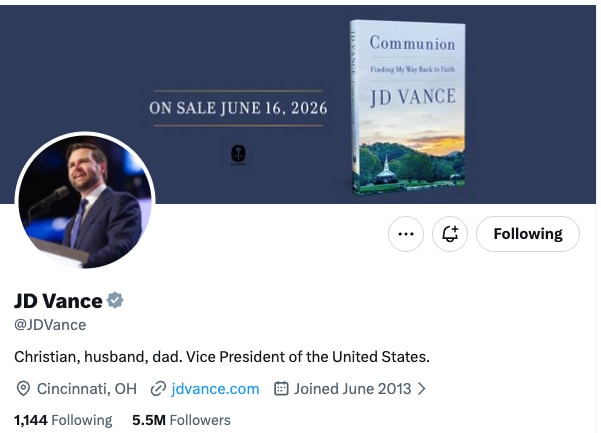
It’s possible that Vance will run a clever dual strategy, Christianism to win the primary and economics and national identity during the general election. Even if he does this, the Dems will portray him as a hardcore Christian fundamentalist, mining Communion for material. More likely, Vance will run on “Christian, husband, dad” all the way. Moment to moment, he might recognize the unpopularity of such a message, but like the drunk who despairs in his alcoholism and vows to change only to succumb to an inevitable relapse, Vance just loves this stuff too much to keep quiet about it.
One thing I didn’t engage with in this review are the many paragraphs Vance spends giving “intellectual” justifications for his theism. The book’s out there for anyone who wants to read them, though you shouldn’t expect them to be worth your time. It brings to mind a tourist attraction called the Ark Encounter, a full-scale model of Noah’s Ark built in Kentucky by young-Earth creationists. It’s kind of like the Large Hadron Collider, an exercise in taking beliefs seriously. Creationism describes a world, a world that isn’t real, but is a world nonetheless, one you can take inspiration from and use to build something. If, as I hope, our descendants abandon religion, I would like to see the Ark Encounter preserved, a museum to the falsehoods that once held sway over our species. There will be nothing to preserve in the barren ruminations of J.D. Vance’s pseudo-theism, which says nothing and builds nothing.
I’ll end this review by addressing a common argument in Communion: secularism is bad for fertility. It is true that, across many different cultures, the non-religious have fewer children than the religious. But what should we take away from this? If your species won’t breed unless it’s told a bunch of fairy tales about virgin births and talking snakes, the correct takeaway is not “pretend the fairy tales are true,” it’s “this is a major maladaptation that should be fixed with a eugenics program.” But Vance is not interested in eugenics, a word that never appears in Communion. Why develop a new, superior version of mankind when we already have Jim Bob from Appalachia? He’s the pinnacle of our species, a real solid family man, and fully capable of “doing his own research” about everything from vaccine safety to economic policy to the age of the Earth. And if he does have problems, well, we all know who to blame, *you* dear reader, for not believing in God.
P.S. Vance, it should be noted, has almost surely heard the pro-eugenics argument. He writes in Communion about a friend who self-identifies as a Nietzschean and calls Christianity a “slave religion.” This person is very likely a fan of eugenics, as are others in Vance’s BASED milieu.
Discuss
Popular Products
-
 Orthopedic Shock Pads For Arch Support
$71.56$35.78 -
 Remote Control Fart Machine
$80.80$40.78 -
 Adjustable Pet Safety Car Seat Belt
$57.56$28.78 -
 Adjustable Dog Nail File Board
$179.56$89.78 -
 Bloody Zombie Latex Mask For Halloween
$123.56$61.78