Lit Hub Asks: 5 Authors, 7 Questions, No Wrong Answers
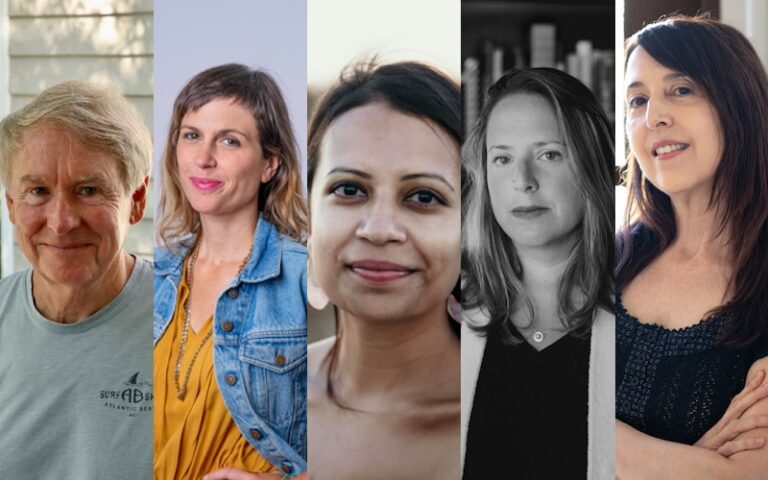
The Lit Hub Author Questionnaire is a monthly interview featuring seven questions for five authors with new books. This month we talk to:
Ben Fountain (Rasputin Swims the Potomac)
Courtney Maum (Alan Opts Out)
Nayantara Roy (Sisters of a Halved Heart)
Hannah Selinger (Valley of the Moms)
Deb Olin Unferth (Earth 7)
*
Without summarizing it in any way, what would you say your book is about?
Ben Fountain: A few people trying to hold on to their sanity in the midst of a really bad acid trip into American politics of the here and now.
Courtney Maum: Competitive grass heights. Domesticated lobsters. Retail therapy gone awry. Advertorial campaigns for cow’s milk. Daily life in one of the country’s most exclusive neighborhoods. Children who are more adult than their parents. Trying to reclaim one’s humanity in an inhuman age.
Nayantara Roy: Love. Unreliable narrators. Bad decisions. Music. The promiscuity of grief. The reverberation of a single lie. The extreme pedestals we put some people on. What makes a thing, an emotion, a feeling go viral, then eat itself whole. Gin. Sex. An unchastity. The American dream.
Hannah Selinger: Wealth and power in small towns and how these forces define who we are and the decisions we make. The concept of equity in postmodern America. Petty grievances. And also: marriage.
Deb Olin Unferth: The strange technological band-aids we are coming up with to try to keep civilization going in the face of climate change. The elegance of the natural world. Transience. Insignificance. Love. The great cosmic forever. Sand. Souls.
*
Without explaining why and without naming other authors or books, can you discuss the various influences on your book?
Courtney Maum: Too many choices in the dairy aisle. Dunkin’ Donuts getting rid of “Donuts” in their signage. Endless rebrands, remakes, resets. Desperately wanting a time out from the professional and financial pressures in my life. Desperately wanting to live for a year in a river shack in northern Florida with terrible Wi-Fi and no mailing address. All this smushed up against how much I love my fellow humans. I want the best for us. I want to be happy. I want you to be happy.
Nayantara Roy: No one in India in the ’80s was getting divorced—having a half sibling was as rare as a happy marriage. The hedonism of (my own) youth. The extreme sensation of getting dumped when head over heels. Gentrifying Bushwick. Luminous light. Family cannot be left behind, not ever—they live on in your veins.
Hannah Selinger: The Real Housewives of New York City. Billionaire culture. Groucho Marx. Boxford, Massachusetts. LifeTime Fitness.
Deb Olin Unferth: The 1960s space-age craze. Recent scientific revisions to the Big Bang Theory. Climate change activism. Billion-dollar ideas about how to live forever. The question: what is death? The question: do we matter?
Ben Fountain: Whoever and whatever was or is trying to figure out the good and the bad of America, and the ways in which the good, the bad, and all variations thereof affect our personal and interior lives.
*
Without using complete sentences, can you describe what was going on in your life as you wrote this book?
Nayantara Roy: Day job, hallucinations of long-ago lovers, trolls, the internet, the discipline and urgency of an extreme need to write, publication, vitamins B and D, dinner parties in Silver Lake, melatonin, an engagement.
Hannah Selinger: One book sold and ready to launch. Time on my hands.
Deb Olin Unferth: Covid. Texas deserts. The great Sahara. The Arctic and the 82nd parallel. Conversations with my dear friend Lucy Corin. Lots of reading. Reading and reading and reading.
Ben Fountain: Yardwork (weeds never sleep), our daughter’s wedding, selling and leaving our house of 36 years to move 1,500 miles away, moving into a lightly insulated house built in 1905 and getting through a really cold winter, reading a lot, watching too much TV, trying to filter the news to manageable doses, having a novel come out, sending out birthday cards, buying my friends’ books, a few funerals.
Courtney Maum: Retinal tearing. Lost cat. Identity theft. Tween shopaholic versus her buy-nothing mom. Entrance into the Dead Dad Club. Castelvetrano olive addiction. Rereading The Prince of Tides.
*
What are some words you despise that have been used to describe your writing by readers and/or reviewers?
Hannah Selinger: I don’t think it was very nice that I was called “charmless” and “glib” by a New York Times reviewer last year, since I am very obviously full of charm, and since I am sincere in telling you, not at all glibly, how much I despised that characterization.
Deb Olin Unferth: “Quirky” is the one that drives me a little crazy. That word to me sounds like it implies the work is unserious, light, just for fun, cutesy, cartoonish, lacking in depth.
Ben Fountain: “Meandering.” Though who knows, maybe they were right.
Courtney Maum: I get “gimlet-eyed” a lot. This bothers me for personal reasons because on Thursdays, my late father would have a gimlet, and it did not become him. It made him cranky, so I don’t have pleasant associations with that term. Recently, where a reviewer could have written “gimlet-eyed,” she said that I sank my “white-hot kebab skewer into the high-end grill set” instead.
Nayantara Roy: Unrealistic (when describing bad behavior, perhaps the worst). No, sir, in fact you too may be capable, under the right circumstances. Unlikable. Nothing gets my goat faster than the desire that fiction’s characters, particularly ones who identify as women, reward your preconceived, internalized expectations by being nice/worthy of redemption in the end. To what end, I ask, too often for my own good.
*
If you could choose a career besides writing (irrespective of schooling requirements and/or talent) what would it be?
Deb Olin Unferth: Superwoman. I’d like to save the world.
Ben Fountain: A really successful hunter/finder of shipwreck treasure in tropical waters. A.k.a., tanning for fun and profit.
Courtney Maum: Ranch hand.
Nayantara Roy: I have a day job. But I don’t think it alone would make me happy. I’d like to live somewhere greener, grow a bunch of stuff (a flower, my own carrots, chickens, etc.) and cook for people. So, run something of a B&B. Or if we’re fantasizing, a classical musician.
Hannah Selinger: I don’t know if there is a name for this job, but I would love to be paid to ride on a roller coaster all day. I’d also like to be a doctor. That seems like an important job for which I am woefully underqualified.
*
What craft elements do you think are your strong suit, and what would you like to be better at?
Ben Fountain: I like writing dialogue, though that doesn’t mean I’m any good at it. I would like to get better at everything.
Nayantara Roy: I’m good at visceral feelings, novels of the body, of the weather, and I think, at momentum and a landing. I want to improve my brevity, throw fear into the trash where it belongs, and write the leanest, crispest, most delicious little sentences.
Courtney Maum: I think I’m good at pacing, humor, dialogue, and though it doesn’t come naturally to me, with hard work and revision, I can chart my way to a good plot. I think I’m terrible at landscape descriptions. I know nothing about botany, horticulture, or geology, so writing calm, inceptive landscape scenes is embarrassing for me.
Deb Olin Unferth: I’m good at endings. I build whole novels around my ending and then I work toward earning that ending for years. Conversely, beginnings aren’t really my strong suit. I always struggle and rewrite the first forty pages again and again.
Hannah Selinger: I like to think I have a good sense of how people speak—that my dialogue is natural—and that I capably describe place, which I always regard as sort of an ancillary character in my work. I often struggle with scenes that involve more than two or three characters. I need to work on it.
*
How do you contend with the hubris of thinking anyone has or should have any interest in what you have to say about anything?
Courtney Maum: Concerning yourself with what other people will think about your writing while you’re writing is a surefire way to never write at all. I’m always interested in what other people have to say through art, so I think of my work as joining a conversation that’s already underway.
Hannah Selinger: I don’t. The best we can do is hope that our work impacts a handful of people and take it from there.
Ben Fountain: Oh, that’s easy. I just don’t think about it.
Deb Olin Unferth: Hmm, I have a million daily doubts about myself and my work and my life choices and my abilities, but that isn’t one of them. Maybe it sounds bad, but I do feel like I have something to say.
Nayantara Roy: I don’t. I write the novel because I must, because an unwritable idea has possessed me for a long time, and because it is what I want to read. I tend not to think about publication at all. After it is done, I assail my agent, my now-husband, and friends who are early readers with great doubt and impossible questions.
Popular Products
-
 Automotive CRP123X OBD2 Scanner Tool
$649.56$324.78 -
 Portable USB Rechargeable Hand Warmer...
$61.56$30.78 -
 Portable Car Jump Starter Booster - 2...
$425.56$212.78 -
 Electric Toothbrush & Water Flosser S...
$43.56$21.78 -
 Foldable Car Trunk Multi-Compartment ...
$329.56$164.78