The Babies Left Behind In America
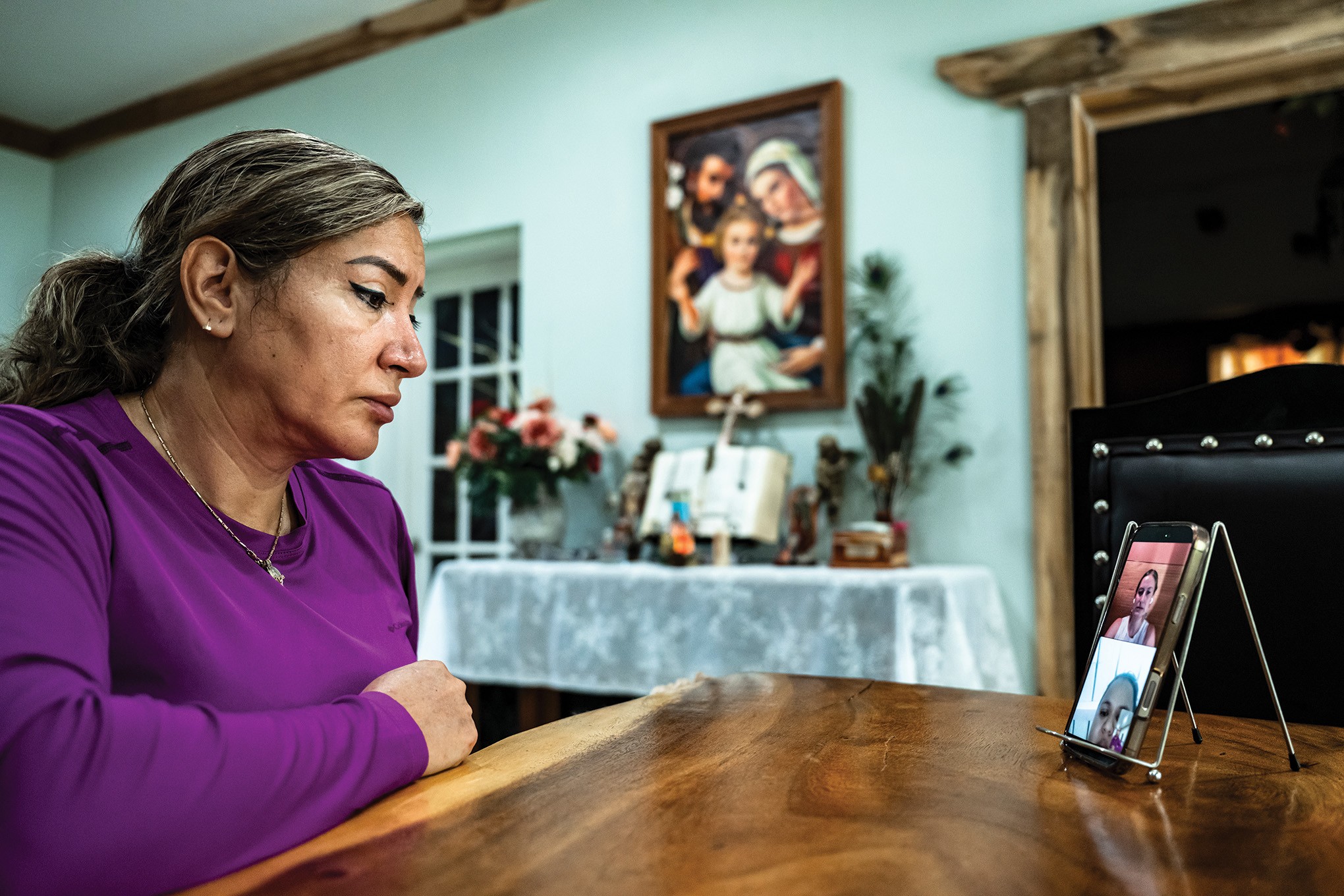
Photographs by Meridith Kohut
Estela Garcia and 2-year-old Eber repeat their routine every morning: Around 8 a.m., he rustles her awake in the bed they share. She picks him up, changes his diaper, and pulls out a fresh set of tiny clothes. While Estela dresses him, Eber coos, “Mama, mama.” She smiles and strokes his cheeks, trying to hide her sadness at his confusion. Estela is 50 and has three sons, but Eber is not one of them. She’s been caring for him because ICE deported his parents to Venezuela, despite his mother’s pleas to be reunited first.
Estela and her husband, Miguel, moved to Mobile, Alabama, 20 years ago to raise their own boys in a place that felt safe and had a slower rhythm than Las Vegas, where they’d met. Miguel works as a remodeling contractor. He spent years developing their four-acre property, building a wood shop, a chicken coop, and houses for two of their children (the third lives 15 minutes down the road). They bought peacocks as pets and planted bright perennial gardens, adorning them with stone fountains. By the driveway, they fly an American flag from an antique tractor. Over the years, their home evolved into a kind of retirement sanctuary—until this past winter, when it started to look like a day care.
A police officer pulled over Eber’s mother, Marlyn, last November and, without accusing her of an infraction, turned her over to ICE, despite her work permit and pending asylum application. Eber, who had just finished breastfeeding, and his 7-year-old brother, Isaac, had nowhere to go. Marlyn’s 23-year-old cousin took the boys briefly. Then two of Marlyn’s friends—both undocumented—agreed to take one child each. Eber was moved into a rusty trailer with no heat; the woman watching him put socks on his hands to keep him warm. He was sick, but she was too scared of ICE to take him to a doctor. Isaac’s caregiver worked nights. Sometimes he made it to school; sometimes he didn’t.
The boys needed a better home. Frantic phone calls among Marlyn’s friends and co-workers eventually led to Estela. They had all worked together at a plant nursery, and Estela was the only American citizen they knew. She agreed to take the boys and then return them to Marlyn, not knowing that doing the right thing would go so wrong: that county officials would end up investigating her for trafficking; that her bank account would dwindle to almost nothing; that Eber would still be in her home, unable to remember his own mother, nearly a year after she was picked up.
“I’ve lost a lot of weight because it’s so stressful,” Estela told me, sitting in her living room. Eber was clinging to her, his face buried in her chest. “My family is like, ‘What have you done?’ ”
President Trump’s rush to deport as many immigrants as possible is creating a new family-separation crisis. Whereas his first administration took children from their parents at the border to deter illegal crossings, the second is separating families living in the United States as part of a purge. Like last time, Trump officials claim that this is untrue. But stories like Eber’s are not hard to find, as I learned this year while reporting on immigration enforcement in Alabama, California, Illinois, Missouri, and Texas.
[From the September 2022 issue: Caitlin Dickerson on the secret history of family separation]
As of April, the Brookings Institution put the total number of affected children at about 205,000—71 percent of whom are U.S. citizens. Most of those cases involve the loss of one parent, a devastating blow to families. But the Brookings researchers believe that more than 35,000 of the cases are like Eber’s, in which a child has been left with no parent at all.
Since the analysis was published, the pace of ICE arrests has increased. In July, the agency arrested a record 49,000 people, a majority of whom have no criminal record, according to a New York Times review of data obtained by the Deportation Data Project. Many of the people ICE is targeting entered the United States legally, through parole programs or by requesting asylum, and were in the process of working toward permanent legal immigration status. (A Department of Homeland Security spokesperson told me the Deportation Data Project’s numbers are “inaccurate” but did not correct them, adding that a pending application for legal status does not shield immigrants from arrest.)
In recent years, ICE policy required officers to either reunite detained parents with their children before deportation or confirm that the children had an official caregiver in their parents’ absence. But in July 2025, DHS revised the policy, sprinkling it with caveats, such as “when operationally feasible,” that appear to allow officers to prioritize the speed and volume of deportations over everything else—including the children whom deportees leave behind.
The result is tens of thousands of children being shuffled among the houses of anxious temporary caregivers. It can take months to procure the passports, visas, and other permissions necessary to transport children to their parents, many of whom have been deported to countries whose governments can’t help, or won’t. This past spring, the United Nations’ International Organization for Migration reunified 12 children with their deported families using funding from the U.S. State Department, according to a UN official, who added that the organization has received requests to help other children, but they lack the proper paperwork.
Some children end up with foster families after caregivers burn out, and some have landed in the homes of abusive relatives or acquaintances. In January, 2-year-old Orlin Hernandez Reyes was left with his aunt’s ex-partner, who was known to be dangerous, when ICE detained his mother. She begged deportation officers to reunite her with Orlin before she was deported to Honduras, but that didn’t happen. Soon after, Orlin’s body was found with broken bones and signs of sexual abuse, and his caregiver was charged with murder. (He has pleaded not guilty.) Then–ICE Director Todd Lyons blamed his mother, saying that she “chose to leave her son here with a violent murderer who took his life.”
Even children like Eber, who land in a safe place, are likely to experience long-term psychological harm from separation. “To have such a huge number of children forced into a traumatic situation because of some policy—it’s really kind of unimaginable,” Wendy Smith, a retired associate dean at the University of Southern California’s school of social work and a co-founder of the nonprofit National Foster Youth Institute, told me. We are “creating a whole class of children who are going to grow up with all sorts of problems.” (The DHS spokesperson said that the agency “does not separate families or deport U.S. citizens” and that, absent indications of abuse or neglect, parents “can choose to take their children with them.”)
There are key differences between the family separations happening now and those of the first Trump administration. In 2017 and 2018, career bureaucrats worked from within the government to try to prevent separations, alert the press when they happened, and reunite families under court orders that high-level DHS officials were trying to defy. But many civil servants deemed insufficiently loyal to Trump were fired en masse during the early months of his second term. Since then, the White House has sent a clear message that pushing back on mass deportation will cost you your job.
Also different: The separations of the first Trump administration were the result of a distinct policy (“Zero Tolerance”) that, once brought to light, could be challenged in federal court. Today, family separations appear to be incidental—the consequence of a ruthless effort to hit a quota, no matter the cost. And this time, people with firsthand knowledge of separations are keeping quiet. Many temporary caregivers are undocumented themselves or have relatives who are; they worry that drawing attention would put their own families at risk. Government and nonprofit workers are also scared to speak up. The White House has attacked organizations that oppose its goals by cutting funding, launching dubious criminal investigations, and issuing retaliatory executive orders.
“In a lot of jurisdictions, people don’t want to write anything down,” Maria Cancian, a Georgetown University economist who co-authored the Brookings study, told me. She and her colleagues spoke with caseworkers in more than half a dozen states who had assisted separated families; they agreed to communicate only because she did not plan to disclose their identities or locations in her report. “Why would you volunteer any information that makes you more of a target?” said Cancian, a former Obama appointee in the Department of Health and Human Services who helped oversee children in immigration custody.
Alabama, where Estela lives, has an estimated 70,000 undocumented immigrants. Many are concentrated near Mobile, where they work at plant nurseries, shipyards, construction sites, and fish-packing plants. On a visit there over the summer, I was barraged with stories of parents swept up in ICE raids, leaving children marooned with relatives or neighbors who were unprepared to care for them. These arrests were a constant topic of discussion in churches, at dinner tables, during school drop-offs. Everywhere I went, cellphones buzzed with information about immigration checkpoints and intersections where local police seemed to be pulling over anyone who was visibly Latino.
A woman named Josefa told me that she and her relatives were taking turns caring for their nieces and nephews—ages 9, 7, and 1—because they could afford only a few days of diapers and extra food at a time. A 15-year-old girl was living alone in a squalid trailer because her father had been detained, and his last paycheck was running out. When Miguel, Estela’s husband, got home from work one evening, I asked if he would call around to co-workers and friends to see if they knew of any other displaced children. “Oh yeah,” the first man he called said. “My wife and I also have two little girls.”
The police officer did not tell Marlyn why he’d pulled her over on a grocery run outside Mobile—but he asked if she was in the United States illegally. She pulled out her phone to show him that she’d attended all her ICE check-ins, and that her asylum case was scheduled to be heard in June.
“The immigration judge wants to talk to you,” the officer said, as Marlyn recalled when I first spoke with her, earlier this summer.
“I don’t understand,” she replied. “I haven’t done anything wrong.”
“Don’t worry, they’re not going to deport you,” the officer said.
Of course they are, she thought.
Marlyn says she asked the officer if they could pick up her children because they were at home with a roommate who wasn’t prepared to care for them indefinitely. He refused. She spent about an hour in the Mobile County Metro Jail, followed by 10 days in an ICE detention center in Mississippi. Then she was transferred to the South Louisiana ICE Processing Center, a 1,000-bed facility 90 miles west of Baton Rouge.
Marlyn’s family had arrived at the southern border in May 2023, as Venezuela devolved into chaos under Nicolás Maduro’s regime. A friend had told them that there was work for new immigrants in Mobile. They rented a house and found jobs—Marlyn at the nursery and her husband, Jesus, at Walmart. In April 2024, Jesus got into an altercation with a co-worker, was charged with a misdemeanor for reckless endangerment, and was deported to Venezuela. With two young children to support, Marlyn leaned on other immigrant families for help. She felt adrift but was getting by, until five months later, when she was pulled over on the grocery run.
At the facility in Louisiana, she spoke with an immigration lawyer who told her that she had virtually no chance of getting out on bail under the Trump administration’s policies. The lawyer said she could spend up to two years detained while she waited for a decision in her case, which she was likely to lose anyway.
Marlyn had heard that people who agreed to be deported could request to be reunited with their children beforehand, so she decided to give up her asylum case. She started sending ICE officials three messages a day—the maximum allowed—asking to be deported with Eber and Isaac.
“I told them, ‘I have my two children. One is a little baby who was born here. I have no one to take care of them. They’re going to be left alone,’ ” she recalled, adding: “They just kept giving the same response—that they were going to work on it. But they never did anything.” (DHS did not comment on individual cases in this story.)
In detention, Marlyn worried about Isaac and Eber constantly. Eber was weak and small for his age; he’d been born with a cyst in his lung that still needed to be surgically removed. She would fear the worst anytime Estela didn’t answer the phone. “It’s agonizing not knowing about your children,” Marlyn said. She befriended other mothers in detention. Some had been there for many months. She saw them faint and have panic attacks. One told Marlyn she had been arrested while taking her 10-day-old baby to the doctor.
Early one morning in February, three months into her detention, a staff member woke Marlyn and said she was being deported. Her time had run out. She had to board a plane back to Venezuela, and leave her kids behind.
Trump’s immigration crackdown has sent countless families into crisis. Sharon Balmer Cartagena, a family lawyer in Los Angeles, has had to deliver bad news to parents over and over, with the help of her colleagues at Public Counsel, the largest pro bono law firm in the country. They told one mother, who’d tried to create an emergency plan in case she was detained, that she’d filed the wrong paperwork in court and accidentally given up her parental rights. They told another mother from Mexico, whose ex-wife had cut off contact as soon as she was deported, that the best she could hope for was one or two weeks of court-ordered visitations a year. And they told a mother from Haiti—who was so scared of being deported that she preemptively moved to Mexico—that she may never see her child again; the estranged father had agreed to care for their 3-year-old temporarily, but then blocked the mother’s phone number as soon as she arrived in Mexico. “We had to explain to her, ‘There’s nothing we can do. You have no viable pathway to regain any kind of contact with your child,’ ” Cartagena told me. “It was horrific.”
[From the April 2026 issue: Caitlin Dickerson on how the Cruz family decided to self-deport]
These cases fall into a gray area between immigration law and family law. This means that many of the families ICE is separating will need not one but two lawyers to try to get their children back—and there isn’t enough legal help to go around. Cartagena has tried to recruit more family lawyers to help with immigration cases, without much success. “I’m trying to be like, ‘Everybody, there’s a family-law emergency here!’ ” she said. “Everyone’s busy.”
Cartagena grew up in Reading, Pennsylvania, one of the poorest cities in America, and saw how much her classmates were traumatized when child-welfare agencies broke up their families—often because the adults were too poor to provide for their children, not because they were unfit parents. She went to law school hoping to help children in foster care. Her career has tracked a period of growing consensus that this kind of family separation often does more harm than good; foster-care systems around the country have been shrinking and state agencies have been directed to keep children in their home whenever possible. But under the first and second Trump administrations, separations have become more common for parents who are detained by immigration authorities.
Cartagena first discovered how complicated these separations were in 2018, when she became a directing attorney at Public Counsel. Immigration lawyers started contacting her, asking for help with clients who had been separated from their children under the Zero Tolerance policy. The parents had been allowed to return to the United States under a federal-court settlement, but enough time had passed that some children had been deemed wards of the state, while others had new legal guardians. Family-court judges were blocking their reunifications. Cartagena explained that family courts exist to protect children whose parents have been accused of abuse or neglect; the system is not set up to deal with parents who face none of these allegations but lose custody because they have been deported. She helped one mother regain custody of her teenage daughter, but the process took more than a year. Others never had their parental rights restored.
When I first spoke with Cartagena this year, she was working with a mother named Magdalena Callejas, who had full custody of her 4- and 6-year-old children in March 2024, when she was arrested at a Border Patrol checkpoint in Texas. Magdalena had a pending visa application. Her ex-partner was undocumented, with multiple DUIs; Magdalena had a restraining order against him for abusing her and her son from a previous relationship. But after ICE detained her, he took the 4- and 6-year-old back. She was powerless to stop it.
Magdalena says she asked ICE officials to reunite her with her children but was told the agency “did not do that.” She agreed to leave the country voluntarily, hoping to get her children back as soon as she arrived in El Salvador. In the meantime, her ex filed for custody. An immigration lawyer who met Magdalena in detention contacted Cartagena, who explained that because Magdalena was unavailable to care for the children, the father was within his rights. In court, Magdalena’s ex argued that he was a changed man, and that unsafe conditions in El Salvador outweighed his criminal past. The trial dragged on for months. The judge ordered the children into the custody of a neutral caregiver; when she was no longer willing to help, the judge sent the children to another home. On video calls during the father’s court-ordered visits, Magdalena’s children used a shorthand to tell her that he was still drinking: “Dad went to get some juice.”
Cartagena shared all of this with the court but still didn’t know how the judge was going to rule. Most family-court judges aren’t familiar with immigration law, or accustomed to granting custody to a parent in another country. The longer a separation lasts, the harder it is to reverse; Cartagena said that family-court judges often defer to the status quo rather than disrupt a child’s living arrangements a second time—even if it means keeping them from their biological parent, or a parent who is more fit to care for them. Despite Magdalena’s ex’s history of abuse, Cartagena worried that she could still end up permanently separated from her children. “If she doesn’t win,” Cartagena said, “what do I tell everyone else?”
A judge eventually ordered that Magdalena’s children be returned to her in El Salvador after a 30-day legal stay to allow her ex-husband to appeal. He had stopped submitting weekly alcohol tests, which Cartagena believes may have swayed the judge. But that same day, the children’s caregiver said she was fed up. She was going to drop them off at a police station if no one retrieved them. So even though the judge renewed Magdalena’s five-year restraining order against her ex, he also ordered the father to pick up and care for the children until Cartagena could raise money and find a volunteer to transport them to El Salvador. There was nowhere else for the children to go but back to their father.
Cartagena has a tattoo on her wrist of a mama bear and two cubs—one for each of her children, who are 11 and 14. “I couldn’t imagine if I couldn’t see my kids or I didn’t know where they were,” she said. Sometimes the best advice she can offer detained parents is to get their children out of the United States as quickly as possible, before anyone can intervene. She’s helped procure travel documents and recruit volunteers to shuttle children across borders to their deported parents, including an 18-month-old and a 3-year-old who were sent to Peru in May. She also ghostwrites emails to ICE on behalf of immigration lawyers who want to pressure the agency to reunify families before a parent is deported. Since Trump took office a second time, she has started waking up to answer emails at 5 a.m. instead of 6. She works every weekend. And she began raising money so that Public Counsel can start a five-person division focused on immigrant-family separations. “We’re all doing this on top of our regular work,” Cartagena said. (She recently became the executive director of LevittQuinn, another family-law legal-aid organization in L.A., but will continue partnering with Public Counsel in her work on immigrant-family separations.)
She and her colleagues have held dozens of trainings across Los Angeles for immigrant parents. I attended one at an elementary school in Boyle Heights, an immigrant enclave and a hot spot for ICE raids. A dozen people sat in plastic chairs, their eyes darting to the door each time someone entered. One of Cartagena’s colleagues told the group to be careful about paperwork; well-meaning immigration lawyers had been giving clients a “temporary guardianship” form, which isn’t valid in some states. She urged the parents to arrange a caregiver, a backup caregiver, and a backup for the backup. People burn out or give up, and if there is no plan, the children are left in limbo.
A mother raised her hand. “The only people I know are like me,” she said. “They’re also undocumented.” Another said: “I don’t have anyone. What do I do?”
I found a family with no backup plan in the spring, when I went to Honduras to interview deportees as they arrived by the planeful from ICE detention centers. A father named Edwin said that after three years of meticulously following the government’s requests to further his family’s asylum case, his wife, Sarah, was thinking about going into hiding; she didn’t want to be picked up by ICE and have to leave her children alone.
[Read: A new kind of family-separation crisis]
When I went to visit Sarah in May, in a Dallas suburb, her 4-year-old son, Johnny, answered the door and asked me: “Do you know when my dad is coming home?”
Before I could answer, Johnny continued: “Do you know what happened to him?” He repeated versions of these questions over the two days of my visit. “Do you know where my dad is? Do you know if he’s okay?”
When the questions would start, Johnny’s 12-year-old sister, Katie, tried to distract him with coloring books and screens. Recently, he’d had an hours-long meltdown when Sarah tried to donate some of Edwin’s work clothes that were crowding the closet. Every afternoon he sits at the front window waiting for his dad’s truck to pull up outside.
While reporting this story, I talked with other families with credible asylum cases who were considering going underground to avoid being separated from their children, knowing that it would likely sabotage their chances of ever gaining legal status. This is the bracing irony of Trump’s deportation campaign: Its goal is to crack down on lawbreaking, but its implementation is encouraging it. Immigrants who have complied with the law are being targeted, and they are choosing to hide, despite the fear and stress, because the alternatives are worse: abandoning their children, or being deported with them to dangerous places.
Sarah and Edwin have been running from MS‑13 since 2013, when Sarah witnessed a murder in Honduras. Gang members wrongly assumed that she had testified against the killer and started threatening her. In 2022, they showed up at a relative’s house and killed a young woman, likely mistaking her for Sarah. She and Edwin decided it was time to go. They requested asylum and were admitted across the border during the Biden administration and moved to the Dallas suburbs. Edwin started working in construction and Sarah worked nights as a janitor. They rarely saw each other, but their schedules ensured that one of them was always home with the kids. (I’m using pseudonyms for this family because of ongoing threats.)
In January, the four of them went to an ICE office for a routine check-in. Edwin was detained without explanation. Sarah and the kids were distraught, and hoped it was a mistake. She planned to sell their cars to cover the cost of Edwin’s bond, but then he was transferred from a detention center in Texas to one in Mississippi. There, he checked the agency’s online portal for detainees and saw that he was being deported for allegedly skipping a court appointment that he had not been given the chance to attend. (The DHS spokesperson said the agency affords immigrants due process.)
“If we hadn’t gone to the check-in, my husband would be here,” Sarah told me. “It would have been better if we did things the wrong way.” Without Edwin, Sarah felt forced to take a series of risks. She didn’t have a license but started driving herself to work, because she was now solely responsible for paying the bills. She skipped her next check-in with ICE and, knowing that officers might come looking for her, moved apartments without telling the government. She started leaving Katie in charge of her younger brother while she was at work. “My daughter’s teacher said I shouldn’t tell anyone, because they could be taken away from me,” Sarah said.
Without child care, Sarah installed cameras in the apartment and watched the kids on her phone, in between cleaning toilets and vacuuming. Katie would fall asleep as soon as she left for work. Johnny, who was used to sleeping in his father’s arms, would pace the house every night. One time, Sarah saw him jamming an air freshener into an electrical outlet, which started to spark and smoke. Katie slept through the sound of her mother’s phone calls.
Sarah changed her schedule to work one overnight shift during the week and double shifts on Saturdays and Sundays. Edwin started watching the children on video calls from Honduras while she was gone. On the first evening that I visited, he called while she was making dinner. “Have you eaten, my love?” she asked him.
“Not yet. I’m still working,” he said. Then he pointed the phone at a young man crouched on a hillside just outside the house, looking over the village below. “They’re here watching.”
“Put it down! Put it down!” Sarah told him. “Don’t let him see you.”
MS‑13 patrols their community, setting curfews and extorting people. Sarah and Edwin weren’t sure if the gang had realized that he was back. They were looking for a place to hide if Sarah ends up being deported, but nowhere in Central America seemed safe.
Sarah scarfed down some shrimp pasta. Katie cut Johnny’s food and tried to keep him in his chair. “She’s become my right hand,” Sarah told me of her 12-year-old. She looked at the clock and determined that she had time for a quick nap. She went into the bedroom and set a timer on her phone for 27 minutes. Katie started doing the dishes. She packed some leftover pasta into a Tupperware container for her mom and placed it in Sarah’s backpack with two bottles of water and a ziplock bag of cookies.
Sarah sprang up when her alarm went off. Her eyes were red and wet. She threw on her uniform—khakis and a polo shirt—and brushed her hair back into a ponytail. She called the kids into the bedroom and told them to put their pajamas on while she did her makeup. They climbed into bed and Katie dialed Edwin, then propped her phone up against a lamp so that he could watch them after they fell asleep. A minute later, Johnny was out of bed, pacing. When Sarah finished getting ready, she gathered him in her arms and placed him next to his sister. She looked into the camera at Edwin and said, “Okay, you’re in charge now.”
Marlyn has been living a version of Sarah’s nightmare since she arrived back in Venezuela in February, with video calls as the only portal to her children. She and Jesus moved back into their family home in Guanare, a small city about six hours by car from Caracas. Jesus struggled to find work and Marlyn spent most of her days trying to figure out how to reunite with her sons.
Back in Mobile, Eber demanded to be held constantly, screaming every time Estela put him down. Isaac would hyperventilate and hide anytime someone mentioned ICE. He started acting out in school. Estela was called in for a meeting with his teachers, during which she explained that she was trying to figure out how to get the boys back to Marlyn. This only seemed to make things worse. A county social worker showed up at her house unannounced, asking questions: Where were the boys sleeping? What did they eat? Did they have clean clothes? A few days later, the social worker called and threatened to take the boys from her. “You don’t know what you’re getting yourself into,” the social worker said, according to Estela. “If you don’t have custody and their parents aren’t here, the state has the right to take them.”
“I just wanted to do something good,” Estela told her, “and everyone is making it seem like I’m doing something wrong.”
She called Marlyn in a panic. After her own experience in detention, Marlyn was terrified of her children ending up in government custody. Estela tried to reassure Marlyn that she wouldn’t let anyone take the boys. But she was also scared that she might not be able to stop it from happening. Tension was building between the two women. Estela despaired about giving up her life to take care of Eber and Isaac. All of her time, and a lot of her money, was going toward the boys’ needs: clothes, school supplies, food, medication. Marlyn, who had no way to repay her, was grateful for the help and embarrassed by how much she needed it. She also worried that her children were becoming too attached to Estela. “She was scared I would keep her kids,” Estela told me. “I said, ‘No, I would never do that, because I’m also a mom.’ ” But she knew that sending the boys to Venezuela could traumatize them all over again. She put Eber in day care so they wouldn’t grow too close.
Eber couldn’t travel until he’d had lung surgery; his doctors said the cyst would become cancerous if it wasn’t removed, and getting the procedure in Venezuela would be nearly impossible. And no airline would be willing to fly Isaac out of the country without a legal guardian or passport.
Estela made dozens of calls to lawyers and nonprofit groups. She contacted ICE offices in Georgia and Alabama but received no response. Finally she reached an official in Chicago who said that if she turned Isaac over to the government, he could be deported back to Venezuela within a few weeks. It seemed like the only option.
Estela asked Isaac’s father to explain the plan to his son over a video call. Jesus told Isaac that he was going to a shelter with other children who were waiting to be returned to their parents. “You are going to be okay,” he said. “Nothing bad is going to happen to you.” Marlyn and Estela repeated the reassurances until Isaac was willing to go.
In late April, Estela loaded a backpack with clothes and snacks. The next morning, she put a piece of paper with phone numbers into Isaac’s shirt pocket and told him not to lose it. She drove him two and a half hours to the closest ICE field office, in southern Louisiana. They said they loved each other. A couple of hours later, she got a text from ICE saying that Isaac was on a plane to a foster home in Texas, where the 7-year-old would wait until he could go before an immigration judge and formally request “voluntary departure” to Venezuela.
Estela returned to Mobile, and to Eber’s more complicated situation. He needed surgery, and his travel would be harder to arrange than Isaac’s. He was a U.S. citizen, so he couldn’t enter Venezuela without a visa—which requires a parent’s permission and usually their presence. Meanwhile, most construction work around Mobile was on hold because workers were too scared to leave their houses. Miguel’s business was suffering, but Estela couldn’t help, because she had no time to work.
And soon after she began to look into travel documents for Eber, the police started showing up at her house.
The sheriff’s deputy at the door said he was looking for Isaac. Estela started to explain the situation all over again, but her heart was racing. She worried that the officer didn’t understand or believe her, so she called Shaina Simenas, a social worker at the Young Center for Immigrant Children’s Rights. “Okay, put him on the phone,” Simenas said. She told the officer that Isaac was in federal custody and that ICE had deported both of his parents. He seemed satisfied, but officers returned to Estela’s house twice, until finally Simenas persuaded the department to close its investigation.
The Young Center normally advocates for unaccompanied children in their immigration proceedings, but when family separations began to accelerate after Trump took office for the second time, it assigned a team of six to focus on them. Since then, they’ve worked on more than 150 cases and have a growing waitlist. “It’s a drop in the bucket compared to the need,” Kelly Kribs, one of the team’s co-directors, told me.
Even without advertising this work, the Young Center has been overwhelmed. Some children and detained parents have found them by word of mouth. “We got a call from a 17-year-old boy a few weeks ago who was looking for help because his mom was his only caregiver, and he’s couch surfing in upstate New York,” Kribs said. “I think he Googled us.”
Kribs and her colleagues have tried to advocate for a number of women who were still breastfeeding when they were detained, despite an ICE policy against such detainments outside “exceptional circumstances.” One mother from St. Louis who had no criminal history was detained at three months postpartum. ICE ignored the Young Center’s request to release her under the policy. It took days for Simenas and a colleague to set up an account on the detainee tablet system, so she could message her family. “She went weeks without even seeing her infant because of how nonfunctional the system is for these families,” Simenas told me.
The Young Center has also tried to support temporary caregivers who are so overwhelmed that the children are unsafe. Kribs told me about a man in Florida who’d had to quit his job to care for five children, including a six-month-old, after their mothers—the man’s girlfriend and her sister—were detained. He had no income to pay for food and diapers. “He was father to none of these children,” Kribs said. One Illinois woman taking care of a 5-year-old boy whose father had been deported to Mexico was so financially strapped that she became homeless; she sent the child to sleep at a friend’s apartment while she lived in her car. Kribs eventually persuaded ICE to transport the boy back to his father. But first she had to send the caregiver $20 in gas money so the boy could be handed off.
On rare occasions, Kribs and her colleagues have transported children themselves, as in the case of a 13-month-old girl they ferried back to Mexico last year. Kribs said the reunion was bittersweet: The baby’s mother was waiting at the airport with balloons and a giant stuffed animal. But the little girl, who had spent more than half her life separated from her mother, didn’t seem to recognize her.
Now that ICE is almost solely dedicated to maximizing deportations, Kribs said, few people are left at the agency who will listen to their concerns. When possible, the Young Center tries to work with contractors to encourage ICE to comply with the policy on reunifying parents and children, or sorting out custody before deporting them. But not every detention center has enough staff to handle those requests, and some are busier than others. Kribs said that trying to appeal to deportation officers, who are under the most pressure to hit the president’s numerical goals, is especially challenging. One officer admitted to her that he thought it was “just so much easier when they leave their kids here,” she recalled. “Like it’s a logistical headache for them to try not to separate families.” (DHS did not comment on this claim.)
Separated parents have told me their pain is all-consuming. Before she was deported, a mother named Lucía called me from the South Louisiana ICE Processing Center, crying about not having seen her 14-month-old and 3-year-old in three months. She said it was excruciating not being able to explain to them why she was gone. “They’re babies,” she said. “They don’t understand.” Lucía said that most of the women around her were in similar situations. Some had a spouse who was with their children, but other kids were staying with extended relatives or acquaintances. “In this room where I am,” she said, “there are 56 of us, and the majority are moms.”
After just over a month in federal custody in Texas, Isaac landed at the airport in La Guaira, Venezuela, in May. When Eber had his surgery, also in the spring, Estela spent three days and nights in a chair next to his hospital bed. She sent pictures to Marlyn and Jesus to keep them updated. Marlyn said very little in response. Not being able to be with Eber had left her speechless. “Thank you, Estela,” Jesus replied in one message. “I don’t know how, but one day I’m going to repay you for everything you’ve done for my son.”
Estela promised Marlyn that she wouldn’t hand off Eber to another caretaker, and that she’d get him back to Venezuela. But she’s exhausted. She feels like she’s neglecting her sons and her husband. Recently their bank account was down to $27. She used to go to church four times a week, but now manages just one. In the pews, she asks God to allow Eber to return to his family, and for the patience to keep caring for him in the meantime. “This baby needs to be with his mother,” she said.
During a video call with Marlyn in August, he sat on a couch next to Estela, picking Lucky Charms out of a bowl. For 10 long minutes, Estela cajoled him to say hello or blow his mom a kiss. He only glanced at the camera, and didn’t seem to recognize Marlyn’s face or voice.
When I speak with Marlyn by phone now, her speech is slow and soft, almost zombie-like. She says she can’t sleep. Venezuelan officials said that they would add her name to a list of parents who need their children back from the U.S., but they have not given her a timeline for Eber’s return. She calls them every day, but they tell her to keep waiting. She stays in touch with mothers she met in detention, and they update one another on trying to get their children back. So far, Isaac is the only success story among them. Meanwhile, Marlyn didn’t see Eber’s first steps or hear his first words. He was so fragile the last time they were together. Now he’s much bigger, with a mischievous smile that she’s never seen in person. He launches himself into bear hugs that she’s never felt. Even if he makes it to Venezuela, they’ll never regain the time they lost. “I’ve missed everything,” she said.
This article appears in the November 2026 print edition with the headline “The Babies Left Behind in America.”
Popular Products
-
 Orthopedic Shock Pads For Arch Support
$71.56$35.78 -
 Remote Control Fart Machine
$80.80$40.78 -
 Adjustable Pet Safety Car Seat Belt
$57.56$28.78 -
 Adjustable Dog Nail File Board
$179.56$89.78 -
 Bloody Zombie Latex Mask For Halloween
$123.56$61.78