The Capital Is A Mess
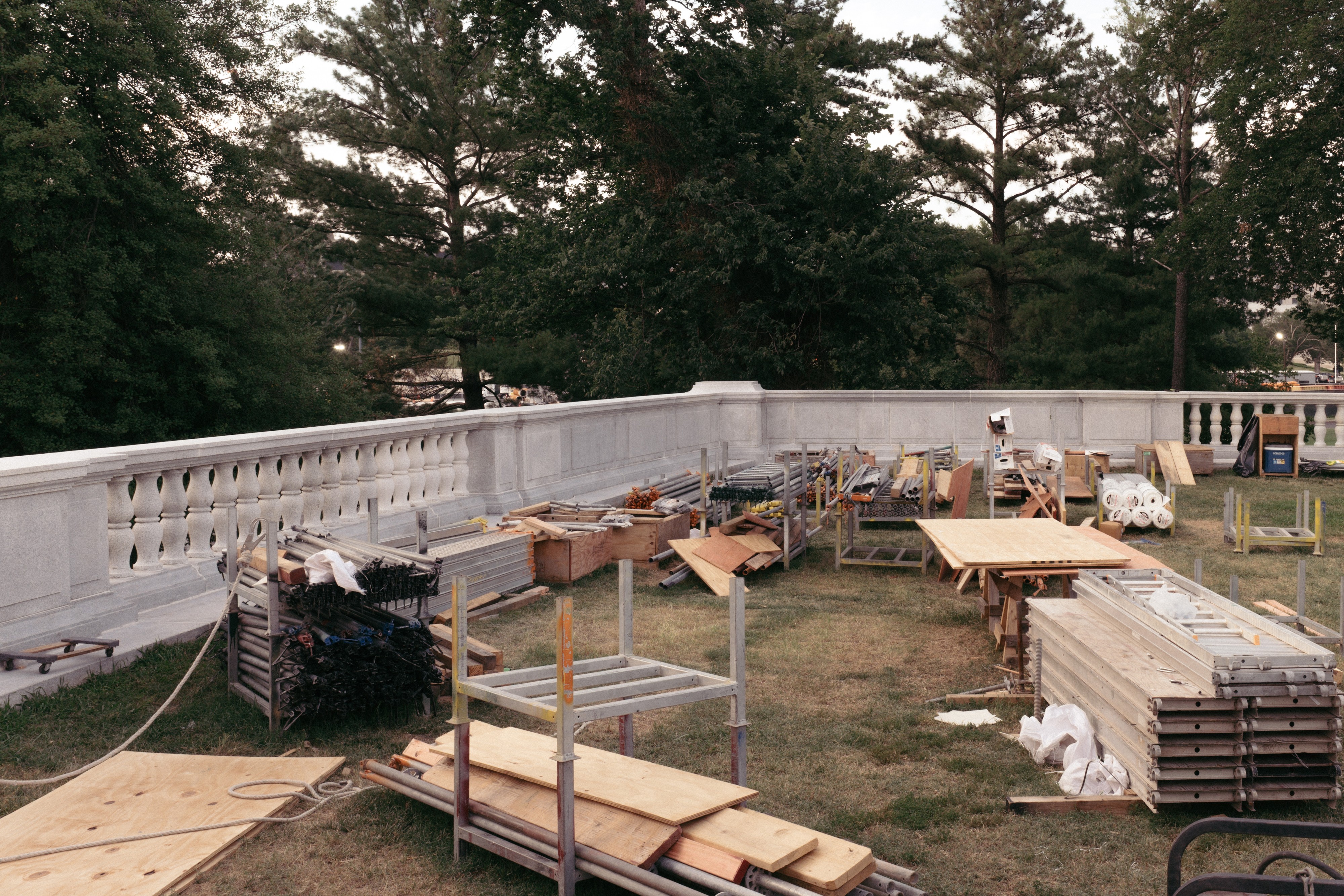
Photographs by Caroline Gutman
The capital city is an absolute mess.
The White House is an active construction site, with cement trucks going through the same gates typically used by the president’s armored limousine. There’s a gaping hole where half of the building once stood, a project held up by lawsuits. The South Lawn and the Ellipse, a 52-acre park between the White House and the Washington Monument, are completely torn up. The once-green grass where a temporary arena held a bloody UFC fight last month has turned brown. It looks like a demolition derby took place.
The Reflecting Pool is a murky shade of green, despite a multimillion-dollar renovation to repaint it American-flag blue and mitigate its algae problem. It is now surrounded by fencing and ominous signs that read DANGER EXPLOSIVES and show a bomb being detonated. Ducks that died in the water are being tested.
The National Mall seems to be wrapped in a variety of fencing, some of it in place for construction reasons, some of it to create a security gantlet for the July 4 celebration. At East Potomac Golf Links, at nearby Hains Point, is a massive pile of dirt that some golfers have dubbed “Mount Trump,” taken from the East Wing debris in preparation for a golf-course redo. The Federal Reserve is under construction, as are various roads and bridges, and the Kennedy Center is allegedly in disrepair—and now has an odd contraption of scaffolding and flame-retardant tarps covering its signage at the main entrance like a giant Band-Aid. There are construction cranes, National Guard troops, and portable restrooms everywhere.
Throughout the city, there are government signs proclaiming, We are making DC safe and beautiful. D.C. may be relatively safe, but much of it certainly isn’t beautiful.
Donald Trump has often prided himself on being a builder of grand things. He laid out an expansive vision for Washington, including a gargantuan new triumphal arch in a traffic circle that leads to Arlington National Cemetery. He aggressively took over the 250th celebrations in Washington, redirecting tens of millions of dollars to glam up the tired capital. But so far, he has done more demolition and renovation than construction.
“It’s as if there were a natural disaster, and we’re looking at the damage after a hurricane. Or think of Manhattan after the World Trade Center was hit by an act of terrorism,” Charles A. Birnbaum, the president of the Cultural Landscape Foundation, told me. “If you were just to parachute into Washington, you’d say: Gosh, what happened here?”
Happy birthday, America.
When Trump was getting his start as a developer in New York in the 1980s, his attention to detail could be difficult to manage, Barbara Res, who oversaw construction for the Trump Organization and was placed in charge of building Trump Tower, told me. He kept tinkering with the design of his apartment, she said, making changes that stretched the patience of the architect. He didn’t like the braille markers in the elevator and wanted them removed from the designs. (They ultimately stayed, she said.)
Plans for the Trump Tower atrium and lobby called for a collection of ficus trees, which Res said were grown in Florida for a year and a half, with an employee dispatched every so often to check on them. Workers constructed a special tunnel to bring the larger ones into the building, in Midtown Manhattan. Once Trump saw how the specially grown trees blocked views in the atrium, leaving those on higher floors unable to see the pink marble floor and indoor waterfall below, he realized that they were a mistake.
[Read: Trump’s other paint job]
“One by one, he made us cut those trees,” Res said. “We begged him, Don’t cut down the last tree.”
Every ficus tree in the atrium was gone, but Trump allowed four to remain in the lobby. Years later, when their leaves eventually fell off, workers attached fake leaves to the real trees. Trump was probably right that cutting down the trees made the atrium look better, Res recalled. “He interfered, is what he did,” she said. “But he let us do our work. He respected us. Now he doesn’t respect anyone.”
In Washington, Trump’s dreams have been slowed by lawsuits. The Cultural Landscape Foundation, Birnbaum’s Washington-based nonprofit, has filed a challenge to Trump’s renovations to the Reflecting Pool and joined as a co-plaintiff on suits related to the president’s plans for the Kennedy Center and a “National Garden of American Heroes” in West Potomac Park. Trump’s proposals for a ballroom and an arch also face legal challenges. Some of the suits are aimed at proving that the Trump administration is avoiding the normal review process for federal projects that would reshape the capital landscape in ways that it hasn’t been in decades. Birnbaum said that he has been “gobsmacked” that the careful layout of the city and the legal protections that have been in place for more than a century are being upended.
The desire to give the nation’s capital a fresh look for a big birthday is not unusual: When the United States celebrated its bicentennial, in 1976, the occasion became an accelerant for projects that reshaped the city. But in that case, it was the culmination of planning that had taken years. A reflecting pool in front of the U.S. Capitol building was completed in 1971, and the Hirshhorn Museum and Sculpture Garden was finished in 1974. The Washington Metro system opened its initial, 4.6-mile line on March 27, 1976. The Constitution Gardens, a 50-acre park along the Mall, was dedicated as a bicentennial tribute in May 1976. The National Air and Space Museum opened to the public that July.
Trump has argued that his projects are an emergency and thus need to bypass certain rules that would typically apply. (“We knew the 250th was coming,” Birnbaum countered dryly. “It didn’t sneak up on us.”) This is how the administration gave no-bid contracts for work on the Reflecting Pool, providing $14.7 million to the contractors that installed sealant that has been peeling away, and another $1.7 million for a “high-tech nanobubble ozone technology” that is supposed to combat the algae that grew so rapidly in recent weeks.
Trump is thinking like a developer, seeing open space not as part of a design feature but as real estate that he can try to build upon. White House officials disputed the notion that the nation’s capital hasn’t seen improvements and said that Trump has done plenty to spruce it up. They gave me a lengthy list of improvements that includes the removal of 154 homeless encampments, the rehabilitation of 1,143 benches, the fixing of 1,695 lights, and the cleaning of 28 statues and 45 monuments and memorials. The administration also boasted of installing 134 “rat-resistant trash cans.”
Trump has been particularly proud of the improvements and repairs to 22 water fountains around the city and to the changes he’s made to the White House complex itself. He paved over the Rose Garden’s central lawn and added patio furniture, installed two 100-foot-tall flagpoles on the North and South Lawns, and repaved the colonnade with black granite (Trump said that he would pay for the repaving himself but has instead billed it to taxpayers, as my colleague Michael Scherer discovered). White House officials told me that the more ambitious projects—the ballroom and the arch—will take longer because of federal reviews and the amount of construction required.
“For the first time in decades, America’s capital has been dramatically transformed thanks to President Trump’s commitment to Making DC Safe and Beautiful Again,” Taylor Rogers, a White House spokesperson, said in a statement.
Trump toured several of his projects on Sunday, looking at Lafayette Park and the restored fountains; going on a motorcade ride through Memorial Circle, where he wants to build the arch; and then inspecting the golf course that he wants to redesign. After his tour, he released a 589-word post on social media saying that progress was being was made throughout the city on statues, monuments, and fountains (“Truly beautiful, even nicer than the day they were built”); the Reflecting Pool (“The criminally made algae is gone”); and Lafayette Park (“Has not looked so good since its inception in 1820!”). “We will build one of the Greatest Golf Courses anywhere in the World,” he wrote, saying that work would begin on September 1, although a federal judge has ordered work not to proceed without required approvals and notification.
Don Folden, a 73-year-old, has been stationing himself on the north side of the White House for six years, speaking to tourists through his microphone and trying to convince the crowds to “stop hating each other because you disagree.” But lately, his message has been as much about spreading peace as it has been about handling disappointment. He’s seen one of Washington’s most sought-after photo backgrounds disappear behind fencing and other obstacles. The other day, he shouted: “You came at the wrong time! The other side is closed too!”
The construction has also made the White House, a symbol of American power, seem small. Much of Lafayette Square has been surrounded by fencing for most of the year, with crowds still gathering to get the best possible view they can, though it’s not a good one. “Is that claw thing still here?” one woman wondered aloud during a recent visit, inquiring about the UFC cage that loomed over the White House like a giant spider.
“People are disappointed,” Folden told me. “The one time they come to D.C., and people are surprised to find this. It is discouraging.” He’s hopeful that the end result will be a nicer park. But there have also been security concerns after a series of incidents, and the Secret Service is aiming to install a gating system to quickly secure the area if needed. The National Park Service wants to reopen the park by July 4, although it’s unclear whether it will meet the deadline. When I stopped by yesterday morning, the fencing had been opened slightly to make more space for tourists. Behind the fences, the fountains are working and the grass is green, but I watched as a woman extended her selfie stick above to try to get an unobstructed view.
[Read: What I saw inside the Kennedy Center]
Down by the Potomac River, the Kennedy Center has kept the wrapping over the entrance, where Trump’s name was attached to the marble walls before a judge ordered it removed. A spokesperson for the Kennedy Center would not provide a timeline for when the covering might come down, telling me, “The scaffolding and tarp will remain up as crews address maintenance needs of the marble and soffit panels.” The wrapping also just happens to restrict viewers from seeing that Trump’s name is no longer there. The grand entrance to the building now identifies it as: THE JOHN F. … ORMING ARTS. It’s like an exhibit by Christo, only with scaffolding instead of polypropylene fabric.
Washington Mayor Muriel Bowser described the state of the National Mall as “different” from anything she has seen over her years living in the city, but, she added, “I’ve also never been alive for the 250th anniversary.” On Monday, she urged residents and tourists who want to attend the July 4 celebration to plan ahead and be patient. The forecast is for sweltering temperatures and a possibility of rain. A heavy security presence is expected, and fireworks are not planned to begin until at least 10:30 p.m.—when they will illuminate the not-yet-transformed city below.
Popular Products
-
 Put Me Down Funny Toilet Seat Sticker
$33.56$16.78 -
 Stainless Steel Tongue Scrapers
$33.56$16.78 -
 Stylish Blue Light Blocking Glasses
$85.56$42.78 -
 Adjustable Ankle Tension Rope
$53.56$26.78 -
 Electronic Bidet Toilet Seat
$981.56$490.78