The Decay Of American Journalism In A Disinformation Age
As a historian, I often have the opportunity to teach classes that speak to my research interests. I teach variety of courses on U.S. political history and immigration studies—a subject in line with my reporting background. However, I recently decided to bring together my love of journalism and history to teach a class I billed as “A History of Disinformation.”
Recently, as a visiting assistant professor of history at Oberlin College, I designed a course to ask a fundamental question: What is disinformation, and how long has it existed in American politics?
Disinformation is undoubtedly a hot topic in American politics. Since the Mueller Report’s findings on Russian disinformation campaigns in the 2016 election, scholars and pundits have spilled much ink addressing political disinformation amidst the rise of social media. Disinformation has existed as a political tool for centuries; as Richard Hofstader described in his landmark essay The Paranoid Style in American Politics, disinformation—or the fear of it—has always been a staple of American political discourse and in other democracies like the U.S.
The past decade, however, has ushered in a new disinformation era – one where conspiracy theorist such as Alex Jones or demagogues like Donald Trump and Robert F. Kennedy Jr. develop wealth and power over the peddling of false narratives.
Yet the class is more than just about deception as a tool of political opportunists or hawkers of conspiracy theories. The subtext for the class is a history of American journalism. The history of recent disinformation cannot be understood without seeing how journalism has dramatically changed in the digital age. At its core, the question of disinformation is rooted in the movement of information and our faith in the institutions that disseminate it.
I have a deep interest in how history is presented to the American public—and journalism has often been a means by which historians offered lessons on the past to understand our present. Moreover, journalism offers scholars a unique opportunity to engage beyond the ivory tower and reach the public on important issues. At a time when the historical profession has been attacked by the far right, historians who can share their work with the larger public are urgently needed. For me, that means contributing to local journalism—and fighting the good fight to save it.
One of the challenges both shared by journalism and academia is the ways in which tech—specifically AI—has swiftly undermined the foundations of each profession.
Since the arrival of ChatGPT and other AI programs, historians have not only had to confront the reality that students sometimes use ChatGPT to complete their assignments, but also face the growth of disinformation such as deepfakes. If you were to ask a historian decades from now how to write about media discourse in the age of Trump, the pervasiveness of AI deepfakes on all social media platforms leads one to question which sources are valid and which are not.
American journalism, like education, has been shaken in the past decade by AI. Some of this can be attributed to the restructuring of the newspaper industry and choices made by media owners. Other aspects of the decline of American media originate from changes in technology and the advent of AI. But, most of all, what needs to be appreciated are the consequences of such changes. The rise of AI and deepfakes have not only produced a jaded public which believes that nothing can be trusted, it has led to a media market where conspiracy theorists and far-right media personalities have thrived.
To some degree, this is what journalists and historians alike are trained to do: contextualize sources, decipher bias within records, and produce a fluent narrative of events. In some cases, journalism was influenced by media bias and corporate sponsorship. As historian Julia Guarneri argued in her 2017 book Newsprint Metropolis, several newspapers in Chicago ran articles in the 1910s that promoted products by sponsors—akin to “product placement” and “sponsored content.” Often because the newspaper relied on advertising for revenue, journalists faced the reality that writing a critical report on a company that supported the newspaper had consequences.
At the same time, the 1910s saw the rise of independent publications that engaged in muckraking, or investigative journalism. As James Aucoin discusses in his book The Evolution of American Investigative Journalism, early investigative journalism of the muckraking era (1900–1918) relied on private donations to sustain publications like McClures or, coincidentally, The New Republic. When The New Republic was founded in 1914, its founders, Walter Lippmann, Herbert Croly, and Walter Weyl, relied heavily on the financial backing of heiress Dorothy Payne Whitney and her husband, Willard Straight. A parallel can be seen today with online publications like ProPublica and The Intercept, which rely heavily on donations and subscribers alike to continue their investigative work.
In the current Trump administration, the work of investigative outlets has preserved journalism as a tool to fight corruption. You can see this, for example, in ProPublica’s groundbreaking coverage of ICE’s detention of U.S. citizens, or its deep dive into the financial connections between GOP billionaires and Supreme Court Justices Samuel Alito and Clarence Thomas.
Yet little did I know that the erosion of American journalism would accelerate considerably over the past year.
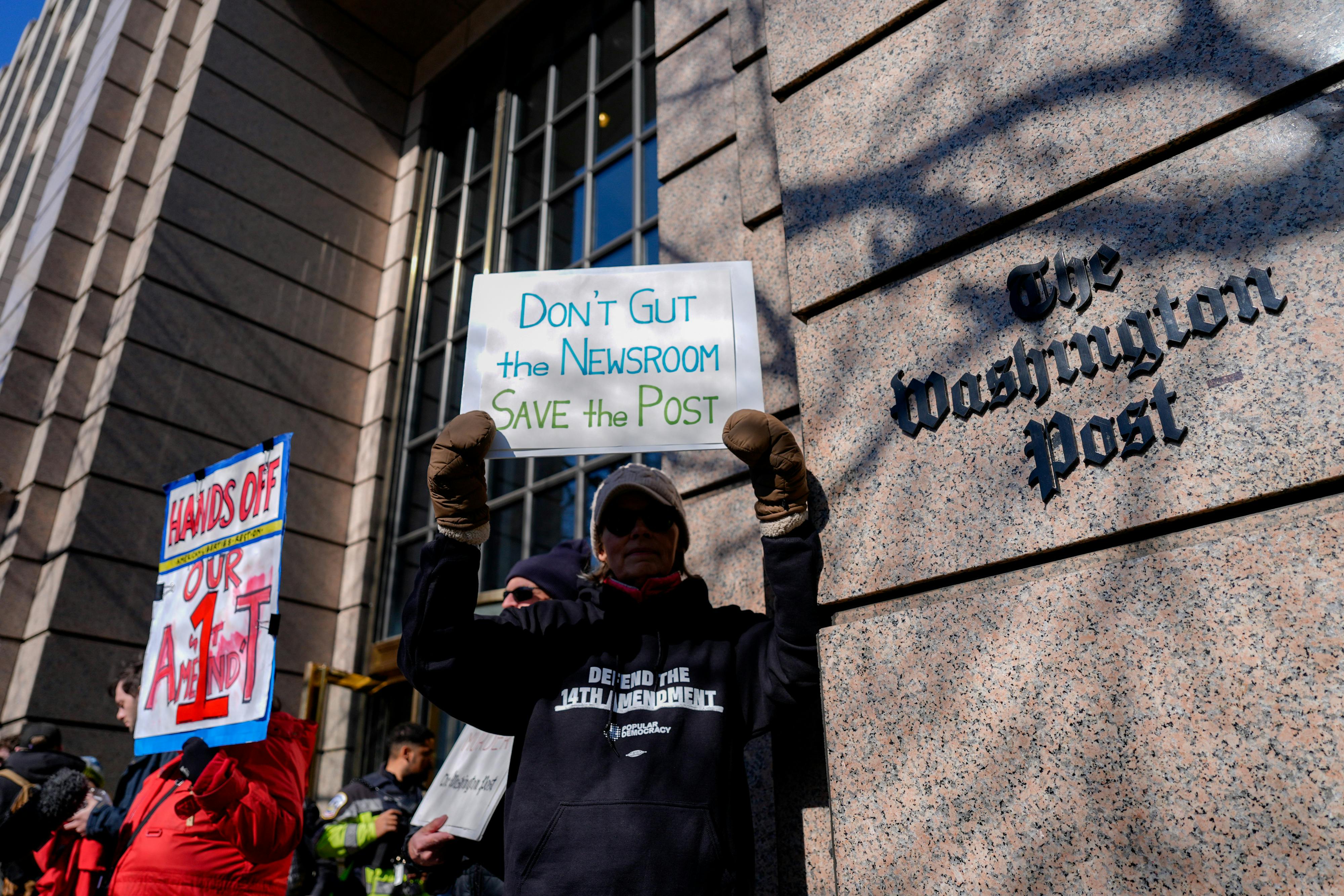
In the past months, many writers have decried the death of legacy media. A great example of this is the recent shakeup at The Washington Post. In 2017, during the first Trump administration, the paper billed itself as a beacon of democracy under the subtitle “Democracy Dies in Darkness,” and became known for its investigative reporting.
Nine years later, the Post is much less that same beacon. Last month, the paper’s owner, billionaire oligarch Jeff Bezos, laid off 30 percent of the staff. The cuts were traumatic on many levels—the paper’s entire roster of staff photographers was let go; one of the paper’s war correspondents found out she had lost her job while on assignment in a combat zone. Many, like The Atlantic’s Ashley Parker, decried the layoffs as the “murder” of the Post and its long-standing reputation.
In a statement to The New York Times, Post editor Matt Murray explained that the paper fell victim to the rise of AI: “The Post was ‘too rooted in a different era, when we were a dominant, local print product’ and … online search traffic, partly because of the rise of generative AI, had fallen by nearly half in the last three years. [Murray] added that the Post’s ‘daily story output has substantially fallen in the last five years.’”
The gutting of the Post is cataclysmic, but not an isolated event. Many newspapers have suffered in the wake of the AI boom. Northwestern University’s Medill School of Journalism found that, as of October 2025, 50 million Americans have limited to no access to local news. In their annual State of Local News report, which documents the status of local newspapers and public broadcasting, found that 136 local newspapers closed in the past year.
And the decline of American media is not only limited to legacy publications. The Medill report also found public radio and television stations are on shaky ground as well, often becoming the last source of news in some areas. At the national level, the historic doom spiral at CBS news under the editorship of Bari Weiss, which has grown increasingly conservative under the banner of “free speech,” has shattered the outlet’s reputation. Whether it has been the censoring of programming, such as pulling 60 Minutes’ investigative report on Salvadoran megaprison CECOT, or privileging interviews with far-right pundits like Erika Kirk, the story of CBS demonstrates the consequences of large media corporations bending toward Trumpism.
But some have argued that the death of American journalism arrived decades before the AI boom and rise of Trumpism. You could go as far back as 2008, when David Simon premiered the fifth season of his revolutionary series The Wire. In it, Simon and company focus on the activities at The Baltimore Sun—Simon’s former employer—and the internal politics of the newsroom amid downsizing and buyouts. Aside from its timelessness in depicting the failures of the “war on drugs,” the show’s fifth season demonstrated how regional newspapers like the Sun spoke to a broader existential crisis in journalism.
A year after The Wire’s fifth season ended, Robert McChesney and John Nichols published The Death and Life of American Journalism. Charting the decline of journalism over the previous 15 years—even before social media had an iron grip on American’s attention—McChesney and Nichols preached to readers that the death of American journalism was occurring rapidly due to the rise of the internet (the authors also referenced Simon’s handiwork repeatedly). By making commercial and entertainment content a priority instead of civic and democratic values, as McChesney and Nichols argued, American newspapers teetered toward the precipice of demise.
Aside from offering a grim outlook on the future of legacy media, McChesney and Nichols offered a sound solution to the crisis—government intervention. Rather than buying up newspapers to become organs for different administrations, the writers argue that government-supported media would offer a means by which local news outlets could report on local events and pursue investigative reportage on local communities.
McChesney and Nichols arguably had the right answer to the issue. Unfortunately, in the 16 years since their book appeared, attempts at providing government support have been far and few. Perhaps nothing illustrates this better than the story of California’s attempt to tax tech companies and use the revenue to support local journalism.
In 2024, I wrote an op-ed for The Sacramento Bee commenting on the importance of the California State Assembly’s legislative initiative Assembly Bill 886, or the California Journalism Preservation Act. Introduced by Oakland Assemblymember Buffy Wicks and state Senator Steve Glazer, the bill would have taxed major tech firms—specifically Google and Meta—through usage fees of news content on their platforms to shore up local newspapers throughout California. Recognizing that many counties in the state had lost local print media outlets, Wicks and Glazer, modeling their bill on similar legislation in Canada, presented it as a means of saving the remnants of local journalism by taxing tech firms that republished local news reporting.
At the time, California had lost a third of all its newspapers across the state since 2005, based on statistical data gleaned from a report by the Northwestern Medill School of Journalism. Worse, as the Los Angeles Times found, the number of journalists in the Golden State had dropped 68 percent. A particularly bitter moment came in January 2024, when Patrick Soon-Shiong, the owner of the L.A. Times, decided to lay off 20 percent of its workforce.
In the weeks leading up to the assembly vote, newspaper organizations such as the L.A. Times, The Sacramento Bee, and the Media Guild of the West endorsed the passage of A.B. 886 and Senate Bill 1327. As Los Angeles Times columnist George Skelton surmised in his column shortly before the final vote in the state assembly: “Weak journalism leads to a sick democracy. A functional democracy must be fueled by a reliable flow to citizens of credible information. The void created by the decline of factual journalism is filled by misinformation.” Both bills enjoyed bipartisan support, ranging from those who wanted to knock Big Tech down a peg to those concerned over the abysmal state of local journalism.
An unexpected turn came in August, when Governor Gavin Newsom intervened. Following negotiations between the bills’ authors and then–Speaker of the State Assembly Tom Umburg, Governor Newsom, and tech representatives, Wicks and Glazer withdrew their bills in favor of a compromise. The new agreement stipulated that Google and the California state government would jointly spend $175 million over five years to create a slush fund toward supporting local journalism. The proposal would require the state to initially contribute $70 million and Google $50 million to a fund housed by Berkeley’s School of Journalism. As part of their contribution, Google’s pledge included $12.5 million earmarked toward an artificial intelligence “accelerator.”
As then–Media Guild of the West president Matt Pearce wrote in his Substack in response to the announced proposal, the deal was a lost opportunity for California journalism: “My conclusion is that this is a pretty rotten deal with no bigger winner than Google, which got to escape regulation for a pittance. Or maybe Gov. Gavin Newsom, who got out of having to avoid vetoing something that his tech friends didn’t like—Newsom won, too. The losers are the journalists, the teachers and anybody else dependent on state money, and the public.” In May 2025, Governor Newsom’s office walked back the initial $70 million to just $10 million, citing budgetary constraints. As CalMatters’ Yue Stella Yu reported in January, the 2026 budget proposal includes no funding for local newsrooms.
California is not always the best microcosm of the U.S. as a whole. But in this case, I would argue it serves as a harbinger for things to come. Local journalism, without government support, will slowly decay as media companies liquidate what assets remain of small newspapers and tech further hooks the American public on its platforms.
As the Medill school found in its studies of American journalism, the disappearance of regional journalism has been the canary in the coal mine for print media, leaving many American communities outside major metropolitan areas in the dark. This is why the destruction of the Post is noteworthy; as many smaller papers have declined across the country, more Americans rely on major city papers like the Post, the New York Times, or the Los Angeles Times.
If, as Joseph Pulitzer once said, “our Republic and its press will rise or fall together,” it seems the two are certainly in a free fall. Our only hope is we can find a parachute in time.
Before I close on a pessimistic note, I would like to give the last word to a journalist.
Terril Yue Jones, a 40-year veteran of the newspaper business who has worked with Reuters, the Los Angeles Times, Forbes magazine and the Associated Press, is no stranger to the changes in the journalism industry. Having reported for bureaus in Beijing, Tokyo, and Paris—he’s uniquely fluent in Japanese, Mandarin Chinese, and French—he has seen it all. Now a visiting lecturer of government at Claremont McKenna College in Southern California, he trains the next generations of journalists for the digital world.
When I asked him what aspiring journalists should expect for the future of journalism, he expressed a more optimistic outlook: “While the future of printed newspapers is in doubt—the Newark Star-Ledger and Atlanta Journal-Constitution are now exclusively online—the future of journalism is solid. New journalists should prepare for an all-digital ecosystem. There will still be hard-copy newspapers for the foreseeable future, but fewer news organizations will print them, and fewer consumers will read them.”
As for his advice for aspiring journalists, he offered this wisdom: “Be hungry, but be realistic. Don’t assume your first job will be in New York or Washington. Some of the best advice for training reporters hasn’t changed in decades: Often the best place is a small, local (possibly remote) news outfit.” Here, Jones is right on where some of the best journalistic work originates—in small communities that are often left out of the spotlight. “Those are places young reporters can learn about covering politics, police, schools, communities, marginalized communities, businesses, sports, and other issues.”
Last but not least, he left with the same advice I leave my students on using AI in lieu of original work: “Never ever fabricate or plagiarize. AI can work for you, but do not have it write for you.”
We both agree that regardless of the changes in the world, journalism will persist: “Who can imagine a society these days without journalism? Citizens and voters (and noncitizens and nonvoters) will still crave and rely on what they feel is unbiased information, whatever their politics may be. Journalists should learn to scrape, analyze and visualize data, make FOIA requests, study foreign languages, and get used to writing on deadline. The more journalists can combine these skills, the more adept and valuable they will be in facing journalism’s challenges.”
Popular Products
-
 Put Me Down Funny Toilet Seat Sticker
$33.56$16.78 -
 Stainless Steel Tongue Scrapers
$33.56$16.78 -
 Stylish Blue Light Blocking Glasses
$85.56$42.78 -
 Adjustable Ankle Tension Rope
$53.56$26.78 -
 Electronic Bidet Toilet Seat
$981.56$490.78