The Deferential President
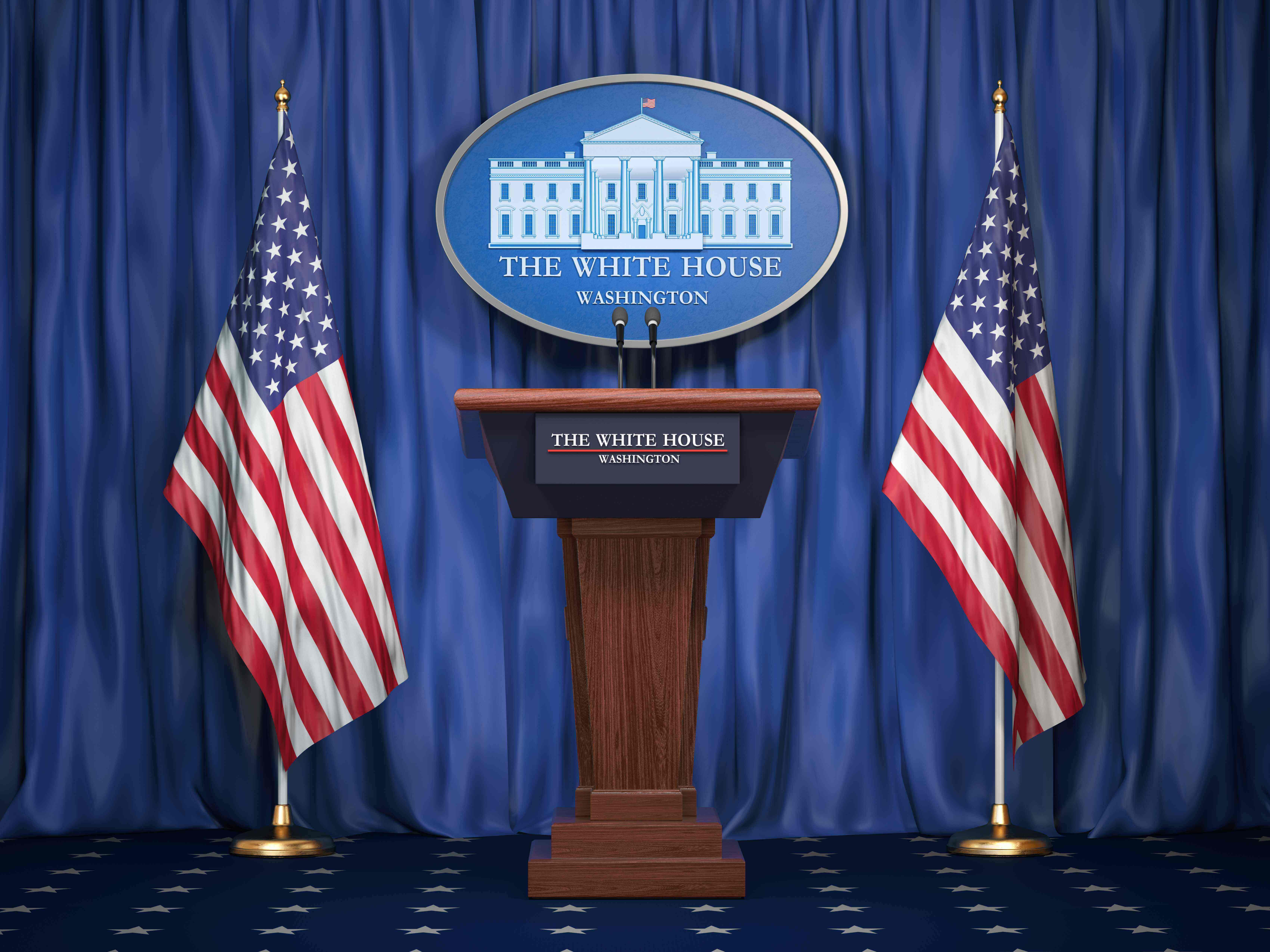
The 747 slowly wheeled to a stop last night on the tarmac of Joint Base Andrews, just outside Washington. Portable stairs were put in position, while a red carpet was unfurled and lined by both American and Chinese soldiers in dress uniforms. After a few minutes, Chinese President Xi Jinping appeared at the aircraft door. He paused and waved. Waiting below, staring up expectantly, was President Trump.
It was a remarkable act of deference. By tradition, American presidents don’t make the 12-mile trip to the base to greet a foreign leader. They instead wait at the White House, backed by the grandeur and power of the executive mansion. But not this time.
Xi did not display the same level of hospitality when Trump visited Beijing in May, and the U.S. president’s gesture suggested that he will take a conciliatory role during the closely watched summit between the leaders of the world’s foremost superpowers. Trump is not expected to push Xi on core issues, including the pace of artificial-intelligence development, Taiwan’s defense, and China’s support for Iran in its war with the United States.
It was not that long ago when Trump, a self-styled international bully, could credibly claim to “run the country and the world.” But he seems far smaller on the global stage now. His speech this week to the United Nations General Assembly, usually a signature moment on any president’s foreign-policy calendar, generated few headlines other than those about his threat to “annihilate” Iran. But even that bluster felt familiar and tired; Trump is stuck in a war he is desperate to leave, and leaders in Tehran seem to believe that he doesn’t have the political will—or the defensive munitions—to authorize a full-fledged return to the conflict. His trade war with traditional U.S. allies has pushed those nations away, leaving them to seek deals and make alliances that cut out Washington. His years-long campaign to commandeer Greenland for the United States ended with little to show for it. He can’t bring the war in Ukraine to an end.
Trump’s foreign policy has never been all that coherent, his isolationism haphazardly mixed with spasms of military intervention. But now his erratic behavior—his threats and bluffs, his emphasis on making money over spreading democracy—has left the United States in retreat from the rest of the world. “Trump has dramatically accelerated the arrival of what can be described as a post-American world,” Richard Haass, who worked in four presidential administrations and then led the Council on Foreign Relations, told me. “He’s reduced U.S. influence by not standing up to our foes or standing with our allies.”
The height of Trump’s power might have been earlier this year on January 3. It was then, under the cover of darkness, that U.S. Special Forces stole into Venezuela and seized the nation’s leader, Nicolás Maduro; by day’s end, Maduro was in a grim detention center in Brooklyn. Trump had deposed a leader who defied him and, later, would get control of much of Venezuela’s oil. An unspoken message went out to other nations: Don’t cross me. You could be next. Trump turned his attention to Greenland, to Cuba, to Canada. The U.S. military seemed capable of anything.
Unfortunately for Trump, he also believed that illusion. Not even two months later, he did what his predecessors had avoided and launched a full-on war with Iran. Teaming with Israel, the U.S. decapitated Tehran’s leadership and smashed much of its military. But the conflict soon bogged down. Iran seized control of the Strait of Hormuz. Energy prices soared. The Pentagon’s bombing campaign lost its effectiveness. Defensive munitions ran low. American bases were hit. Trump alternated among making apocalyptic threats, promising that negotiations had peace close at hand, and declaring that, actually, the war had already been won. (He sometimes did more than one in the span of the same day.) But none of it was true.
[Read: The makings of a prewar world]
The debacle in Iran, which is poised to drag down Republicans in the upcoming midterms, underscored some hard truths about America’s new standing in the world. Since beginning his second term, Trump’s message to most other nations, including longtime friends, was that they were largely on their own. He left the bulk of Ukraine’s defense to Europe while he and his negotiators continued to sweet-talk Russia. He alienated allies by launching trade wars. He warned of further military intervention in his own hemisphere. He happily accepted gifts and business investments from Gulf states, only to ignore their pleas to not attack Iran. He allowed Elon Musk’s DOGE to slash foreign aid and other U.S. soft-power programs around the globe. Nearly everywhere, America’s influence is shrinking.
This week offered a chance for a reset. For decades, presidents have traveled to New York in mid-September to address the General Assembly, huddle with world leaders and really, really snarl Manhattan traffic. In 2017, Trump shocked those gathered by threatening to wipe out North Korea because Kim Jong Un was “on a suicide mission.” The next year, dignitaries and heads of state burst out laughing when Trump claimed that his administration was one of the most successful in U.S. history. Last year, following his return to office, he angrily decreed that European migration policies and efforts to combat climate change meant that its “countries are going to hell.”
Those speeches were at least memorable. This one zipped by nearly without a trace. It was short by Trump’s standards—not even 40 minutes—and included a call to rebrand “artificial intelligence” as “super intelligence.” Much of the audience sat in silence. His meetings afterwards, even with the leaders of Ukraine and Venezuela, generated few headlines. The president touted a new security agreement for more U.S. involvement with Greenland that, upon closer review, didn’t change much from the status quo and was far short of Trump’s original demand for total U.S. control. Perhaps contributing to the day’s forgettable nature: Other than for the speech, there was limited video footage because the networks boycotted the trip after Trump banned three media outlets from the White House, including the trip’s scheduled TV pooler, CNN.
[Read: The Greenland fiasco stumbles to an end]
But the UN assembly this year was, in essence, an opening act to the summit and state dinner with Xi. The anti-China rhetoric that dominated Trump’s 2016 campaign is but a distant memory; in hopes of securing a massive trade deal, he has courted his Chinese counterpart and bragged about their friendship. White House aides have offered few goals for the summit, other than to note that a number of tech leaders have been invited to the White House. Some issues may be downplayed, or ignored entirely, in an effort to continue to cozy up to Xi. Though lawmakers from both sides of the aisle have urged the president to partner with China to create AI guardrails, Trump has instead vowed to let the technology grow unchecked—in part because it is propping up the stock market and much of the U.S. economy (at most, a White House aide told me, there would be some sort of broad-strokes agreement to try to avert an AI-fueled apocalypse). He has not ruled out halting weapons shipments to Taiwan, a request high on Xi’s wish list. And Trump has shown no inclination to scold China for sending Iran supplies and intelligence.
Tonight, he will extend the pageantry further and throw a glitzy state dinner for the Chinese president. Trump’s trip to Andrews last night underscored the lengths to which he is willing to go to flatter Xi; there have been only a handful of times when a president has greeted a visiting leader at the base—among them, a pair of pontiffs (the most recent was President Obama greeting Pope Francis in 2015) and the Soviet leader Nikita Khrushchev, who was welcomed by President Dwight Eisenhower at the height of the Cold War. This time, both the United States and China's anthems were played, and a cannon sounded. Xi glanced above as a pair of B-1 bombers flew overhead. Trump winced at the noise.
Popular Products
-
 Classic Oversized Teddy Bear
$23.78 -
 Gem's Ballet Natural Garnet Gemstone ...
$171.56$85.78 -
 Butt Lifting Body Shaper Shorts
$95.56$47.78 -
 Slimming Waist Trainer & Thigh Trimmer
$67.56$33.78 -
 Realistic Fake Poop Prank Toys
$99.56$49.78