The Democrat Who’s Winning Over Voters In Trump Country
Charles Benjamin voted for the first time in 2024, casting a ballot for President Trump. Since then, he’s watched his McDonald’s order—two McDoubles and large fries—go up seven bucks. His Red Bulls cost more too. One of his fraternity brothers at East Stroudsburg University, who’s in the military, just shipped off to the Middle East to support a war that Benjamin believed Trump had promised not to start. “I don’t appreciate that he lied,” Benjamin, a 21-year-old junior sporting a leopard-print sweatshirt and holding a lacrosse stick, told me. I met Benjamin as he was waiting to see Josh Shapiro at a campus rally. Benjamin was curious about the Pennsylvania governor, but unsure whether to vote for him.
The event got off to a lackluster start. A few dozen people stood around a small stage set out on the quad as students walked to class behind them, ignoring the speeches from local Democratic officials. Then Shapiro came out. He talked about high prices and the Iran war and corruption among elected officials. “I understand that there are some of you who showed up today with a little bit of healthy cynicism, a little bit of healthy skepticism, wondering, Is anything ever really going to change?” Shapiro said. Yes, he told the crowd—but only if you care, and only if you vote. Benjamin and his friend Nick Vyprynyuk, a volunteer firefighter with disheveled strawberry-blonde hair who had also cast his ballot for Trump in 2024, listened carefully. By the end, Shapiro had won their votes. He was “electrifying,” Vyprynyuk, a senior, told me. “I like how enthusiastic he was.”
Shapiro’s exuberance on the stump, in speeches that channel the optimistic pragmatism of former President Obama (not to mention his speaking cadence), could help explain the Democratic governor’s popularity in Pennsylvania, a state that voted for Trump in 2016 and 2024. Shapiro has been able to feed deep-blue Democrats’ loathing of Trump while assembling a coalition that is large enough to include people who voted for the president. It’s an effective strategy: Polls regularly show him leading Republican Stacy Garrity, the MAGA-aligned state treasurer, by more than 20 points. (Garrity is pledging to “fix the problems Josh Shapiro has created,” including Pennsylvania’s relatively high tax burden and rising food prices.) Shapiro’s lead is larger than his margin of victory in 2022 against state Senator Doug Mastriano, who had a history of espousing far right-conspiracy theories and associating with Islamophobes and anti-Semites.
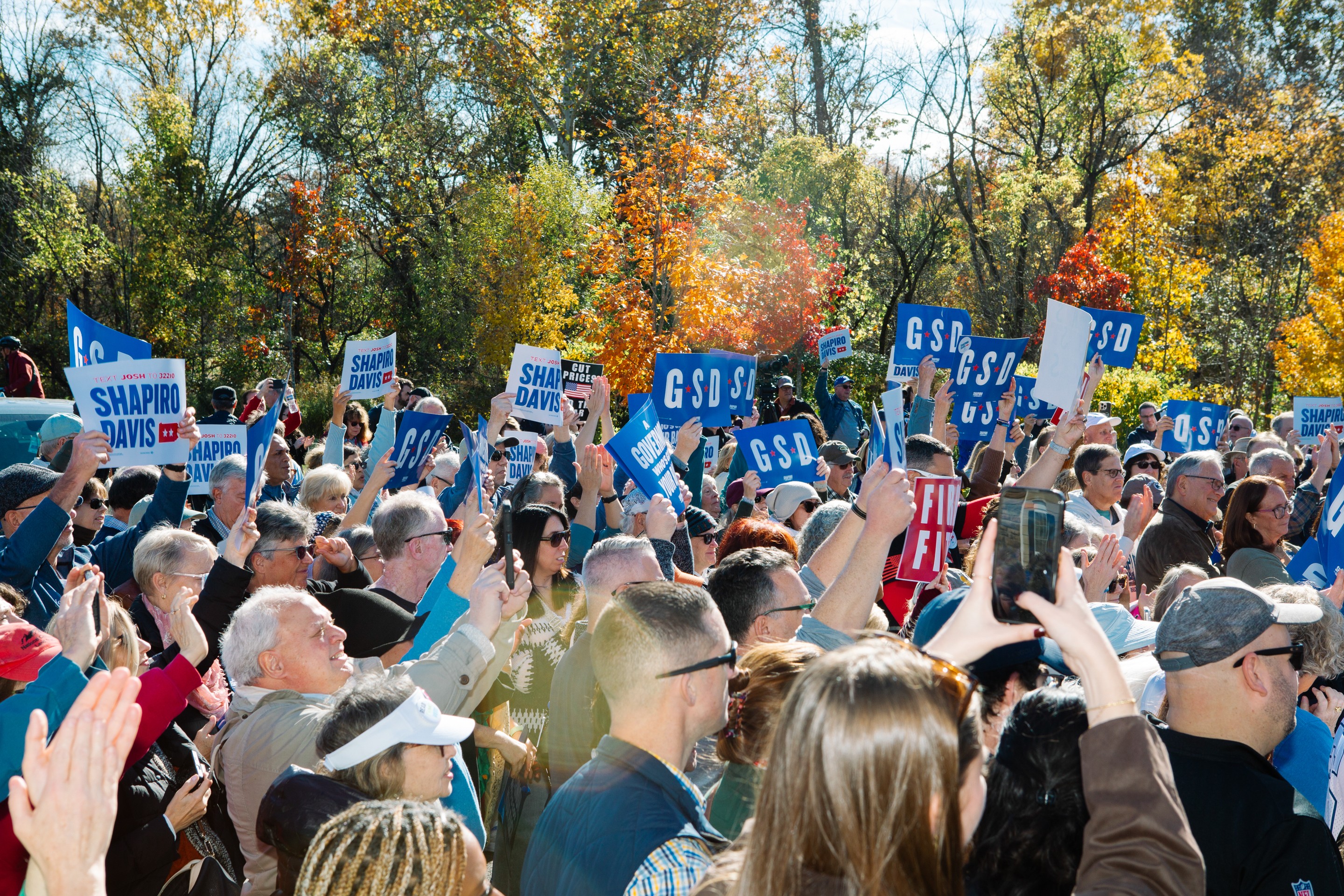
Shapiro spent last week touring the state, with a focus on trying to win over rural voters—though actual Republicans tended to be elusive at his rallies. In Pike County, the ruby-red gateway to the Poconos, Trump won by 24 points two years ago. Few, if any, of the president’s supporters showed up to see the governor. In Milford, a tiny town in the state’s northeast corner, it was die-hard Democrats only—including the organizer of the town’s self-proclaimed “Resistance Committee,” a group that spends Wednesday afternoons in the center of town protesting Trump, and a guy in a Grateful Dead–themed Make America Grateful Again sweatshirt. Shapiro told people to take two signs on their way out—one to stick in their front yard that day, and another to replace it a day or two later, after their neighbors steal the first. “Smile when you put it back out there,” Shapiro said. “That sends a message to your neighbors: You’re not going to be messed with.”
Even when Trump acolytes don’t show up, Shapiro is trying to send a message to rural voters: I’m looking out for you. Inside an old hunting and fishing lodge in Pennsylvania coal country, Shapiro bragged about ending the state’s century-old ban on hunting on Sundays. When he appeared at a small gym at a community college near Wilkes-Barre, Shapiro boasted of writing an executive order that heavily regulates the construction of AI data centers after hearing from concerned residents of a nearby community.
[From the November 2026 issue: The great data-center rebellion]
Shapiro’s campaign slogan is GSD, for “get shit done,” and that message plays to a broad swath of the state, said Danny Ceisler, the Democratic sheriff of Bucks County. He told me that Shapiro is “the antidote to what everybody hates about politics.” Ceisler unseated a Republican incumbent in the purple suburban county last year after criticizing his decision to partner with ICE. Ceisler said Shapiro’s ability to make things happen—including hiring more cops statewide—has earned him the respect and support of many law-enforcement officers.
Shapiro told me that achieving success as a Democrat in a purple state really is as straightforward as getting shit done. “Show up, especially in communities that didn’t vote for you. Treat people with respect. Listen to them and maybe why they made a different choice, and then do. Go back to the office and deliver for them,” he said outside the hunting lodge, which was in Schuylkill County and surrounded by crisp red-and-yellow maple leaves. It’s not a very satisfying answer—and it sounds a lot like what all politicians say is a winning formula.
But Shapiro is betting that he can make that message resonate outside of his own race—and far beyond Pennsylvania. Four more years in Harrisburg to keep GSD-ing looks like a given, so he’s using his campaign to try to flip four swing congressional districts in Pennsylvania. Shapiro has tied his political future to the success of Scranton Mayor Paige Cognetti, Janelle Stelson in south-central Pennsylvania, Bob Harvie in Bucks County, and Bob Brooks in the Lehigh Valley. They’re all Democrats trying to defeat incumbent Republican members of Congress. The effort is personal for Shapiro, who took credit for recruiting the Democrats to run. If he can help pull them over the line, he’ll have significant bragging rights for 2026—and one more achievement to tout if, as expected, he runs for president in 2028.
Shapiro’s all-in support for the four is as telling as his calculations about which Democratic candidates not to fully back. At the hunting lodge in Schuylkill County, he spoke at the same event as Rachel Wallace, a Democrat running against Republican Dan Meuser. (Meuser accused Shapiro of lying about cuts to food assistance and health insurance in his speech at the lodge, claiming his remarks show a “lack of moral character.”) But Meuser’s seat is considered safe—he won by more than 40 points two years ago—and Shapiro knows it. He said he wants to see Wallace win but did not give her the kind of full-throttle endorsement he gave the other four. He recently created a federal political-action committee so he could funnel donations to the candidates he’s supporting, and Wallace is not among them.
The vibe is different for the candidates he wants to help win; Shapiro often notes that Democrats need just four seats to flip control in the House. Standing beside Cognetti last week in Milford, he told the crowd, “You have the ability, by electing her, to literally put the Democrats in charge of the Congress and deliver a check against this president.” The next night, he told 200 people in a Teamsters parking lot that electing Stelson—a former Lancaster news anchor who narrowly lost a congressional race against the same competitor, the incumbent Scott Perry, two years ago—“quite literally will tilt the balance of power in Washington.”
As I followed Shapiro’s bus tour through the Poconos and the Blue Mountains, I asked Cognetti, Stelson, and Wallace about how Shapiro—an anti-Trump Democrat from the liberal Philadelphia suburbs who spends a good portion of every speech slamming the president’s “chaos, cruelty, and corruption”—has won the backing of so many Republicans. (A New York Times/Siena poll in September found Shapiro winning support from a fifth of self-identified Republican voters.)
Cognetti told me it’s because Shapiro is not a partisan in the way he governs; he appointed Republicans to his administration and has worked with the Republican-controlled state Senate. She’s been trying to convince voters that she does the same. “He doesn’t run the government of Pennsylvania in a hyper-partisan way,” she told me in a classroom at East Stroudsburg. “Similarly, I don’t run the city of Scranton in a partisan way.” Wallace, a longtime Democratic staffer who returned to Schuylkill County a few years ago when her mom was diagnosed with Parkinson’s disease, told me the lesson she takes from Shapiro is to show up. Stelson, who calls Shapiro “the other J.S.,” said his success stems from his work ethic. “He works for all of us, and that’s the kind of representative I’d like to be as well,” Stelson said before taking the stage outside the local Teamsters headquarters near Harrisburg.
For Shapiro, his investment in the House races is a clever way to make an impact on national politics without the speculation that comes from visiting early presidential-primary states such as New Hampshire or South Carolina. But his casual manner in front of a crowd, even in impromptu speeches, masks his strict message discipline. Those close to him know not to feed the 2028 rumors, and to stick to the Shapiro line: Keep it local.
Stelson was the only one of the congressional candidates willing to even acknowledge that Shapiro’s dreams might be bigger than Pennsylvania, when praising his ability to quickly reopen I-95 after an overpass collapsed in Philadelphia in 2023. “He’ll be talking about that, you know, should he ever decide to run for higher office or anything,” she told me, before stopping herself. “Should he ever,” Stelson said with a wink.
An hour later, Shapiro walked onstage at the Teamsters rally. He closed his speech by reminding attendees that Philadelphia hosted the Constitutional Convention, and the city was where the Founders signed the Declaration of Independence. He talked about the promise of democracy and the work that individual Americans must do to keep it alive. It’s a story with special resonance in Pennsylvania—and one that would play pretty well in South Carolina too.
Popular Products
-
 Classic Oversized Teddy Bear
$23.78 -
 Gem's Ballet Natural Garnet Gemstone ...
$171.56$85.78 -
 Butt Lifting Body Shaper Shorts
$95.56$47.78 -
 Slimming Waist Trainer & Thigh Trimmer
$67.56$33.78 -
 Realistic Fake Poop Prank Toys
$99.56$49.78