The Demon Next Door
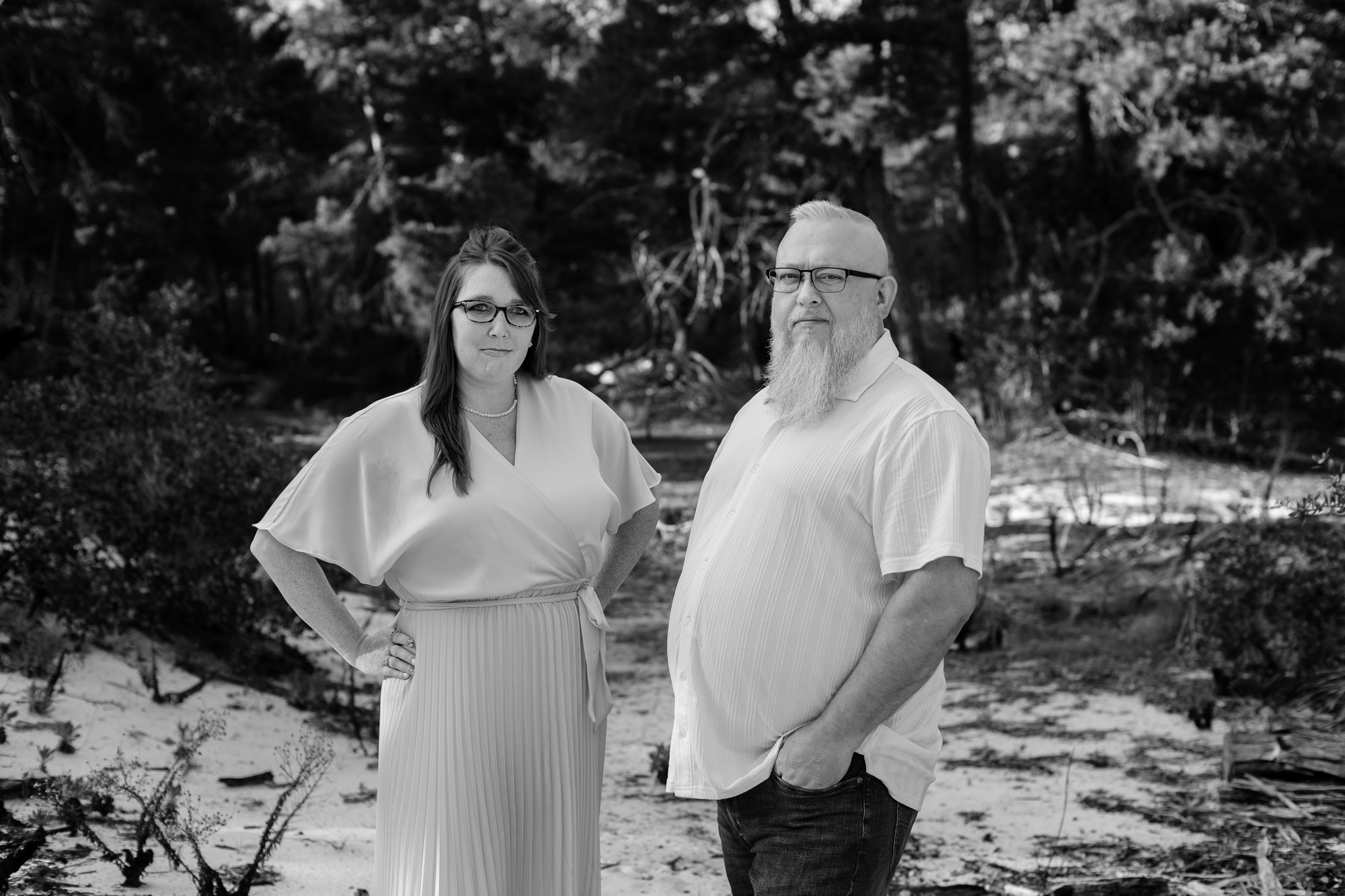
Photographs by Houston Cofield
From the outside, the church looked like a plain brick storefront, the mirrored windows peeling, a sign above painted white with blue letters. THE WELL, it read, and underneath, REVIVAL HUB.
There were older and grander churches in Maryville, a college town in East Tennessee where you could barely drive a minute without passing a cross or a sign about Jesus. But when Mike and Andrea Brewer established the Well, in 2016, they understood themselves to be part of something more mystical and revolutionary than any existing denomination—a charismatic-Christian movement that has drawn millions of Americans with the promise of supernatural encounters with God and visions of cosmic battle.
By his own account, Mike had been an exhausted factory worker and a lapsed Pentecostal addicted to pornography when one night, at home and praying for a better life, he heard an unfamiliar voice calling out to him and believed that it was God. At church a few days later, he would write, he felt a “tangible explosion” in his chest, followed by “the purity and righteousness of God moving through me in waves.” He came to believe that a demon had exited his body and that the Holy Spirit had taken its place. He decided that God had chosen him for a divine assignment.
The Brewers began attending conferences with names such as “Voice of the Prophets” and “Voice of the Apostles” in places like Lancaster, Pennsylvania, and Springfield, Missouri. At one gathering, Mike claimed to have seen an actual angel, and at another, a manifestation of the Holy Spirit that he described to me as “like five fog machines, like a cloud just rolling into the room.” He and Andrea came to believe that God was unleashing new signs and wonders and raising up modern-day apostles and prophets, including, it turned out, them.
They went abroad as missionaries to India and Haiti, which only confirmed their emerging understanding of a universe with three distinct realms—the heavenly, the earthly, and the underworld, with the Earth being the realm of spiritual warfare. On one side, the Holy Spirit, angels, and believers comprised an army of God. On the other were the forces of Satan—legions of demons with names, ranks, and personalities that could inhabit people, geographical regions, and entire nations. In India, the Brewers claimed to have battled Shiva, Brahma, and Kali. In Haiti, Python and Mami Wata. There was Marduk, Osiris, Ra, Horus, Diana, Artemis, Shesha Naga, and so on—a whole pantheon of demons that represented ancient religions and civilizations, and whose earthly expressions were essential to understanding current events.
By the time the Brewers returned to Maryville, they saw themselves as hardened spiritual warriors. They founded the Well to continue the battle, joining an international network of churches and ministries called Global Awakening, which also had a seminary, where Andrea began studying demon history and hierarchies. When Mike asked God for their exact assignment, he told me when I visited in March, “the Lord spoke so clearly. He said, ‘I’m giving you and the Well a mandate for the full eradication of witchcraft and demonic activity in the region.’”
And that was what led the Brewers to look across the street one day a few years later and determine that the central hub for demonic activity in the region was roughly 100 yards away. It was a bookstore called Southland.
The owner was Lisa Misosky, and she was chatting with customers one afternoon when she found out that people in town were accusing her of demonic activity, and not in a metaphorical way.
Over the course of three decades in Maryville, Misosky had made Southland Books and Cafe into a local institution, a sprawling maze of old bookcases where people could find a leather-bound Mark Twain, a paperback Charles Bukowski, shelves of military history, and flyers for a local mah-jongg group. Misosky had a bar downstairs where she hosted trivia nights, readings, all-ages punk shows, and fundraisers that sometimes involved drag performances. She occasionally provided space to the local Democratic Party. But none of that had drawn public protest until a new church moved in across the street.
“You’re not gonna believe this shit,” a friend texted her, and then sent the first of several videos posted by a man who introduced himself as Mike Brewer, the leader of an “apostolic hub” called the Well. Sitting at a desk, he explained in a calm and methodical manner that the bookstore had been identified as a “regional demonic stronghold.” A high-ranking demon named Lilith was involved, Misosky would learn, and the bookstore was being targeted for something called “strategic-level spiritual warfare,” the goal of which was to “remove the enemy.”
Misosky had been born and raised in Maryville. She was 58, Catholic, and gay, and told me she was used to living among conservative Christians. Still, demonic came as a surprise. “This is probably the dumbest thing I’ve ever heard,” she remembered thinking after seeing the first video, not yet realizing that the church was part of the fastest-growing segment of Christianity in the country, or that the language she was hearing in the fall of 2022 was spreading across the Christian right and the wider political landscape.
[Molly Worthen: What the growth of charismatic Christianity reveals about America]
In the years ahead, Donald Trump would accuse the entire Democratic Party of being demonic. Tucker Carlson would claim that he had been mauled by a demon in his sleep. Steve Bannon would call Lutheran and Catholic activists who help immigrants demonic. A federal emergency-management official would speak of being teleported to a Waffle House 50 miles away, elaborating that he was not sure whether the transporting forces were “good” or “evil.” J. D. Vance would say of UFOs, “I don’t think they’re aliens. I think they’re demons.” And the same apostles and prophets who’d claimed that God had anointed Trump to be president would encourage him to see his war with Iran as a cosmic showdown with a demonic entity known as the Prince of Persia.
In that beginning moment, though, Misosky was simply wondering what the accusations meant for her bookstore and the people who went there. Why was she being targeted? What, precisely, was demonic about Southland? The mah-jongg? The romantasy section? A drag performer called Icky Stardust? Her? She wondered if she needed to worry about security.
She began searching for books on the subject, learning of an entire specialty called demonology. She found a manual written by an East Texas couple called Pigs in the Parlor: A Practical Guide to Deliverance, which had a chapter outlining 53 different demonic groupings.
From her front door, she kept an eye on what was happening across the street. A tobacco store blocked her full view of the church, but on Thursdays and Sundays, she could see cars and trucks wheeling into the craggy parking lot.
In one way, of course, none of this was new. Belief in satanic forces has been part of Christianity since the first century. What was relatively new was the rising movement that was supercharging these concepts, and that had first taken root in charismatic circles during the 1990s. Early leaders called their ideas the New Apostolic Reformation, claiming that a wave of Holy Spirit power was surging around the globe, heralding a “new apostolic age.” NAR leaders revised a common End Times narrative in a way that would prove revolutionary: Instead of retreating from the world and awaiting the return of Jesus Christ, they believed, Christians were supposed to establish God’s Kingdom, right now, on Earth.
[From the February 2025 issue: Stephanie McCrummen on the New Apostolic Reformation’s army of God]
Their version of the Kingdom mapped neatly onto the political goals of social conservatives, libertarians, and, more recently, the MAGA movement. The Kingdom would have limited government, free markets, two genders, one kind of marriage, and one kind of God. The “right now” part, meanwhile, offered an urgent paradigm for mobilizing grassroots believers out of the Church and into electoral politics, government, education, and all other realms of life where they were to assert God’s dominion. The new apostles and prophets of the NAR spread these ideas through decentralized networks of churches, international prayer ministries, schools, revivals, and prayer rallies, attracting followers who could find a sense of power and purpose in building the Kingdom. Leaders spoke of believers as “warriors” or “God’s army” or even “special forces,” and churches as “military bases,” and certain apostles as “generals.” They believed that being a Christian meant being in a constant state of spiritual warfare.
In its most basic form, this simply meant praying for God to eradicate evil. But NAR leaders pioneered a more radical version that they called “strategic spiritual warfare,” which entailed the idea that demons could take over cities and institutions, and that Christians could target and scatter them by their physical presence, intensive prayer, singing, marching, and other strategies.
One version of how this could look was when a team of NAR leaders in the ’90s climbed Mount Everest, where they spent weeks praying at various altitudes in an attempt to displace a high-ranking demon called the Queen of Heaven, whom they believed to be suppressing the spread of Christianity across the Middle East and Asia. Another version was the run-up to the January 6, 2021, insurrection, when prominent apostles and prophets held prayer rallies calling for “the minutemen of the Kingdom” to rise up against demonic forces that they believed had stolen the 2020 election, after which many of their followers were among those who stormed the U.S. Capitol. Another version was what happened after the Brewers returned to Maryville.
The first gatherings of the Well were held in the office of a former used-car dealership, just a few families praying for God to reveal the enemy. As more people joined, the group relocated to an office building, where one Sunday Mike decided that it was time to begin the first phase of strategic spiritual warfare, targeting what he considered to be ground-level demons. He invited anyone carrying “emotional pain or tormenting thoughts” to come to the front of the room. As he and Andrea tell the story, a young man recently released from prison stepped forward. Andrea put her hands on his shoulders, and as Mike ordered any demons to come to attention, the young man began shaking and crying, a catharsis that Mike declared to be God’s victory over a demon that they later identified as Odin, because of the man’s participation in a white-supremacist prison gang that embraced the Norse god. After that, more people began coming forward, and it was during this time that Mike received the mandate for the full eradication of witchcraft and demonic activity in the region.
The church moved in 2021 to the brick building, a former grocery store along a main thoroughfare in town, and set aside Thursday nights for delivering the people of Maryville. The sign went up. Into the sanctuary went 100 or so chairs arranged in a semicircle around a drum kit, guitars, and amplifiers. On one wall went a map of the area superimposed with what appeared to be a huge spiderweb that divided the region into prayer sectors. Where a church’s pulpit or a cross would usually be was an arrangement of amber-toned spotlights and glowing flameless candles. And when people came, they found the sort of free-form services common in the movement—people dancing with colored prayer flags, or pacing the room, or lying prostrate on the floor, the band playing one anthemic song after another.
A woman named Sasha, a driver for Uber Eats at the time, told me that on her first night at the Well, “this cry came out of me,” which she believed was a demon leaving her body, freeing her of the emotional and physical pain of a hysterectomy. A 62-year-old woman named Pam told me that a deliverance team conducted a “spiritual evaluation” to determine how demons might have entered her body, asking whether she’d had astral projections or tarot cards read, done meditation or yoga, or ever felt envious, angry, depressed, or insecure. The team then led her through an elaborate process of renouncing curses and revoking demonic rights, and when it was over, she said, “I really believed I was a child of God.” A young man suffering from severe anxiety and depression told me that after his cleansing, he felt “the most love I have ever felt.” A middle-aged woman who had struggled with drug and pornography addictions told me that after several sessions, she felt “euphoric—whole, complete, one, merged with the Trinity,” and that whatever God asks of her, “I will do, at all costs.”
People came from Alabama, Florida, Michigan, Minnesota. Mike said that a wealthy businessman from Indiana flew in for a private session. Deliverance leaders told me that they identified demons by the ways a person might be tormented. Feelings of worthlessness was Belial. Sexual confusion could be Jezebel. Anger could be Thor, who was under the command of Odin. The Brewers estimated that they’d delivered many hundreds of people, enough that they decided they were ready to move into the next phase of spiritual warfare. This meant identifying higher-ranking territorial demons, which involved a process that Andrea called determining the “narrative of hell” over the region.
She began gathering what she called “spiritual intelligence.” She kept track of what demons had been identified during deliverances at the Well. As she drove around the area, she told me, she made note of Masonic lodges, tarot-card readers, and anything else that made her feel uneasy. She paid attention to her dreams. Then came the day that Mike noticed an event posted on Facebook, an upcoming fundraiser for local foster kids that involved death-metal and drag performances. The Murvul Punk Toy Drive was being held at a bookstore right across the street.
The Brewers had not heard much about Southland, but scrolling through the shop’s Facebook page, they saw rainbow flags. They saw postings about local Democratic Party meetings and a drum circle, along with videos of past drag shows, including one in which Icky Stardust performed an elaborate routine to a blasting metal version of “White Wedding” and poured fake blood all over their dress. Mike thought that he saw a teenager in the audience.
“It was obvious,” Andrea said. The high-ranking demon influencing the region was Lilith, a Mesopotamian wind goddess who ruled over forbidden sexual desire, and Southland was the stronghold, which Mike defined as a place where certain thoughts, attitudes, and behaviors contrary to God were flourishing. Mike informed the church elders. “I said, ‘We cannot just let this stuff go,’” he told me. “I said, ‘This is evil.’”
After she watched the video, Misosky started asking around about the Brewers. She was a little bit older than Mike, but it only took a couple of phone calls to find out that he was from a nearby town called Townsend, known as a tourist gateway to the Great Smoky Mountains. Her sister and a friend had worked with his cousins; another friend who had worked at Southland had joined the Well, and Misosky had not seen her since. She realized that Andrea had worked at a local hardware store.
“Jackleg preacher,” Misosky would mutter when Mike’s name came up.
She had never wanted to be a political activist. But during the Trump era, Southland was becoming a social haven of the sort that can be found in many small southern towns. The campus of Maryville College was down the street, and students and faculty often hung out in the café. A professor sometimes gave lectures on the Constitution. Older gay couples met for beers. Misosky decided to host the county’s first Pride event in 2019, the same year that the Well received the mandate. She had thought that a dozen or so people would show up, but more than 700 did, which she found unexpectedly moving. She hosted more events after that, including drag-show fundraisers; minors could attend with a parent or a guardian, which was the case with the punk toy drive that was now drawing the attention of the Well.
Misosky flipped through Pigs in the Parlor. “This is the day of spiritual battle and spiritual-victory,” read a chapter titled “The Final Conflict.” “The warfare is on!”
She went online and looked up Lilith. “Primordial she-demon,” read one description. “Banished from the Garden of Eden for disobeying Adam,” read another.
“Every story needs a hero—a protagonist and an antagonist,” she remembered thinking. “So I guess I’m their antagonist, in collusion with Lilith.”
She wanted to blow it all off but couldn’t. She’d thought that the QAnon conspiracy was bonkers, and it had compelled a man to drive to Washington, D.C., with an AR‑15 and fire shots inside a pizza parlor. Nancy Pelosi, as speaker of the House, had been called demonic, and then her husband had been assaulted by a man who spoke of “evil” forces.
Across the street, the Brewers turned a conference room at the Well into what they called a “war room.” They put maps of all the surrounding counties on the walls, representing what they considered their spiritual theater of operation. Mike began posting about the fundraiser to his thousands of social-media followers, saying that it was from “the pits of hell.” At some point, he said, someone apparently upset by this sent him an envelope full of excrement; others sent checks and urged him to keep going. A few congregants started “prayer walking” near the bookstore, a tactic of spiritual warfare that had been deployed in the days and weeks before the January 6 insurrection, when people marched around the U.S. Supreme Court and state capitol buildings, calling the Holy Spirit into battle.
Meanwhile, Andrea began doing research into Tennessee laws and found an old statute banning cabaret performances within 1,000 feet of a church. The Brewers sent the information to the local district attorney, the police, the sheriff, and city and county commissioners. Soon, a wider circle of activists and pastors became involved in the cause, including one who had recently held a book burning in the town of Mt. Juliet, about three hours away—a huge bonfire that had drawn a crowd of cheering people who’d tossed copies of Harry Potter and other books deemed demonic into the flames.
At the Well, Mike showed images of the drag shows to his congregation. He kept streaming live videos describing what was happening at Southland as “wicked.” Then, a few days before the fundraiser, in November 2022, Mike and Misosky spoke by phone.
Her recollection is that she called Mike, and that he talked about doing spiritual warfare against voodoo chiefs in Haiti, and that she said, “That’s great, Mike. Why don’t you have a cup of coffee with me?”
Mike’s recollection is that he called Misosky. “I said, ‘I’m not calling to resolve differences. We’re not going to do that. I am calling to request that you go 18 and older for events,’” he said. “ ‘If you’re marketing to children of this area, we’re going to do everything within the law and the spirit to stop you. We will never harm you physically.’ I said, ‘I’m calling out of respect.’”
And that was the last time they spoke.
Soon after, Misosky got a call from the Anti-Defamation League. There had been some chatter about a protest at Southland on neo-Nazi forums that the group monitored. At the time, all kinds of LGBTQ events around the country were being targeted by extremist groups. A gunman had just killed five people and injured 19 at an LGBTQ nightclub in Colorado. Misosky called the police. She called some local pastors she knew and asked that they show up at the fundraiser wearing their collars. She posted on Facebook that “MAGA fascists” were threatening the toy drive.
The next evening, she stood with dozens of supporters in front of the bookstore, watching as a group of nine men, some with their faces covered with bandannas, marched down a side street and up to the sidewalk in front of the entrance, where police stopped them from going any farther. According to local press reports, the men held signs that read GROOMERS ARE PEDOPHILES and IT’S OK TO BE WHITE. At least one of them appeared to have a gun.
The Brewers said that they had no idea who the protesters were, and that they were at home at the time. On Facebook, Mike speculated that Misosky had organized a “false flag” operation to smear Christians. Later, the ADL and another watchdog group would identify the men as members of a neo-Nazi group called the Tennessee Active Club, part of a network of such clubs across the United States. Members of the group would show up the next year in the town of Franklin, about three and a half hours from Maryville, to provide security for a mayoral candidate named Gabrielle Hanson. During her campaign, Hanson spoke of battling vague forces threatening the nation and was anointed for office at a tent revival whose promotional posters declared WE ARE TAKING BACK THE LAND BY DISPLACING DEMONIC FORCES AND USHERING IN HIS GLORY. (Hanson said in a statement later that she had not hired the men who showed up, and denied being affiliated with “any white supremacy or Nazi-affiliated group.”)
In front of Southland, there was shouting back and forth between the protesters and Misosky’s supporters, and after a few hours, the masked men returned to their cars, which were parked several blocks away; some of them reported to the police that their tires had been slashed.
The fundraiser went on, but Misosky remained unsettled. She blamed the Well for “putting a target on our back” and providing “moral cover” for people who might want to justify violence. She spent the night of the protest and several nights after that camped out on the floor of Southland with a .38, a 9-mm, a shotgun, and a baseball bat.
Mike told me that he and Andrea were merely bringing the reality of demonic activities at Southland to light. “The truth hurts,” he said. “We won’t resolve our differences, our worldviews. I would never physically harm anyone, but I will bring an awareness.”
When I reached one of the protesters named in local press accounts, he told me that he had never heard of the Well but made clear his view of drag performances. “Influencing children to sexual activities isn’t demonic?” he wrote in a text message.
Not long after the fundraiser, Misosky received word from the county sheriff, through an intermediary, asking whether she wanted to sign her staff up for active-shooter training.
Andrea, meanwhile, received word from God. It came through one of her mentors, a prophet in Colorado, who trained people in spiritual warfare and told Andrea that she had gotten a prophecy that the Well was entering into a final battle with Lilith, which the Brewers understood less as a prediction than as an instruction.
Until recently, all of this might have been considered a dispatch from the fringes of American religion, except that the ideas taking hold in Maryville are becoming more and more mainstream.
While the Southern Baptists, United Methodists, and other denominations continue to decline, millions of Americans are finding their way to nondenominational churches with names such as Oasis, Elevation, and Harvest Rock, where they are learning about the intricacies of demons, spiritual warfare, and other NAR ideas. Some of the nation’s largest megachurches, such as El Rey Jesús in Florida and Free Chapel in Georgia, are led by apostles and prophets in the movement. One such apostle, Paula White-Cain, is President Trump’s spiritual adviser.
[Read: The most interesting part of Trump’s prayer rally]
By 2024, roughly 61 percent of American Christians agreed with the statement that “there are modern-day apostles and prophets,” and roughly half agreed that “there are demonic ‘principalities’ and ‘powers’ who control physical territory,” according to a survey conducted by Paul Djupe, a Denison University political scientist who is among the few scholars attempting to track the ways that NAR ideas are transforming Christianity. By December 2025, roughly 59 percent of evangelical Christians and 22 percent of non-evangelicals agreed that “the church should organize campaigns of spiritual warfare and prayer to displace high-level demons,” Djupe found in a follow-up survey.
The same survey also indicated that more people are encountering these concepts on social media than in church, which speaks to how people are following apostles and prophets through online ministries and prayer networks, and to how influencers across the broader Christian right are leveraging these ideas to gain and possibly radicalize followers.
This was obvious at the memorial for Charlie Kirk following his assassination last year. Defense Secretary Pete Hegseth described the moment at hand as a “spiritual war.” The right-wing influencer Benny Johnson urged members of Trump’s Cabinet to “wield the sword for the terror of evil men in our nation.” The far-right activist Jack Posobiec told people to “put on the full armor of God and face the evil in high places and the spiritual warfare before us,” rhetoric that has only continued to escalate as the midterm elections approach.
[Read: Charlie Kirk and the ‘third Great Awakening’]
Speaking about the anti-ICE protests in Minneapolis earlier this year, the influential NAR strategist Lance Wallnau said that “the demons are manifesting.” More recently, the lieutenant governor of Indiana, Micah Beckwith, speaking about Democratic attempts to gerrymander congressional districts, said that the party was being led by “the minions and voices of darkness.”
“Wake up, Christians. They are coming for you,” he said on a show called FlashPoint, a kind of nightly news for the apostles-and-prophets crowd. “You can’t pet a demon. I know people like to say, ‘Hey, demons, stay over there. Just don’t hurt us, and we won’t hurt you.’ It doesn’t work that way. Evil will find you. Until strong men stand up and do something and fight fire with fire, then we will continue to lose ground, our children will be warped, the curse will be over the land.”
As the MAGA coalition has fractured, some of Trump’s former supporters have been turning this language against him. Among others, Tucker Carlson has questioned whether Trump could be the anti-Christ, while Carlson’s critics have suggested that Carlson himself might be under demonic influence. The conservative writer Rod Dreher, seeking to explain his former friend’s growing anti-Semitism, recently wrote that he wondered whether there was “some demonic force in the New England wood where Tucker lives, and if it has been working on his mind.”
Dreher, a friend of Vance’s who identifies as Eastern Orthodox, has been writing a lot about demons lately and told me that he believes something larger is going on in American culture. “I think the whole materialist paradigm we’ve lived by is breaking down,” he said. “The world is becoming re-enchanted, whether people want it to be or not. It’s all very real. People—the overclass, the professional class—just don’t see it and don’t want to see it.” In books and interviews, Dreher has been promoting parable-like stories about demons that seem designed to reach those people, or perhaps shift some spiritual Overton window. One involves a haunted McMansion in Louisiana. Another is about a wealthy New York City woman whose husband placed her under an exorcist’s care. Yet another is about a Chicago lawyer terrorized by alien visitations that turned out to be demons.
[From the March 2026 issue: Rod Dreher thinks the Enlightenment was a mistake]
In a more immediate sense, invoking demons can be a means of dehumanizing and delegitimizing political enemies, which has often been a precursor to actual warfare and political violence. “It’s a very useful way to get around the Christian imperative to love your enemy,” Matthew Taylor, a visiting scholar at the Center on Faith and Justice at Georgetown University, told me. “For the most part, that is the ironclad command. So how do you get Christians to hate their enemies? Or to hate them even if they love them? Demons are easy to hate. They are irredeemable objects of hatred.”
Which Misosky understood as she told the sheriff’s office that, yes, she would like to sign up for active-shooter training.
And so, three years into a campaign of spiritual warfare against demonic forces in Maryville, she and her staff learned how long it would take for police to arrive should she call 911, and what to do in those minutes. They learned how to duck and cover, and run for the exits. The trainer suggested that Misosky arm each door with something to spray in the eyes of a possible shooter. She bought some cans of wasp spray and placed them strategically near the two entrances, behind several bookcases, by the door to the downstairs space, and under the bar.
Upstairs, she kept the baseball bat and a gun under her desk, which she adjusted so that she could face the front door and scan each person who came in. Sitting there, she sometimes found herself thinking, “I know they would shoot me first.”
Across the street, the Brewers were feeling more and more triumphant. In 2023, Tennessee’s state legislature passed the nation’s first law banning drag performances in public spaces or where minors could view them. Arizona, Kentucky, Oklahoma, Arkansas, and Idaho, among other states, then passed laws similar to Tennessee’s, which is being challenged in court, but which still felt to them like a victory for the Kingdom of God.
In accordance with the prophecy that Andrea had received from Colorado, the Well entered the final phase of spiritual warfare against Lilith in the spring of 2024, which involved 40 days of continuous prayer asking for God to liberate Maryville. The Brewers said that people showed up every day and sometimes stayed into the night. “We just left the doors open, and people came,” Mike said, describing how he believed those prayers were answered when the state legislature passed a resolution declaring July of that year to be a month of prayer and fasting for the entire state.
That summer, a Republican state representative coordinated prayer rallies for all 95 counties across Tennessee, and Andrea was asked to speak at one in Maryville, along with state and local officials. As the Brewers saw it, the law, the government, and the whole state were coming into alignment to fulfill the mandate that God had given them.
The rally was on the steps of the county courthouse. The day was a bit cloudy, and several hundred people came, including many from the Well, some of whom had American flags in their pockets, and many of whom kneeled, then bowed, pressing their forehead to the warm concrete. When it was Andrea’s turn to speak, she felt full of God’s authority. She commanded that Lilith leave the region in the name of Jesus, at which point, she said, she heard sirens going off. When she looked up into the sky, she said, she saw something like clouds parting, and what she discerned to be a “halo” of colors in the sky.
“Something shifted,” she said. “Something changed. There was a moment where God said, ‘I am breaking through this situation.’ And everybody present—you just felt it.”
And now it was a spring Sunday at the Well, one like so many other Sundays in a church where spiritual warfare never really ends, and several dozen people filed into the sanctuary to hear what God might want them to do next.
A member of the congregation gave a message about grief, but mostly there was praying as the band played, drums pounding, building and building, amber spotlights glowing. Two women danced around the room with prayer flags, and others lay on the floor. After 45 minutes of this, someone declared, “Right there, I felt like we pushed through the atmosphere,” and someone else said, “Something is breaking right now in this room, and it’s going to break through this city, and break through this region,” and someone else said, “In the name of Jesus, every demon out!”
During the two weeks I spent at the Well, prayer teams performed deliverances almost every day. Some of them involved newcomers, but many were a kind of spiritual maintenance for long-standing congregants who kept returning for more—more purification, more power, more of this version of freedom and purpose. People told me that during their deliverances, they had visions of snakes and soldiers, doors and colors.
Sasha, the woman who’d worked for Uber Eats, told me that she had struggled with childhood trauma, homosexual feelings, and drug addiction, and that she was on her fifth or sixth deliverance to rid herself of those and other things that she did not consider God. The sessions could be emotionally exhausting, and she said that her deliverance leader had explained that she should space them out for her own safety: “She told me, ‘Honey, you’ve been through so much, your frame could not contain it.’” By that point, Sasha had been liberated from Python, Osiris, Apollo, Lilith, and other demons, and she suspected that more were still in there.
At the same time, she and others said that their deliverances were not only about their own purification. The experience had also changed how they saw the world and their role in it. “It’s like being a warrior—there’s no rest,” Sasha said. “Things are changing in the spirit realm, and people are not ready for what’s to come.”
She and others told me about all the ways they now saw Satan working in the world. It was Jeffrey Epstein, and child trafficking, and underground tunnels. It was Iran, and Muslims whose goal is “to outpopulate us all and take over,” in Sasha’s words. It was Pride Month, and transgenderism. It was churches that were stifling the Holy Spirit. It was not just separation of Church and state that was the problem in this country, but a far more profound separation of humanity from what they understood to be the one true God.
“If we keep everything separate, no one will ever see the big picture,” Sasha said, and she explained how she starts her days.
“I wake up in the morning, and I anoint myself,” she began. She said that she asks God to open her senses to the supernatural, because at times she can smell demons. She puts her hand on her head and asks God to “silence the voice of the accuser in Jesus’s name” and to “silence the voice of my own thoughts in Jesus’s name.” She asks to “have the helmet of salvation and the very mind of Christ” and to “bring every thought into submission.” And then she heads into the world, a spiritual warrior.
Across the street, Lisa Misosky started her day with the wasp spray still by the doors, and the baseball bat and gun still under her desk, and a worn copy of Pigs in the Parlor on a shelf.
The Brewers, meanwhile, had decided that their work in Maryville was done. “A beachhead has been established,” Mike said. The Well would continue. But he and Andrea were moving on to the next front, relocating to a town north of Palm Beach, Florida, where Mike was starting a ministry to train businesspeople and other leaders in “Kingdom warfare.” Andrea was developing the narrative of hell in their new neighborhood, where many streets were named for Greek gods.
“The Well has been in war for almost 10 years to deliver this territory,” Andrea said just before they left Maryville. “Now it’s a calmer season. But there will be another wave.”
This article appears in the August 2026 print edition with the headline “The Demons of Maryville.”
Popular Products
-
 Fake Pregnancy Test
$61.56$30.78 -
 Anti-Slip Safety Handle for Elderly S...
$57.56$28.78 -
 Toe Corrector Orthotics
$41.56$20.78 -
 Waterproof Trauma Medical First Aid Kit
$169.56$84.78 -
 Rescue Zip Stitch Kit
$109.56$54.78