The ‘fight Club’ Rule On Gerrymandering
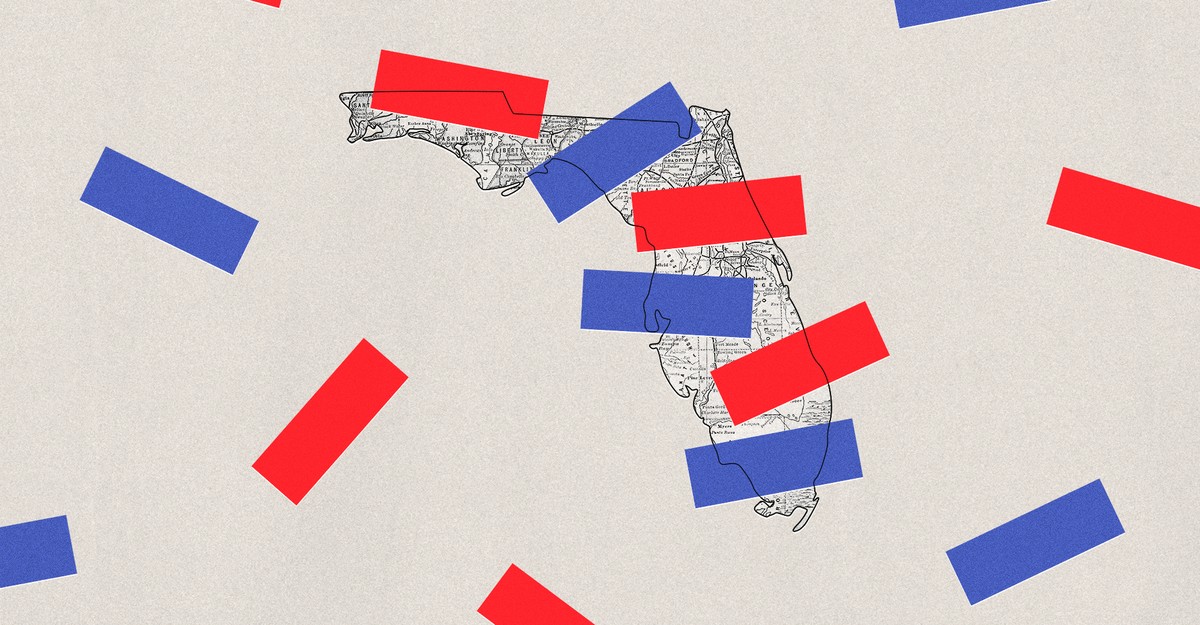
Florida Republicans have approved a new congressional map that could hand them as many as four House seats that Democrats currently hold. Their goal is straightforward and universally understood: They want to bolster the GOP’s majority in Congress and retake the lead in a yearlong, nationwide partisan gerrymandering showdown with Democrats.
Good luck, however, getting top Republicans in the Sunshine State to openly admit that.
In contrast with other states that have held lengthy and freewheeling public debates over redistricting during the past year, the drive to redraw maps in Florida has been marked by secrecy and obfuscation. Republicans can’t acknowledge the intent of their gerrymandering proposal, because the state constitution expressly prohibits partisan redistricting. As a result, Florida GOP officials—starting with Governor Ron DeSantis and extending all the way to lowly political operatives—have treated the subject of gerrymandering like a defendant respecting a Miranda warning: Do not say anything that could jeopardize these new maps in court.
“Anything you say will get you subpoenaed,” one political consultant who works for Republicans in the state told me. The consultant spoke on the condition of anonymity because he, too, does not want to be hauled before a judge when Democrats inevitably challenge the new maps as violating the ban on partisan gerrymandering. “You can’t say, ‘We need to make more Republican seats.’ You’re done. You’re toast, and then your map’s invalidated.”
No Republican has followed this fight-club rule more carefully than DeSantis, who called the legislature into session less than a week after Virginia voters evened up the national gerrymandering race by narrowly approving an aggressive Democratic redistricting plan. The Florida governor’s office drew lines based on the likelihood that the Supreme Court would announce a decision weakening enforcement of the Voting Rights Act, insulating the proposal from a challenge in federal court. The justices proved DeSantis’s presumption not only correct but exceptionally well timed: The Court handed down its ruling this morning while Florida legislators were preparing to vote on the new districts, and they paused their debate to read the decision. The 6–3 ruling voided a Louisiana voting map that included a new majority-Black district as an unconstitutional racial gerrymander. It could lead other GOP-led states to eliminate House seats drawn to boost minority representation in Congress in the months and years ahead. The court did not touch Florida’s state ban on partisan gerrymandering, however. The governor’s proposed map eliminates a district created to comply with Section 2 of the Voting Rights Act, a successful bet on the Supreme Court’s move to limit that provision.
Until Monday, no one had actually seen the map that DeSantis wanted lawmakers to adopt within a few days’ time. When he finally released it, the governor claimed that the proposal was “separate” and “independent” of the tit-for-tat redistricting battle that President Trump launched last year in Texas. “It’s the right thing to do for Florida,” DeSantis told Fox News’s Laura Ingraham.
[Read: Trump’s enormous gerrymandering blunder]
DeSantis’s official rationale for redistricting is that Florida was shortchanged in the 2020 census and that the state’s population has grown dramatically. (“Florida has experienced 10 years’ worth of population growth in, like, three” years, DeSantis said at a news conference in early April.) The closest he came to acknowledging the partisan nature of the new map—which could give Republicans 24 out of Florida’s 28 House seats—was to note, in a statement to Fox News, that the GOP has overtaken the Democrats’ longtime edge in the state among registered voters and now has 1.5 million more. (DeSantis did signal a partisan intent in ways less likely to backfire in court: He gave his proposal first to Fox News before sending it to the legislature, and the map was drawn in shades of red and blue to denote how many seats Republicans could control if it were enacted.)
DeSantis’s bigger gamble is that newly gerrymandered district lines will yield Republicans as many House seats as they aim to gain. For months, the prospect of joining the redistricting race has divided the Florida GOP. Current members of the party’s House delegation were leery of seeing their districts become more competitive in an effort to flip more seats, and some officials feared that in a midterm election year expected to favor Democrats, an aggressive gerrymander could backfire and cost Republicans more than help them. Florida Republicans already drew themselves a skewed congressional map in 2022; they hold more than 70 percent of House seats in a state where Trump earned 56 percent of the vote in the most recent presidential election.
An analysis by the nonpartisan Civic Data & Research Institute published earlier this month argued that Republicans had essentially already maximized their advantage in Florida and that an aggressive redistricting plan would produce “zero net gain” in House seats. Other strategists, however, disagree. “They’re not maxed out in Florida,” Matt Gorman, a former senior staffer at the National Republican Congressional Committee, told me. “You’ve got to make sure you’re not drawing the lines too thin, but the idea that you can’t move anything is ridiculous.”
DeSantis’s proposal appears to adopt that view. Republicans at one point had discussed trying to flip as many as six Democratic seats in Florida, which would have given the GOP all but two statewide. DeSantis didn’t go that far, but the four he is seeking to shift might be more than Republicans can win if the party has a bad year (as polls suggest it will).
Democrats have characterized the gambit as simultaneously illegal and foolish. House Minority Leader Hakeem Jeffries dubbed the proposed map “the DeSantis dummymander” and told reporters that if Democrats turn out in Florida as they did in 2018 and 2020, the party could win an additional three to five seats that were not previously in play. Other Democrats, however, avoided Jeffries’s bravado. Steve Schale, a longtime party strategist in Florida who helped Barack Obama twice carry the state, told me that Republicans “definitely created a harder pathway” for Democrats. But, he added, “I don’t think it’s a slam-dunk four-seat Republican gain.”
The GOP proposal appears to target seats held by Democratic Representatives Kathy Castor in Tampa and Darren Soto near Orlando, and Debbie Wasserman Schultz and Jared Moskowitz in southeast Florida. Schale compared gerrymandering to squeezing a balloon: The air moves around inside, but it’s still there. “The reality is there’s a lot of Democrats in southeast Florida. There are a lot of Democrats in Central Florida,” he said. “You can’t make them just disappear into the ocean.”
The uncertainty of how successful DeSantis’s map will prove to be for Republicans is intertwined with the broader question of Florida’s shifting political identity. Both parties agree that it is no longer the swing state that decided the 2000 election by a few hundred votes. But is it the light-red state that gave DeSantis and Trump narrow statewide victories from 2016 through 2020, or the deeper Republican stronghold that delivered the party double-digit wins in 2022 and 2024? Trump’s win in 2024 relied in part on large gains among Latino voters, but they have swung back to Democrats in special and local elections since then.
For now, Democrats who persuaded voters to approve their gerrymanders in California and Virginia were hoping to block the Republicans in Florida—if not in the GOP-dominated legislature then in the courts. They have grasped at what little moral high ground remains in the redistricting fight, pointing out that whereas Democrats took their plans directly to the voters (which state law had required them to do), Republicans jammed their new maps through the legislature with minimal public debate.
[Read: Welcome to the gerrymandering apocalypse ]
As lawmakers convened this week in Tallahassee, opponents of the GOP plan tried to generate a public groundswell against it. Now that it has passed, they plan to sue on the grounds that it violates the Fair Districts Amendment, the 2010 ballot measure that bans both partisan and racial gerrymandering. “This legislature has refused to engage with the public because they know that what they’re doing is illegal,” Genesis Robinson, the executive director of the advocacy group Equal Ground, told me.
In making its case for the new maps, the governor’s office seems to be banking on a favorable ruling from the Florida Supreme Court, which is composed entirely of Republican appointees and upheld the preceding, GOP-tilted House map that was used in 2022. A memo to the legislature from DeSantis’s general counsel argued that the Fair Districts Amendment was unconstitutional, and in testimony yesterday, a lawyer for the governor’s office acknowledged that mapmakers had used partisan voter data in drafting their proposal. Democrats saw the admission as an opening in the litigation likely to follow enactment of the new map. What seemed clear was that if Florida’s ban on partisan gerrymandering remained intact, the informal ban on copping to it was weakening.
Popular Products
-
 Devil Horn Headband
$25.99$11.78 -
 WiFi Smart Video Doorbell Camera with...
$61.56$30.78 -
 Smart GPS Waterproof Mini Pet Tracker
$59.56$29.78 -
 Unisex Adjustable Back Posture Corrector
$71.56$35.78 -
 Smart Bluetooth Aroma Diffuser
$585.56$292.87