The Murdoch Billions Behind The Democrats’ Centrist Turn

In early 2025, as Donald Trump’s second term began, Pete Buttigieg met with two members of conservative media mogul Rupert Murdoch’s family. The former and likely future presidential candidate had earned the nickname “Slayer Pete” for his virtuosic runs through the Fox News gauntlet, the Murdoch-controlled cable network that helped shape a generation of the American Right.
This time, however, Buttigieg was meeting the Murdochs not as adversaries but as potential allies. James Murdoch, a former News Corp. and 21st Century Fox executive now estranged from his father, Rupert, and the empire he built, was about to spend some of the family fortune on center-left candidates and media outlets, a concerted move to undo the political polarization his father’s businesses had helped create.
Over lunch at a Manhattan restaurant, the 52-year-old Murdoch and his Oregon-born wife Kathryn questioned Buttigieg about the political terrain. They had had drinks with Buttigieg the month he launched his presidential campaign in April 2019, and the following month invited him to their 12,000-square-foot Upper East Side townhouse for a small event focused on climate change. That fall they hosted a campaign fundraiser in the back garden, raising about $30,000, and two years later, they sold the home for 1,000 times more than that. The former South Bend mayor represented the type of candidate the billionaire couple wanted to see in the White House: a pragmatic, millennial problem solver.
In the intervening six years, as they grew increasingly disillusioned with the family-run conservative media empire in which they uneasily existed, James and Kathryn Murdoch have emerged as an unlikely force on the American left. The couple wears their money quietly — a farm in Connecticut, a 450-acre retreat on British Columbia’s coast reachable only by boat or float plane — but their political impact is becoming unmistakable. Armed with $3 billion from sales of their stakes in News Corporation, 21st Century Fox and the Murdoch family trust, they have become revered among some Democratic operatives as “the good Murdochs” and reviled by others as a potentially corrupting force within the party.
Through their Lupa Systems investment firm and their Quadrivium Foundation, the couple has begun to assemble a portfolio of influential media investments united above all by a shared ambition to shape public debate, taking an increasingly direct role in the properties. They now own the cosmopolitan liberal New York Magazine and the earnestly technocratic Vox while backing the science site Climate Central. They recently explored acquiring Crooked Media, which includes the podcast Pod Save America, according to two people familiar with the discussions, and now have a close business relationship with the centrist Bulwark.
At the same time, the couple has become significant donors to Democratic candidates and causes, giving more than $30 million in federally reported political contributions since 2020, on top of more than $111 million their foundation has disbursed to climate, voting and other nonprofit groups from 2020 through 2024, according to IRS records. It is a figure well behind the spending sums of Michael Bloomberg and Reid Hoffman but enough to put them at the center of discussions about the Democratic Party’s future after its romp through last week’s midterm elections.
This week, the Murdochs’ influence was on display in Denver as one of the groups they have sponsored hosted a post-election gathering explicitly designed to set the party’s direction for 2028. They have put millions into Majority Democrats, a hybrid political action committee and super PAC that launched last year to back candidates advocating a move away from progressive policies and identity politics. The event showcased many of the candidates they have helped elevate, including Buttigieg, Iowa Sen.-elect Josh Turek, and Pennsylvania Gov. Josh Shapiro, to whom they directly donated $500,000 late last year. “We have a nice relationship,” Shapiro said of the Murdochs in an interview.
“I think they like the way I govern, and I was grateful that they invested early on in my race. I think they appreciate pragmatic politics.”
This account of the couple’s emergence and future plans is based on interviews with 21 current and former associates, many of whom were granted anonymity to speak candidly about the couple and their approach to politics. Newly freed from all business and financial ties to the Murdoch family and mindful of their privacy and image, James and Kathryn declined repeated requests to be interviewed for this article or provide responses to its claims. They posed recently for a joint portrait by famed photographer Annie Leibovitz in Vanity Fair, where they ranked 47 on the publication’s New Establishment list, 16 spots lower than James’s older brother and rival, Lachlan. Lachlan and Rupert Murdoch both declined to comment for this article, as did representatives for Rupert’s elder daughters, Elisabeth Murdoch and Prudence MacLeod.
James and Kathryn Murdoch’s choice in candidates, causes and media represents a self-conscious dedication to a political and cultural future in which government is made to function and its leaders rewarded for solving problems rather than for performing outrage. The Murdochs call it “radical centrism,” although the radical part is mostly the scale of the spending. It has funded efforts to open primaries, implement ranked choice voting and redistricting reform, all on the theory that polarization is a plumbing problem and better rules will produce better politicians. Skeptics in both parties see rich donors engineering a temperamentally moderate, pro-business politics more to their liking and calling the result neutral.
James Murdoch has spent nearly a decade trying to escape a world his father made. Now he wants everyone else to find a way out, too.

In 1953, after his father’s sudden death, a 22-year-old Rupert Murdoch left his studies at Oxford and returned to South Australia to take over an afternoon newspaper the one-time war correspondent had owned for decades. Over the next seven decades, Rupert leveraged regional newspapers into News Corp., a global media empire that reshaped entertainment, sports and news, the last through a shared international language of populist sensationalism. His tabloid acquisitions in London in 1969 and New York in 1976 intimidated and rewarded politicians, whom he used to create favorable regulations that fueled further expansion.
When the chance came to purchase American television stations, Rupert readily gave up his Australian citizenship in 1985 to comply with limits on foreign ownership. In 1986, he launched Fox as a competitor to the three national broadcast networks, but it was the Fox News Channel’s arrival on basic cable a decade later that left the biggest impact on American life. The channel helped define the vernacular of post-Reagan conservatism, with its Manhattan studios as a requisite stop for Republican candidates on their way to office and a way-station for those on their way out or between jobs. (At least 19 of Trump’s appointees upon his return to office last year were former Fox News hosts, contributors or producers.)
Dedicated to the idea of a dynastic family business, Rupert often said that he wanted one of his four adult children — from two separate marriages — to succeed him. (Rupert is now on his fifth marriage.) Early on, he made clear that one was “first among equals,” as he put it in a 1997 interview: Lachlan, who was born in Australia, loved newspapers and always stayed connected to his father’s home country.
James was 15 months younger, born in London in 1972 as Rupert was just beginning to find his footing on Fleet Street. He spent much of his childhood in New York City, attending elite private schools. James, always the more intense and rebellious of the brothers, dropped out of Harvard to start a hip-hop label in New York and hung a poster of Chairman Mao on the wall. It was a joke on his father and also, perhaps, an exit. Did James know that Rupert had had a bust of Lenin in his room at Oxford? Eventually, James’s label was pulled into News Corp, as so much was, and so was he.
In 1999, upon his divorce from his sons’ mother, Anna Torv Murdoch, Rupert locked the family’s corporate voting shares into an irrevocable trust structure that would split them equally among his four eldest children from his first two marriages after he dies. Their oldest sister, Prudence, never wanted to be part of the business, and Elisabeth eventually escaped to build her own company outside the family.
That left the two brothers as the only Murdoch children in the company, and their father often pitted them against each other in a way that only seemed to magnify the differences between the two sons. Lachlan, an avid surfer, bore the tanned, relaxed aura of the Antipodes; James spoke in a clipped, almost transatlantic accent, with frequent references to the Roman Empire and Shakespeare.
While Lachlan took on successively powerful roles in the U.S. through the 2000s, including as deputy chief operating officer of News Corp, James ascended in the company’s international businesses, running Star TV in Asia and British satellite broadcaster Sky. (In 2006, James led an initiative to make Sky carbon-neutral; that summer, Rupert invited Al Gore to a company retreat to give his climate presentation, igniting Kathryn’s passion for environmental activism.) In 2005, undermined by his father, Lachlan lost a power struggle with Fox News chief Roger Ailes and abruptly left News Corp.
The company’s future suddenly looked to be in the hands of James, who at the end of 2007 became CEO of News Corp’s European and Asian businesses. Within years, however, the British newspaper division under James’s watch would become the scene of the most humiliating chapter in the family's modern history. The News of the World hacked the phones of the famous and the grieving to listen to their voicemails, a rival newspaper first reported in 2009. The revelations forced the Murdoch-controlled tabloid to abandon its stance that a previous incident of phone hacking had been the work of a single “rogue reporter.” The paper closed in 2011 and the company had to scuttle other expansion plans in the United Kingdom. The scandal’s seeds were planted before James arrived in London, but nevertheless damaged his reputation inside and outside the family. In the aftermath, the company split its movie and television business into a new company called 21st Century Fox and kept the newspapers in News Corp. James moved back to New York in 2012.
Even as the move looked like a route to rehabilitation for James, Rupert kept trying to get Lachlan to return to the business, according to three former Murdoch associates, who were granted anonymity to speak about internal company dynamics. In 2015, Rupert Murdoch designed a competitive power-sharing arrangement between the brothers. James was named CEO of 21st Century Fox, and Lachlan was elevated to Executive co-chairman, alongside Rupert.
On paper, James ran the company's day-to-day operations, but Rupert was always pulling Lachlan into decisions. James, who had worked with relative independence atop complex businesses in Europe and Asia, often complained that his brother lacked the experience to manage a multinational enterprise, according to the three former associates.
The brothers tried to project unity, and worked together in 2016 to dispatch Ailes amid a sexual harassment scandal. But their alliance ended there. It was clear to James that Rupert favored Lachlan. And the Trump era was just beginning, pulling Fox News along with it. Upon Ailes’s departure, James wanted to bring in former CBS News president David Rhodes to run the cable network as a conservative channel with a younger sensibility and tighter editorial controls, the former associates said. (Rhodes did not respond to messages seeking comment.) Instead, Rupert took on the role himself.
In 2017, after white supremacists marched in Charlottesville, James publicly condemned the marchers and the president's reaction to them, and he and Kathryn gave $1 million to the Anti-Defamation League. To him, it represented a statement of the obvious. But that move further fed the impression that James was broadcasting a different politics from his father and brother.
After Disney bought most of the company in 2019, James saw a chance to break from a toxic dynamic and start anew, enriched by a $2 billion windfall from the sale. “I was 49 years old,” he would later tell a court, “and this is an incredible opportunity for all the shareholders, for the whole family. Have something completely clean, a clean slate, if you will, and be able to go and pursue something on your own terms.”
In 2020, James resigned from the News Corp board, his last official link to the family business. In testimony during the case over the family trust, James described being reprimanded by two fellow board members after he and Kathryn issued a statement expressing their “disappointment” in some of the Australian papers’ climate denial in their opinion coverage of the country's bushfires. But James saw other forces at work. “To be blunt,” he testified, “I think they were looking for a reason to put me under pressure to leave. And I think that they used it as a pretext.”
After a lifetime seeking to build a family company, Rupert Murdoch ended up splintering his own. In late 2023, the 92-year-old mogul moved to amend the family trust, seeking to consolidate power over the family companies under Lachlan while stripping voting rights from James, Elisabeth and Prudence. Their share of the money would stay the same, but their say over the company would disappear. Lachlan sided with his father. While the issues were technical, the trial at its most basic level was about who gets to be a Murdoch and what it takes to make one.
"James is very bright and articulate – but time and again showed poor judgment,” Rupert wrote in a January 2023 email to his ex-wife, James’s mother, which was read back to him in court. “I'm at fault for not taking him through this, not that he would have listened."
Politics was never far from the personal drama. At trial, Rupert revealed that he worried James would try to change Fox News’ conservative bent if he put the company in his hands. James insisted he would maintain Fox’s political character but simply wanted to add greater editorial controls to avoid scandals like phone hacking, which engulfed the company in the early 2010s, and the $787.5 million settlement the company was forced to pay Dominion Voting Systems after Dominion accused Fox News and its parent company of allowing its hosts and guests to falsely portray that their voting machines were manipulated to hand the 2020 presidential election to Joe Biden.
During the trial over the family trust, Rupert presented an email he had received from Anna Murdoch, the mother to Lachlan and James who died in February of this year. She encouraged the father to back Lachlan, as the leader of the company, writing that she was “sure James and Kathryn are very comfortable in their own circle of like minded Woke friends," and that she had "been faced with Kathryn passive aggression many times." (Other testimony at trial pointed out that Anna was by then suffering from dementia.)
The probate commissioner ruled against Rupert and Lachlan, determining that their effort to strip James, Elisabeth and Prudence of their voting shares a “carefully crafted charade” to cement Lachlan’s control, rather than an effort to protect the value of the family-controlled companies. It was time for James, as Rupert speculated at trial, to go “off to do his own things with his 2 billion.” The ruling never took hold. In September 2025, the family settled: James, Elisabeth and Prudence sold their interests in the trust for about $1.1 billion each.
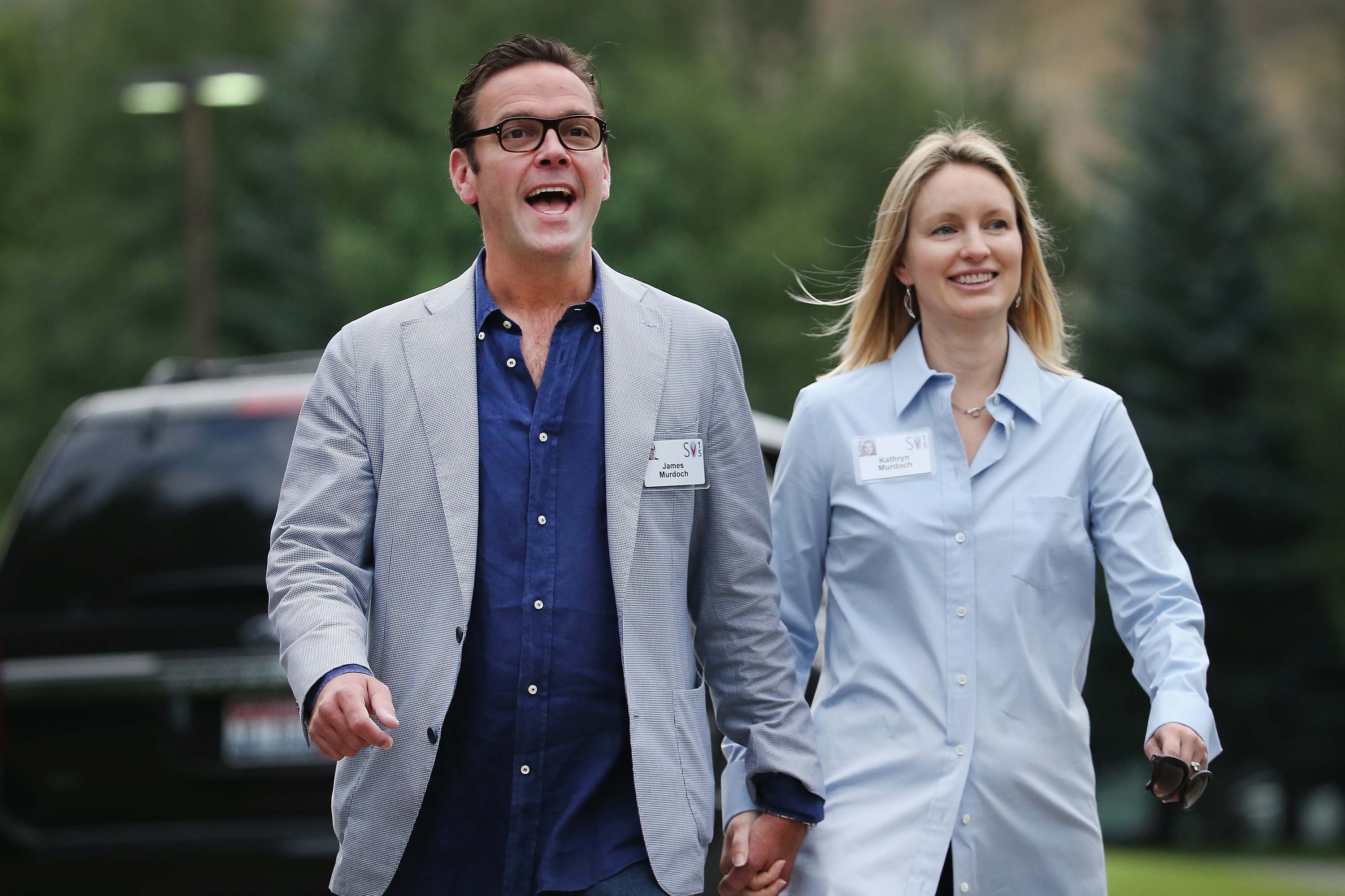
Years before that abrupt split, James and Kathryn had gradually begun to define their own political agenda. Kathryn was drawn to procedural reforms, and in 2019 she became co-chair of Unite America, which advocates electoral systems meant to reward politicians for moving to the middle, including nonpartisan primaries and ranked-choice voting. The changes been implemented most comprehensively in Alaska.
James’s donations looked like those of a business executive seeking to maintain his standing with those likely to wield power, much as Rupert had held fundraising breakfasts for Hillary Clinton and his Sun tabloid backed Tony Blair’s Labour Party even as his own politics were to the right of theirs. James gave five-figure gifts to both Speaker John Boehner and Senate Majority Leader Mitch McConnell, while in 2016 he delivered the Federal Election Commission maximum to Clinton and Democratic Party committees.
That year Kathryn appears to have made her first-ever federal hard-money contribution, to Clinton’s campaign against Trump, whose eventual victory set the Murdochs off on a leftward course. The Republicans they backed were those who established varying degrees of distance from MAGA, like Utah Sen. Mitt Romney and Pennsylvania Rep. Brian Fitzpatrick. (Romney left the Senate in 2025 and Fitzpatrick lost his seat last week to a Democratic challenger.) They wrote checks to a handful of Republicans and Never Trump causes like Bill Kristol’s Defending Democracy Together and Republicans for the Rule of Law.
As moderate Republicans became a vanishing species, James and Kathryn’s money drifted left. In 2020, Kathryn gave $1 million to Senate Majority PAC, a leading Democratic super PAC, and she and James each gave $615,000 to the Biden Victory Fund. The family foundation, Quadrivium, backed the Environmental Defense Fund and the Brennan Center for Justice.
Kathryn established herself in donor circles as a technocratic centrist who approached giving like an investor. In 2017, Kathryn commissioned what she called a “landscape analysis” of groups working on changes to voting systems and found that many spoke well but were too small to have real impact. The Murdochs’ list of recipients narrowed and the amounts they donated increased, as did their expectations. “People are messy,” she tells friends, an observation she may have picked up from her husband’s family.
In the 2020 cycle, they became the largest donors to the political arm of Unite America, which pushes open primaries and ranked-choice voting, giving $10.5 million of the $16.5 million that Unite America spent that year. Kathryn now co-chairs the group.
The Murdochs moved towards a sharper-edged view of political conflict, according to someone who has solicited their donations and watched their political evolution. They have acknowledged that “yes, sure, you need those [democracy] reforms, but first you need to fight back against Trump to have enough power to do the reforms,” this person said.The couple’s electoral giving roughly tripled between the 2020 and 2024 elections, according to a review of FEC filings that reveal a portrait of a preferred candidate type: the electability-minded Democrat, meant to balance the party’s leftward movement over the last decade.
The couple’s primary question to politicians they consider backing, according to a person who has witnessed the encounters, is not “Why are you running?” but “What are you going to do?”
Steve Israel, former chairman of the House Democrats' campaign committee and one-time adviser to Majority Democrats, which was founded to promote such candidates, said the Murdochs' combination of strategic thinking and money was “a force multiplier” for those who might otherwise struggle for attention against progressive opponents.
“No matter how self-interested they are, people tend to have a value premise that makes them a hero in their own narrative and reconciles their contradictions,” said Jeff Hauser, executive director of the Revolving Door Project, a watchdog organization that scrutinizes political influence and corruption. “That's what I see in donors like James and Kathryn Murdoch. They forget that Kamala Harris tried to co-opt reasonable Republicans into her campaign, and turn away from populist anger, and it didn't work.”
Those looking for the ultimate contradiction in James’s worldview point to his longtime board role at Tesla, the company founded by Elon Musk, who poured hundreds of millions of dollars into Republican causes and candidates in an unsuccessful bid to defend Republican control of Congress. James told Vanity Fair that Tesla has nothing to do with X, Musk’s social media platform, and that his circle defends his board role as simply a way to focus on sustainable energy.
Which brings us to the part Rupert would understand.
James and Kathryn Murdoch's theory of change has three components. Change the rules, through primary and ranked-choice reform, so the middle becomes a place from which candidates of both parties can win. Change the candidates, through groups that recruit and train moderate Democrats to operate in a media environment that bears little resemblance to the one their predecessors ran in. And change the conversation, which is where the money starts to look less like philanthropy and more like a Murdoch.

In October, James and Kathryn addressed New York Magazine staff at an all-hands meeting. Three months earlier, their Lupa Systems had closed its purchase of roughly half of Vox Media’s business: Vox.com, the Vox Media Podcast Network and New York Magazine, which Rupert owned from 1977 to 1991 and whose offices James visited as a kid. In announcing the purchase, James said Vox aligned with their existing holdings and reflected “both our interest in the forward edge of culture and our deep commitment to ambitious journalism and agenda-setting conversations.” A representative from Vox Media and New York Magazine declined to comment for this article.
Before the acquisition, the couple met at a downtown bar with Kara Swisher, prominent host of some of Vox’s most lucrative podcasts, to ensure that she would stay on after any purchase. After the deal closed, the couple became hands-on owners, showing up together for management meetings. The pair is forming a four-person board over the new Vox properties that includes James, Kathryn, James’s longtime lawyer Jeff Palker, Lupa’s general counsel and James’s longtime lawyer, and Angelo, a former New York Post editor and executive whom James has known since kindergarten and says he trusts “with my life.”
At the magazine’s SoHo office, editor-in-chief David Haskell interviewed the two new owners. The tall, sneaker-clad James sat between his wife and his new employee, chatting amiably with the assembled staff, according to three attendees. When asked about New York maintaining its independence, James, the son of one of the most famous interventionist media owners in history, spoke about how he wanted the magazine to succeed, and to do that, editors and reporters had to take risks and not look over their shoulders to discern what the owner wanted. (The only hitch in the meeting was when Kathryn exhorted a skeptical staff to look at the opportunities that AI presents instead of only its perils, according to some in attendance. A person familiar with the Murdochs’ dynamics said that Kathryn was referring to the potential for an array of positive outcomes, not as something to use in the newsroom. Haskell declined to comment.)
Seen one way, the acquisition of the iconic biweekly magazine and a podcast network that includes Swisher and Scott Galloway’s Pivot and Esther Perel’s Where Should We Begin? represents another investment in the diversions of the educated rich: stakes in the Tribeca Film Festival and a major stake in MCH, which owns Art Basel, the series of contemporary art fairs in Basel, Paris, Miami Beach and Hong Kong; and the Futurific Institute, which is planning an event aimed at rivaling the Aspen Ideas Festival. With Uday Shankar, whom he met working together at Star India, James co-founded Bodhi Tree, the investment vehicle that put money into what became the Indian media giant JioStar, which says it has 300 million subscribers, roughly Netflix’s global count.
James never possessed the nostalgia for printing presses that animated his father and brother. Instead he was always trying to figure out what came next, according to six people who worked alongside him at the family companies. James’s new investments have “no guiding thread except his principal interests, which are well-known,” said Claire Enders, a prominent financial analyst who declared many of his investments as “decent, informed, thoughtful and long-term,” noting that there have been no “clangers that shut down.”
Seen another way, the media acquisitions are an extension of the ongoing Murdoch political project. Through its website, New York Magazine has transcended its namesake hometown and become the house journal of the country’s metropolitan left. Vox’s namesake site, devoted to explaining complex policy questions, focuses on climate and democracy, which drew Kathryn to it, according to someone who has spoken to the couple about the businesses. Vox recently announced that Swisher, who hosts several podcasts on the Vox Media Podcast network, would co-host a new show with Clinton. “James was all for it when I proposed it,” said Swisher. “I mean I would have done it even if he did not.”
As they continue to examine the books at a variety of media upstarts, with an eye toward additional acquisitions, the Murdochs seem to be considering multiple bottom lines. Kathryn first met former Republican political consultant Sarah Longwell through Longwell’s advocacy work, and in 2019, the founder of the newly launched Never Trump nonprofit website the Bulwark sought Kathryn out for guidance. “I asked for her advice, and she told me to run it like a business,” Longwell recalled. “I took that very seriously and really leaned into it.”
The Bulwark became a for-profit company in 2021, with Lupa Systems as a minority shareholder, and now projects more than $30 million in annual revenue this year. Vox recently signed a deal to handle the Bulwark’s advertising sales and marketing for three years. The Murdochs expressed interest in buying the Bulwark, but were told it was not for sale. It all marks a departure from the way Rupert approached politics, which followed power rather than doctrine. James and Kathryn are funding boutique civic initiatives and prestige media while trying to compete with the raw, industrial-scale political engine his father left behind.

Nine days after the election, a new set of retro-aesthetic concert-style posters graced the walls of Mission Ballroom, a 3,950-person foot music venue in Denver’s River North Arts District. This time, however, the posters showed not rock and pop stars on tour but politicians on a victory lap, including Iowa Gov.-elect Rob Sand, Pennsylvania Rep.-elect Bob Brooks, and Texas Sen.-elect James Talarico.
Each took the stage over the course of the three-day What’s Next conference organized by Majority Democrats, which sought to retrospectively frame the party’s 2026 successes as a triumph for pragmatism. “There’s a durable majority to be built on common sense,” said the group’s chair, Massachusetts Rep. Jake Auchincloss.
Some were in Denver to explore how that assumption might sustain a 2028 presidential campaign, including senators Elissa Slotkin and Ruben Gallego, or further develop a national political network for one. Consultants just coming off midterm races prowled the halls in search of their next clients. At a bar reception hosted by Colorado Rep. Jason Crow, Buttigieg purposefully navigated the crowd to find Turek and extend congratulations on winning a U.S. Senate seat from the state whose 2020 caucuses launched Buttigieg as a serious presidential contender.
Operatives from wings of the party not well-represented in Denver looked at with deep cynicism upon the slick event, which one consultant who backed a rival candidate in a 2026 primary characterized as “a bunch of New York liberals in a Brooklyn-based lab trying to design normal candidates in middle America or latching onto existing successful candidates and taking credit for their work.” The consultant was granted anonymity to speak bluntly at a moment when most Democrats are looking to bask in their broad-based victory this month and avoid interfactional conflict.
Yet that peace may not last. Reporters covering the Denver conference received unsolicited opposition research revealing the surprise surname among Majority Democrats’ top donors. It is not hard to imagine where this could be headed in a fierce primary season: some candidates rushing for a share of James and Kathryn’s cash, while their opponents stigmatize it as permanently tainted blue-blood money.
“People are really angry at the cozy relationship between the political establishment and who they view as a donor class that has way too much power and access in our politics,” Ravi Mangla, national press secretary for the Working Families Party. “It raises questions of whether those groups are best positioned to deliver on what voters are asking of people or are asking of the party.”
Many in Denver already owed some part of their successes to James and Kathryn, through either Majority Democrats, a likeminded committee known as the Bench, or direct campaign contributions. (Among prospective 2028 presidential candidates, the couple is most drawn to Gallego, Buttigieg, Shapiro, Slotkin, Georgia Sen. Jon Ossoff and Arizona Sen. Mark Kelly, according to two people familiar with their motivations.) But the Murdochs were not in Denver. They didn’t need to be.
Jessica Piper contributed to this report.
Popular Products
-
 Fake Pregnancy Test
$61.56$30.78 -
 Anti-Slip Safety Handle for Elderly S...
$57.56$28.78 -
 Toe Corrector Orthotics
$41.56$20.78 -
 Waterproof Trauma Medical First Aid Kit
$169.56$84.78 -
 Rescue Zip Stitch Kit
$109.56$54.78