The One Town That Wants A Data Center
Opposition to data centers may be the singular unifying issue in American politics. Seventy percent of Americans are against data-center construction in their communities. They worry about the environmental dracularity of these facilities, the electrical costs they may impose, and the imperiousness with which tech companies target struggling communities while drastically altering the landscape. Bernie Sanders and Alexandria Ocasio-Cortez have spoken out against data centers; so have Steve Bannon and the right-wing podcaster Matt Walsh.
About 75 data-center projects were blocked or delayed in the first three months of this year—roughly the same as were blocked or delayed in all of last year. Still, this is a fraction of the more than 1,500 projects in development. Those who seek to stop the spread have recently turned to statewide moratoriums. Fifteen states have introduced moratorium bills, but only two of those bills have made it through the legislature. Last month, New York became the first to ban the construction of “hyperscale” data centers (ones that use 50 megawatts of power or more). Maine was supposed to have beaten it. In April, the state passed LD 307, which would have banned new centers using 20 megawatts or more. The bill went to the office of Governor Janet Mills to be signed into law. And she vetoed it.
Mills took no issue with the thrust of the bill, writing “a moratorium is appropriate.” She vetoed it for one reason only: It failed “to allow for a specific project in the Town of Jay.”
Jay, Maine (population: 4,620; motto: “Proud of our past and working for our future!”), wants a data center. It had one in the works, and town officials lobbied the governor to preserve it. Mills listened. “We must consider the perspective of the Town of Jay,” she wrote.
In May, I drove to Maine to consider the perspective of the Town of Jay. I wanted to understand why this town had fought for the very thing that so many others dread. What I found was a reminder that politics is local. Jay’s embrace of the data center had less to do with the power of rapacious tech companies or the future of AI than it did with the failure of a series of welds that sealed a 166-foot-tall pressure cooker at a half-century-old paper mill.
There are two Maines. The first Maine is right there on the license plate: vacationland. Lighthouses, lobster bibs, the jagged coast, anywhere with a big, beautiful lake or a big, beautiful ski mountain. The other Maine—Jay’s Maine—is Appalachia. When I asked ChatGPT what I should see in Jay, it suggested (gently) that I should visit somewhere else. Jay is a 90-minute drive from the coast. It has no lighthouse and no giant lake. The school is the town’s largest employer. A surprising number of people ride motorized scooters—they can no longer afford cars. What Jay does have is space.
In 2023, a company called JGT2 bought 1,000 acres just across the Androscoggin River from Jay. To inexpert eyes, the property—the site of the former Androscoggin paper mill—doesn’t look like much: a few rusted and stained industrial buildings sprouting weeds in the shadow of an immense landfill. But to Tony McDonald, one of the developers who leads JGT2, the site looks like money. It has direct rail access, gas, a 35-million-gallon-a-day wastewater-treatment plant, and, crucially, power: a 150-megawatt electrical interconnect, plus access to 25 megawatts of hydroelectric power.
McDonald’s original idea had been to turn the place into a wood-product manufacturing facility. Mills traveled to Jay to announce the project, which was expected to create about 125 jobs. And yet over the next two years, the factory plan quietly died—throttled by the Trump administration’s tariffs on specialized equipment, steel, and aluminum.
Jay has minimal zoning laws; McDonald didn’t need to ask anyone’s permission for what he planned to do with the land. So few in the town knew that his focus had switched from wood to data until one freezing night in late March, when he showed up to see the Jay Select Board—the five-member panel that sets town policy. News of the moratorium bill had broken, and McDonald needed the town’s help to preserve his project in Jay. He apologized that this was the first the board was hearing about his deal with the data-center firm Sentinel: “It never occurred to me to discuss it with anybody,” he said, “so to any of you that got blindsided by that, really, I’m sorry. That’s on me.” But without their help, he told the board, the bill “will kill this project. Dead, dead, dead,” before adding, “Dead. Never coming back.”
Secrecy around such projects is not unusual, even in places that require town approval. In a recent report, NBC analyzed more than 30 data-center proposals from 14 states and found “in a majority of cases, local officials signed NDAs and worked with what appeared to be shell companies that can conceal visibility into the project developers.” The justification is that secrecy preserves a competitive advantage; the effect is that citizens learn of these projects only when it’s too late to do anything about them.
Still, towns have fought back. In October, when the people of DeForest, Wisconsin, discovered plans to build a $12 billion data center, the backlash was powerful enough to kill the project a few months later. In April, a town council in Festus, Missouri, approved a $6 billion center plan; a week later, the town voted out every city-council member who’d voted for the project.
None of that happened in Jay. Less than an hour after McDonald stood up in the meeting, the board voted 4–0 (with one abstention) to draft a letter of support to Mills. Analyze the footage as much as you like—it will provide no clear answers as to why, in this moment of bipartisan resistance to new data-center construction, these town leaders would go from total ignorance to unanimous support in the time it takes to bake a lasagna.
Then—perhaps even stranger—most people in the town embraced the decision. Some were skeptical. More than a few traded insults in “The Jayborhood” (the town’s Facebook group). But meaningful resistance was scarce. One resident, concerned about noise pollution, started a petition, then gave it up after a 30-minute conversation with McDonald.
Mainers guard their individual freedom fiercely and apply limitations only selectively. More than one person I spoke with in Jay dismissed the broad resistance to data centers as simple NIMBYism. A common refrain I heard went something like: It’s Tony’s land. He can do what he wants with it. Cody Jacques, a union electrician who grew up in Jay, put it this way: “I don’t want you to tell me what I can do at my house. This is my property. I live here.” The same is true of McDonald’s site, he said. “At the end of the day, nobody likes to get told what to do with their stuff.” Still, the town doesn’t oppose all moratoriums on principle; it bans retail marijuana stores, which surround Jay on all sides.
The reason Jay wants this data center—the reason the board lobbied the governor for it—has everything to do with the land on which it would be built. The Androscoggin Mill once employed 1,500 people. Those who didn’t work in the mill envied the mill workers’ wealth, which bought houses, four-wheelers, prom dresses. “It was everything,” Trevor Doiron, who is running to represent Jay’s district in Maine’s House of Representatives, told me—“the identity of the town.”
Growing up, Jacques would stare at the mill and imagine a gleaming city. “The scale of the mill and all the lights, all the towers,” he said—“we’d always joke around and say, ‘There’s Portland, Maine, on the river.’”
After a stint in the service of Vacationland as a lobsterman, Jacques returned to Jay in 2019 to work at the mill. It employed fewer people than it once had, but Jay was hardly some bombed-out ruin; the paper mill still tithed substantially to the town, and offered Jacques a 401(k) and the chance to rise through the ranks. The year that OpenAI released GPT-3, he was studying for a promotion to pulp-digester operator, spending his days off at the mill with a clipboard and notebook.
On April 15, 2020, Jacques was at home. His phone buzzed with a few texts from friends asking what was going on at the mill. He figured a mill job had been posted and they wanted an inside track. “So I was like, Hey, no, you just gotta go on the website and apply,” he recalled, “and they were like, No, the mill blew up. I’m like, What do you mean it blew up?”
Dash-cam footage from a truck nearby recorded the explosion. The video shows the traffic just outside the gates and the mill in the background. What you can’t see is a weld, one of thousands sealing the 166-foot tower that turned wood chips into wood pulp, opening a crack in the wall. Then another weld. And another. One moment there is blue sky, the next, a black column hundreds of feet high. Oozing brown pulp drums on the hood of the logging truck like hail as the drivers on the radio squawk and curse. Soon it’s so thick that the camera is almost entirely obscured. The black cloud is on its way toward Jay, where it will drop wood pulp on the houses.
Jacques got in his car. He tried to get into the mill—to help, to pull out bodies if needed; he didn’t know—but police blocked the road. Mill employees worked in 12-hour shifts—about 170 workers on site at a time. They worked weekends, nights, and holidays together. They were like family. Jacques saw that the two 166-foot towers where he’d worked, the same towers he had imagined as a city when he was a kid, were gone.
Remarkably, no one died. A government report attributes this extraordinary outcome to the timing of the explosion. It was lunchtime. People in Jay credit the grace of God. Once everyone was accounted for that evening, the town’s thoughts turned to the future. “ We knew right then and there they weren’t rebuilding,” Kenny Jacques, Cody’s father, told me, before blowing a brief rendition of Taps through pursed lips. “It’s over. It’s over.”
I asked Lucien Richard, a former engineer at the mill who now works as McDonald’s site manager, to show me the parts of the property that are best suited for a data center. The mill was mostly silent, with the exception of a few demolition workers smoking and listening to AC/DC. Walking through the machine rooms, I understood why Elon Musk wants to put data centers on the moon—the facility was so dark, cold, and seemingly endless that we may as well have been in outer space.
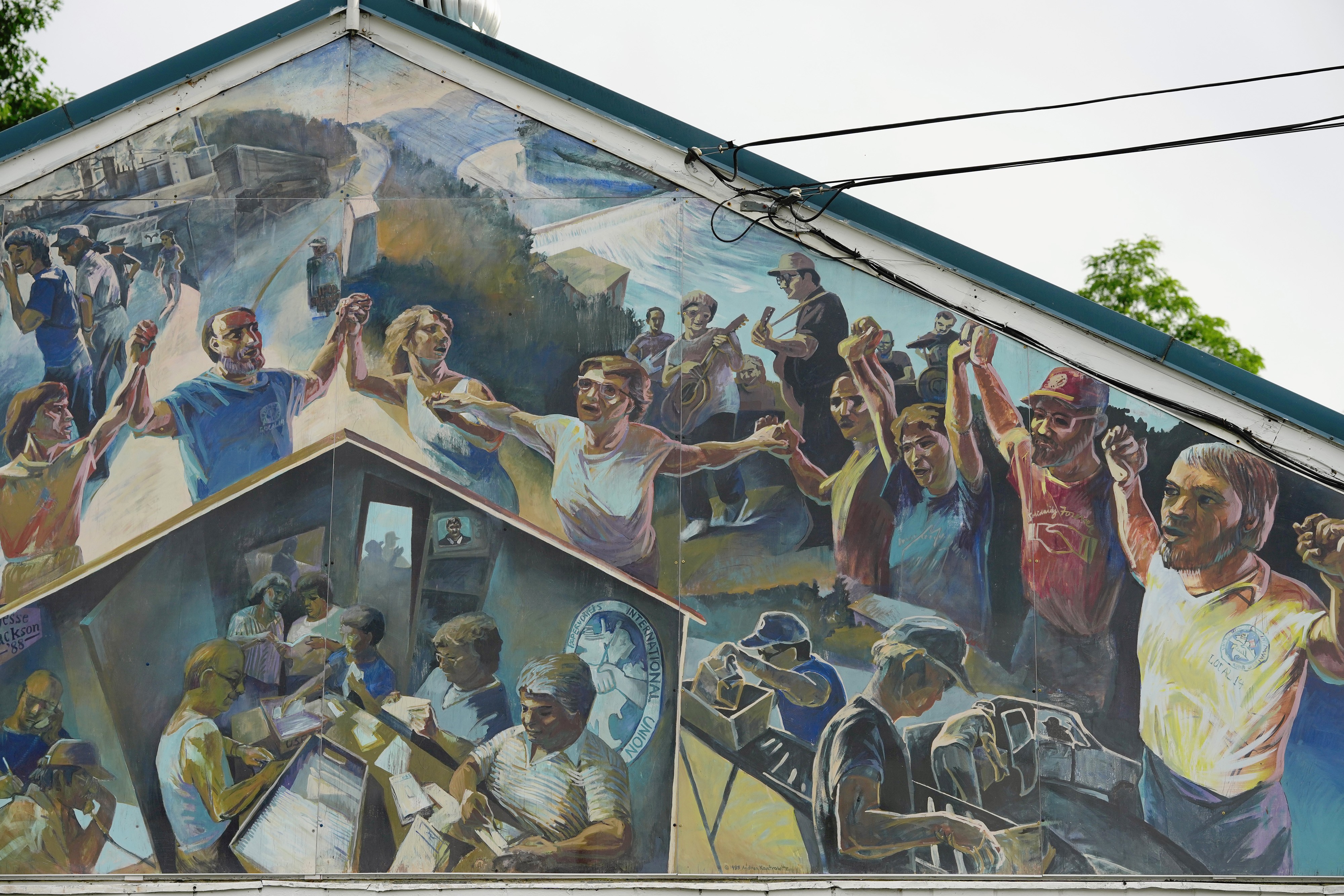
At one point, Richard’s flashlight fell across a mural—a hand-painted image of a rowboat full of puppies, peering out at a row of ducklings. “Some pretty talented people used to work here,” he said.
Last year, Donald Trump directed the Environmental Protection Agency to identify sites like the former paper mill for potential data-center use. The reasoning is that in some cases, much of the infrastructure is already there. According to McDonald, the mill site is permitted to pull 82 megawatts from the electrical grid. To supplement that power, he plans to build a 150-megawatt solar facility, and to employ the hydroelectric facilities that sit on the Androscoggin River. Elsewhere in the country, power plants are struggling to keep up with demand from data centers, which can drive up electricity costs. The pitch, then, is that this data center would exist in a walled garden—generating much of its electricity on-site, and pulling no more from the grid than the mill did before the explosion.
In dry states such as Arizona, data centers strain an already precarious water supply. Maine is wet. Richard showed me another vast room, this one with rows of sand pits stretching off into the darkness, into which 35 million gallons of water were once pumped up and filtered daily. McDonald expects the data center to use 1 percent of that, or about 300,000 gallons a day. Richard mused that they might need a smaller pump.
Some of the language McDonald uses—his promises of “no environmental impact” and “all positives,” “no negatives”—is clearly overstated. Maine has environmental and power regulations like everywhere else, but no specific playbook for data centers. The reason the Maine legislature passed the moratorium in the first place was so it could make a set of rules before development started.
On every point, this is how the argument goes: Would a data center be loud? Can’t be as loud as the mill! Could it smell bad? The mill smelled like rotten eggs! Would it pollute the environment? The river was covered in toxic foam in the mill days! “All you gotta do is get over the people’s fear,” Richard told me. “You need lots of water. We used to use lots and lots of water. You need lots of power. We used to use or make lots of power. It’s a natural fit.”
Using the past in this way, as a means of justifying the future, is a dangerous gambit, nostalgia being the hack-and-burn editor that it is. For some, the counterargument couldn’t be more obvious. Just look at the river now: It’s blue. But the mill is a handy benchmark for what the town is willing to tolerate.
Although the work Richard oversees may resemble Jay’s productive industrial past (angle grinder, indoor cigarettes, AC/DC), the task here is demolition. Tons upon tons of complex machinery have already been disassembled and shipped to Pakistan. When the place is empty, the trucks can roll up, the servers can be plugged in, and the building can start humming its ceaseless B-flat. And not so many years from now, the mural will be a sort of cave painting. Perhaps some AI-powered technician will roll past and wonder what possible efficiency might have been gained by painting a boat full of puppies on a wall in a workplace.
After the mill exploded, Jacques heard from a friend that work was to be had as a union electrician. He took an aptitude test, and soon became an official brother of IBEW Local Union 1253. Its logo is an electrified bear in a hard hat. His work, by and large, has been in the booming industry of data-center construction.
Accustomed to heat, noise, and toxic chemicals, Jacques was struck by the pristine cleanliness of data-center facilities. The downside is the distance—he travels all over the northeast and lives on-site for weeks at a time. Recently, he was halfway through an eight-week job in Niagara Falls when he called his girlfriend to say he wasn’t going to make it another four weeks without seeing her and their young daughter. They looked at a map and chose Albany, that bright and empty city, as a midway meeting point. Seeing his daughter through the open window of his girlfriend’s car as they pulled up, he felt elation, and relief.
If Jay had a data center, one of the construction jobs would almost certainly be his.
During local elections late last year, Meta spent $6 million running ads in state capitals such as Sacramento, Tallahassee, Salt Lake City—places with the power to buoy (or ban) data-center construction: “Los Lunas used to be a one-stop town. Most people were employed by a farm or a railroad. I needed to support my family and leave home to find work, traveling all the time. I missed a lot—important moments I can’t get back.”
The put-on simplicity of the voice-over script, paired with the Old MacDonald imagery (horses, hay bales, pickups) reeks of insincerity. “Then Meta came to town and opened a data center, bringing new jobs to Los Lunas. And now I don’t worry about missing out much anymore.”
Tony McDonald has said he expects that the Jay project will create 125 to 150 full-time high-paying jobs. Those jobs were a key factor in Mills’s veto of the moratorium. But projects with similar footprints employ 30 to 50 full-time staffers. Five years from now, if the predictions of AI companies are to be believed, the number will be smaller. So when Tom Saviello, the mill’s former environmental manager who is now a county commissioner, started quoting Field of Dreams to me—“If you build it, they will come”—I worried that Jay was being sold a future that would only ever exist in Meta ads.
Saviello’s grief at the loss of the mill was so intense that, for years after the explosion, he couldn’t bring himself to visit the place. When the data-center project was announced, that grief evaporated. We talked in the mill’s parking lot. “I just get excited about it,” he told me, sheepishly. “That’s all.” The people of Jay have “been through turmoil,” he said, “but they’ve survived. And this is a chance for them to even do better.”
I spent one of my afternoons in Jay with Trevor Doiron, the House candidate, a Democrat who supports the data center. He’s 28, with the look of a politician who has come home to run for office: neck sunburn, flannel tucked into jeans. He told me he’s been surprised by how people are living—with holes in the floor because they can’t afford repairs, using the oven to heat the house.
Maine has the oldest population in the country, and the population of Jay is older even than the state median. Trevor volunteers at the food pantry on Tuesdays along with a 92-year-old man who helps pack and deliver meals to Jay’s older residents. “The elderly are the ones providing the services for other elderly people,” he said. “A year from now, who’s gonna be filling the boxes?”
Before visiting Jay I expected that the current running beneath its bid for a data center was desperation: To survive, Jay needs anything. What I heard instead was Jay wants something. Because something is better than nothing.
In a recent article about Jay and rural data centers, Anthony Elmo, who studies economic development, said of rural towns, “They don’t have the resources to negotiate. They don’t know what to ask for.”
I think Jay knows plenty. In its support of McDonald’s project, the town offered no tax break, and stood to make about $6 million in property taxes. That’s a transformative amount of money for the town’s budget—about $7.2 million this year. Locals were clear-eyed about the promise of full-time jobs and skeptical of the claims being made in Meta ads. “I don’t care if it’s 10 jobs. I don’t care if it’s 100 jobs,” Saviello said. “One is more than zero.” Many also reminded me that residents such as Jacques already make their living on temporary construction gigs. “ It’s ugly. It’s ugly,” Doiron told me about Loudoun County, Virginia—which is often thought of as the data-center capital of the world—but “Loudoun County has a lot of really nice stuff.”
“ Even if all that industry comes back, it’s not gonna be us that builds it,” Patrick Hopkins, a carpenter and Jay resident, told me. “It’s gonna be automated. It’s not gonna be the days where this whole line of dudes walks in and they’re all wearing the same company shirt and the same company hat, and they’ve all got their lunch pails. That’s just some dream from the past—a moment in time. It’s gone. It’s better for us as a people to be like, We need to move on.”
The most powerful companies in the world want these data centers. Many of the campaigns to build them are waged in secret against towns worn down by decades of losses. You could think that it was wrong to let one town stand in the way of a statewide moratorium. You could think that Jay was naive, and yet another data center won’t make anyone better off. And yet for Jay, the data center is an opportunity to push back against the steady encroachment of poverty, 15-hour commutes, the atomization of an aging society. I found I couldn’t argue with such a pragmatic and hard-earned hope.
But on June 11, the town posted an announcement on its Facebook page. Commenting was disabled. The data-center project had been put on indefinite hold. McDonald’s client, Sentinel, had backed out.
I called a lot of the people I’d spoken with in Jay. Most were disappointed. None seemed that surprised. McDonald is trying to find a new firm; the demolition work continues. But no one is particularly optimistic. The data-center project was just the latest on a long list of things that were there one day and gone the next.
Popular Products
-
 Electric Toothbrush & Water Flosser S...
$43.56$21.78 -
 Foldable Car Trunk Multi-Compartment ...
$329.56$164.78 -
 Mommy Diaper Backpack with Stroller O...
$111.56$55.78 -
 Ai Dash Cam with Front & Rear HD, GPS...
$295.56$147.78 -
 Smart Auto-Recharge Robot Vacuum Cleaner
$613.56$306.78