The Sleeper Referendum That Could Reshape The National Judiciary
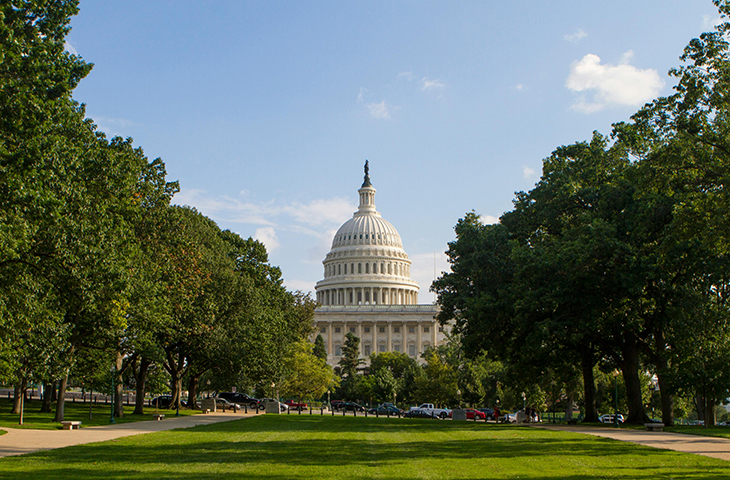
A ballot referendum in Kansas that’s generated little national attention could set off a nationwide arms race to politicize state courts.
Kansans on Tuesday will decide whether to amend the state constitution to allow voters to directly elect justices to the state’s highest court — a push by the legislature’s Republican supermajority to reshape a judicial system that’s repeatedly stymied its policy priorities.
Critics of the measure worry Kansas could become the inspiration for other states to overhaul their own high courts, eroding the independence of the judiciary nationwide.
Some supporters say that’s the point.
“Anyone who observes the U.S. Supreme Court or state supreme courts and pretends that there aren't political inclinations and political factors going into the judges' calculations on close cases is deceiving themselves,” GOP Kansas AG Kris Kobach, who backs the amendment, said in an interview with POLITICO.
“If politics are inevitably involved in some of these very controversial decisions, then should the selection of justices be done behind closed doors by individuals who are unaccountable,” he said. “Or should ‘we the people’ be able to decide whether one political argument or another one should have weight in selecting a justice?”
Kansas is the first state to attempt a wholesale shift in process from nomination to election — and if it passes, “it could spark a trend nationwide,” Deirdre Schifeling, the chief political and advocacy officer at the ACLU, told POLITICO.
Micah Kubic, the executive director of the ACLU of Kansas, said he expected the court to soon consider several controversial policies, including on LGBTQ+, labor and voting rights.
More than $12 million have been funneled into the referendum from both sides, including the ACLU, the Koch brothers-backed Americans for Prosperity and organizations tied to the conservative legal activist and Federalist Society co-chair Leonard Leo.
Selecting supreme court justices varies state-by-state, and in more than 20, voters already elect them. But the proposed amendment in Kansas is part of a broader pattern of politicizing state-level judiciaries. Ohio voters made their supreme court elections explicitly partisan in 2022, resulting in a far more conservative bench. Last year, a supreme court election in Wisconsin shattered records when megadonors including Elon Musk and George Soros pushed total spending on the race past $100 million. And in November, Montana could vote on whether to enshrine nonpartisan judicial elections in the state constitution.
For nearly seven decades, justices on the Kansas supreme court have been picked by a nominating commission composed of five lawyers selected by other lawyers, and four nonlawyers selected by the governor. When a seat on the court opens, the commission taps three finalists, one of whom the governor must nominate to the bench. Thirteen other states also use that basic model, known as the Missouri Plan, for judicial selection.
But Republicans in the state legislature have been roiled by a series of decisions the Kansas supreme court has made since 2005 — including on school funding, the death penalty and abortion. GOP state Sen. Mike Thompson, who introduced the amendment, cast the court as overly liberal and out of step with Kansas voters, telling POLITICO he sees the justices as “basically legislating from the bench.”
“We're not even asking for it to be closely aligned with any party,” he said of the court. “We just want it aligned with the constitution.” Thompson added that the court decided “a number of different rulings” that “we felt were incorrect,” including the abortion, school funding and death penalty decisions.
“You see this inherent politicization of the court, and there have been attempts over the years to right size that,” Americans for Prosperity-Kansas State Director Elizabeth Patton said. “And eventually it just became clear that, especially from the lawmakers' perspective, this needs to be a vote to the people to give them the opportunity to have a say on how they want to hold their court accountable.”
Opponents of Tuesday’s measure say it’s a bid by Republicans to take another stab at a slate of conservative policies.
“The reason for changing this isn't because it's not working,” Kansas Democratic Gov. Laura Kelly said in an interview with POLITICO. “It's because [the court is] not doing what the legislature wants it to do.”
Like this content? Consider signing up for POLITICO's Playbook newsletter.
Popular Products
-
 Classic Oversized Teddy Bear
$23.78 -
 Gem's Ballet Natural Garnet Gemstone ...
$171.56$85.78 -
 Butt Lifting Body Shaper Shorts
$95.56$47.78 -
 Slimming Waist Trainer & Thigh Trimmer
$67.56$33.78 -
 Realistic Fake Poop Prank Toys
$99.56$49.78