The Trump Administration Once Hailed Aviation Workers As "great Professionals." That’s Changed.

The Trump administration was once a vocal champion of federal workers at the front lines of aviation safety. Now many of those workers feel left out in the cold.
The new, chillier approach includes a nearly six-month-long delay in a congressionally mandated pay hike for the nation’s 15,000 air traffic controllers, which the Federal Aviation Administration granted only recently while demanding concessions on work hours. Meanwhile, the Transportation Security Administration has provoked a union grievance by requiring its document checkers at airport checkpoints to stand throughout their shifts.
At the same time, Congress has spun its wheels on efforts to ensure that controllers and TSA workers get paid during future shutdowns, despite pleas from unions and the industry.
“When there were shutdowns, these workers were hailed as heroes, and when they're being paid again their modest wages, their needs and interests seem to be forgotten,” said Daniel Horowitz, legislative director of the American Federation of Government Employees, which represents TSA screeners. The average TSA screener earns roughly $60,000 per year, according to the Bureau of Labor Statistics, which is location dependent. DHS also wants to nix the TSA's union contract, which AFGE is fighting in federal court.
It’s a sharply different tone from a year ago, when administration leaders and GOP lawmakers repeatedly praised both groups of employees while denouncing congressional Democrats for leaving them without pay during the 43-day federal shutdown. President Donald Trump’s appointees described the controllers and TSA agents as critical to keeping the nation’s skies safe.

“We do have the best controllers and they work really hard, and they care deeply about keeping Americans safe through our airspace,” Transportation Secretary Sean Duffy said last November, adding that most were “great professionals.” (Duffy did at one point scold controllers who he said were calling out sick and “lashing out" amid the shutdown, compounding travel setbacks). Vice President JD Vance empathized with workers over missed paychecks and pointed to worries about feeding their families while urging Democrats to “stop this craziness.”
In March, Trump called TSA agents "hardworking" and "great" when he ordered his administration to dip into existing accounts to pay workers during a 76-day DHS shutdown.
The disconnect reflects a broader tension in the Trump administration’s costly push to modernize the nation’s air traffic control and security systems. Controller and TSA worker pay, retention, recruitment and working conditions are at the heart of the administration’s efforts to improve the flying experience.
In short, no modernization plan can succeed without the people responsible for keeping the nation’s skies safe and its airports secure.
'No administration has done more'
The White House countered that air safety workers have never had it better.
White House spokesperson Allison Schuster said in a statement that “no administration has done more to support our air traffic controllers and modernize America’s air traffic control system than the Trump Administration,” She added that the Trump administration provided workers “bonuses, offered payments to their families, and issued them raises,” pointing to a recent 2.8% pay raise for controllers.
“Unlike the Democrats, President Trump believes taking care of air traffic controllers and maintaining adequate staffing will keep Americans safer in the skies,” Schuster added, blaming Democrats for the shutdowns.
DOT offered similar sentiments.
In a statement, the agency said that “suggesting this Administration doesn’t support our nation’s air traffic controllers is absurd, especially less than a week after we announced a 2.8% pay increase retroactive to the beginning of the year.”
“We’re also building a brand new air traffic control system to give controllers the modern tools they need to do their jobs,” DOT said.
TSA did not respond to a request for comment.

The contrast from last year also underscores how quickly the politics surrounding airport workers have changed since last year’s shutdown and this spring’s record-shattering lapse in appropriations at the TSA’s parent, the Department of Homeland Security, when staffing shortages, long security lines and mounting delays put the workforce squarely in the public eye. The TSA also lost roughly 1,100 employees in that stretch.
Controllers “are working day in, day out, and moving this country's traffic shorthanded,” said National Air Traffic Controllers Association President Nick Daniels.
Daniels said prolonged staffing pressures have left workers pushing for better pay and conditions. Moreover, he said, the recent rash of shutdowns — or even the threats of them — have controllers second guessing their financial security and the ability to focus on the job.
Congress is staring down a Dec. 11 government funding deadline.
Congress spins its wheels
The union recently notched a win, securing a 2.8% pay raise after months of uncertainty over whether the FAA would approve it. FAA Administrator Bryan Bedford attempted to tie the pay to increasing controllers’ time actively managing flights, known as time-on position.
“There will always be more to be done,” Daniels said of getting the pay bump after months of stalemate (he's also eyeing a 3.9% bump next year). Daniels noted some frustration with controllers having to see the discussions surrounding their pay and “how hard they work” dragged out into the public.
He added, “It's another move in the right direction but ... the sentiment is always going to be varied. When you're working understaffed, you're absolutely overworked, and then you have the economic pressures that are out there, it is long overdue.”

On Capitol Hill, meanwhile, efforts to ensure aviation workers are paid during shutdowns have failed to gain much traction.
Lawmakers since last year have introduced bipartisan proposals to ensure crucial aviation workers are paid during government shutdowns.
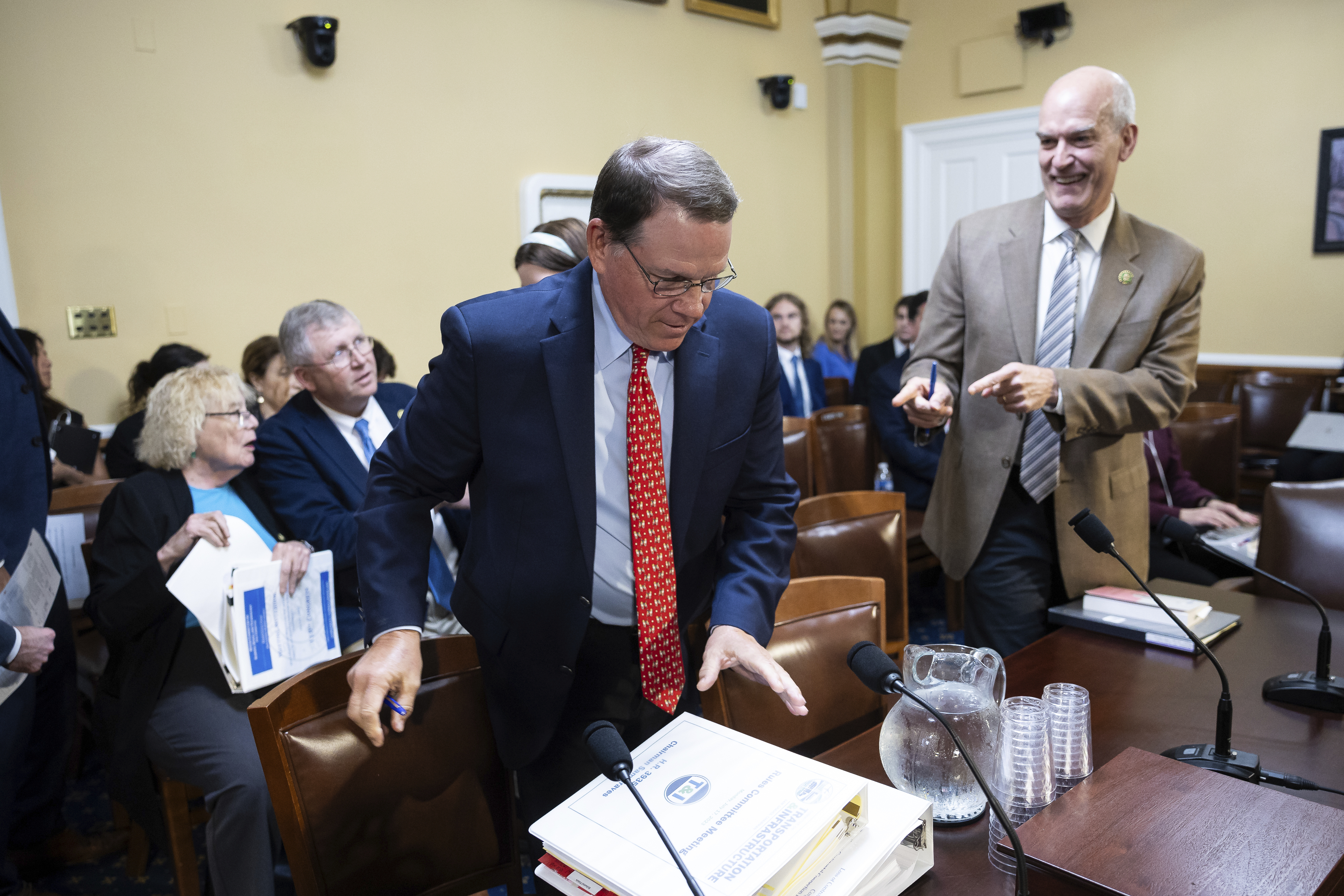
One of those bills, the Aviation Funding Solvency Act, H.R. 6086 (119), authored by House Transportation Chair Sam Graves (R-Mo.) and ranking member Rick Larsen (D-Wash.), advanced out of the panel in December.
But the bills haven’t gone far, with pressure on Congress to act fading away after the crises subsided. Congressional appropriators have consistently stymied the bills, with some arguing that passing such legislation would remove leverage during shutdowns.
A House Transportation spokesperson said the committee will keep an eye on the situation once Congress returns and as the next shutdown date in December approaches.
Even amid the latest funding lapse earlier this year, Democrats introduced and attempted to pass standalone or partial funding bills to pay TSA workers several times. For example, a bill in March to secure pay for TSA workers failed to advance on the Senate floor. Nevada Democrat Sen. Jacky Rosen’s proposal was blocked by GOP Sen. Roger Marshall of Kansas.
Some TSA screeners and air traffic controllers received $10,000 bonuses during last year’s shutdown. During the spring shutdown, Sen. Ruben Gallego (D-Ariz.) introduced legislation that would give TSA officers and other DHS employees a 10% bonus upon the agency reopening.
But no permanent pay protection for either aviation-focused worker group has been enacted.
Another shutdown looms
Christopher Sununu, president of Airlines for America, said that despite the stalemate, he is heartened by efforts in both the House and Senate, arguing there has been more movement on legislation to protect aviation workers’ pay during government shutdowns than in previous years.
“Given how difficult the legislative environment is — most things just die on the idea stage,” Sununu said. “It does seem to resonate with folks, and I think we can find a path for at least one of these things to kind of come to fruition.” He specifically cited the bill from Graves and Larsen.

Sununu noted that regardless of what Congress accomplishes during its lame-duck session, the potential for another shutdown is just around the corner. Such a lapse would disrupt holiday travel and bring the administration’s air traffic control modernization effort — a major undertaking for DOT and FAA — to a halt.
Even with lawmakers out of Washington and on the campaign trail for the midterms, lobbying efforts have not slowed, he said. A4A and its umbrella group, the Modern Skies Coalition, are engaging with lawmakers “every day” to stress the importance of the effort and push for results, he said.
“I think folks understand that shutdowns erode confidence in government, and both sides of the aisle need to — especially post-election — hopefully move something forward,” he said.
Popular Products
-
 Automotive CRP123X OBD2 Scanner Tool
$649.56$324.78 -
 Portable USB Rechargeable Hand Warmer...
$61.56$30.78 -
 Portable Car Jump Starter Booster - 2...
$425.56$212.78 -
 Electric Toothbrush & Water Flosser S...
$43.56$21.78 -
 Foldable Car Trunk Multi-Compartment ...
$329.56$164.78