Transcript: A Maga Voter’s Remarkable Takedown Of Trump: “pathetic!”
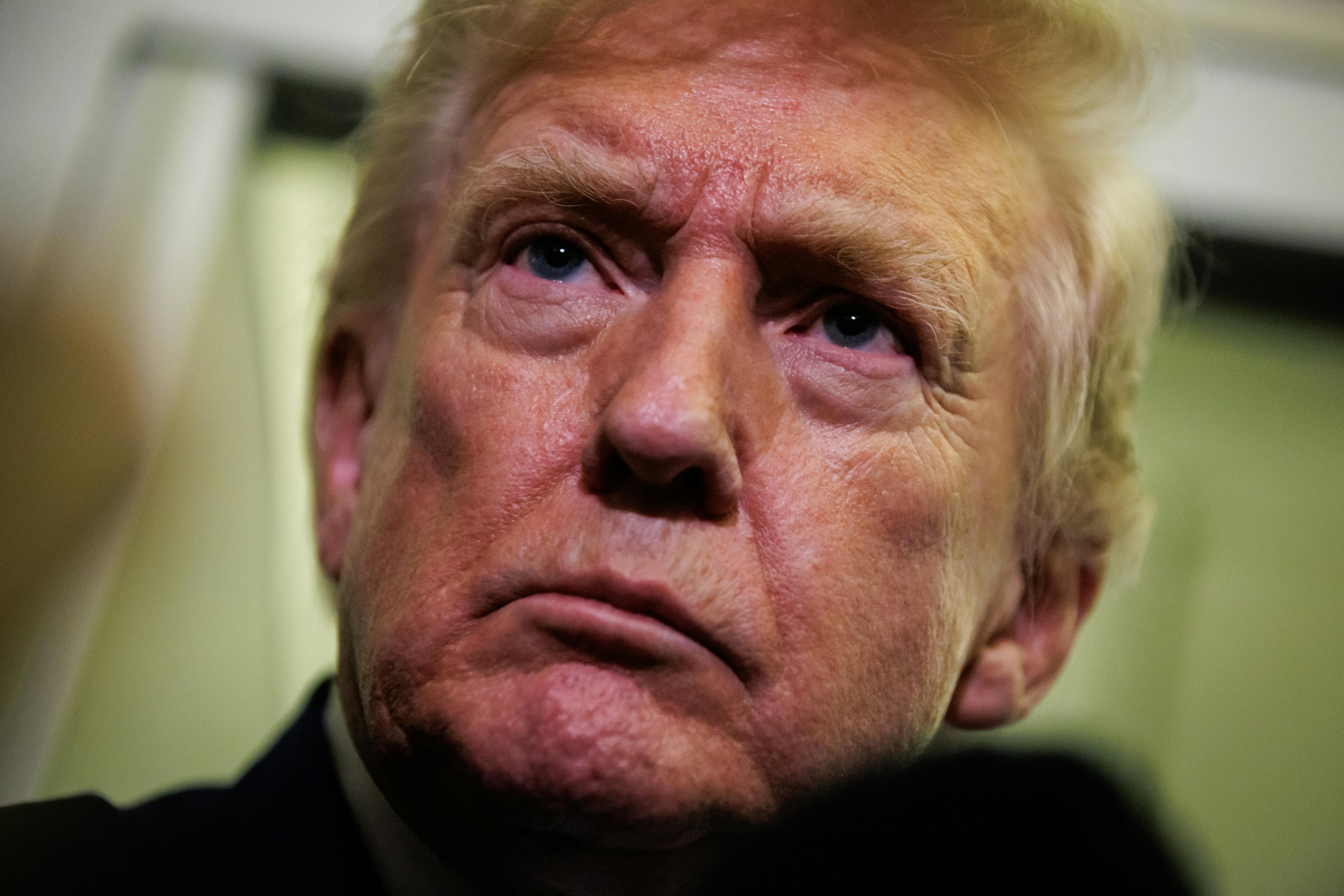
The following is a lightly edited transcript of the February 10 episode of the Daily Blast podcast. Listen to it here.
Greg Sargent: This is The Daily Blast from The New Republic, produced and presented by the DSR Network. I’m your host, Greg Sargent.
It’s not every day that Donald Trump backs down, but that’s exactly what happened after he posted a vile, racist video clip of the Obamas. It triggered a massive outcry, and the post was quietly taken down. Surprisingly, the backlash included some Republicans, and one self-described three-time Trump voter issued an extraordinary takedown of Trump, apologizing to the nation for having ever supported him. Why did all this happen in this particular case? We think one reason is that Trump and MAGA are in an unusually weak position in the culture right now. So we’re talking to New Republic senior editor Alex Shephard, who has a new piece explaining how Trump and MAGA have thrown away their cultural dominance over the last year. Good to have you on, Alex.
Alex Shephard: It’s great to be back.
Sargent: So as many of you have seen by now, Trump’s Truth Social feed featured a video clip with an image of Barack and Michelle Obama as apes. It was set to “The Lion Sleeps Tonight.” When this blew up, White House Press Secretary Karoline Leavitt’s first reaction was to call this an “internet meme video” depicting Trump as “King of the Jungle” and Democrats as characters from The Lion King. She dismissed the outcry as “fake outrage.” Alex, your thoughts on all this?
Shephard: Well, first of all, there are no apes in The Lion King. So it was always a ridiculous defense to begin with. But I think more to the point, you see this happen all the time now—that there is this, like, real rush, particularly within the administration, whenever Trump does something vile or racist, to just back it fully to the hilt before they can do anything to change it or to reverse course.
And so you get this sort of situation—I think we’re seeing this more and more play out—where there is increased pressure from other Republicans. In this case, senators, including Susan Collins, who is, of course, “concerned” as she always is, but also Tim Scott, among others. And I think that that put real pressure on the White House. The video was then taken down.
But I think one of the differences between this administration and the prior or the previous Trump administration is that, like, you have these Karoline Leavitt figures that just go out there and say, “Actually, it’s good that he did this.” We’re just going to make up all this ridiculous stuff about this racist nonsense and say why it’s good that he posted it. And then they have to back down. And I think it makes him look significantly worse.
It forces people like Tim Scott to come out and say just how bad it is. It reminds everyone that the president and the people around him are utter racists. And it makes the apology look like it’s forced by public pressure and not by anything that they actually care about.
Sargent: I think you’re getting at an important dynamic here, which is that people like Karoline Leavitt and others around the president now really are a whole lot more bought into this kind of ethos where you “never back down” because the “liberal enemy” will just take what it can get from you.
Shephard: One of the lessons that a lot of people close to Donald Trump have taken is that the fact that Trump was reelected proves to them that there is no downside for not apologizing, for doubling and tripling down. And I think, one, that’s a really bad lesson to actually take away from Donald Trump, who sort of lucked into a second term and was convicted for dozens of felonies and probably would have been convicted of dozens more had he hung around.
Also, I think he is also just a unique figure in American politics, right? And I think he is a uniquely charismatic figure in a way that JD Vance, for instance, is not. But another, I think, point that is not worth letting go of is that when it comes to depicting the first Black president and his wife as apes in a video, even a, you know, a historically charismatic president who is historically shameless can’t get away with that.
Sargent: Well, here’s some audio of a man who called into C-SPAN, identified himself as John from New Mexico and a three-time Trump voter. It’s a bit long, but it’s worth it.
John from New Mexico: I voted for the president; I supported him. But I really want to apologize. I mean, I’m looking at this awful picture of the Obamas. What an embarrassment to our country. All this man does is tell lies. He is not worthy of the presidency. He takes bribes blatantly, and now he’s being a racist blatantly.
They were supposed to deport the dangerous criminals. They were not supposed to go after small children, storm schools, bring terror upon—you know—the little kids and the women and children, not just the immigrants in the school. All the children are scared. This is not a decent man. This is not an honest man. He openly takes bribes. He’s pathetic as a president. And I just want to apologize to everybody in the country for supporting this rotten, rotten man.
Sargent: Note how he doesn’t just denounce the racist attack on the Obamas. He also strongly criticizes mass deportations and how they’re not going after criminals—they’re going after kids and non-criminals. Alex, we always talk about how there were signs saying “Mass Deportations Now” at the GOP convention. But a lot of people clearly didn’t think through what this meant. What’s your reaction to this man’s amazing tirade?
Shephard: I mean, I think that it is—it’s incredibly cathartic to listen to, actually. I think that this lines up with a lot of polling that you have covered, I think pretty extensively too, that you’re just starting to see this fissure between this sort of core MAGA base—which is, you know, maybe 25 to 30 percent right now—and [the] sort of other 25 percent of voters who kind of go along with a lot of this nonsense because they think it’s good for their bottom line.
I think that we’re not even close to seeing the bottom here yet, but it’s really, really starting to break. I think Minneapolis kind of—to my surprise—is one of the things that really helped do it. And I think, especially as the administration keeps trying to push to deport five-year-old Liam Ramos, it’s only going to get a lot worse.
Sargent: Yeah, I think I’m not the first to say this, but it’s sure looking like Minneapolis is going to be kind of akin to Trump’s Katrina. You mentioned earlier that Republicans were pretty harsh on this picture of the Obamas. I want to read some quotes because they really are pretty harsh.
Senator Tim Scott said, quote: “It’s the most racist thing I’ve seen out of this White House,” close quote. Representative Mike Lawler called it “wrong and incredibly offensive.” And Roger Wicker said: “This is totally unacceptable. The president should take it down and apologize.”
Alex, Republicans have discovered that Trump is a racist. Look, I mean, I think this was partly because this was so obvious an example, but I really don’t think that’s all it is. It seems to me—and you got at this earlier—that even among Republicans, there’s a newfound sense that something fundamental has broken in Trump’s political standing. Is that too optimistic?
Shephard: No, I think that one of the big shifts is that there was this idea in the last election—”Let Trump be Trump”—sort of pushed by Susie Wiles in particular, currently the chief of staff. That, essentially, the president knows best and that what he’s doing may seem kooky and off the wall and irrelevant to politics as usual, but pursuing that kind of stuff is what people like about him and you should just let him do it.
And I think that that kind of idea actually carried a lot of Republicans for most of last year, too—even really as you started to see the administration kind of hit a rut, let’s say the late summer of last year. And what we’re seeing now, I think, is a return to a lot of the dynamics of Trump I, right? When Republicans were aware that the president being not in full possession of his mental faculties—to put it mildly—was a drag on their electoral prospects.
And so I think what we’re starting to see now is an increased willingness for politicians to call this kind of stuff out. But it sort of just returns us to, I think, one of the biggest fictions of Trump I: which is that Trump can stop doing all of this stuff; that he can somehow not post a fake, racist Lion King video and maintain the aura of being Trump. “Trumpian greatness” will come when he drops all that stuff. That’s who he is. The core of Trump’s political appeal is, like, walking right up to the line where he posts a racist Lion King video.
Sargent: By the way, we should note that, as you pointed out, the post was quietly deleted, but an anonymous official placed the blame on an anonymous White House staffer who supposedly did this “in error,” as Politico put it. Quote: “It was not immediately clear who in the White House has access to the president’s Truth Social account.” Yeah. I know one person who has access to President Trump’s Truth Social account. I mean, look—they know this is really damaging.
Shephard: Everything always makes me feel ancient now when I talk about Trump, the first Trump... Trump... but there was the moment in the fall of 2015 where he had also posted a racist video and took it down and said, “The post was made by a young intern who’s sorry about it.” And you’re like, “Well, he’s obviously lying then. He’s obviously lying now.” There is—it’s a White House where no one can be accountable because the president’s not accountable. And again, this is going to happen again. And it may happen again on Monday after the Super Bowl, right? Or Sunday night.
Sargent: Certainly might. Well, let’s talk about your great piece that’s in The New Republic. It argues that after Trump’s win, there was kind of a widespread illusion that the culture had genuinely gotten much more right-wing and more reactionary—more MAGA, really. What I really liked is the argument that, in some ways, the right actually has made some progress in the culture, especially online with figures like Joe Rogan, who have this kind of cultural penetration that is quite extraordinary.
And I guess Rogan is kind of MAGA-adjacent, you might put it, and a lot of these young male figures are MAGA-adjacent, but they’re pretty fluent in “MAGA-ese” to some degree, right? If that’s the right way to put it. But you know, it’s worth pointing out that it’s precisely figures like Joe Rogan who are now breaking with the president over the ICE war on Americans. He’s been relentless in criticizing the ICE stuff, and he’s caught a lot of flak from MAGA for it as well. I really do think that you’re getting at something important there. There has been a move in a way by some on the right to make some progress in the culture, but they’re kind of throwing it away with what they’re doing.
Shephard: Yeah. I was thinking in part about a piece that I’d written a week or so after Trump’s reelection, which basically argued that there had been a kind of cultural taboo on supporting Trump openly in sort of mass culture—whether it was sports or music in particular—and that that had broken. In the weeks—days and weeks—after Trump’s reelection, you sort of saw the “Trump dance” everywhere. I was watching a U.S. men’s national soccer game and Christian Pulisic, the sort of captain, broke into it.
There was just this sort of larger sense that supporting Trump was kind of “cool” among certain, like, young men in particular. And that was, I think, reinforced in large part or pushed by podcasts like Rogan, who you mentioned, or Theo Von, the sort of Nelk Boys kind of... nihilistic Canadian pranksters. And I think what we’ve really seen over the last few months is that all of these figures, I think, regret their support of Trump in some way. You’re just not seeing kind of open—the open embrace of Trump anymore.
Like, you know, a month after he was—or a few weeks after he was inaugurated last year—he went to the Super Bowl in New Orleans. He was applauded at that Super Bowl. And he will not be in attendance at this one. He told the New York Post it’s because it’s too far away. It’s in Santa Clara, which is funny when you look at the places that he’s been so far. But I think that one of the big reasons there is that he knows that he would be booed.
And again, the halftime show there is being supported, among criticism from the MAGA base, by NFL commissioner Roger Goodell—one of the least “woke” people in human history. [It] will be a kind of anti-Trump bonanza with Green Day and Bad Bunny. There’s going to be a huge culture war backlash against it. But I think what we’re seeing is that that backlash is going to make MAGA people look even more ridiculous. Right? Normal people are watching the Super Bowl. The sort of MAGA base is having this kind of Turning Point USA-themed “alternative” halftime show with Kid Rock and a few country singers named Colton. And you know, no one’s gonna watch that, right? Like, normal people are gonna watch Bad Bunny.
Sargent: People should realize that Bad Bunny just got a whole lot of acclaim—and some criticism from the right—for strongly attacking ICE when he gave his Grammy acceptance speech. There’s a little nugget that I think is worth pulling up here for people to think about. It’s that a few months ago, back in October, Homeland Security Secretary Kristi Noem went out and kind of boasted that ICE was going to be “all over” the Super Bowl. And [she said] the only people who should show up at the Super Bowl are “patriots and people who love this country.”
Even just a few months ago, the amount of hubris about the culture and MAGA and its cultural dominance was really quite pronounced, to the point where they could really say, like: “You know, we don’t care if you hate ICE. We’re going to swarm them all over the Super Bowl.” And now that’s been quietly canceled. And you’re not going to see ICE at the Super Bowl because Trump and Kristi Noem cannot afford a moment where ICE is booed. I couldn’t guarantee that that would happen at the Super Bowl—I don’t really know—but it’s certainly likely, or at least possible, that they would receive a pretty hostile reception. And that’s not something Trump and MAGA and Noem can stand.
Shephard: Yeah. And I think just to sort of double down on that point—that when Trump came into office, the thing he loved the most was [prestige]. That’s why he took over the Kennedy Center, right? It’s why he went to the Super Bowl. He wanted to appear beloved, right? He wanted to go and be applauded everywhere. And I think he was truly excited about hosting the World Cup this summer and then the Olympics in Los Angeles in 2028, because they were going to reinforce this idea of his personal greatness, right? So it’s like their ridiculous Arc de Triomphe-times-80 that they’re putting up in D.C. And, you know, I think that that is all kind of crumbling around him right now. And it’s happened remarkably fast, right? It’s been a year, essentially, since the last Super Bowl when he was in this position. One of the things that gave them momentum as they were coming into office last year was the sense that they had kind of “conquered” the culture wars—that they had won this battle that they had been losing for half a century, and that all of this effort to take down Donald Trump for being a, you know, sort of bore and a racist had failed. And that, in fact, that meant that everyone here was more powerful and they could do whatever they wanted.
And I think, you know, as we turn the corner into 2026, you just see no evidence of that at all. Trump can’t show his face at the Super Bowl. Whether he attends a World Cup match this summer, I think, is an open question. But the truth of the matter is that if they go anywhere, they’re met with massive public resistance and backlash. You see it at the Grammys. You see it at the Super Bowl. You see it in the streets of Minneapolis. You see it all over the country. And I think there was this brief moment where it seemed like we were entering into a kind of “new era” defined by hard-edged, right-wing culture, and that everything had changed. And all of that power that they had a year ago? It’s just already gone now.
Sargent: Yeah, that’s a huge story. It’s really one of the big stories of the moment—Trump and MAGA just watching their cultural power slowly dribble away, drain away. They’re really shriveling right before our eyes. Alex Shephard, really nice to talk to you. Thanks so much for coming on.
Shephard: I always appreciate it.
Popular Products
-
 Electronic String Tension Calibrator ...
$41.56$20.78 -
 Pickleball Paddle Case Hard Shell Rac...
$27.56$13.78 -
 Beach Tennis Racket Head Tape Protect...
$59.56$29.78 -
 Glow-in-the-Dark Outdoor Pickleball B...
$49.56$24.78 -
 Tennis Racket Lead Tape - 20Pcs
$51.56$25.78