Viktor Orbán Could Actually Lose
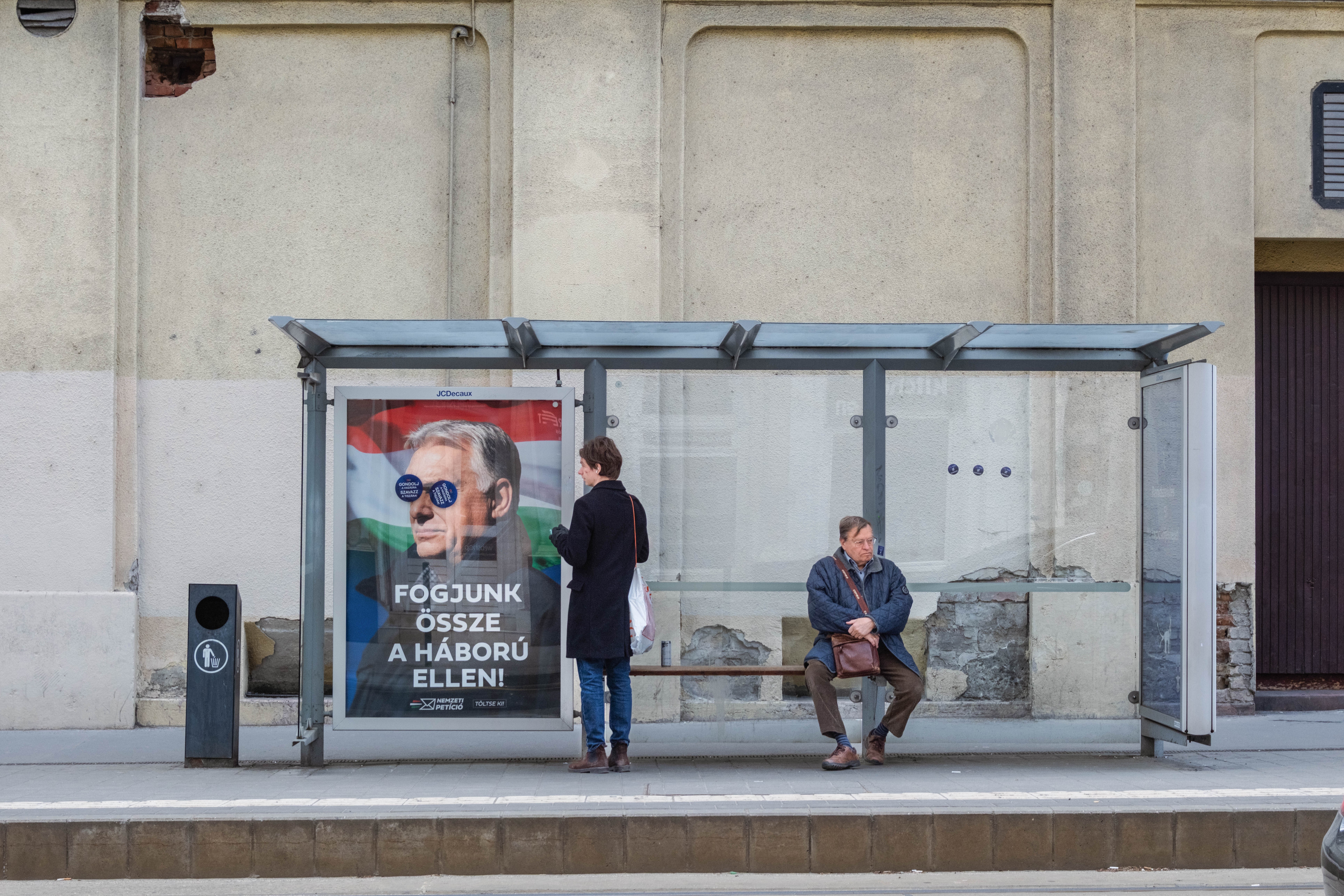
Viktor Orbán is the closest thing in Europe to a prime minister for life. He has served four consecutive terms since 2010, perpetuating his power with the ruthlessness of a royal. But ruthlessness may not guarantee him reelection. That became clear to me recently in Székesfehérvár, a small city in central Hungary where Orbán was born.
Székesfehérvár lacks Budapest’s grand boulevards and baroque extravagance, but the city is not without luster. Hungary’s first king, Stephen I, built a basilica in Székesfehérvár that served as the coronation site for later monarchs. Rain was lashing the city when I visited one evening last month. It was dark and cold. But close to 1,000 people had gathered in the town square, all of them waiting for Péter Magyar, a onetime Orbán loyalist who broke with the prime minister two years ago and is now trying to unseat him in elections on Sunday. Most polls have shown Magyar’s party, Tisza, with a comfortable lead over Orbán’s Fidesz Party. But it’s not a given that popular support will translate into a victory at the polls.
Such is the state of Hungary’s democracy. Gerrymandered districts give lopsided influence to the rural countryside, traditionally fertile territory for Fidesz. Deceptive campaigning is rampant, in the form of billboards that dot Hungary’s highways, deepfakes that dominate the internet, and pro-government messaging that fills newspapers and television channels owned by the prime minister’s allies. Orbán enjoys the support of foreign governments, in both the United States and Russia. Donald Trump’s endorsements have been as forceful as any he has issued in this year’s domestic midterm elections, a sign of his personal stake in a regime revered by the MAGA movement. His vice president, J. D. Vance, traveled to Budapest this week to underline the political alliance and advance conspiracy theories about “bureaucrats in Brussels” meddling in the election, words that could have come from the lips of Kremlin spin doctors.
It may not be obvious why an election in Hungary, a landlocked European country with a population roughly the size of Michigan’s, has commanded so much international attention. It’s not a nuclear power, a global media hub, or a center of innovation. Its language is a beast to learn. But Sunday’s vote may well be one of the most important elections in the history of postcommunist Europe. It will test the longevity of a regime that has deviated from principles of democracy and the rule of law that were vindicated by the peaceful revolutions of 1989 and later secured by the European Union, which incorporated Hungary as part of its eastward expansion in 2004. The bloc doesn’t have a mechanism to expel a wayward member, but Western diplomats told me that brazen electoral theft would inaugurate a perilous new era. Some suggested that the prime minister, who oversees entrenched patronage networks that reach into the minutiae of municipal jobs, has too much at stake to accept defeat. Each side has accused the other of planning violence if the results don’t go their way.
Successive setbacks have predisposed Hungarians to pessimism, even self-pity. Consider what has befallen them in the 11 centuries since Hungarian tribes moved into the Carpathian Basin in 896. They were abandoned during the Mongol invasion in 1241 and then subdued by the Ottoman empire in 1526. Their aspirations for independence from the Habsburgs were crushed in 1849, and their territory was amputated by the peace agreements that ended the First World War. They suffered under communism when the Iron Curtain split Europe, spilling their blood in a failed uprising against the Soviets in 1956. “We are the most forsaken of all people on the face of the earth,” Sándor Petőfi, Hungary’s national poet, lamented.
It would be natural for people in Székesfehérvár to feel that way today. Their manufacturing-led, export-oriented economy is a textbook expression of the model that made Hungary a postcommunist success story. Now it represents the defects that have made Hungary one of the poorest countries in the European Union, and opened Orbán up to his most serious challenge in 16 years. Hungarians have an expression for accepting a disagreeable situation: lenyeli a békát, literally “swallowing the frog.” The people I met in Székesfehérvár were no longer swallowing the frog.
A pack of university students were standing on a retaining wall to get a better view of the stage. The red, white, and green of the Hungarian tricolor, projected onto buildings that surround the square, danced across their faces. One of the students, Márton Szépvölgyi, climbed down to speak with me. He has been thinking of leaving Hungary for a master’s degree in physics. But if Magyar wins this month, he told me, he’ll stay. “I’m hopeful,” he said. Szépvölgyi mocked the prime minister, who is 62, for seeming unsteady when boos erupted at one of his recent rallies. “He’s crashing out like Ceaușescu,” Szépvölgyi said with a snicker, referencing the Romanian dictator Nicolae Ceaușescu’s shock when an audience turned on him in December 1989, a decisive moment in the collapse of the country’s Communist dictatorship.
When Magyar took the stage, he used the same sardonic tone as the student, calling it “awkward” to watch the prime minister reckoning with the limits of his power. “He realizes for the first time that it’s over, that the Hungarian people will dismiss him,” the 45-year-old candidate, whose gelled hair and Tisza-branded windbreaker project an easygoing polish, said. His party’s full name is the Respect and Freedom Party, but it’s known by a portmanteau of the first syllables of those Hungarian words. Tisza is also one of the country’s most important rivers. It often floods the Great Hungarian Plain, a phenomenon invoked by the chant repeated at Magyar’s rallies: “The Tisza is rising!”
[Read: The MAGA intellectual who prophesied a Queen Melania]
Magyar spoke from a podium bearing the words NOW OR NEVER!, but with a strike-through leaving only the word NOW. Urgency is a theme of his campaign. “This is the very last chance to take back our country,” he told his supporters. Another theme is independence, drawing on Hungary’s historic struggle for self-rule and allowing Magyar to recast the support Orbán has received from the United States and Russia as a liability. “Hungarian history is not written in Moscow or Washington,” he said. His stump speech includes a direct appeal to young people like Szépvölgyi who are contemplating leaving Hungary. The share of emigrants from ages 20 to 24 has doubled during Orbán’s time in office. Magyar urged the crowd to make the outcome of Sunday’s election personal, saying, “Tell your grandparents you want to stay.”
Szépvölgyi told me that his grandmother wants Orbán to win. But maybe she could be convinced otherwise. Toward the back of the crowd, an elderly woman, herself a grandmother, told me that she had lost faith in the ruling party. Fidesz, founded as an anti-communist youth movement, still positions itself as the guardian of Hungary’s independence, secured in the peaceful revolutions that swept Central and Eastern Europe in 1989. “They talk about 1989, but they turned 180 degrees,” she said. “Everything broke down.”
Orbán has many traits in common with Trump. But on the campaign trail, he doesn’t completely deny reality. Székesfehérvár is an hour’s drive from Pécel, a suburb of Budapest where I saw the prime minister rally his supporters. He seemed to acknowledge that life has not been easy in Hungary, thanking voters for remaining loyal to him over the past 16 years and asking them to cheer for one another. “Go Hungary” is his refrain. “Go Hungarians.”
The prime minister’s delivery was limp, but I could hear hints of rhetorical gifts. He managed to articulate the core claim of his campaign, that he’s a bulwark against Hungary being dragged into the war in Ukraine, in a way that sounded halfway plausible. As bad as things were, Orbán seemed to suggest, they could get much worse. So don’t take a risk with a government willing to advance European plans to send more money to Kyiv. “Your whole monthly salary will be spent on utilities,” he said.
[Read: The hardest job in Europe]
Throughout Russia’s war, Orbán has maintained friendly relations with President Vladimir Putin. Recently leaked audio revealed that Orbán’s foreign minister, Péter Szijjártó, strategized with his Russian counterpart about advancing Kremlin interests inside the European Union. The U.S. government once aspired to impede Hungary’s drift into Russian arms. But the Trump administration has reversed those efforts, giving Budapest relief from U.S. sanctions for buying Russian oil and glorifying Orbán’s government for dissenting against a supposedly woke EU bureaucracy. “We have not only a national but also a Christian government,” Orbán told his supporters in Pécel. In the crowd, I met Adam Hajdu, who is studying to be a police officer, and his grandmother, Klara, both wearing red Make America Great Again caps. They told me that Trump and Orbán both love God and want peace.
Orbán has a knack for conjuring enemies just in time for election season. In 2014, he cast blame on “multinationals, bankers, and bureaucrats in Brussels” for trying to thwart his economic nationalism. In 2018, he cast George Soros, the Budapest-born Holocaust survivor and liberal financier, as a menace to Hungarian sovereignty. In 2022, he repositioned Ukraine, the victim of Russia’s invasion, as a danger to peace in Hungary. Now he is rerunning a version of that campaign, and his supporters seem convinced by it. A retired postman in Pécel told me that Ukrainian President Volodymyr Zelensky is nothing more than an actor, swindling the rest of Europe.
The cynicism of this strategy is astonishing. It was Orbán’s bold call for the withdrawal of Soviet troops from Hungary, in 1989, that first gave him political star power. He was a shaggy-haired, anti-communist youth activist, with humble origins as the son of an agricultural engineer and a teacher, when he delivered a speech at the reburial of Imre Nagy, the Hungarian prime minister who was executed in 1958 for having led the failed uprising two years earlier. At Heroes’ Square in Budapest, Orbán aligned himself with those “fighting for the establishment of liberal democracy.”
When democracy came in 1990—in the form of Hungary’s first free, multiparty elections—Orbán won a seat in Parliament as a representative of Fidesz, an acronym for the Alliance of Young Democrats. Eight years later, he became prime minister, at the age of 35. By that time, he had already redefined his party’s anti-communism, originally identified with Western-style liberalism, as patriotism and national conservatism, a pragmatic move aimed at finding a niche in a fractured right-wing landscape. He was narrowly ousted by a center-left coalition in 2002, a defeat his biographers say he blamed on the media. In the opposition, he plotted total domination, remarking, “We have only to win once, but then properly.” Comments like that fuel criticism of Orbán as an autocrat. Some of his supporters don’t entirely disagree. “He has a firm hand,” a retired teacher at Orbán’s rally in Pécel told me. “He’s almost an autocrat, but not quite.”
When Orbán reclaimed power in 2010, it was with the two-thirds parliamentary majority necessary to rewrite the constitution, which he did, audaciously, in the face of criticism from the European Union and the United Nations. Early changes curbed the power of the judiciary, weakened independent watchdogs, and rewrote election rules to favor the ruling party. A new media law threatened outlets with fines for coverage considered disreputable. By bringing public broadcasters more firmly under government control while clearing the way for loyalists to take over private news organizations, Fidesz now exercises authority over an estimated 80 percent of the country’s media. He continues to reshape the constitution for maximum advantage in the culture wars. Enumerating his government’s accomplishments at his rally in Pécel, he pointed to a constitutional amendment approved last year mandating that all Hungarians are officially counted as either male or female.
These changes form the basis of the “illiberal state” that Orbán first proclaimed in 2014, scorning the values meant to bind EU member states, including fidelity to the rule of law and respect for individual rights. For successful models, Orbán pointed beyond the bloc to Russia, Turkey, and China. It took Brussels another eight years to respond with financial penalties. In 2022, EU institutions began to freeze billions of euros in funds over rule-of-law violations.
[Read: Europe’s far right is turning on Trump]
The consequences have been catastrophic. The economy stagnated for three straight years, starting in 2023. Price shocks from Russia’s war in Ukraine were widespread in Europe, but the loss of EU funds compounded the government’s problems, according to Zoltán Török, head of research at Raiffeisen Bank Hungary, a subsidiary of an Austrian bank. “Hungary is an outlier,” Török told me. “And this is purely derived from the political decisions of the prime minister.”
A different kind of deception about the country’s finances helped lead Magyar into public life, originally as a Fidesz apparatchik. He was a young lawyer in 2006 when a leaked recording caught Hungary’s then–prime minister, from the country’s Socialist Party, admitting that his government had misled the public about the economy. Thousands took to the streets, and police responded by using rubber bullets, tear gas, and water cannons to disperse the protests, in a show of force that carried echoes of 1956.
Magyar, who comes from a well-connected conservative family, helped create a legal-defense group for the protesters. He also lined up behind Orbán, who leveraged the popular anger to make a political comeback in 2010. Magyar held diplomatic roles in Brussels, where his wife advised a Fidesz member of the European Parliament. She became Hungary’s justice minister in 2019, but her political career cratered in 2024 when she took the fall for a widening scandal over a government pardon in a child-molestation case. By then, the couple had divorced, and Magyar soon released audio of his ex-wife, which he secretly recorded, discussing government meddling in politically sensitive prosecutions. The ploy provoked personal blowback, including allegations of domestic abuse, which Magyar denied. But the revelations brought widespread protests. He used the occasion to announce his leadership of Tisza.
Previous election-year efforts to unseat Orbán have fallen well short—first a loose alliance of left-liberal parties, then a far-right party that tacked to the center to broaden its appeal, and finally a broad coalition that united behind a small-city mayor. None achieved consensus or message discipline. But Magyar has some intrinsic advantages, both as a former Fidesz insider and as a frontman for a new party. “People believe him when he talks about Fidesz corruption because he participated in it,” an EU ambassador told me. He also understands how Orbán campaigns; repeatedly, Magyar has prepared his supporters for smear campaigns and false-flag operations designed to strengthen the prime minister’s hand. To fend off attacks, he has found candidates without political baggage to run in the country’s 106 constituencies. His recruits include an opera singer and a zoo director. They have maintained low profiles, keeping the focus on Magyar, who has become a “messianic figure,” as one of his associates put it to me. The associate acknowledged that meteoric expectations may create problems should he get the chance to govern.
Magyar has promised to right the economy and rid the country of graft, studiously avoiding incendiary cultural issues. On immigration, he is said to hew to Orbán’s hard-line views. His foreign-policy adviser, who has a Ph.D. in international relations from Tufts, has told interlocutors that a Tisza government would restore Hungary’s stature in Brussels and reorient its relationship with Moscow. “We’re not a friend of Russia,” the adviser, Anita Orbán (no relation), told the ambassador of a NATO country. At the same time, she outlined a pragmatic approach to the war in Ukraine, reflecting Hungary’s unique energy needs as a landlocked country.
People who have interacted with Magyar describe him as headstrong and aggressive. But Orbán’s opponents aren’t being picky. Numerous other parties didn’t merely throw their support behind him; they withdrew from the election altogether to avoid dividing the opposition vote. That was a difficult decision for a liberal party called Momentum, according to its parliamentary-group leader, Dávid Bedő. But it’s working. “In previous elections Orbán always controlled the narrative,” he told me. “Now Magyar is in control because he knows how the system works.”
Bedő, who is 33, has been traveling to traditional Fidesz strongholds and recording interviews with locals, which he posts on social media. Some of the clips show onetime Orbán loyalists venting dissatisfaction with the government. Bedő’s surveys, while unscientific, have convinced him that Orbán can’t win an honest election. He predicted that the prime minister will leave office one way or another. If the election doesn’t ratify a change, “people are going to revolt,” Bedő said. “We can’t take it anymore.”
I heard similar sentiments from right-wing opponents of Orbán. Gábor Vona, who challenged the prime minister unsuccessfully in 2018, told me, “We are one step away from a civil war.”
Western embassies in Budapest are preparing satellite phones and other emergency precautions in the event of mass unrest. Ambassadors who spoke with me did so on the condition of anonymity to avoid the appearance of meddling in domestic politics. Several said it was ironic, however, that Trump released a video on Truth Social endorsing Orbán around the same time that Hungary’s foreign minister warned EU ambassadors in a meeting not to get involved in the election. The message, they said, was that interference was acceptable only if it favored the government. Vance reinforced the point when he traveled to Budapest and declared his intention to “send a signal” to European officials to stay out of the election. In remarks to students the next day, he recalled asking the prime minister over lunch, “What can I do to help?”
[Read: J. D. Vance is definitely against foreign election interference]
Among foreign diplomats as well as former Hungarian government officials, I encountered different views about the lengths to which Orbán would go to stay in power. A recent documentary alleged a Fidesz-operated scheme to buy the votes of the country’s poorest citizens, especially its large Roma minority. Informal patronage networks are also instrumental. In small towns, municipal jobs or spots in government-run child care may depend on support for Fidesz. Outright manipulation of the vote count may be more difficult. Tisza officials told me they’re positioning multiple observers at each of Hungary’s 10,000 polling stations. But some voters I met speculated that Orbán might take last-minute measures to obstruct the election if he expected to lose. Last weekend, he claimed that explosives had been found near the pipeline that carries Russian gas into Hungary through Serbia—assertions the opposition condemned as a pretext to delegitimize the vote.
Foreign diplomats told me they’re placing their trust in international observers from the Organization for Security and Co-Operation in Europe. In past elections, the organization’s monitors have characterized voting in Hungary as free but unfair, citing Fidesz’s structural advantages. The diplomats told me that they don’t expect the U.S. government, the organization’s largest donor, to hold Hungary to account if voting is marred by irregularities. If anything, they said, Trump might encourage his ally in Budapest to declare victory prematurely, just as he did in 2020, before calling his supporters to the Capitol on January 6, 2021.
Zoltán Kovács, Orbán’s spokesperson, dismissed these concerns. When I met him in his office, his television was tuned to CNN. A chyron was relaying Trump’s latest statement about the situation in Iran (Trump: Go get your own oil). Kovács, who is more reflective in person than his bulldog persona online, told me that Hungary’s election system is secure. “Rigged elections are impossible,” he maintained. He allowed that Fidesz is nervous about the final stage of the campaign. “Trying to believe we control reality is a false pretension,” he told me.
Vance’s visit added to the surreal quality of the campaign. The vice president stumped with Orbán five days before the election as if they were running mates. While Trump was on Truth Social threatening to wipe out Iranian civilization, his vice president was onstage in Budapest praising the Hungarian prime minister as a partner in the defense of Western civilization.
[Read: The first post-reality political campaign]
After the U.S. and Iran reached a fragile cease-fire, raising hopes for the reopening of the Strait of Hormuz and a return to normal oil prices, the vice president delivered a debrief on the negotiations. His audience included students at the Mathias Corvinus Collegium, a government-linked educational institution financed in part by shares in a company that processes Russian oil. Vance mocked European countries for their dependence on foreign fossil fuels, asking, “Why have the Europeans made themselves completely dependent on unreliable sources of energy?”
His interlocutor, the director general of the MCC, didn’t inform him that Hungary is one of the few European countries that didn’t reduce its reliance on Russian oil after the 2022 invasion of Ukraine, and that Hungary’s reliance on Russian oil is in fact a foundation of the prime minister’s reelection campaign. A student seated next to me laughed intermittently during Vance’s remarks. When the vice president concluded, I turned and asked her what she had found funny. “He doesn’t know much about Hungary,” she said.
On a rainy evening in Budapest, I met Renátó Fehér, a Hungarian poet. He was in good spirits. Previously, Hungarians opposed to the government were indignant but apathetic. “Now we are enthusiastic in our outrage,” he said. The change reflects an energetic opposition party, but also an ability to see clearly what the prime minister represents. In Fehér’s telling, Orbán melds Russian-style tactics with the ideology of the American far right. He is, Fehér said, “truly a man of the future.” That’s why Fehér calls Orbán’s politics not illiberal, the word used by the prime minister, but post-fascist. The term was coined by Gáspár Miklós Tamás, a Romanian-born Hungarian philosopher who died in 2023. Post-fascism doesn’t involve paramilitaries or do away with elections outright. It operates by stripping certain groups, such as immigrants and sexual minorities, of full citizenship. In place of theories of a master race, its rationale is based on perceived cultural incompatibility or civilizational defense. It is not utopian but cynical and bureaucratic.
In 2014, after Orbán announced his plans for what he called an “illiberal state,” Tamás gave an interview in which he implored the public to read between the lines. “He told us that he will not be removed by elections,” Tamás said at the time, predicting that “those who are against him must be prepared for the grimmest struggle.” Yet for all of Orbán’s aspirations to amass unchecked power, Hungary’s democracy is not yet extinguished. The prime minister must still answer to voters, and their preferences may override all of the advantages he has allowed his party. Sunday will put that possibility to the test. The election could mark the conclusion of this chapter in Hungary’s democratic struggle, or else the start of a grim new one.
Karoly Szilagyi contributed reporting.
Popular Products
-
 Adjustable Shower Chair Seat
$107.56$53.78 -
 Adjustable Laptop Desk
$91.56$45.78 -
 Sunset Lake Landscape Canvas Print
$225.56$112.78 -
 Adjustable Plug-in LED Night Light
$61.56$30.78 -
 Portable Alloy Stringing Clamp for Ra...
$119.56$59.78