What Bernie And Aoc Get Wrong About Data Centers
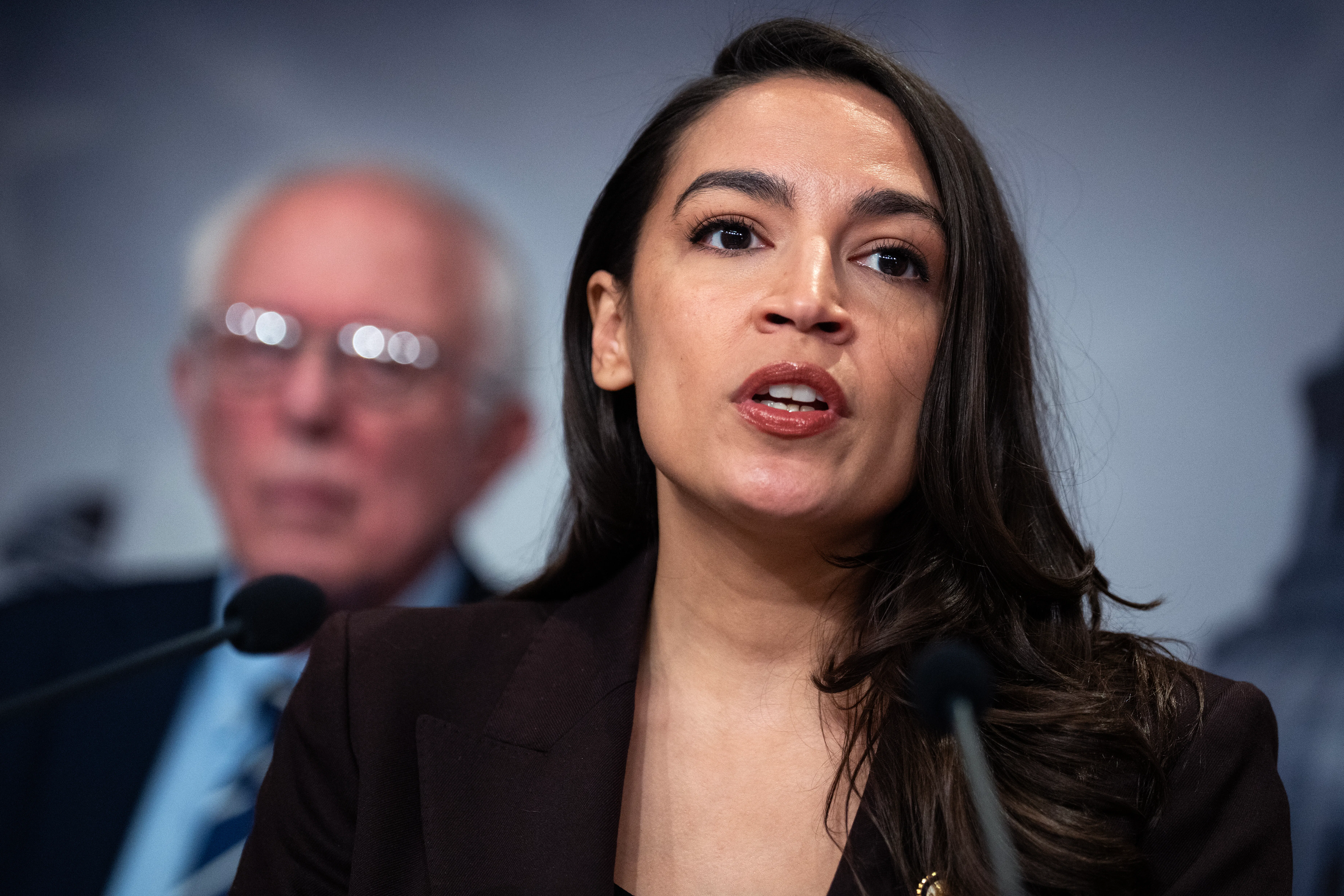
Grassroots rebellions against AI data centers are sweeping the country. The backlash cuts across partisan lines, and the political class is scrambling to catch up. As politicians rush to stake out positions, though, they risk obliterating a crucial component of the movement’s strength. These local coalitions’ holds aren’t succeeding because they’re progressive or conservative. They’re succeeding because they draw on a political grammar that predates and exceeds the progressive tradition. And progressives might do well not to squander this rare opportunity by branding it.
Last week, Bernie Sanders and Alexandria Ocasio-Cortez formally introduced the AI Data Center Moratorium Act. The bill would halt new data center construction until Congress enacts federal protections for workers, consumers, and the environment. The impulse is sound, and the national attention is welcome. But the legislative language leans heavily on wealth redistribution, labor displacement, and climate justice.
While that’s one way to argue for a pause, it’s not the argument that’s actually winning in the places where data centers get built. The bill frames the moratorium in terms of national priorities, including worker protections, environmental safeguards, and distributive fairness. Local opponents usually frame it more plainly, focusing on water, land, electricity, and control. The contrast is not ideological but procedural; less a dispute about values than about who gets to decide.
The communities with the most at stake are not in Silicon Valley or Brooklyn. They are in small towns like Caledonia, Wisconsin and Granbury, Texas, and in rural counties like mine in North Carolina. In Michigan, a Republican state representative led a bipartisan moratorium effort. In Florida, Governor Ron DeSantis proposed giving local communities authority to limit new construction. The Missouri Farm Bureau has argued that rural voices must govern expansion on farmland. These are not progressive institutions.
There is, however, a distinctly anti-elite, anti-authoritarian flavor to the backlash. As Republican gubernatorial candidate James Fishback put it: “They’re not building an AI data center next door to Mar-a-Lago. They’re building AI data centers in our agricultural communities like Loxahatchee, like Fort Meade.”
What unites these voices isn’t a shared position on labor policy or climate change. It’s a more fundamental conviction: Decisions should be made by the people who have to live with the consequences. The farmer whose well competes with a cooling system, the family whose electric bill doubles, the county commission that must weigh tax revenue against aquifer depletion: These are the people who bear the costs if the decision is wrong. The principle that those most affected should have the strongest voice in deliberation isn’t, in this case, flowing from political theory—but rather from the intuition that makes self-governance feel legitimate in the first place.
Liza Featherstone, writing for The New Republic in February, was right to highlight that the rebellion “cuts across partisan lines.” The question worth pressing further is whether conservative participation reflects mere tactical overlap or something more durable. I’d argue it’s the latter. When rural Republicans show up at zoning hearings to oppose data centers, they’re not borrowing progressive language or stumbling into alignment with the left. They’re invoking something older: the belief that outside capital does not get to impose irreversible consequences on a community without that community’s consent. The insistence that those who bear the consequences should hold meaningful authority in the decision is doing the real work here, allowing actors with otherwise incompatible policy commitments to remain aligned long enough to act together.
The standard rebuttal, offered with equal enthusiasm by President Donald Trump’s interior secretary, Doug Burgum, and titularly Democratic Senator John Fetterman, is that a moratorium would surrender America’s lead in AI to China. The argument sounds serious. It is not. Countries around the world, China included, are grappling with what this technology will do to their people, their land, and their labor markets. As demonstrated at the Paris AI Summit last year, many are looking for someone to take credible first steps toward collective governance. A moratorium is not a retreat from leadership. It is a claim to a different kind of leadership: the willingness to slow down long enough to ask whether the next step should be taken.
The deeper issue is what kind of society we become if we don’t. The race-to-deploy logic treats speed as the only value and communities as obstacles to be managed. That is not a vision of technological progress. It is a vision of technological imposition, one that differs from classic twentieth-century authoritarian models only in its corporate rather than state sponsorship. This is why the local fights matter beyond their immediate geography. Last month, in Lee County, North Carolina, nearly 200 residents packed a commissioners’ meeting to demand a moratorium on what would be the only fracking-powered data center in the United States, a proposal to drill into unstable ground above unmapped coal mines to fuel servers for a crypto-mining operation. Lee County isn’t just deciding about their aquifer. They’re determining whether anyone besides tech companies gets a say at all. The better answer to China is not to match its indifference to local communities. It is to demonstrate what authoritarian states cannot: that a free people can govern powerful technology through legitimate deliberation rather than fiat, whether that fiat comes from a politburo or a board of directors.
The politicians on both sides of the aisle racing to support AI risk repeating a familiar pattern. The free trade agreements of the 1990s were justified as necessary for national competitiveness, but the communities that would lose their manufacturing base were not meaningfully consulted. The furniture and textile factories that employed generations of my family and neighbors never returned. These job losses became what one study calls the “economic underpinnings of the drug epidemic” in small towns. The fallout reshaped the electorate in ways that still destabilize American politics. Insisting that rural counties be allowed to pause and debate before their tax dollars, water, and electricity subsidize the very data centers fueling the next major displacement is not Luddism. It is a refusal to repeat a procedural failure that treated loss as something to be managed rather than decided.
The Sanders-AOC bill may not pass this Congress. But the local moratoriums will keep coming, and the coalitions behind them will keep growing. The bill’s value may lie less in its legislative prospects than in the legitimacy it confers on a movement that was already winning without federal sponsorship. The question now is whether that movement’s energy gets channeled into a framework capacious enough to hold its full coalition, or whether it narrows into something that feels, to rural conservatives, like someone else’s cause.
A moratorium is not a white flag. It is not an especially progressive idea. It is what happens when a free country still believes powerful technology must answer to the people whose land, water, and economies it reshapes. Mis-frame that principle as partisan, and the coalition fractures. Lose the coalition, and the decision defaults back to those with the least at stake in its consequences.
Popular Products
-
 Put Me Down Funny Toilet Seat Sticker
$33.56$16.78 -
 Stainless Steel Tongue Scrapers
$33.56$16.78 -
 Stylish Blue Light Blocking Glasses
$85.56$42.78 -
 Adjustable Ankle Tension Rope
$53.56$26.78 -
 Electronic Bidet Toilet Seat
$981.56$490.78