Why Elena Kagan Is Defending The Roberts Court
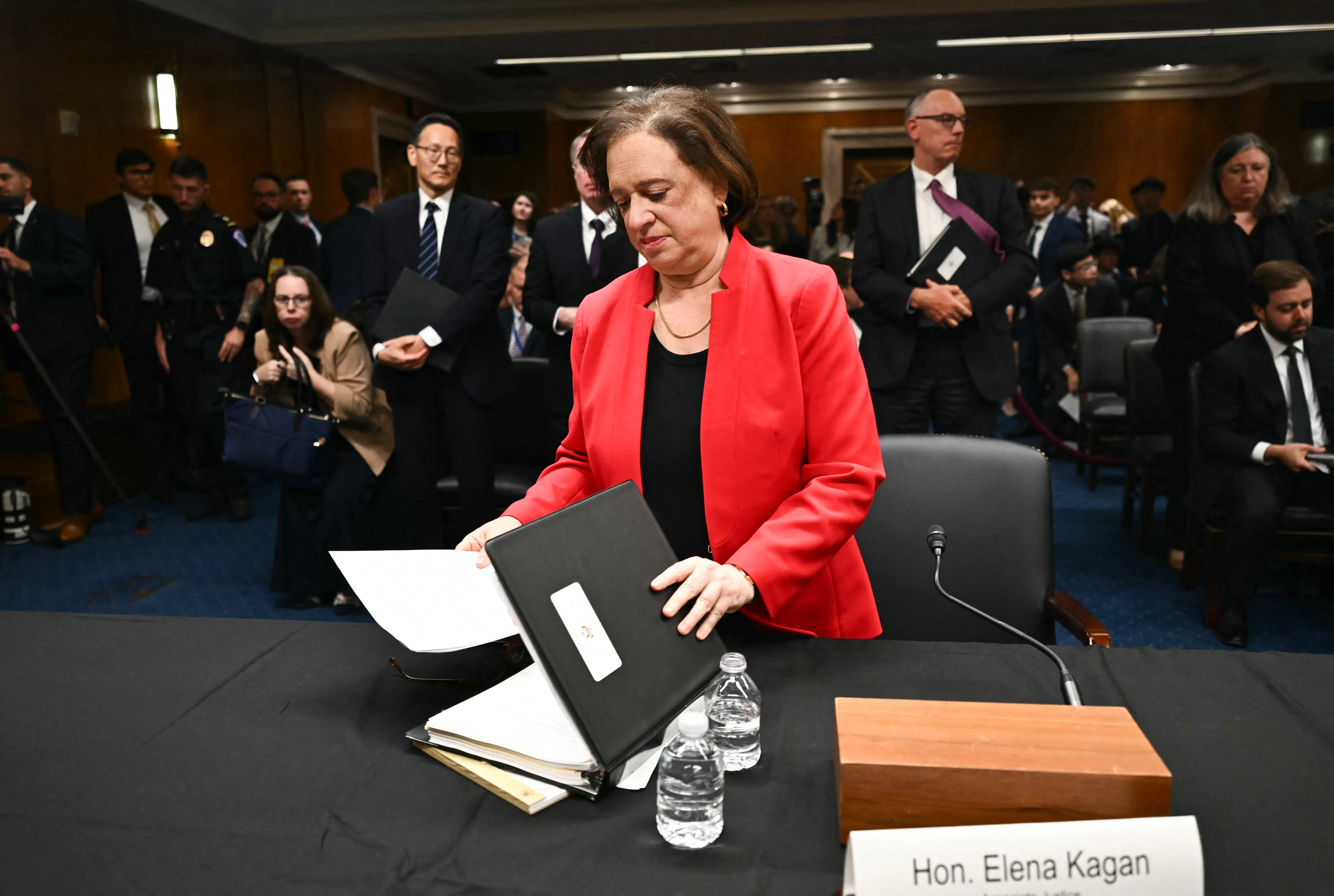
Justice Elena Kagan offered a notable defense of her colleagues on the Supreme Court last week by rejecting claims that the justices were simply doing Trump’s bidding. “I don’t see this as a court that is just like, ‘We’re just going to rubber-stamp what the current administration does.’ You know, quite the opposite,” Kagan told an audience last week in Washington state, according to Politico. “I think that that is a bad rap.”
Kagan is generally correct, with a few notable exceptions. It is important to understand why she is correct to better appreciate what the second half of Trump’s term will look like, and what the playing field will look like for the next Democratic administration.
It is true that Trump has scored a number of major victories at the Supreme Court in his second term. But they have largely been on matters in which the court’s six-justice conservative majority would have supported any Republican president. “You just have to deal with the fact that there’s a conservative court doing things that conservative jurists have long thought it appropriate to do, and I can really dislike that,” Kagan explained last week. “But it has nothing to do, I think, with becoming the arm of this current administration.”
In Trump v. Slaughter, for example, the Supreme Court ruled that Trump could fire commissioners of the Federal Trade Commission, giving him de facto control over multiple federal regulatory agencies that Congress had designed to be independent. The obvious beneficiary of that ruling is Trump. But legal conservatives have been gunning to overturn Humphrey’s Executor v. United States—the 1935 case that upheld for-cause removal protections—for decades.
On voting rights and campaign finance laws, Trump also has very strong views on the matter. The president has been an enthusiastic champion of partisan gerrymanders over the past 18 months in a desperate attempt to maintain GOP control of Congress. He also welcomed efforts by Elon Musk and other Silicon Valley billionaires to bail out his struggling presidential campaign in the summer of 2024 with large cash infusions into friendly super PACs, abandoning his past calls to overturn Citizens United.
The court’s recent rulings in this direction have nothing to do with Trump. The Supreme Court’s current hostility toward the Voting Rights Act of 1965 dates back to a 2009 case when the justices hinted that certain portions might no longer be constitutional. That ruling not only predates the Trump administration itself by eight years but also predates Trump himself becoming a major presence in American politics by roughly a year. The high court’s war on campaign finance laws also began in earnest with the Citizens United decision one year later in 2010.
Every administration faces tough decisions about whether to appeal certain cases to the Supreme Court. A temporary defeat in the lower courts might ultimately be preferable to a permanent nationwide defeat from the justices. The second Trump administration has shown itself to be highly adept at predicting which cases are worth running up this particular flagpole, so to speak.
In the first few months of his second term, for example, Trump accrued a deeply lopsided margin of defeats in the lower courts. One analysis estimated that his administration had lost in 96 percent of rulings at the federal district court level. Rather than appeal most of those decision to the Supreme Court level, the administration quietly took the losses unless it strongly believed that the six conservatives would back it with a reversal.
This selective approach resulted in a lopsided margin of victory at the Supreme Court. By last September, Trump had prevailed in more than 20 different cases on the high court’s shadow docket, according to a Courthouse News analysis. His administration only faced substantive defeats in two interim cases during that span: the Kilmar Abrego Garcia case and one involving frozen USAID funds for work already completed.
By only bringing cases before the high court that appear to be surefire winners, the Trump administration has greatly inflated its overall winning percentage at the high court. Naturally, none of this means that the Supreme Court is actually more liberal than it appears. Trump and his Justice Department team simply seem to have a good read on what the high court will and won’t allow.
The Trump administration’s worst losses have come when it tried to force the issue upon the justices. In Learning Resources v. Trump, the high court rejected his efforts to use a Cold War–era law to levy hundreds of billions of dollars in tariffs on American businesses and customers who buy overseas goods. This was essentially the centerpiece of the president’s economic agenda, and Trump appeared to take an unusually personal interest in orchestrating what he saw as a blank check to impose tariffs for any reason or virtually none at all.
Nonetheless, the Supreme Court happily struck it down in a 6–3 margin last fall. Trump’s baldly illegal tariffs split the court’s conservative majority down the middle, pitting three justices who favored a maximalist approach to executive power against three justices who were averse to adopting a maximalist reading of statutory language. That enabled the court’s three liberal justices to tip the balance.
In Trump v. Barbara, the high court also rejected Trump’s broadside attack on birthright citizenship. Some legal conservatives tried to boast afterward that they had shifted the Overton window on the subject after a century and a half of consensus. This is what youngsters these days call “cope.” As I noted earlier this month, only two justices endorsed Trump’s position in any meaningful sense, and only one of them—Justice Brett Kavanaugh—is still likely to be serving on the court in 10 to 15 years.
The conservative legal movement has shown itself adept at building internal consensus around other major constitutional shifts in recent decades, such as the now-magisterial view that the Second Amendment protects an individual right to bear arms. Conservative legal scholars also spent decades laying the groundwork for the high court to overturn Roe v. Wade, which it eventually did in 2022. The slipshod pseudo-academic work that sprang up last year to justify Trump’s birthright citizenship order failed to convince most of the court’s conservative justices.
Perhaps Trump’s most foolish defeat came in Trump v. Cook. In a shadow-docket ruling last year, the court’s conservative justices effectively ruled that Trump could fire any Senate-confirmed official at will despite federal law to the contrary. The sole exception they made was for members of the Federal Reserve’s board of governors, whom the court said in an unsigned order were protected by a “unique historical tradition” dating back to the early-nineteenth-century central banks.
Trump nonetheless tried to remove Lisa Cook last August. The Supreme Court, unsurprisingly, did not take this pseudo-defiance very well. First, the justices voted to keep Cook in office pending litigation last year—a step that they had explicitly declined to take in similar non-Fed cases. Then, last month, they constitutionalized the Fed exception to presidential removal powers.
Another advantage for Trump is that he and his allies have largely constructed his second term around what they think the Supreme Court’s conservative majority will let them get away with. Project 2025 is the best example of this approach to governance. The Heritage Foundation’s policy project is largely a blueprint of what conservative elites thought the Supreme Court might uphold: a more centralized executive branch, fewer federal agencies and regulations, mass deportations, and so on.
To the extent that parts of Project 2025 haven’t been implemented, it is either because congressional approval would be necessary (and hasn’t been obtained) or because the Trump administration has abandoned or delayed those items for tactical reasons. One proposal in Project 2025, for example, is to revitalize the Comstock laws to criminalize the distribution of abortion medications and birth control methods. Trump has personally resisted this plan, perhaps fearing an electoral backlash in the upcoming midterms, to considerable frustration from anti-abortion groups.
The Supreme Court’s rulings have even allowed the Trump administration to claim some victories it didn’t earn. The White House and some conservative organizations have bragged about dismantling diversity, equity, and inclusion programs and pressuring corporate and academic institutions to do the same. But the real cudgel is the Supreme Court’s embrace of a “colorblind Constitution” in the affirmative-action ruling two years ago, meaning that even remedial efforts to address racism are presumptively unconstitutional. Trump and his allies are claiming wins for decisions that these organizations’ own lawyers would have likely reached anyway.
Even the high court’s ruling in Trump v. United States can be chalked up to long-running trends in right-wing constitutional thought. There is no shortage of resentment in legal conservative circles for Watergate and Iran-Contra, which respectively ended the Nixon presidency and overshadowed the later Reagan administration. Five of the court’s six conservative justices would have happily signed on the ruling if it protected a President Rubio or a President Vance instead.
That said, if there is one case that can’t be justified under Kagan’s thesis, in my view, it is Trump v. Anderson. The disqualification clause case was a rare moment for the court to interpret part of the Constitution on a blank canvas and, well, it blew it. It cannot be justified on originalist grounds, and reading the clause out of the Constitution for mere convenience is indefensible. Rarely does the court hand down such a transparently outcome-driven ruling. I do not expect Kagan to criticize the court for this one, though, because she and the other two liberal justices joined it.
Why does all of this matter as we look toward the future? There have been talks in some liberal and left-wing policy circles about Democrats creating their own version of Project 2025 for the upcoming presidential election cycle. One can hardly blame them for wanting to build their own version of what may be the most impactful policy manifesto since the New Deal. It is also a prime opportunity for American progressivism’s various factions to claim a leadership mantle for the next election cycle.
But Project 2025’s true power did not come from how it was written, or which stakeholders were involved, or even whether a presidential candidate touted it on the campaign trail. Its success can be entirely attributed to the inescapable fact that there are six conservatives and three liberals on the Supreme Court who would uphold almost all of what a president did with it. Had there been six liberals and three conservatives on the high court for the last two years, Project 2025 would simply be the world’s most unreadable work of fan fiction.
The only real way for Democrats to create their own version of Project 2025—and, more generally, to enact their own policy agenda, regardless of its ideological underpinnings—is to add more justices to the Supreme Court. Policymaking and governing strategy still matter, but everybody to the left of Mitt Romney should lower their expectations of what the next Democratic president can actually achieve unless the court’s ideological makeup is changed. The Roberts court will happily enforce its own conservative vision upon the country, no matter who happens to sit in the White House right now.
Popular Products
-
 Large Wall Calendar Planner
$55.76$27.78 -
 Child Safety Cabinet Locks - Set of 6
$83.56$41.78 -
 USB Touchscreen Heated Fingerless Gloves
$75.56$37.78 -
 Golf Swing Trainer Practice Stick wit...
$21.56$10.78 -
 Golf Swing Training Belt
$41.56$20.78