Zohran Mamdani’s Millionaire Tax Is Extremely Popular
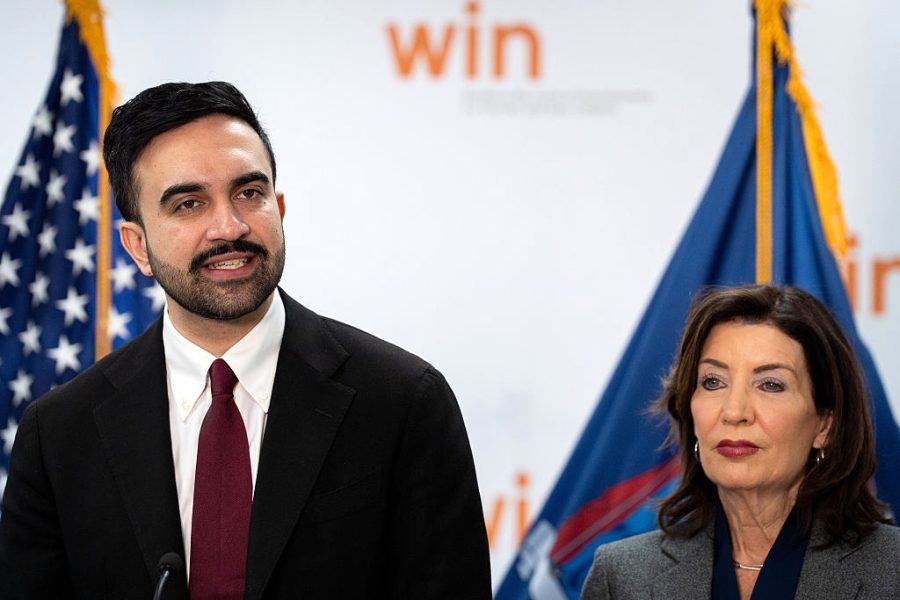
Taxing the rich in New York, as Zohran Mamdani has proposed, isn’t just right and necessary. New polling shows a strong majority support making the wealthy pay, suggesting that Gov. Kathy Hochul’s refusal to do so is political malpractice.
On Wednesday, a new Siena poll found that the majority of voters in New York State support New York City mayor Zohran Mamdani’s proposal for an income tax increase on earnings above $1 million. Across the state, 54 percent support the proposal, and only 29 percent oppose it. Among New York City voters, the support number jumps to 62 percent. Among Democrats statewide, it’s 72 percent. Even in the more moderate downstate suburbs, 50 percent of voters support Mamdani’s idea.
Governor Kathy Hochul is vying for reelection this fall. Her own favorability sits at 46 percent. Mamdani needs Hochul’s cooperation to implement his proposed millionaire’s tax but she has thus far refused to take up the demand, no doubt seeking to placate wealthy donors. The polls suggest this actually might be political malpractice. Taxing the rich is often talked about in American politics as if it were a niche left-wing demand, but in New York right now, it’s a majority position — and the democratic socialist mayor pushing for it is the most popular politician in the state, besting Hochul herself.
Mamdani inherited a $5.4 billion budget gap from the bumbling Eric Adams administration, a shortfall that is compounded by Donald Trump’s gutting of federal programs for health care, food assistance, and housing. Behind these specific pressures is also a longer-standing structural problem: New York City generates the majority of the state’s revenue but receives far less than its share back. Without new revenue from a millionaire tax, the mayor has said plainly, the alternative is a property tax hike on all New York City homeowners. Mamdani has made it clear which option he prefers but says the choice ultimately belongs to Hochul.
Inspired by the democratic socialist Mamdani’s meteoric rise to mayor last year, everyone from Trump to Gavin Newsom has started talking about “affordability,” a word his campaign popularized through repetition. That includes Hochul, who is heading into her reelection campaign with affordability as her signature message — a message that clashes with her resistance to new taxes on the rich.
On Tuesday, state legislators announced they will introduce measures aligning with Mamdani’s millionaire tax plan. If Hochul fights these, she will be taking a more conservative stance than even Andrew Cuomo. As governor in 2021, Cuomo, under pressure from the Left, agreed to a tax hike on millionaires that generated over $4 billion in new revenue.
It’s also worth remembering what we’re actually talking about here. Mamdani’s proposal is a two percentage point increase on the city’s top marginal income tax rate. As economist Martin Bernstein has argued in Jacobin, the academic literature on tax-induced migration (the chief concern Hochul cites in defense of her stance) is essentially unanimous: out-migration would shave a negligible fraction off of revenue gains. And this increase would come in a context where the ultrawealthy just received an enormous federal tax break: Trump’s Big Beautiful Bill cut taxes for the richest 1 percent of Americans by over $50,000 per year. Mamdani’s millionaire tax would just claw back some of the federal government’s giveaway to the rich.
Hochul’s resistance is increasingly out of step and not just with her own constituents. In Maryland, Governor Wes Moore, hardly a democratic socialist, signed a tax package last year that created new income tax brackets for high earners and added a capital gains surtax in response to a $3 billion budget shortfall and the chaos of federal cuts. Moore framed it as a fiscal responsibility measure, and in substance, that’s what it is. As the country deals with the fallout of the Trump administration’s austerity, political leaders in blue states can either make the very rich pay more or force working people to absorb the damage.
As Liza Featherstone has written in Jacobin, Mamdani knows that his affordability agenda demands Hochul to be more of a partner than an antagonist. His corresponding strategy has already yielded results, like the beginnings of universal childcare for two-year-olds. But it has also drawn criticism from the Left: he endorsed Hochul before she agreed to tax the rich and was absent at a late February “Tax the Rich” rally in Albany sponsored by New York City Democratic Socialists of America. But he has attempted to exert pressure on the governor in other ways, like his threat of a property tax hike if Hochul does not tax the rich. Is the mayor playing this perfectly? It’s impossible to say; we are in uncharted territory here. It’s clear, though, that the complexities of real-world politics are far preferable to the simplicity of political marginalization.
All the same, the political reality is clear: the demand to tax the rich is mainstream, popular, and urgent. Mamdani needs Hochul to move, and the public is on his side.
Popular Products
-
 Classic Oversized Teddy Bear
$23.78 -
 Gem's Ballet Natural Garnet Gemstone ...
$171.56$85.78 -
 Butt Lifting Body Shaper Shorts
$95.56$47.78 -
 Slimming Waist Trainer & Thigh Trimmer
$67.56$33.78 -
 Realistic Fake Poop Prank Toys
$99.56$49.78