I Was A Justice Warrior. I Needed The Whole Gospel. You Do Too.
From 2016 to 2018, I was a social media justice warrior. I spent my time on Facebook and Twitter confronting the powerful and comfortable, championing justice issues, and fighting for racial and political reconciliation. If you read my posts, you might not have guessed that I grew up in a conservative Christian home nestled in suburbia, or that I spent every day of my education, starting at age 4, in Christian schools.
In my upbringing, I learned the rich depths of the Christian faith. I surrendered my life to Jesus, and I learned that Jesus came to seek to save the lost. Yet that evangelistically oriented world of my youth was intentionally sanitized and separated from the painful realities of poverty and injustice just 10 minutes down the road.
When I discovered this disparity, I became a justice warrior online. And while that posture was certainly a reaction to my upbringing, I wasn’t being a hypocrite. My social media advocacy reflected my actual life. I’ve lived and worked in an underresourced neighborhood since 2001. During my first 15 years in the neighborhood, I grew burdened over the disconnect I saw between the conditions my neighbors faced daily and how many in the American church live. The political, racial, and socioeconomic divide between my church life and neighborhood gutted me.
So when I went online, I was convinced I was sharing the true gospel. Yet that “gospel” I shared was merely centered on producing tangible results in the here and now, not on affecting eternity. What I needed instead was a holistic gospel, one that centers around both God’s kingdom mission and also his sacrificial death for sinners on the cross.
Two Gospel Aspects
I began to see two aspects in the biblical gospel. Let’s call them the gospel of the cross and the gospel of the kingdom.
The gospel of the cross is the good news that Jesus Christ saves and adopts believers as his children through his substitutionary death and glorious resurrection. We’re all born alienated from God. In sin, we’re his enemies. In Christ, as we believe the good news, we’re reconciled to God (Rom. 5:6–10) and assured of eternal life with him (John 3:16). As Peter writes, “Christ also suffered once for sins, the righteous for the unrighteous, that he might bring us to God” (1 Pet. 3:18).
Moreover, the cross aspect of the gospel emphasizes that those entrusted with this message must share it with a lost and dying world (Matt. 28:18–20). The gospel of the cross must be heralded; it must be proclaimed. It is the priority. From this gospel flows every good gift.
What I needed instead was a holistic gospel, one that centers around both God’s kingdom mission and also his sacrificial death for sinners on the cross.
The gospel of the kingdom is the good news that God’s will for justice, goodness, and peace is already being unleashed. As God’s children, believers are invited to play a part in seeing that kingdom mission come to fruition.
Jesus begins his ministry by preaching a message that proclaims “good news to the poor” and “liberty to the . . . oppressed” (Luke 4:18). He calls his hearers to repent, including from ways they’ve oppressed and neglected the poor (Matt. 3:2; 4:17). He specifically rebukes the Pharisees for neglecting “the weightier matters of the law: justice and mercy and faithfulness” (23:23).
Paul, too, teaches that the gospel not only reunites us to God but also works justice by reconciling divided peoples to one another in the church. He writes, “For [Christ] himself is our peace, who has made us both [ethnic groups] one and has broken down in his flesh the dividing wall of hostility” (Eph. 2:14).
We fulfill the law and live out the gospel’s kingdom implications through our identity as shalom-makers (Matt. 5:9). The kingdom aspect of the gospel equips us with a vision for pursuing God’s will “on earth as it is in heaven” (6:10), that is, for seeing all things made new (Rev. 21:5). This gospel of the kingdom must be lived out through embodied action.
Mapping Our Approaches to Cross and Kingdom
Most Christians today rightly see these two gospel aspects—the message proper and its kingdom implications—as part of the same biblical pie. But we often fail to see them as necessarily intertwined. As a result, many emphasize only one aspect or the other. And sadly, some neglect both these aspects of the gospel altogether.
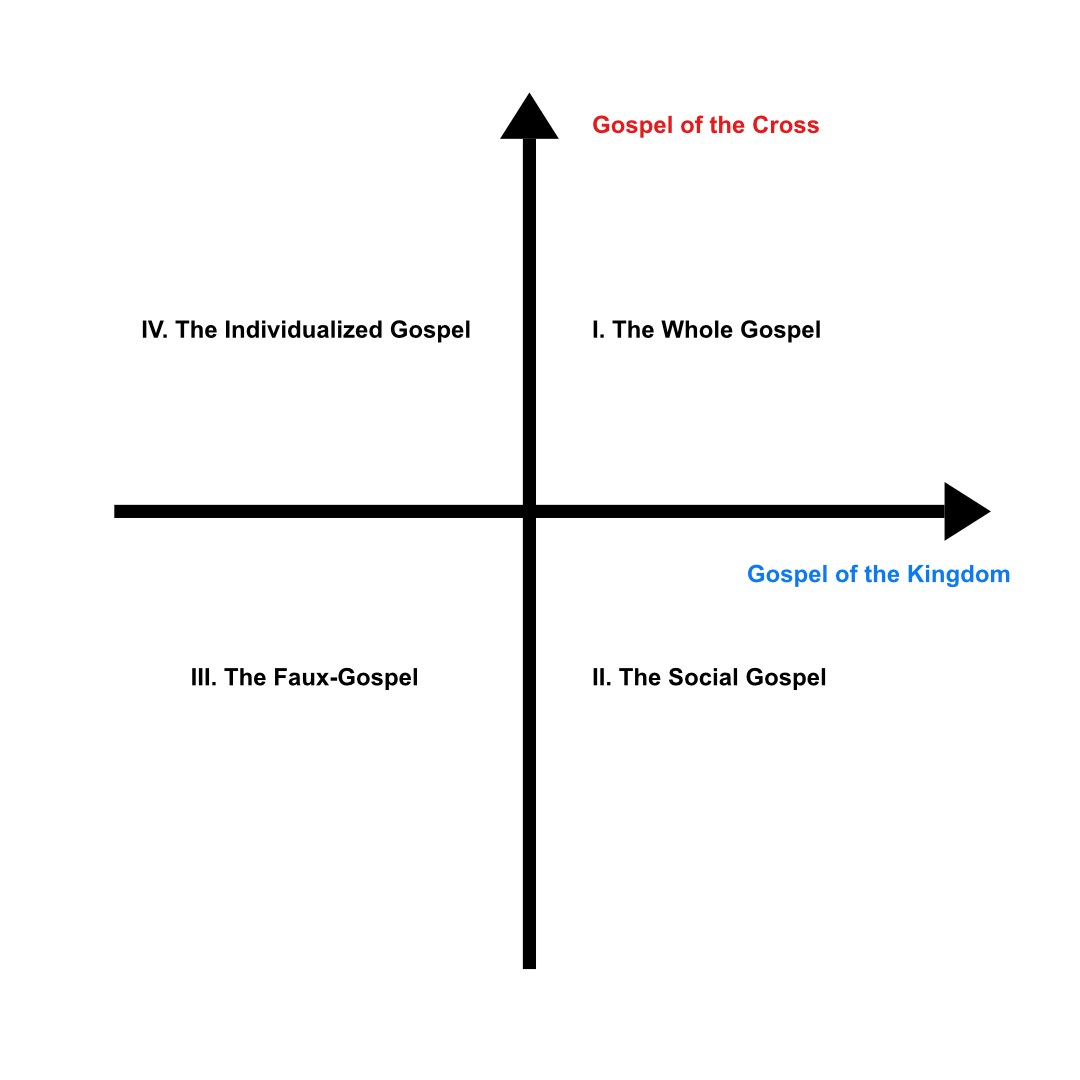
Nicholas Wolterstorff writes that shalom is “a harmony and delight in all of one’s relationships: between us and God, us and other people, us and other cultures, us and creation, and between us and our very selves.” In the four-quadrant grid below, I’ve mapped out the ways we typically approach the cross and kingdom aspects of the gospel. (For more, see section II.3 of The Gospel Coalition’s Theological Vision for Ministry.)
Christ’s sacrifice on the cross restores us to harmony and delight with God. This is our most important relationship, and it’s represented on the diagram by the upward-pointing vertical axis. A kingdom emphasis on harmony and delight in other people, other cultures, and the creation is represented by the rightward-pointing horizontal axis.
Quadrants II and IV represent two errors—the false choice of emphasizing either the cross or kingdom while neglecting the other. Many American Christians have been ensnared by one of these two quadrants. Quadrant III designates a total neglect of both cross and also kingdom. All these disconnects result from misunderstanding who a Christian is and what a Christian should do in this broken world.
Quadrant IV: Individualized Gospel
Advocates of an individualized gospel (quadrant IV) want to get people saved for the afterlife without stressing the social implications for this life. When sinners are saved, we always celebrate! However, Christians who fit in this quadrant often don’t emphasize the kingdom aspect of the gospel. Such individuals and churches may financially support ministries in underresourced neighborhoods but don’t often emphasize transformative service there. Many such churches and their members may not understand or appreciate the depth and range of problems in struggling communities, even in neighborhoods not far from them.
Quadrant II: Social Gospel
Advocates of the social gospel seek to meet people’s imminent needs but neglect their ultimate need of the salvation Jesus offers. This is a scandalous compromise, and it’s the false gospel I believed for nearly a decade and then proclaimed as a social media justice warrior.
My wife and I moved into our underresourced neighborhood to live close to the school where I served for 18 years. Living and working among the poor showed me that many people need more than hearing about Jesus alone. They needed tangible help. Many of my quadrant IV friends concluded my neighbors were ignorant, dangerous, and to be avoided. So I reacted to my peers by propelling myself into the social gospel.
Most Christians today see these two gospel aspects as part of the same biblical pie. But we often fail to see them as necessarily intertwined.
The social gospel is an late 19th- and early 20th-century theological movement focused on breaking the chains of oppression and championing the poor. Advocates seek to make Christ’s kingdom manifest on earth through acts of charity, philanthropy, and just legislation. Some social-gospel advocates choose to live close to the poor to improve their neighborhoods and lives.
Yet the social gospel focuses solely on meeting imminent needs. It neglects preaching Christ as the sinner’s Savior. In fact, many social-gospel advocates reject the evangelical gospel and biblical authority.
Many parachurch organizations that serve underresourced communities are held hostage by social-gospel theology. Though the leaders may be Christians, you can scour the organizations’ websites and messaging yet find no evidence of an orthodox theological foundation.
Quadrant III: Faux Gospel
Those who ignore both the gospel of the cross and the gospel of the kingdom don’t just keep their light under a basket (Matt. 5:15); they snuff it out altogether. Churches who reflect this quadrant are more like the social club Martin Luther King Jr. warned about in his “Letter from a Birmingham Jail” (1963):
So often the contemporary church is a weak, ineffectual voice with an uncertain sound. So often it is an archdefender of the status quo. Far from being disturbed by the presence of the church, the power structure of the average community is consoled by the church’s silent—and often even vocal—sanction of things as they are. . . . Today’s church . . . will lose its authenticity, forfeit the loyalty of millions, and be dismissed as an irrelevant social club with no meaning for the twentieth century. Every day I meet young people whose disappointment with the church has turned into outright disgust.
Leonard Sweet says that the sins of the church sometimes aren’t “the sins of commission or omission, but the sin of no-mission.” This critique captures quadrant III perfectly.
Whole Gospel: Further Up. Further Forward.
G. K. Chesterton once wrote that “Christianity is centrifugal: it breaks out.” When we proclaim the whole gospel and live its effects, we’re adopting a “further up and further forward” mentality. Instead of facing the false choice between cross and kingdom, we’re enriched by the full message and life of Jesus Christ.
The gospel unleashes us to boldly proclaim Jesus’s message of the grace to a world drowning in darkness. It also launches us to be Christ’s hands and feet, empowering us to live out justice, shalom-making, giving, and the befriending of the poor and brokenhearted.
Instead of facing the false choice between cross and kingdom, we’re enriched by the full message and life of Jesus Christ.
Jesus told us to pray, “Your kingdom come, your will be done” (Matt. 6:10). This petition positions us both to proclaim his message and also demonstrate his character through our actions. In these ways, we direct lost hearts to Christ and help our hurting world to better reflect heaven today.
My dad once told me that a Sunday service functions as both a hospital and also a medical school. When we hear the gospel message, it salves our own wounds and mends our hearts. But it also equips us to bring healing to others through the message of the cross and the blessed deeds of his kingdom.
John reminded a young church long ago, “We love because he first loved us” (1 John 4:19). Because Christ loved and died for us, making us his possession, we’re now empowered and commanded to love others. He sends us. Further up. Further forward. Living in both directions is truly good news.
Popular Products
-
 Fake Pregnancy Test
$61.56$30.78 -
 Anti-Slip Safety Handle for Elderly S...
$57.56$28.78 -
 Toe Corrector Orthotics
$41.56$20.78 -
 Waterproof Trauma Medical First Aid Kit
$169.56$84.78 -
 Rescue Zip Stitch Kit
$109.56$54.78