New Tools For Translation Present Opportunities
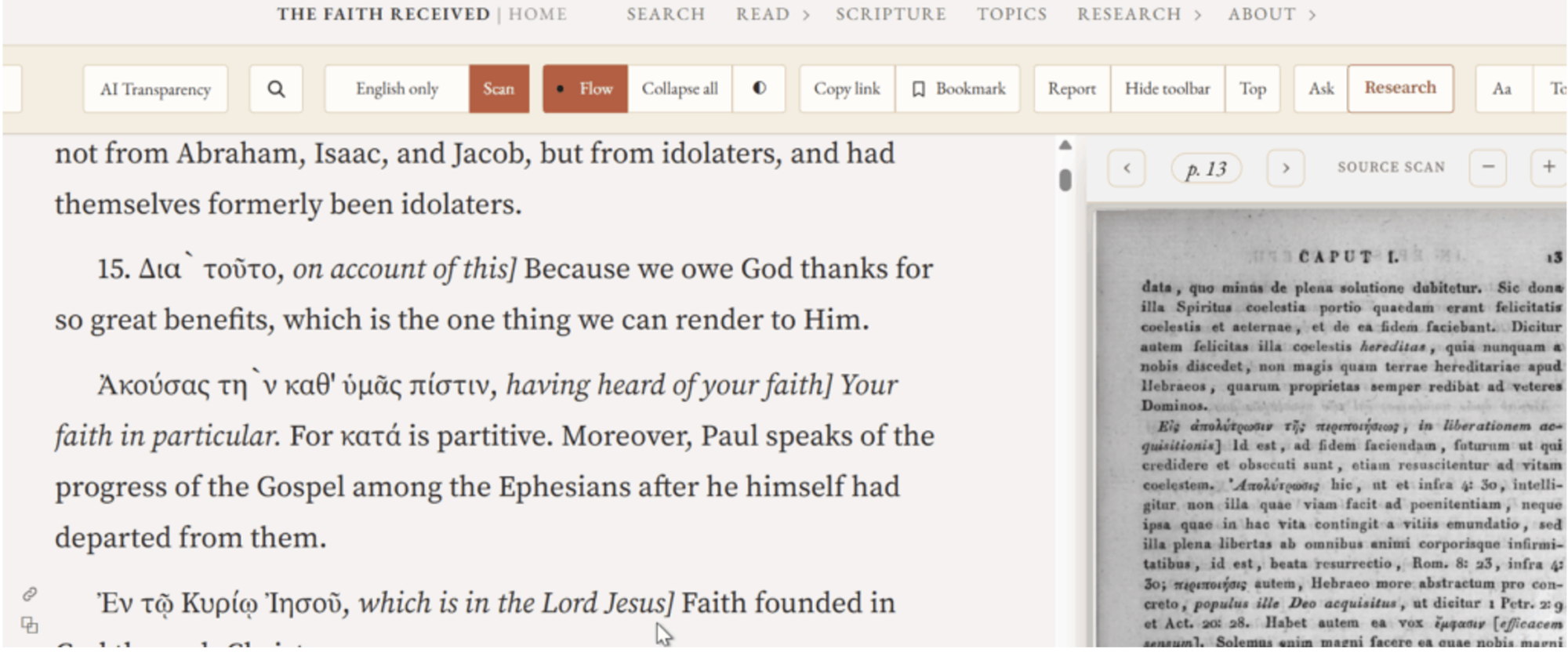
Last week, Mere Orthodoxy released a powerful, free online tool for reading old Christian books. The Faith Received (TFR), though still in beta mode, is a moon shot for theological retrieval, a giant leap for evangelicalkind. Without major funding and within a narrow window of time, the team there has leapt over numerous hurdles and started something deeply significant.
To see why my outlook on this project is overwhelmingly (but not, I hope, naively) positive, it might help to get a little perspective on where we are as 21st century Christians.
Locked Behind Language
Back in 2014, I was on the advisory board for an organization committed to retrieving the riches of the Christian tradition for the edification of Protestant Christians. As we strategized about what was needed and what was possible, we kept coming back to one particular bind: deep and rich resources already existed plentifully in the Christian heritage, but they were not in print or in English. Some of the most important sources that could inform and guide contemporary church life were in Latin. This includes not only vast stretches of the patristic and medieval heritage (which we expect to be in Latin), but even the most elaborate and sophisticated Protestant works (which we sometimes forget were also in that not-just-ancient language). We had the good stuff in abundance, but it was locked up behind a language barrier.
We had the good stuff in abundance, but it was locked up behind a language barrier.
How could that barrier be scaled? Either we needed a large team of highly skilled translators to get a lot more productive, or we needed a truly vast army of pastors and seminarians to learn enough Latin to read for themselves. Or both.
Many good translation projects were already underway: in the first decades of our century, English readers have gained access to Franciscus Junius’s A Treatise on True Theology, most of Petrus van Mastricht’s multivolume Theoretical-Practical Theology, most of Bernardinus De Moor’s even more multi-volume Continuous Commentary, Johann Gerhard’s Commonplaces, Johannes Maccovius’s Scholastic Discourse, and more. Compared to 20th century seminarians, we have so much. Even the important-but-not-famous Vermigli and Zanchi have recently become available in sturdy English editions. A quick reconnaissance of the translators shows steady progress, but at a rate predictably slow and costly.
So, we decided to invest strategically in the other option, making Latin education more available and attractive for people already in ministry. Thanks to generous collaboration, new modalities of delivery, and a little creative disruption of institutions, it seems to me that a respectable wave of interested Protestant parties have received adequate training to claim their own untranslated heritage per linguam Latinam. We may also be benefitting from the growth of classical Christian schooling. Between these new readers and those new translations, we may have moved the needle a bit. But gains are modest.
After years of incremental progress on both strategies, AI translation has emerged rather suddenly as a third force. This tool was simply not an option until very recently, and now here it is. Lots of websites (and lots of independent book publishers) are making AI translations available, with a full range of quality from the obviously terrible to the surprisingly serviceable.
My TFR Test Drive
TFR is a project with several features worth noting, but it’s the vast quantity of AI translations that marks it as novel and attention getting. As soon as I saw the TFR link, I started poking around at the resources. I’ve always wanted to see what Hugo Grotius has to say about Ephesians 1 in his commentary, but have never made the time: I would have to find the PDF online, scroll to the right page, and see how hard his Latin is. But that was last month. Now, I can get straight there very fast and skim my way through an AI translation. On my couch. With my phone.
So how is it? Well, almost immediately I spotted some bad moves. One section of the translation has Grotius saying that “we owe God grace” for his blessings, which is obviously (I don’t even have to check the original) a misreading of gratia, which can mean grace but here has to mean “thanks.” We owe God thanks for his blessings. This is elementary Latin; kids learn “gratias tibi ago” early on.
Let’s assume, based on this one experience, that there must be a ton of similar infelicities and errors going on in these translations. Some parts of the translation will underdeliver, or spawn confusion, or actually mislead the reader.
This is where a very intelligent feature of the site comes in. The display is designed to let the reader click through to a facsimile or page scan view very easily.
There are three advantages to this feature:
- It lets me compare the translation with the original, so I can rise to my own level of ability. Personally, I’m about a B student in ninth grade homeschool Latin, so I need to make sure I don’t get out “over my skis” or beyond my competence. But I can grapple with texts that are about familiar subject matter.
- It empowers me bibliographically by letting me refer to the original text using a published edition and page number. This keeps me from ever having to footnote “The Faith Received + url” to show what Grotius argued. If I need to use this material for publication, I can cite it properly. TFR’s public accountability enables me to pass that responsible behavior down the line.
- It reinforces the fact that what I am reading online is a derivative product, but that some published text is the solid source. The AI translation I see today may be improved next time I visit; it has an ephemerality as a screen phenomenon. (TFR has already fixed a few things I flagged; it really is a beta phase with constant iterative improvement.)
This kind of “show me the page” transparency doesn’t solve all problems. It doesn’t suddenly raise an AI translation up to the same level as a human translation by an expert. I peeked into Cyril of Alexandria’s Against Julian—another book I’ve wanted to read for a long time but haven’t had access to, because English translations of the very important Cyril (d. 444) have famously lagged behind other patristic sources. The AI translation has some gaffes and glitches, but is substantially accurate and readable. I run through a few pages and voila, my mind is filled with Cyril’s argument and evidence against his opponent.
In this case, I also have on my desk a copy of the brand-new Cambridge University Press edition of Cyril’s Against Julian by Matthew Crawford and Aaron Johnson for comparison. It’s a slam dunk for the book. The sentences flow better; I can now see just how wooden the AI product is by contrast. Crawford and Johnson have untangled some knotty phrases admirably, and carved Cyril’s unbearably long ways of phrasing things down into more manageable chunks without leaving out any information. They have traced Cyril’s sources, providing brief footnotes on them. They flag when Cyril is subtly arguing against Plato’s Timaeus but not naming his source. And, while this doesn’t matter very much to me as a non-expert in Greek patristics, their translation is based on a critical Greek text that is itself “the culmination of over two decades of meticulous research involving a large team of European scholars.” I could keep listing all the ways the Crawford & Johnson version of Cyril Against Julian is superior. But it also just now became available in 2025, and it costs $160.
An easily available AI translation may well be good enough to allow real learning to take place.
There’s an old saying that the best vacuum cleaner is whichever one you’ll use the most. An excellent machine that you can’t bear to drag out of the closet very often is worse than a decent one that is ready at hand for daily use. Especially when it comes to very long books, in which the reader needs to navigate dozens or hundreds of pages in search of key insights, an easily available AI translation may well be good enough to allow real learning to take place.
What TFR Makes Possible
Much more could be said about how people will be producing and using AI translations in the coming years. By my lights, TFR is doing a lot of things right, at least as of late 2026. This tech sector is developing so rapidly that no achievements seem permanent, and constant vigilance is necessary. But I want to emphasize a few key words.
1. Accessibility
People in academia may underestimate just how inaccessible these old books really are. There are as many as seven distinct hurdles between a modern reader and an old text:
- Availability. Can I get to it? Has anybody done the work of scanning it? What library holds it?
- Location. Granted that it’s available in the abstract, where actually is it, even digitally speaking?
- Legibility. Some printing was poor; some scans are bad; some pdfs came to us via microfilm. I have assigned gnarly old PDFs to students who had to find a way to tell me politely that the assignment was an assault on their eyes.
- Translation. An obvious barrier already discussed, but only one of several.
- Edition. This can seem positively Gnostic and incomprehensible to non-academics, but old texts exist with variations, errors, and miscellaneous confusions, so our earliest printed editions were often not critically established or well-documented: Migne’s massive sets of Patrologia Graeca and Patrologia Latina are usually in this category of “right book, wrong edition.” The ubiquitous Schaff volumes of Patristic texts are likewise “right book, wrong edition” in many cases. Even if the reasons to prefer later editions are good ones, they are mysterious to non-experts.
- Searchability. Does the text exist as a flattened photo image, or is it in a character-recognized form that can be searched for words?
- Expense. Even if a text exists in a clean, modern, edited, translated version, does it cost over a hundred dollars?
Every time we recommend that somebody should read a particular work, we ought to bear in mind that some of these obstacles might be in place for them.
2. On Ramps
It’s important for scholars with access to historical materials to be alert to these obstacles and design ways for people to be introduced to the work. All sorts of Christians want to read the great tradition. Once they manage to find their way onto the road, all sorts of improvements will become possible: they can start to refine their judgements, discriminate between better and worse, develop a taste for especially good things.
All sorts of Christians want to read the great tradition.
The world of physical libraries is somewhat different than it was 50 years ago; the world of online resources is notably different than it was 50 weeks ago. Scholars and teachers need to be devoting time and attention to building new on ramps for new situations. There is a need for “new rules, new schools, and new tools,” as Karlfried Froehlich once described the changing conditions of the high middle ages.
3. Demand
Lately, we are seeing an efflorescence of projects that leverage AI to offer new resources. Some of these are regrettable, even imaginary products (“The Summa Theologiae for Teenage Boys in Forty Quick Devos,” or “New Praise Songs for Every Verse of Romans”). But even the shoddy and exploitative ventures, if they draw (only to disappoint) an audience, bear witness to the existence of a hunger for something. This is worth monitoring. Perhaps theological supply and demand have become misaligned.
When a responsible, good-faith project like TFR shows up and offers 28 volumes of the works of Rupert of Deutz (d. 1129) for free online reading, it may evoke a new audience as if from nowhere. I’ve wanted to read Rupert’s gigantic works on the Trinity for decades, but previously I faced obstacles. Now that the walls have fallen, perhaps the day has dawned when I can not only read Rupert easily, but actually meet other Rupert fans. How much other invisible demand is out there? It may be the case that readers want more than translators and publishers have been offering.
Misuse Doesn’t Rule Out Proper Use
Many objections to AI translation have more to do with misuse of the tool than with proper use. Things change quickly, but as of late 2026 I’m optimistic that it’s possible to model good use of this particular AI tool.
I know there are other objections to AI translations in general. I don’t think it’s possible to be absolutist in either direction about the issue, because “AI translation” covers a wide range of phenomena. Certainly there is a lower threshold of intelligibility that must be avoided at all costs.
But when the advanced models are carefully guided to produce good enough work, the results can be highly useful as one part of an overall strategy of engaging a corpus of ancient writing.
Popular Products
-
 Mommy Diaper Backpack with Stroller O...
$111.56$55.78 -
 Ai Dash Cam with Front & Rear HD, GPS...
$295.56$147.78 -
 Smart Auto-Recharge Robot Vacuum Cleaner
$613.56$306.78 -
 Wireless Health Tracker Smart Ring - R11
$131.56$65.78 -
 Electric Hair Straightener and Curlin...
$161.56$80.78